
AI Marketing: Everyone Uses It, Nobody Transforms
An opinion piece arguing that AI use among marketers is widespread but has not transformed how work gets done. It discusses copy-paste habits, disconnected AI features, data quality, output volume, ROI measurement, and model updates affecting built workflows.
Written in Q4 2026. This year I've read plenty of research on AI in marketing and talked to plenty of marketers. In this piece, I'm going to tell it straight.
The AI shopping wave arrived overnight. One set of numbers tells you this is the first time anyone's played it this big; another report says we're already in round two. How much consumers will actually buy through AI agents — the forecasts disagree. I don't care about that.
I'm watching the folks who do the marketing.
Most of them are already in. But there's a lot of cheering from the sidelines about how great it is, and very few who've actually welded the tool into their work.
A few days ago at dinner, a friend who works in branding kept sighing: everyone's shouting about using it now, but the way people actually work hasn't changed at all.
This is the haze hanging over the market right now:
Every LLM has shown up at the onboarding desk, but its body is still clocking in at the security booth outside the factory gate.
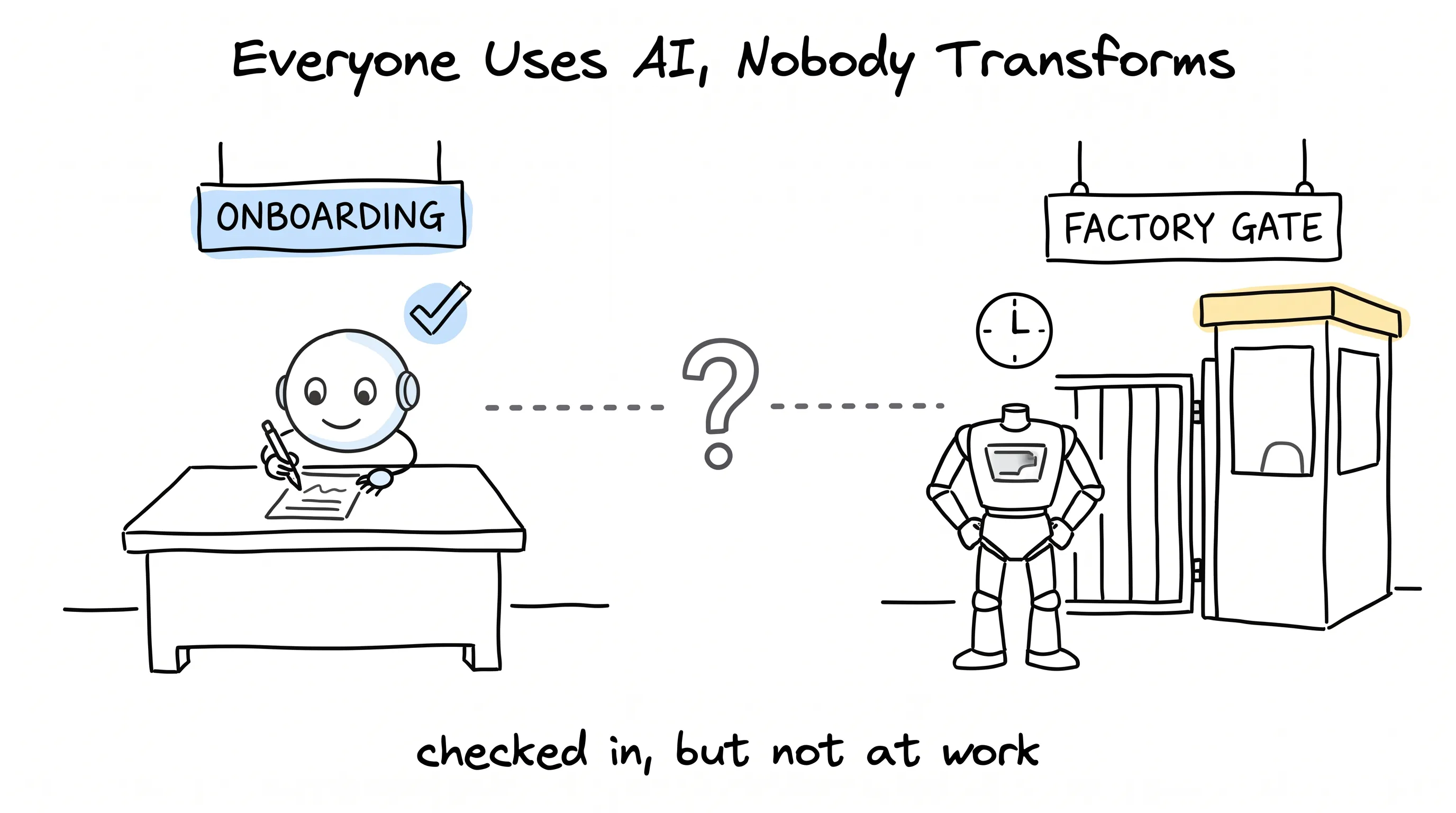
1. First, some good news
Here's the good news: AI in marketing has already gone mainstream.
Over 90% of marketers are using AI. The most common use case is writing content. Some also use AI to build apps, do personalization, and set up workflows.
What does 90% mean? It means almost everyone has one. You have your go-to AI, and I have mine. Some people have two and switch between them.
That's nothing new. Basic tools doing basic work for people — that step was finished long ago.
The problem is the next step.
2. Copy-paste is not a workflow
What's a workflow?
A workflow means AI is embedded in the process of getting things done, not in some app. It can take in the customer data in your CRM, take in the exchanges in your email system, and when the job is done, automatically send the results back.
Sounds great, right?
But think about it: how many gates does a marketer have to pass to get AI into a workflow?
Will IT even let you connect? Do you have technical support? Will the colleague next to you know how to use what you built?
Three gates, and every one of them is a wall.
So the daily routine for most people is: open an LLM, grind away at the keyboard, copy the results, and paste them somewhere else.
Copy-paste is easy. Integration is hard.
Unfortunately, copy-paste is not a workflow. It's just pressing pause on the workflow.
3. Every app has AI, and the result is a bunch of islands
Right now, every tool your team uses has AI stuffed into it. Some of it was done elegantly — a real assistant that can link up with other systems. Some of it was done clumsily — just an AI sticker slapped on.
And it's not just marketing tools. You write proposals in Excel, make presentations in PowerPoint, build spreadsheets in Google Sheets. The AI is in all of them. Ready to help anytime.
But it only helps within that one app.
The next app you're using — it can't touch that.
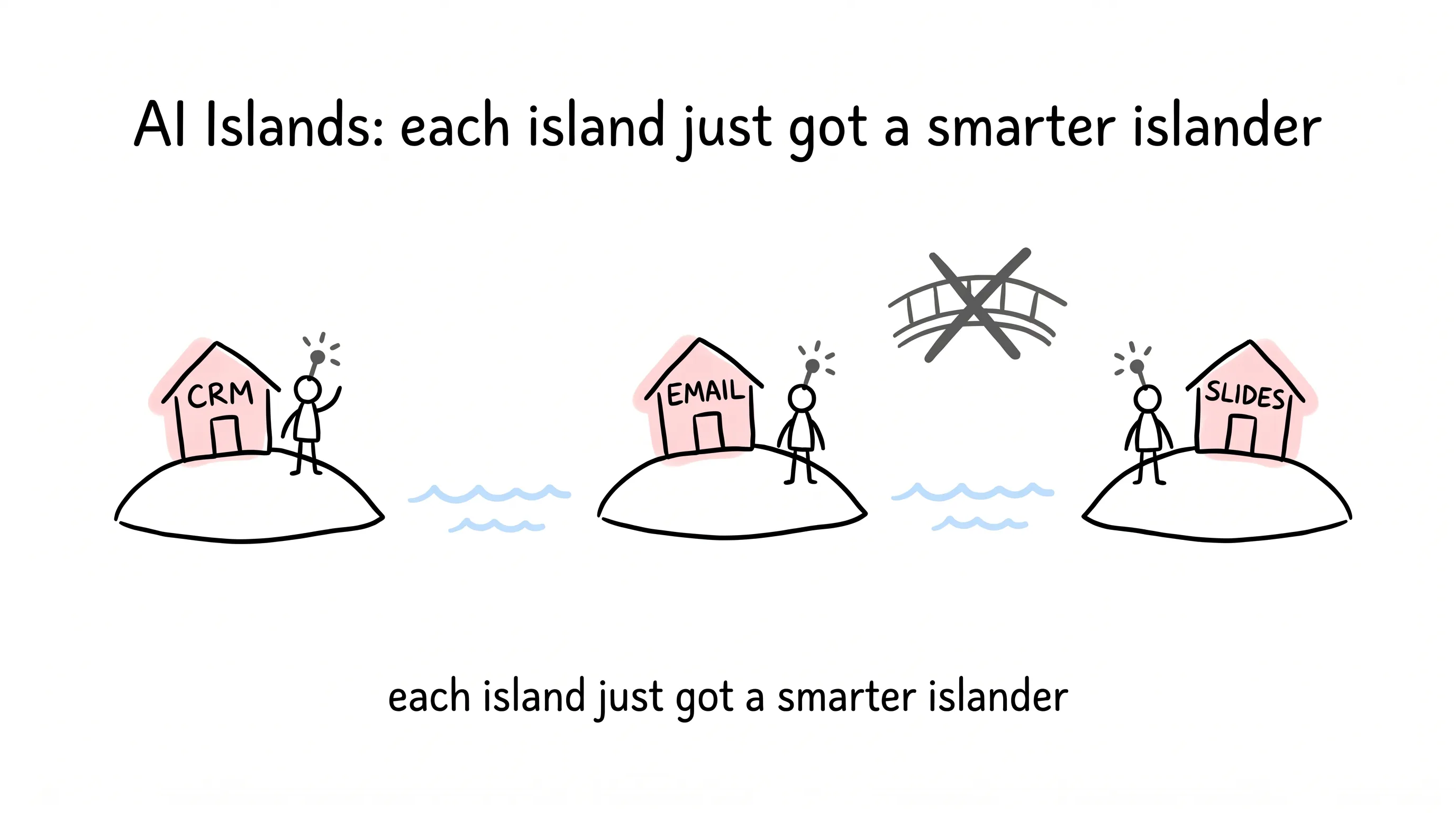
We were hoping AI would connect the CRM, the marketing automation platform, and the office tools into one assembly line. And what happened? AI didn't connect anything. Each app got its own AI, each fighting its own war.
The islands didn't get fewer. Each island just got a smarter islander.
If you're a vendor, it's scarier. Stuffing AI into every product is a real-money cost. Meanwhile, a marketer has AI in a dozen tools at once. You're betting that yours is the AI they use most.
Some people ask: isn't the agent the answer?
It is. But right now, every vendor is pushing agents.
4. If the data is dirty, AI is useless
Many marketers aren't confident about their own data.
"That customer list is three years old, right?" "This field — was it filled in manually by sales?" "Who tagged this batch?"
When you're not sure, nobody dares to use it. Because you know: AI will amplify bad data — with meticulous precision.
What does "garbage in, garbage out" mean? It means: if the data you feed AI is expired ingredients, no chef — however divine — can make a good meal.
While we're here, let me talk about Salesforce.
This company has taken plenty of heat over the past few years: selling the whole bundle, pricey contracts, and the general feeling that "you just want a hammer, but they insist on selling you a renovation crew." Underneath Agentforce and CRM, they've laid a data layer called Data 360, dedicated to data governance.
But you know what?
Salesforce is right.
They've bet the company on AI, so they can't let bad data capsize it. Data and governance are foundation work. Nobody sees the foundation — until it collapses.
So yes, you can absolutely put AI to work on the data you have. Just remember one phrase: garbage in, garbage out.
5. AI is so capable, it's got people doing nothing but "more"
AI is genuinely strong at content creation. More content, more designs, more drafts, more emails — one person can flood every channel.
Good? Hold on. Put on the customer's hat.
Have you ever had this experience? You follow a brand, and it's fine at first, but then it starts messaging you every day. Daily posts, weekly posts, events, promotions. By the third message, you're annoyed.
AI can easily do more, but there's one thing AI doesn't understand: resonance.
Doing more doesn't mean it lands harder.
Several marketing leaders have told me this is exactly what they worry about most in their teams: obsession with "more." AI has multiplied the output. But what customers want has never been more.
6. Doing more — is it because customers want it, or because AI makes it easy?
The problem is, you have to figure out whose idea "doing more" actually is.
In one case, AI is a great helper. The customer just wants a quick answer — check an order, ask a date — and AI answers in seconds. Great experience.
In another case, AI makes it worse. The customer has a real problem, they're anxious, waiting for a human to catch them. You hand them a chatbot, and the experience collapses.
What does that mean? In one sentence: don't mistake AI's convenience for the customer's convenience.
Ask your marketing team one question: Are you doing more because customers want it? Or because AI makes it easy?
7. Where did the time saved go?
This is the most gut-punching line item.
AI can produce 50 versions in a day, which sounds like time saved on writing. But those 50 versions? You have to read them all from the top. Which one is right, which needs fixing, which has the wrong tone, which has drifted off-brand.
The time saved all goes into checking.
There are tools and guardrails on the market that can help hold the line on brand voice, factual accuracy, and style consistency. But most teams are still at the LLM stage, managing creation with prompts. Prompts can help you brainstorm and draft — but the work after that doesn't shrink.
At the end of the year, the books don't balance.
AI-generated work is not the same as efficient work.
8. Time to do the ROI math again
If you want to keep your budget, you have to prove ROI. It's true for ads. It's true for AI.
And this time around, the 2026 research shows fewer marketers confident they can prove AI's ROI than the 2025 research did.
That's not hard to understand.
Brand campaigns, sponsorships, ad spend — these were already hard to account for. Now, on top of that, AI wants its own accounting. And a detailed one: not just how much content was produced, but also the rework, the integration costs, the customer outcomes, the business impact.
9. The model changes, and your workflow gets rebuilt
Suppose your team has built its own setup on some LLM, and wired it into the workflow. It runs fine.
Until one day, it doesn't.
AI models iterate fast. When the model changes, your workflow may change with it. Everything was fine last week; this week, the output is a mess. You go hunting for the cause, and after a full lap you find out: the model updated.
How messy this gets depends on how deep you buried AI in the first place.
Here's an analogy: you built your house on someone else's foundation, and the foundation moves once a year.
The deeper you bury it, the more it hurts to dig up.
Epilogue: This is an organization-level problem, not a marketing-department problem
Look back at these eight observations and you'll find a common thread:
AI in marketing is widespread. It has not transformed anything.
LLMs let everyone use AI, and let AI spread quickly at the individual level. But connecting the AI platforms, the existing systems, and the company's data into one network — that's not a job for the marketing department alone. It's a company-level job. It takes leaders from the technical side and the business side sitting down together to set the strategy.
So have you noticed? Of the eight observations in front of marketers, not a single one is a genuinely "new problem." Quality vs. quantity, efficiency, customer experience, business value — marketers have been falling into these pits for over a decade. AI won't fill those pits for you.
The tools will keep getting newer. The problems will keep getting older.
Here's to using AI not as a conversation, but as a process.
And may you never have to face a "model update, one night of rework."
Continue reading
Related articles

What Is an AI Marketing Agent? From "Using AI" to "Delegating to AI"
A learn article explaining what an AI marketing agent is, how it differs from rule-based automation, and which repetitive tasks such as lead qualification, reporting, and campaign monitoring can be delegated while humans keep key decisions.

Marketing Automation Is Shifting from "You Do It" to "You Say It"
This article explains how marketing automation is shifting from rule-based platforms that merely execute toward AI agents that plan, create, publish, and review campaigns, covering delegable tasks, underlying technologies, tool categories, adoption steps, and risks such as privacy and automating without strategy.

When AI Does the Creative, Mistakes Come in Batches Too
A learn article on the risks of using generative AI for marketing creative across brand, legal, compliance, and operational layers, with case examples and seven practices for review, rights clearance, documentation, and vendor governance.