
Meta ads: how to run them this year?
A practitioner's guide to running Meta ads this year, discussing Threads as a default placement, Advantage+ creative auto-rewrites, creative diversity scoring, Pixel and Conversions API setup, broader targeting with value rules, and reconciling Meta, GA4, and CRM reporting.
A few days ago, I sat with a friend who runs an ecommerce business, going through his ad account.
He looked worried: "I've turned on every targeting option, and I've raised my budget. Why aren't the results moving?"
I told him: hold off on the budget for now. Let's first look at what this platform has actually changed this year.
The changes are bigger than you think.
What happened this year
In 2026, Meta has been moving almost every single month.
In October, Threads became a default placement. Which means your ads may have already been quietly showing up on Threads — and you didn't even know it.
My first reaction was: my god, there are so many advertisers who've been running ads for six months without ever once seeing what Threads even looks like in their own account.
In July, something bigger happened. Advantage+ creative started rewriting the text in your uploaded images by default, and generating headline variations automatically.
Think about it: you work hard on your copy, and the platform casually rewrites it and pushes it live. If that happened to you, would you panic?
Oh, and one more thing. In November, Meta was planning to update a batch of advertising terms, covering AI-generated creative and website scraping. Then on November 5th, it hit the pause button itself. The existing terms stay in effect.
But note: this is a pause, not a cancellation.
By August, there was another easily-missed detail: Meta started scoring creative diversity in Ads Manager. What is creative diversity? It's whether your creatives are actually different from each other. Ones that look alike get grouped together.
Why does this score matter? Because this year's Meta no longer needs you to do targeting.
It does it itself.
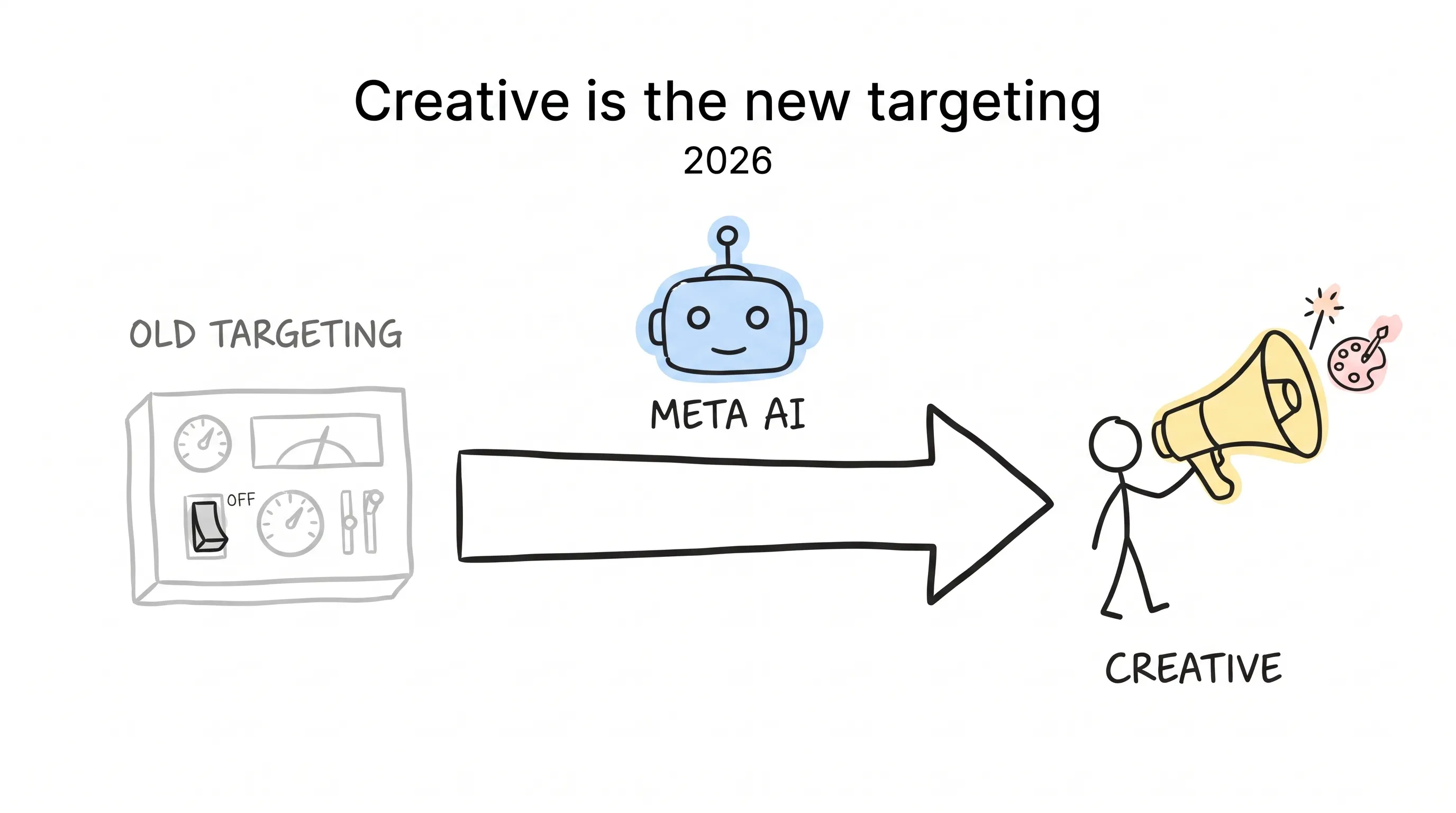
Creative is the new targeting
What's the biggest change in running ads this year?
The power of targeting has moved from your hands into AI's hands.
Meta's AI finds the audiences itself, picks the placements itself, sets the budgets itself. Think about it — what are you left with?
You're left with one thing: creative.
What your ad looks like determines who the AI shows it to. For meat lovers, show braised pork; for gym-goers, show a table of salads. The creative speaks for itself.
So ten identical images with a different background color — that's not testing. That's self-congratulation.
What is real testing? Person vs product, problem vs result, video vs static. Completely different angles — that's what counts.
And go vertical-first. Reels and Stories are the main battleground. Get your captions on, put the hook in the first second. When a user scrolls onto your ad, if you don't grab them in the first second, the very next second they're gone.
And here's a counterintuitive observation: the best-performing ads are often not the carefully designed ones, but videos shot on a phone by real people, telling one useful thing. Polished doesn't necessarily win.
In the AI era, the bar for advertising has shifted from "knowing how to target" to "knowing how to make creative."
But first, fix your data
Hearing this, you may already be itching to run back and change your creatives.
Wait. Not yet.
Because no matter how smart the AI is, it only eats data. If the data is dirty, it will confidently be wrong.
It's like handing a genius chef moldy ingredients. The dish isn't impossible to make — it's just that it can put people in the hospital.
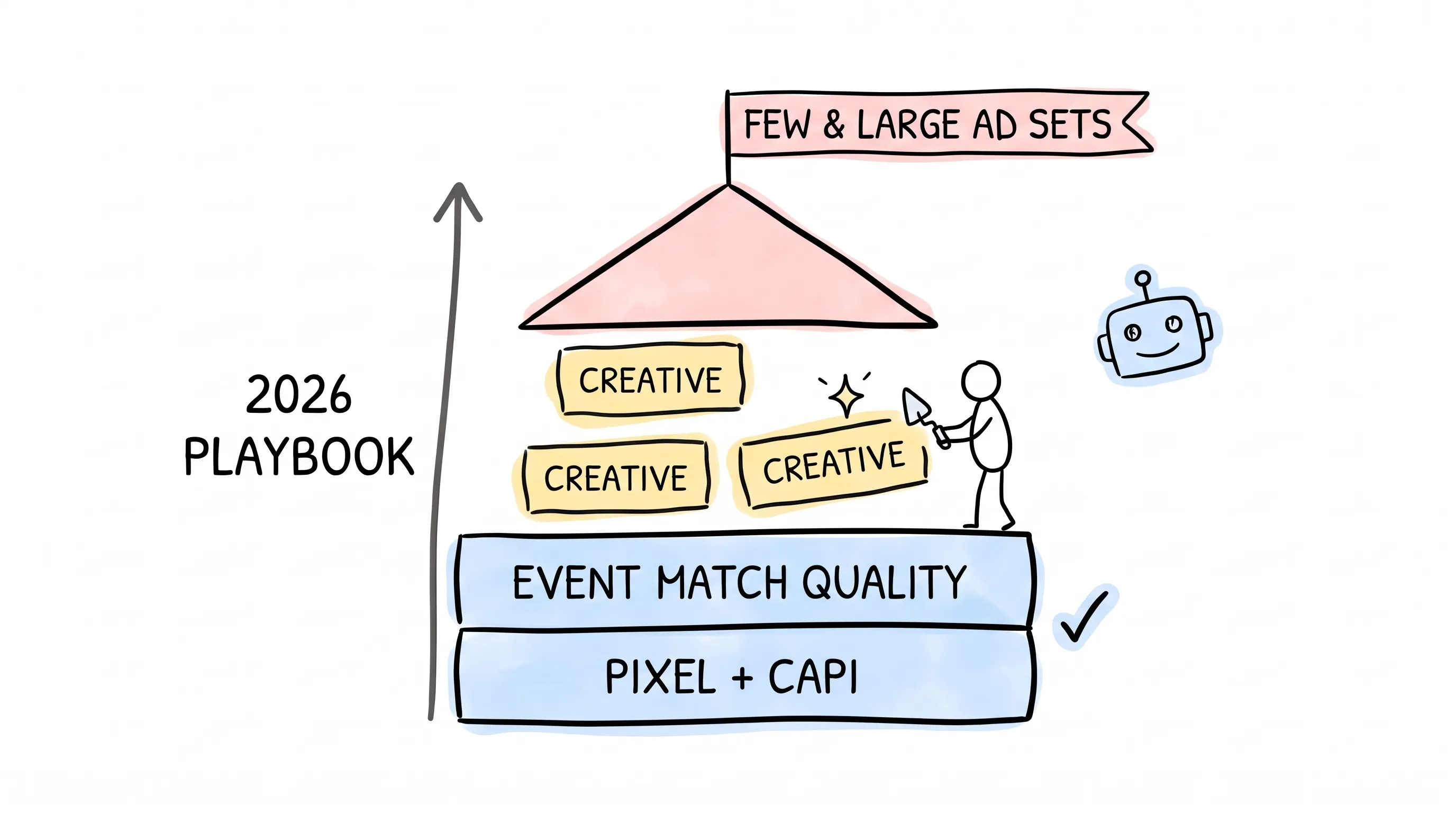
Step one: install both Pixel and Conversions API. What is Conversions API? Simply put, it hands your server data straight to Meta, bypassing the browser route. Ad blockers and privacy restrictions already knock out a big chunk of browser tracking. CAPI plugs that hole.
Run both together, and make sure you set up deduplication. Otherwise, the same sale gets counted twice.
Step two: go to Events Manager and check event match quality. For users who have consented, pass over the hashed email addresses and phone numbers.
Step three: your optimization goal. Optimize for purchases, for real purchases — not for link clicks.
Why? Clicks are cheap; conversions are expensive. The AI will only optimize for the goal you pay it to.
Simplify your structure
Data fixed, creative done — now let's look at structure.
A lot of people have an obsession: build more ad sets, slice the budget into small pieces, divide it up cleanly.
My advice: don't.
This year, do the opposite. Ad sets should be few and large. Why? Because the AI needs to learn, and learning needs data. If you slice the budget into 30 small pieces, each piece isn't enough to feed the AI. It can't learn, and you keep waiting.
For ecommerce, use Advantage+ sales campaigns and run them head-to-head against your current structure — whoever wins, keep that one.
For targeting, go broad boldly. Use exclusions only where they're genuinely necessary, like existing customers.
On placements — say, Threads — you don't want to put much money there. Can you do that? Yes. Use value rules — Meta's feature for adjusting bids by audience or placement — to lower its bid, instead of excluding it outright. Same logic for high-value audiences: raise their bids.
Exclusion is blunt; bidding is precise.
AI changed your ad — you have to be the gatekeeper
One more thing you must be warned about.
As mentioned, since July, Advantage+ creative rewrites your copy and generates new headlines by default. Before you go live, make sure you check these enhancement settings at the ad level.
Anything unsuitable, turn it off.
Especially in regulated industries. Think about it: a financial ad, and the AI changed two words on its own. The compliance team is looking at you, and you say the platform changed it automatically? That doesn't fly.
In your brand settings, add restricted words. Before going live, preview every placement, including the newly arrived Threads.
Your brand, your responsibility. Whatever the platform changed, you have to check it yourself.
Count the money fairly
Finally, let's talk about accounting.
This year, a lot of people have asked me the same question: the numbers in the Meta backend don't match GA4 — is something broken?
Most likely, no. These two systems — one runs platform-side attribution, the other runs last-click — they were never going to match. Don't panic, and don't rush to cut the budget.
So how should you count?
Look at Meta's numbers, GA4's numbers, and CRM's numbers together. Then pick one as the source of truth for decisions. When there's a dispute, that one wins.
More important than total volume is the new-customer rate. Out of 100 conversions, 99 are existing customers — would you dare show that math to your boss?
For big budgets, run holdout tests: hold back a group of people and don't advertise to them, then see the real incremental lift. Where the money goes, whether it's worth it — incrementality decides.
A checklist for you
We're almost at the end. Let me distill this year's lessons from running Meta ads into a checklist for you.
To do:
- Install Pixel + Conversions API together, with deduplication
- Check event match quality
- Test genuinely different creative concepts
- Vertical-first, hook in the first second
- Ad sets: few and large
- Broad targeting + value rules
- Check every AI default setting
- Reconcile Meta, GA4, and CRM; pick one source of truth
Not to do:
- Optimizing for link clicks
- Ten images with a color swap, and calling it a test
- Slicing the budget into dozens of tiny ad sets
- Discovering after launch that AI changed your ad
- Blanket exclusions of placements
- Panicking when Meta and GA4 don't match
Oh, and B2B friends often ask: can you run Meta ads? Yes. For retargeting and cheap reach, it's excellent. A common B2B playbook: Meta for reach, LinkedIn for precision, running in tandem.
Closing thoughts
Back to that friend at the start.
He did three things: fixed CAPI, swapped out the creatives, and merged 30 ad sets into 6. A month later, he messaged me: the account came alive.
The platform's AI keeps getting stronger — that's a good thing. You don't have to fight it anymore; you just have to go along with it and play your own part well.
Data is the foundation, creative is the brick. Only when the foundation is solid and the bricks are replaced will the building stand.
Here's to your Meta ads this year — steadier with every run.
Continue reading
Related articles

It's 2026: Stop "Buying" AI Tools for Your Marketing Team — Start "Hiring" AI Agents
This learn article explains how AI agents differ from standalone AI tools in marketing, outlines three agent categories — build-your-own platforms, CRM-native agents, and vertical tools — and covers use cases across SEO, social media, advertising, and reporting, plus criteria for choosing one.

Did the Money You Spent on AI Marketing Ever Come Back?
A guide to measuring AI marketing ROI across three layers: ad reports, sales pipeline, and the financial ledger. Covers metrics such as ROAS and CPA, eight dashboard metrics, industry benchmarks, and common measurement mistakes.

How to Pick a Creative Automation Platform: First, Figure Out What These Eleven Actually Do
A learn article sorts eleven creative automation platforms — including Bannerflow, Celtra, Smartly.io, and Storyteq — into four functional groups and proposes five evaluation questions covering publishing reach, automation depth, ease of adoption, team fit, and verifiable evidence.