
AI Agents Are on the Job — But Nobody Can Say Whether They're Making Money
A commentary on Invoca's 2026 Broken Funnel Report: conversational AI agents are widely deployed in B2C marketing, yet few teams can trace those conversations to revenue, and AI answer engines are cited as a leading source of high-quality leads.
A while back, I had dinner with a friend who runs home appliance service and repair. He couldn't wait to show off: his shop had just put an AI customer service agent on the job — answering calls, replying to messages, booking technicians for home visits, all fully automated.
I asked him one question: of all those conversations, how many ended up as actual orders?
He froze. He thought for a long moment, then said: "Well... honestly, I have no idea."
I let it go at the time. But a few days ago I came across a report, and I realized my friend wasn't fighting alone.
A company called Invoca released the "2026 Broken Funnel Report." They surveyed 451 U.S. marketers from industries like home improvement, healthcare, finance and insurance, automotive, and telecom — all at companies with more than 100 employees.
The numbers are fascinating.
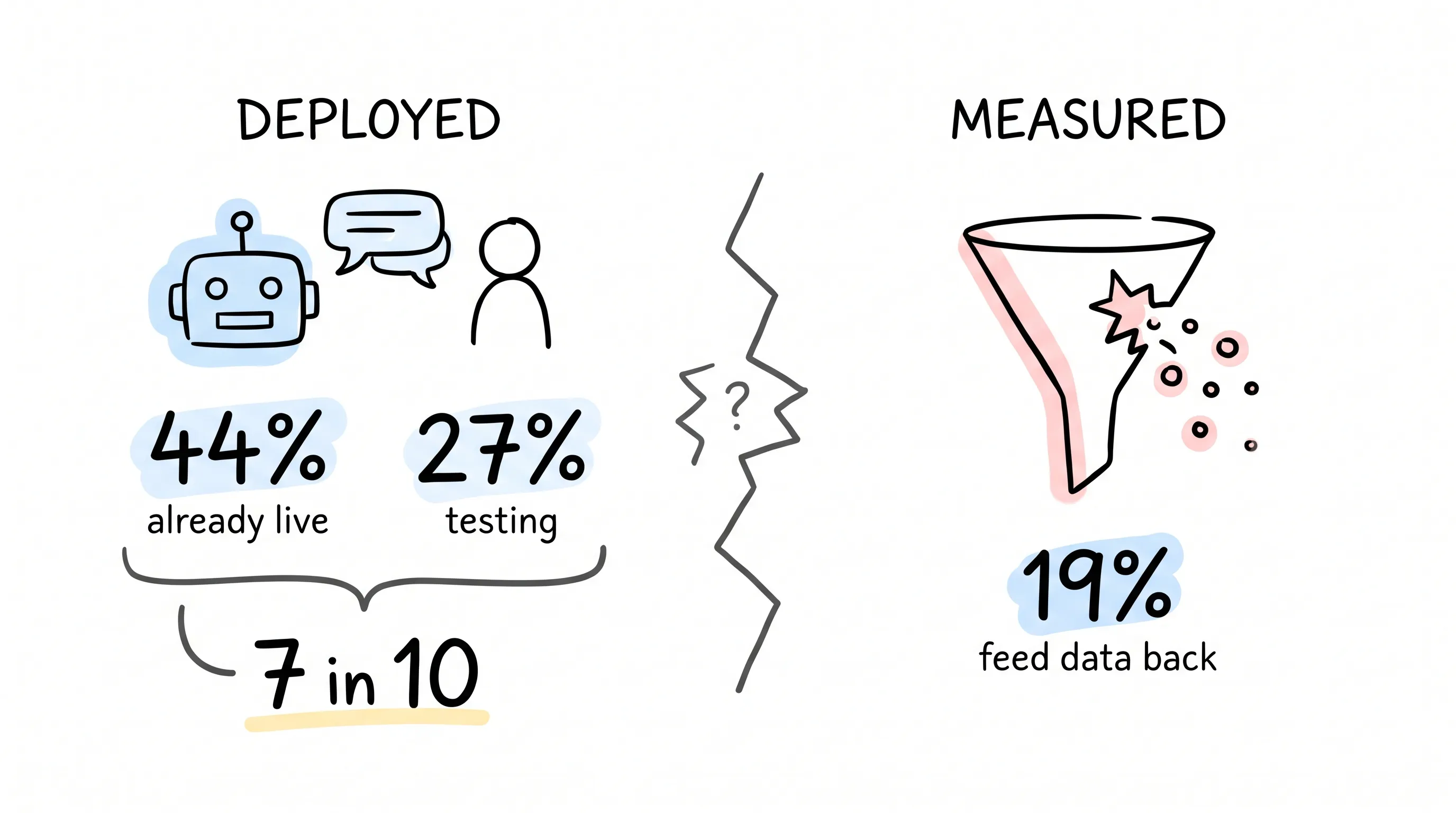
44% of B2C marketers have already put conversational AI agents on at least one channel, and those agents are genuinely taking customer conversations now. Another 27% are testing them.
Add it up, and seven in ten marketers are letting AI speak to customers on their behalf.
Sounds impressive, right?
But.
Only 19% can reliably feed conversion data from AI-agent conversations back to their advertising platforms.
AI agents are being deployed far faster than anyone can measure what they actually contribute.
What's a Broken Funnel? The Money Is at the Door — You Just Don't Know Which Door
Let's do the math.
You run an ad, a customer clicks, chats with your AI agent for a bit, and the conversation goes well. Then they buy — from a dealer.
So here's the question: who gets credit for that sale?
The ad system says the lead came from me. The AI agent says I closed the deal. The store says the sale happened at my counter.
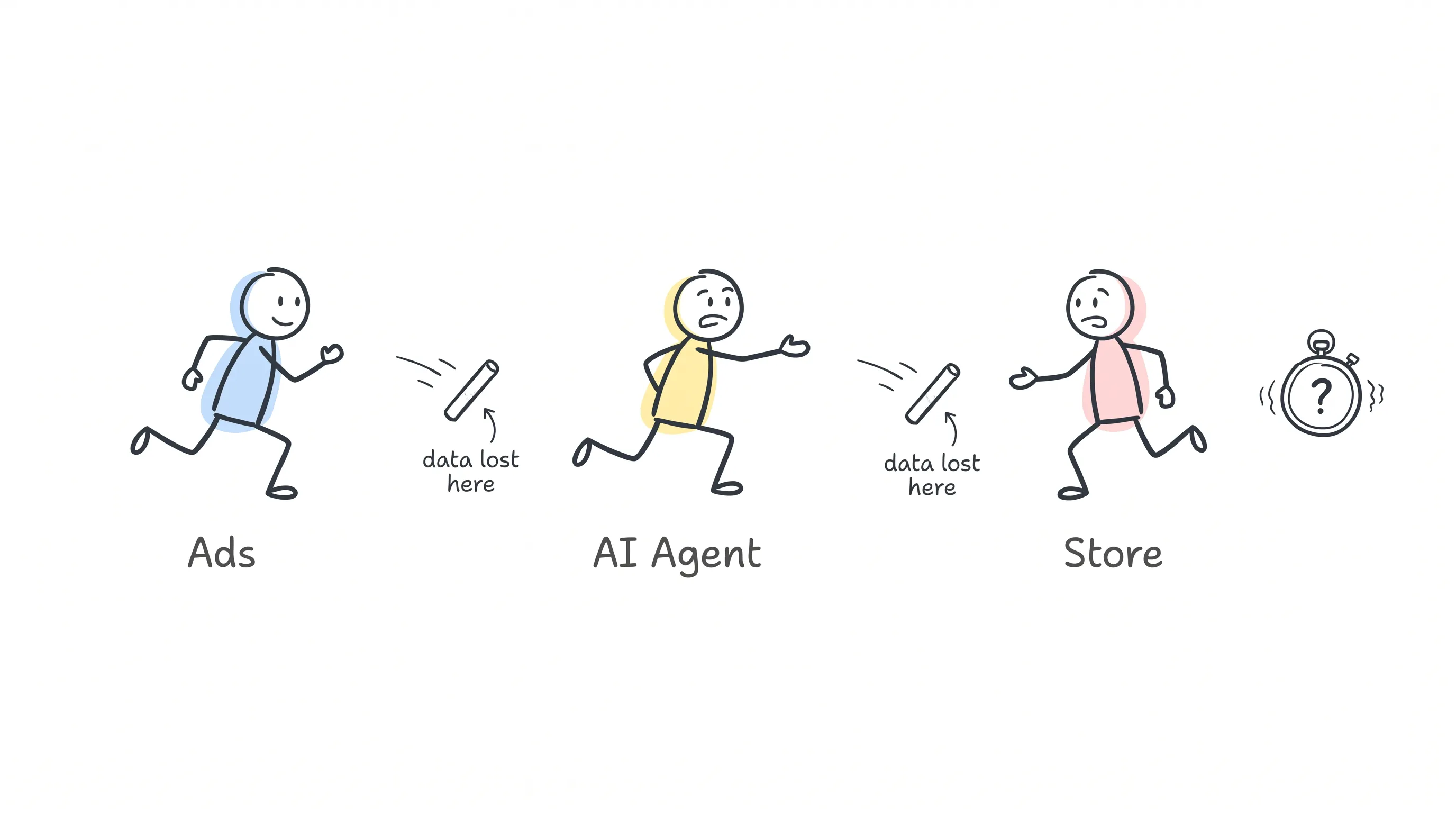
Everyone has a case. Nobody has proof. Somewhere in the middle, the data breaks.
The report puts it bluntly: 74% of marketers cannot trace a single lead from its first digital touchpoint all the way to the sale.
So where does it break?
56% of the time, at the dealer, franchise, or local store. 46% of the time, in text and chat. 40% of the time, on the phone.
Picture this: a marketing campaign as a relay race. Ads run the first leg, the AI agent runs the second, the store salesperson runs the third. Each runner sprints hard, but between legs, nobody passes the baton. Everyone thinks they ran well — nobody knows the final time.
Only 21% of marketers can both see a lead's full journey and influence it.
What is attribution? (attribution) It's answering "who actually brought this sale." When attribution breaks, optimizing your ads is like adjusting your rear-view mirror blindfolded. Per the report, only 26% can attribute results to a specific ad or keyword.
What's Worse: The Way We Grade AI Agents May Have Been Wrong From the Start
So how do companies evaluate these AI agents?
Only 27% of companies put revenue or closed deals first.
What about the rest? Customer satisfaction, qualified leads, conversation volume, "how many conversations need no human intervention," service cost.
Are these metrics useful? Sure. They tell you whether the agent is busy and whether it's cheap.
But busy isn't the same as profitable. Cheap isn't the same as worthwhile.
An AI agent that handles ten thousand conversations a day, with a 95% satisfaction score and low costs, looks like a star performer. But if none of those conversations turn into business, is the money you spent an investment — or an expense?
That's a question every team that just rolled out an agent should think through carefully.
The Surprising Part: AI Search Delivers the Highest-Quality Leads
There's one set of numbers in the report I stared at for a long time.
Marketers were asked: where do your high-quality leads come from?
44% chose AI answer engines — ChatGPT, Claude, Gemini, and the like.
That beats Google Local Services Ads at 40%, organic search at 39%, paid social at 37%, and paid search at 36%.
In other words, by the time a customer reaches your AI agent, they've already done their homework in ChatGPT.
86% of marketers also say they can identify at least some customers who started their research in AI answer engines.
Identifying them is good.
But that's where it ends. The customer starts at an AI answer engine, then moves into chat, picks up the phone, walks into a store... every step gets blurrier. By the time they buy, you've basically lost sight of them.
The Customer Has Been Here Before — Yet Your AI Treats Him Like a First-Time Visitor
There's one more thing I find even more worth pondering than attribution.
Only 27% of AI agents can see and use a customer's past digital footprint.
Here's an example. Last week, a customer combed through every product spec on your website, watched a livestream, added items to his cart. Today he reaches out to your AI agent.
The agent's opening line: "Hello, what would you like to know about?"
All that groundwork, wasted. A familiar face, treated like a stranger walking in for the first time.
Marketers know this best themselves. The report asked them: what capability do you most want to add to your AI agents? The top answer, at 43%, was tailoring conversations to the customer's digital journey. Second, at 41%, was having the agent recognize returning customers and remember they've been here before.
See, what people want isn't an AI that chats better.
It's an AI that remembers.
The Game Has Only Just Entered Its Second Half
Of everything in this report, the point I agree with most: in the AI-agent game, the deployment phase is over.
Going live is no longer rare. You do it, and so does everyone else.
The real challenge comes next: stringing together what the agent knows, what the customer does next, and what eventually becomes revenue — into one connected line.
If you can't string it together, your spend is a muddle and your optimization is guesswork. String it together, and the effort at every stage can finally be seen, counted, and amplified.
My friend later told me he plans to start with something small: tag every AI customer service conversation with its source.
I said: yes. Start right there.
Before rushing to make your AI say more, figure out how much it's actually earning for you.
Continue reading
Related articles

What Is GEO? How Your Brand Gets "Mentioned" in the Age of AI Search
An explainer on GEO (Generative Engine Optimization) for e-commerce and DTC brands: how it differs from SEO and AEO, why AI answers shape brand visibility, and eight practices covering question-focused content, consistent brand messaging, structured pages, external evidence, comparisons, and AI mention tracking.

AI Is Already Making Decisions for Your Customers. Are You on the List?
A learn article explains GEO (Generative Engine Optimization): why AI-generated answers now shape which brands customers see, and how SEO fundamentals, entity clarity, citable evidence, and monthly measurement affect visibility in AI answers.

Google Is Stuffing Ads Into AI Search: These Recent Stories Are Really One Story
A news roundup linking recent AI marketing stories—Google adding ads to AI Mode, Amazon's Ads Agent, ChatGPT image updates, a UK startup tracking brand mentions in AI answers, and an AI ransomware warning—arguing that control over ad data and visibility is shifting toward platforms.