
AI Tore Up the Old Marketing Playbook. What Does the New One Look Like?
A long-form learn article on how AI is reshaping marketing: declining search clicks, the hourglass funnel, AEO/GEO visibility in AI answers, judgment-driven content, two-week sprints, first-party data quality, and HubSpot's Loop operating model.
A few days ago, I had dinner with a friend who works in B2B software.
The moment he sat down, he started venting: website traffic, down 30%.
I asked, what about the business?
He said, here's the weird part. Business didn't drop. It grew.
He couldn't make sense of it. I smiled and didn't answer right away. I said, stop worrying about the traffic for now — let me walk you through the game of marketing as it's played today. You'll see once I've laid it out.
The old playbook ran on a quarterly schedule
What's the old playbook?
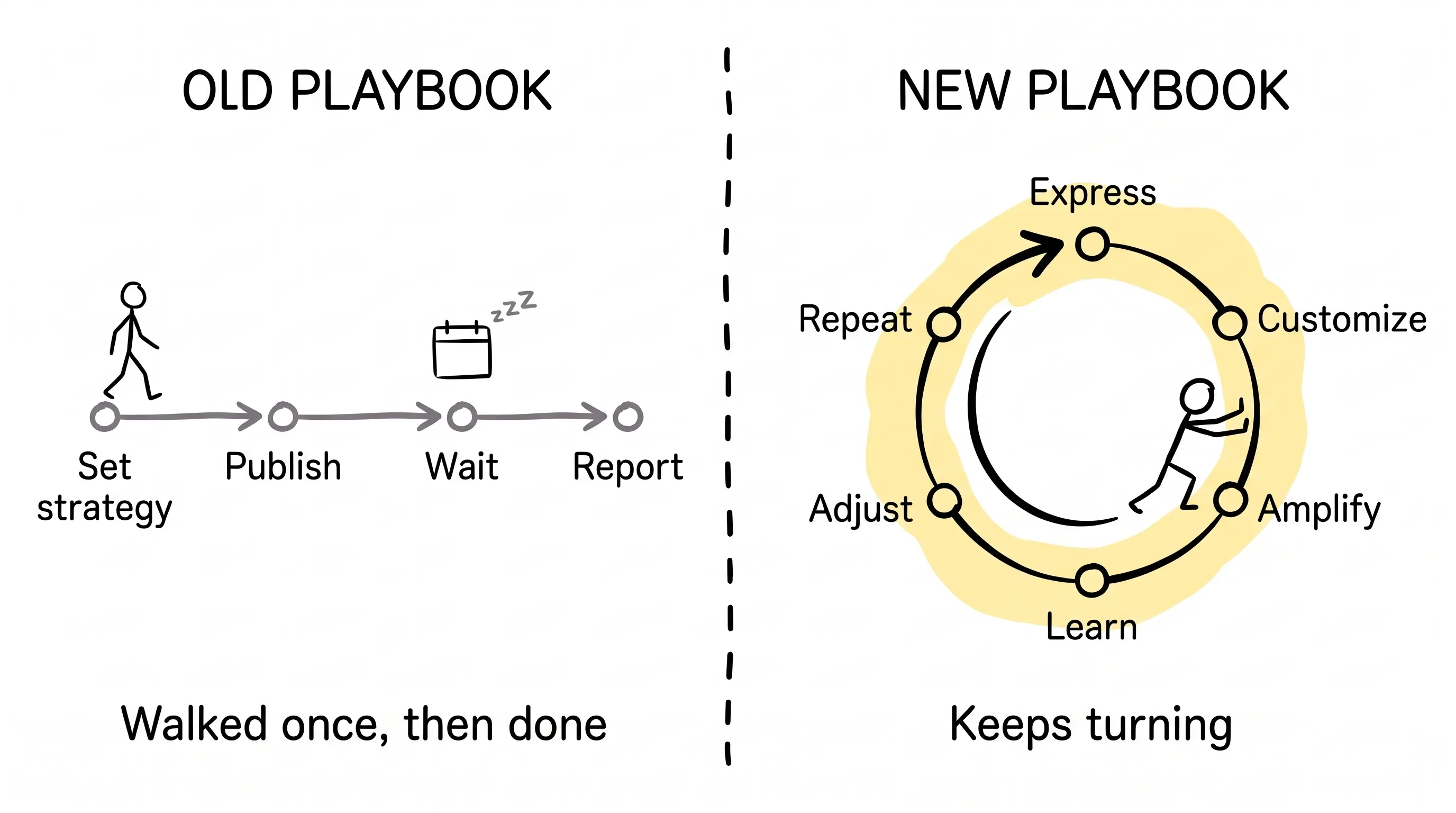
Set strategy, produce content, launch campaigns, then wait. Wait for the quarter to end, write the report, hold the review, then set next quarter's strategy.
One straight line. Walk it once, and you're done.
This way of playing rests on two assumptions.
Assumption one: buyers will come to your website.
Assumption two: results can wait.
Over the past two years, those two assumptions have broken, one after the other.
The first one broke first. Think about your own habits. When you search for something in a search engine, an AI summary appears right at the top of the page — the answer is written for you. Do you still click the blue link below it?
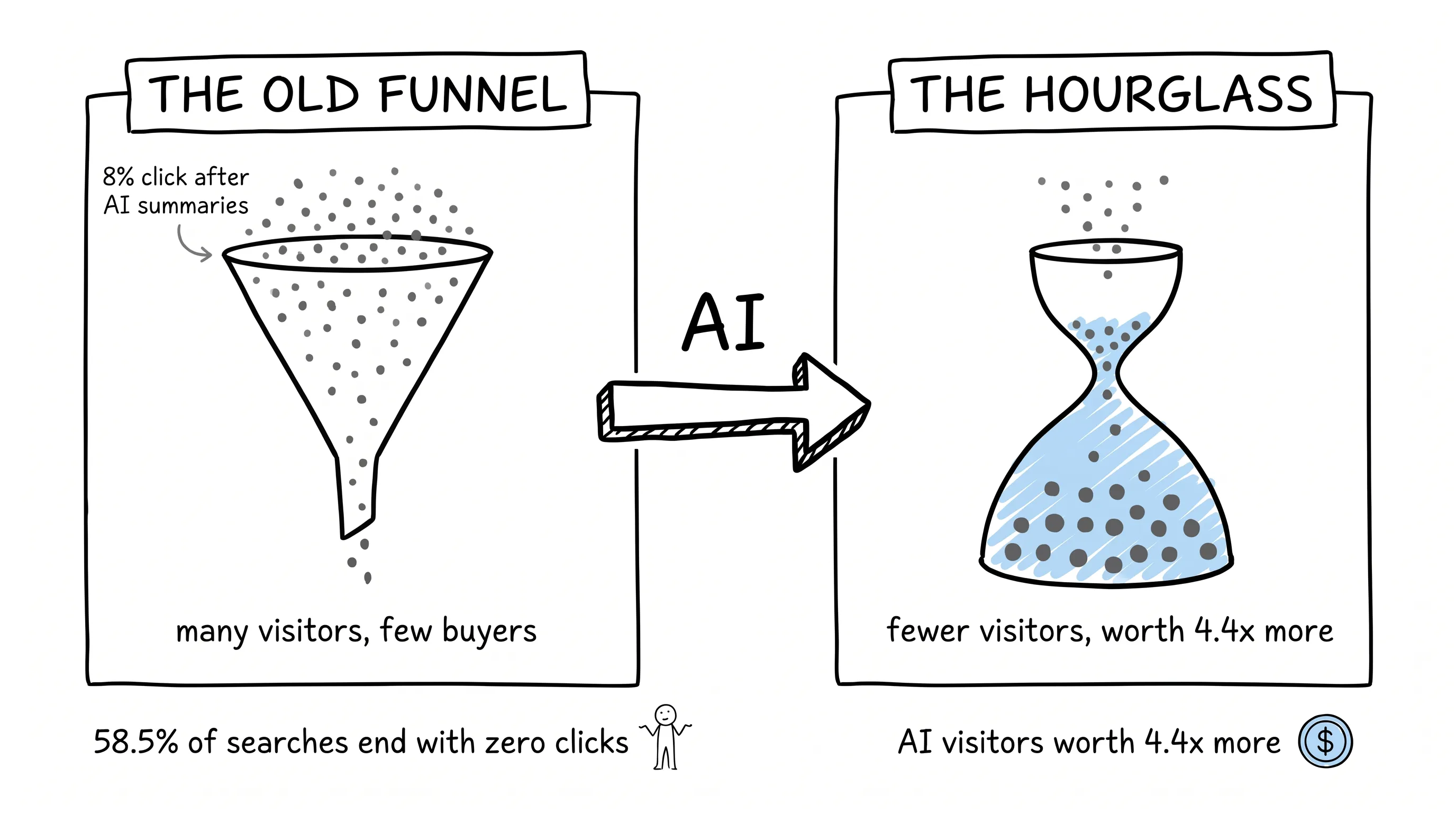
The data says: among users who see an AI summary, only 8% click the regular results. Without a summary, that number is 15%.
Roughly cut in half.
Even more brutal: in the US, 58.5% of searches end with zero clicks. Search, read, leave — never set foot inside a website.
Even HubSpot got hit. The company that coined the term "inbound marketing." The leads its marketing team brought in once powered 80% of the sales team's revenue. In 2024, that engine sputtered and stalled for a while.
Then the second assumption broke: waiting.
Kat Warboys, Senior Marketing Director for HubSpot's Asia-Pacific region, once made a call: waiting six to twelve months to review a campaign no longer works. By the day the report is written, buyer habits have changed, ad costs have changed, and search results have changed too.
You're driving today with a three-month-old map.
The funnel became an hourglass
So how does the business still grow when traffic is falling?
Kipp Bodnar, HubSpot's CMO, and Kieran Flanagan, SVP of Marketing, drew a shape at the 2026 UNBOUND conference: an hourglass.
The traditional funnel is a triangle — wide at the top, narrow at the bottom. Now it's an hourglass: narrow at the top, widening below.
Why did the top narrow? Because the places where buyers discover you have changed.
They discover you in AI answers, through bloggers, in communities, in social apps engineered to make you never want to leave. How many of those encounters end with "opening your website"?
Very few.
Why did the bottom widen? Because the people still willing to click through have already done their homework before arriving. They've checked with AI tools, read reviews, lurked in peer communities — the options are already mostly filtered. Semrush did the math: visitors from AI search are worth 4.4 times as much as visitors from traditional organic search.
Fewer people. But each one is worth more.
On top of that, AI has made personalization cheap — pages, emails, quotes can all be tailored to the individual. The traffic lost at the top gets recovered at the bottom through quality.
Why does AI mention you?
If buyers are discovering brands in AI answers, the new question is: what makes AI mention you?
This discipline is now called AEO — Answer Engine Optimization. Making it easy for tools like ChatGPT, Gemini, and Perplexity to find you, trust you, and cite you.
Its foundation is the same as SEO's: don't let your website be a mess, and make the content genuinely useful. But it adds one more bet: what the entire internet says about you.
Ahrefs ran a study covering 75,000 brands. The conclusion is interesting: the factor most strongly correlated with "appearing in Google AI summaries" is how many times your brand gets mentioned across the web. The top quartile of brands by mentions appeared in AI summaries more than ten times as often as the next tier.
Ten times.
Warboys has a line about this: authority used to mean how many backlinks you earned; now it means how often you're mentioned in the places AI trusts. Reddit, LinkedIn, review sites, industry forums.
So how do you actually do it? A few habits, none of them mysterious.
Answer specific questions. Instead of writing "how should law firms do content marketing," write "should a boutique law firm hire a full-time content writer." What AI is looking for is precise answers to narrow questions.
Make the structure easy for machines to extract. Clear subheadings, short and direct answers, real data, plus an FAQ section. So it can cut straight to the answer.
Mobilize the people around you. Your experts, customers, and partners talking about you on Reddit and review sites is far more useful than you praising yourself.
Publish what only you can publish. Exclusive data, first-hand perspectives. If anyone else wants to cite it, they have to come to you.
While we're at it, one common question: should you still write a blog? Yes. But write it as expert answers grounded in your own data. Generic tutorials are being swallowed whole by AI summaries.
Do these things, and the buyers who arrive because AI mentioned you already feel like they know you. Every downstream step gets easier.
When production is free, judgment is the only luxury
Bodnar and Flanagan said something on stage that stuck with me:
When the cost of production goes to zero, judgment is the only thing left with a price.
For the past century, the hardest part of marketing was production. Writing an article, shooting a video, running an event — all required human effort. Now every team has the same AI, and capacity has been leveled.
So what's the result of leveled capacity? Content looks more and more alike. What you publish, your neighbor publishes too — down to the tone.
Someone has studied this seriously. Graphite's data shows that in November 2024, AI-written articles briefly surpassed human-written ones, and the two have since been roughly even. But the same study found: 86% of articles ranking at the top of Google search are human-written; 82% of articles cited by ChatGPT and Perplexity are human-written.
Publishing more doesn't mean being seen more.
So what determines whether you're seen? Judgment. Four decisions, specifically, that machines can't make:
Who the next piece of content is for, and what problem it solves.
What angle to take. The angle only holds up because it's grounded in your data, your customers, your expertise — something no one else can copy.
What to cut. Don't let your strongest idea squeeze in with ten weak ones.
When to double down, and when to cut losses.
You make these four decisions before every move. Teams that do it seriously publish less, but every piece counts.
Taste is an asset — but you have to write it down first
Judgment sounds mystical. In execution, it's a written thing. HubSpot gave it a name: taste profile.
What's a taste profile?
Write down clearly who your customers are, how they speak, what earns their trust, what makes them stop and look twice. Add your brand's stance, stories, and opinions.
HubSpot's website has a free Taste Profile generator for anyone who wants to start with a template.
But let me warn you: the difference between a taste profile and that style guide nobody opens comes down to one word: maintenance.
HubSpot's own practice is to keep feeding things into the brand guidelines: customer research, sales call recordings, support tickets, executive input. Warboys has a warning I particularly agree with: AI amplifies everything you feed it. If you don't define your own voice, the algorithm will define it for you.
A sufficient taste profile usually contains four things:
Customers' actual words. The kind dug out of sales calls, reviews, and tickets — not the kind you make up in a conference room.
Your stance. Including the stances you refuse to touch.
Evidence only you have. Stories, data, cases.
Your flops. Note which expressions worked and which crashed and burned.
Treat it like a product. Tests show buyers respond to new messaging? Update it immediately. That way, every draft AI writes starts from a better brief than the last one.
Quarterly campaigns, replaced by two-week sprints
The next question: rhythm.
A quarterly campaign gives you four learning opportunities a year. A sprint every two weeks gives you twenty-six.
26 versus 4. More than six times as many.
Bodnar and Flanagan argue for the latter. To make this vivid, Bodnar told a story on stage, which I'll retell for you.
In 1903, a man named Samuel Langley, with a large government grant, had been studying flying machines for years. In December of that year, his machine took its second test flight and plunged straight into the Potomac River.
Nine days later, the Wright brothers took flight at Kitty Hawk. Their entire budget was about a thousand dollars. How did they do it? They built cheap gliders first, crashed, learned, crashed again, learned again.
Langley bet on one success. The Wright brothers bet on a hundred cheap lessons.
Marketing sprints are the Wright brothers' approach. A sprint needs four things:
An idea to validate. For example: a new message for a particular type of buyer.
One primary metric to watch. The kind tied to revenue, like demo requests.
A clear deadline. On the day, decide: scale up, revise, or kill.
A learning note. What this round taught you.
Of the four, the last one is the make-or-break piece.
Warboys has warned: test results stored only in your head walk out the door with you when you leave. Write every test result into the CRM, or build a shared test library, and twenty-six sprints a year will compound into an asset future team members can use.
AI's job in the loop: kill the grunt work
Sprints sound easy. Running them is exhausting. Why did so few teams ever truly manage to run at a two-week cadence?
Because between two moves, there's nothing but grunt work. Pulling data, writing retrospectives, figuring out what to test next. Bodnar says it's exactly this grunt work that makes the two-week rhythm unsustainable.
How much time does grunt work eat? Asana released a work report in 2023: knowledge workers spend 58% of their day on "work about work." Writing progress updates, hunting for files, aligning information.
Less than half the time goes to actual work.
This is exactly where AI comes in. Pulling data used to mean scheduling an analyst and waiting days or weeks; now marketers do it themselves, results in a few hours. Writing retrospectives used to mean several all-nighters on slides; now AI drafts them straight from campaign data. A validated piece of content gets repurposed by AI into emails, videos, landing pages, and social posts — one piece, many uses. Personalized follow-ups used to mean adding a name to a template; now AI reads CRM records and call notes and writes something different for each person. What to test next used to be argued at monthly meetings; now AI ranks options by expected impact and the human makes the call.
The proof is in the numbers. After HubSpot used AI to personalize follow-up emails to new leads, email conversion rates rose 82%. Early users of its Marketing Studio ran 81% more campaigns on average.
Someone might ask: what about the jobs? My take: AI takes over the repetitive labor — reports and first drafts; strategy, judgment, customer relationships, and the final call remain human work.
So the division of labor must be clear: AI may draft the retrospective and rank the tests, but what the numbers mean — a human decides.
Dirty data makes AI a negative asset
This next part may be the most valuable section of the whole piece.
Yamini Rangan, HubSpot's CEO, shared an analysis at the 2026 UNBOUND conference covering more than 300,000 customers. The conclusion is a little scary:
The same AI model, fed bad context — messy, patchy data — produced 28% fewer marketing qualified leads (MQLs — leads marketing has flagged as worth pursuing) than no AI at all, 27% fewer deals won, and 49% fewer meetings booked.
You read that right. Using AI turned out worse than not using it.
What about customers with clean data? Customers using AI on Professional and Enterprise plans saw 3.6 times as many marketing qualified leads as customers without AI, and 3.2 times as many deals won.
Rangan also gave a stinging comparison: about 90% of companies are using AI, and only 6% consider the results transformative.
Where's the gap? It comes down to what you feed it.
What is first-party data? Information you collect directly from your customers and prospects. The most valuable first-party data for marketing comes down to these:
Customer records in the CRM. Unified stages, clean fields, clear ownership.
Sales call recordings, meeting notes, email threads.
Website and content behavior that can be tied to a specific contact.
Support tickets — especially the questions asked a hundred times.
Deals won and lost, and the reasons behind them.
Ad buying works the same way. Flanagan pointed it out on stage: tell the ad platform "give me more form submissions," and it gives you more form submissions, quality be damned; feed it the revenue data from your CRM, and it learns to find the people who actually sign.
Your system has to be able to learn
Data is in hand. One more layer: the system.
What's a learning system? Every campaign's results flow back into customer records, audience lists, and lead scoring, shaping the next campaign. A system that only sends emails and stores reports will just repeat the same thing a hundred times.
The reality is that many companies are far from this step. Gartner's 2025 marketing technology survey found: marketing teams use only 49% of their own tools' capability on average, and those tools consume nearly 22% of the marketing budget.
Nearly half the capability, bought and paid for, lying there asleep.
A learning system looks like this: campaign results automatically update customer and account records; the next round of audience lists reflects the people who actually engaged; lead scoring adjusts with wins and losses, converging toward real revenue; winning assets and conclusions flow back into the taste profile and AI prompts; sales and support actions show up in marketing reports, so you can see what happens after a lead becomes a customer.
None of this happens automatically. A webinar tool standing alone, campaign leads sitting in an Excel sheet, a CRM half the sales team refuses to use — a system like that is always learning from incomplete information.
Moving to an all-in-one platform solves part of it. But the bigger pit is usually process: someone has to own it — how data comes in, how fields are defined, how results are recorded after each sprint.
Traffic is falling — what should the dashboard show?
Traffic is visibly falling, so the dashboard has to change too.
Fixate on traffic and you'll only get more anxious. Watch these instead:
Opportunities per visit. How many sales opportunities a single visit creates.
Conversion rates by channel. Which channel — including AI search — brings buyers who actually act.
AI visibility. When buyers ask AI, does it mention you, cite you?
Learning velocity. How many tests the team completed and implemented each month.
Revenue by channel. Which channel actually collected money in the end.
You don't need to delete traffic. Keep it on the dashboard as a supporting actor. A supporting actor that's doing well tells you at a glance whether the loop is turning smoothly.
Orchestration: making every link mesh
Alright, the parts are all here. Data, content, channels, people, AI. The last question — the one Bodnar and Flanagan say marketing teams should solve next — is assembling them.
This is called marketing orchestration.
How does it differ from automation? One sentence: automation runs the process you pre-set; orchestration looks at live results and decides what to run next.
Traditional campaign management is pinning assets onto a calendar. Orchestration is a signal in the system triggering the next action. For example: a report shows buyers keep asking AI tools about a certain question, and your product happens to solve it.
The walkthrough is roughly five steps:
Data speaks first. Buyers are asking AI tools about a certain question at high frequency.
Humans make the judgment. Pick the angle, approve the AI's draft plan.
Content goes out. CRM data personalizes every email and every page in real time.
Signals come in. The people who engaged, along with what they viewed and asked, are handed to sales.
Results flow back. All data returns to the CRM, becoming the exam question for the next sprint.
Where's the hard part? McKinsey's 2025 State of AI survey gives the answer: the roughly 6% of companies where AI already contributes at least 5% of profit have one thing in common — they redesigned their workflows. And in the same survey, no more than 10% of respondents had deployed AI agents at scale in any business function.
Everyone has the tools. The workflow is the watershed.
Orchestration is still missing one piece: authority and accountability. Which actions can AI take on its own, which require human approval, and who makes the final call on budget, brand, and external messaging. If these three questions aren't written down clearly, the faster the loop turns, the faster it crashes.
The new playbook is a loop
Put everything above into one frame, and you have the new operating model.
HubSpot calls it the Loop. Six steps: Express, Customize, Amplify, Learn, Adjust, Repeat. The old model was a straight line walked once and done; the loop keeps turning. HubSpot itself says this loop isn't inbound marketing torn down and rebuilt — it keeps inbound's "customer-first" roots and adds AI personalization, broader distribution, and never-ending improvement.
What I particularly want to flag: how fast the loop turns isn't decided by the longest plank — it's decided by the weakest link.
Dirty data, and every turn of the loop amplifies the error. A disconnected system, and every turn of the loop, something slips. A team that doesn't use the system — the loop isn't turning at all.
Once AI enters the picture, all of this only gets more obvious. It amplifies everything in your system, the good and the bad alike. The weakest link gets exposed faster.
If you're going to act, start with the weakest link. Because the speed of a loop is the speed of its slowest part.
Back to that dinner
Back to the friend from the beginning.
I saw him again last month, and he's no longer obsessing over traffic. He showed me his dashboard: the traffic column is still there, but shrunk to a corner. The prime spot now belongs to two numbers: how many tests were run this month, and how many times AI mentioned them in buyers' questions.
He said something I still remember: "I used to worry about not publishing enough content. Now I only worry about not learning fast enough."
In the old playbook, marketing was a straight line from strategy to report, and once you'd walked it, you rested.
In the new playbook, marketing is a loop. Data feeds judgment, judgment feeds action, action feeds data — each turn more precise than the last.
Traffic will keep falling. Learning speed is the new moat.
Here's to swapping your traffic anxiety for learning anxiety soon.
Continue reading
Related articles

It's 2026: Stop "Buying" AI Tools for Your Marketing Team — Start "Hiring" AI Agents
This learn article explains how AI agents differ from standalone AI tools in marketing, outlines three agent categories — build-your-own platforms, CRM-native agents, and vertical tools — and covers use cases across SEO, social media, advertising, and reporting, plus criteria for choosing one.

What Is GEO? How Your Brand Gets "Mentioned" in the Age of AI Search
An explainer on GEO (Generative Engine Optimization) for e-commerce and DTC brands: how it differs from SEO and AEO, why AI answers shape brand visibility, and eight practices covering question-focused content, consistent brand messaging, structured pages, external evidence, comparisons, and AI mention tracking.

AI Is Already Making Decisions for Your Customers. Are You on the List?
A learn article explains GEO (Generative Engine Optimization): why AI-generated answers now shape which brands customers see, and how SEO fundamentals, entity clarity, citable evidence, and monthly measurement affect visibility in AI answers.