
AI Marketing Daily · 2026-11-06
AI Marketing Daily for 2026-11-06 gathers 20 items around two threads: whether AI marketing's saved time and spend turn into revenue, and how buyer questions move from search boxes into AI conversations, with guides on GEO, RAG, and AI Overviews plus tool-selection coverage.
Today's 20 intel items really only tell two stories. The first is accounting: four fresh surveys, a new MarTech article, and a white paper are all chasing the same question — has the time AI saves and the money it spends actually turned into revenue? The second is relocation: buyers' questions are moving from search boxes into AI conversations, and three hands-on guides on GEO, RAG, and AI Overviews all landed today in one go. There are also five tool-and-selection items — teams working on Q1 budgets shouldn't skip them.
🎯 Today's Headline
The AI Marketing ROI Gap: Four 2026 Surveys Cut to the Same Answer
On October 31, fractional CMO Tanja Gavrilovic published a long-form piece that takes the four authoritative 2026 surveys apart side by side, and the conclusion is consistent and impossible to ignore: marketing teams are using AI more diligently than ever, yet nobody can say whether it's actually making money. Duke and Deloitte's CMO Survey (spring, 308 US marketing leaders) shows AI has entered 24.2% of marketing activities, up from 13.1% two years ago, with generative AI climbing from 7.0% to 22.4% and 73.9% of companies using it for content. In Emplifi's late-October survey of 405 marketing managers across the US, UK, Australia, and New Zealand, 87% say AI has boosted productivity and 86% are producing more content — but only 48% can put hard evidence of social-media ROI in front of the executive team. Comviva's June survey of 200-plus executives is harsher still: 90% have increased their AI marketing investment, yet only 12% can isolate the revenue AI brings using a controlled method, and 67% can't compute AI's total cost. BCG surveyed 300 CMOs in June: 31% of B2C and 20% of B2B respondents believe agentic marketing (AI agents planning and executing campaigns autonomously) has already produced measurable revenue impact, and only 8% are genuinely running multi-agent autonomous campaign execution.
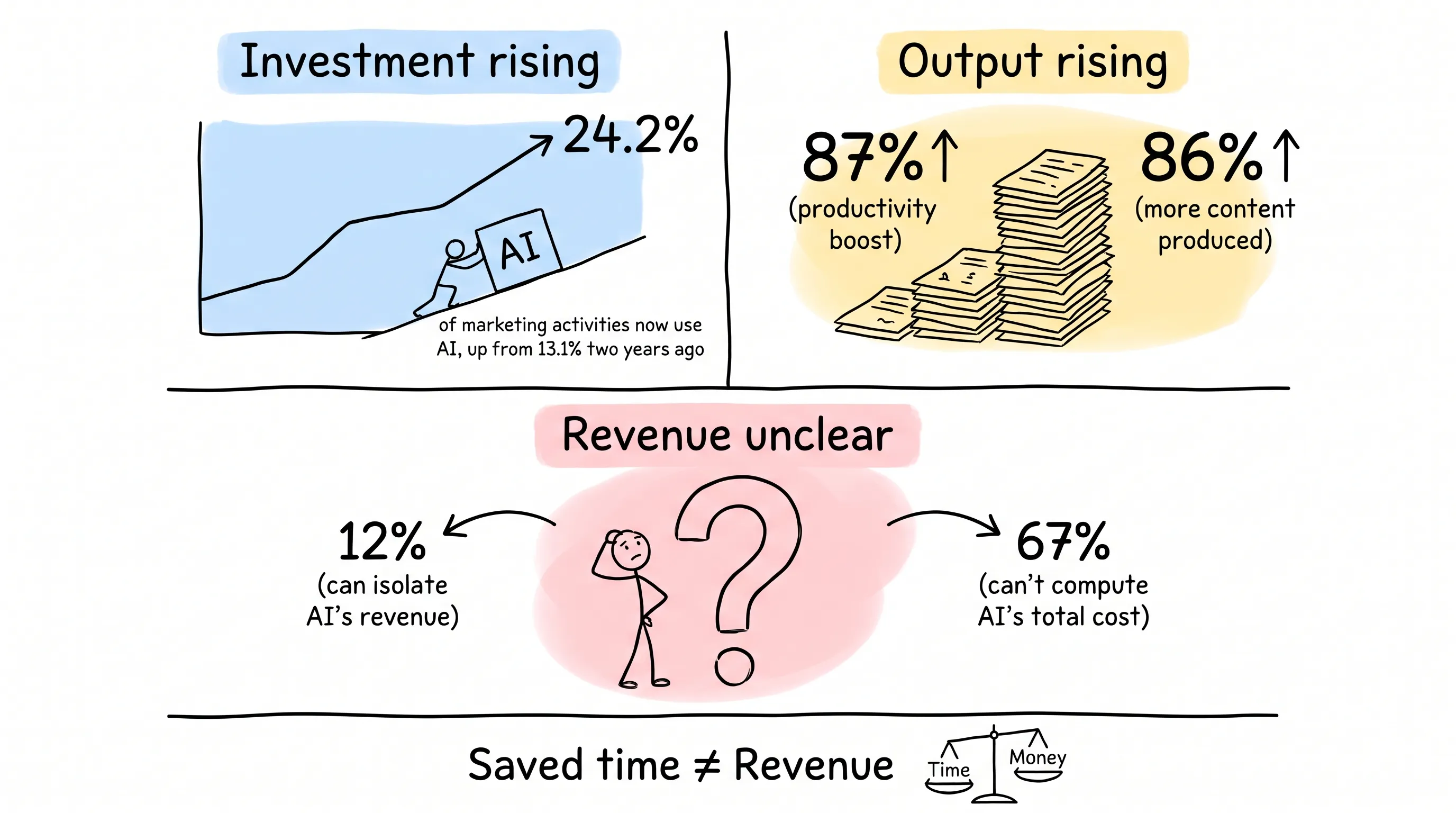
The four surveys differ in sample, industry, and question design, yet they all point to the same fault line: investment is rising, output is rising, and revenue attribution is a mystery. The author deliberately flags the boundaries of each sample — Emplifi sells social-media software, Comviva's sample contains no SaaS companies — and that honesty actually makes the data more credible. The FAQ at the end of the piece says it outright: there's no credible industry benchmark for AI ROI, and since the four surveys differ in sample and methodology, their numbers can't be averaged into one. For marketing leaders whose budgets are under scrutiny, this side-by-side comparison saves the work of stitching four reports together and hands over a framework for answering the hard questions.
The fault line is really about where the saved time goes. Emplifi's data exposes the trap: teams free up three-plus hours a week from reporting chores, then convert that time into more content — output goes up, but the revenue evidence you can put on the table does not. The author's front-line observation includes a counterintuitive detail: leads arriving from AI assistants show higher readiness — they read more and their first question is sharper — but they close more slowly and bargain harder. The author's response is to track three lines by first-touch source: win rate, days to close, and number of touches before the deal closes. A channel that delivers better-informed buyers while stretching the sales cycle imposes a cost that no traffic dashboard will ever show. If your conversion tracking stops at the signup moment, you may be measuring the entire funnel wrong. This is also why B2B lags B2C: long sales cycles and many sign-off layers dilute AI's contribution into the process.
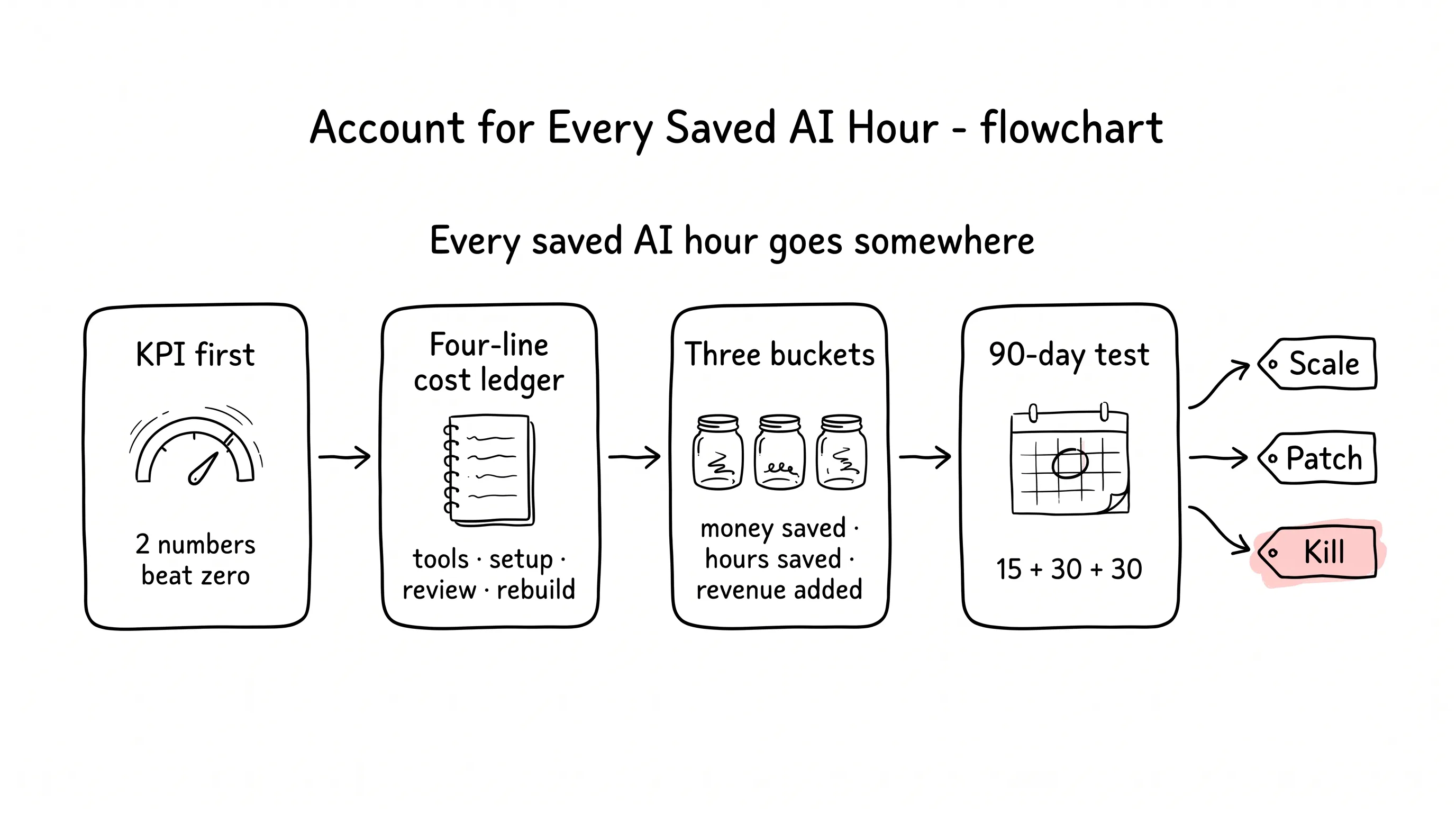
The article offers four SOPs you can copy outright. First, count review time as labor: in the author's testing, AI gets the numbers right but frequently gets what the numbers mean wrong — one draft had all four data points correct while all four sentences of conclusion attribution were wrong. Second, a four-line cost ledger: tools, setup, review, rebuild. A September 2026 model update forced her to rebuild half of her automated workflows from scratch, and rebuild is the line item most often missed. Third, report three buckets separately — money saved, hours saved, revenue added — and never add them into one number; the formula is (added profit plus money saved minus AI's total cost) divided by AI's total cost. Fourth, the 90-day test: take baseline data for the first 15 days, run against the old process for the middle 30, verify results for another 30, then choose to scale, patch, or kill. B2B teams should start with the assets closest to the deal — comparison pages, alternative pages, sales enablement material — where signals show up far faster than content volume does.
What makes this piece worth bookmarking is not the data but the warning: if the time AI saves just gets converted into more content, AI is nothing but a faster garbage producer. In the second half of 2026, the dividing line for marketing teams will likely fall right here: same AI, but some use it to stack up output while others use it to write the first ROI ledger that can survive a board meeting. The rest of today's items keep circling back to this theme.
🔗 Further reading: Read the full article
🏷 AI Search and GEO
Backlinko's GEO Playbook: Next Year, LLM Traffic Starts Fighting Search for Its Seat
Backlinko has published a long-form guide to Generative Engine Optimization (GEO — optimizing to be cited inside AI answers), and the numbers are solid. Semrush predicts LLM traffic will overtake traditional Google search by the end of 2027; Backlinko's own LLM referral traffic has grown 800% year over year in three months. Semrush's 2025 research shows AI Overviews already cover about 16% of queries, up from 6.49% at the start of the year — more than doubling in a year. ChatGPT's weekly active users hit 900 million by February 2026; by late 2025, nearly a third of US consumers were using conversational AI for shopping tasks, and among under-45s it's 41%. The guide's weightiest section is SparkToro's experiment: SparkToro ran 12 prompts nearly 3,000 times across ChatGPT, Claude, and Google AI Mode, and the odds of AI producing the same brand-recommendation list were under one in a hundred; identical ordering, under one in a thousand. The seven-step plan for putting it into practice: shore up your SEO fundamentals, accumulate brand mentions and co-citations (your brand named alongside peers across the web), lay out across multiple platforms, find out what sources each AI platform cites, answer your audience's questions, structure content for generative engines, and keep tracking visibility.
💬 Stop asking where we rank in ChatGPT — the question itself doesn't hold. Ask the same thing at a different moment and the answer changes. This week, build a prompt sample set covering 20 real buyer phrasings and run one round per week, logging how often your brand appears. That number gets closer to the truth than any ranking report.
🔗 Further reading: Read the full article
Forbes Takes Apart the GEO Problem: Winner-Takes-All, and Small Brands Are Being Squeezed Out of AI Answers
Forbes's feature puts hard numbers on what AI search is doing to traffic structure. 30% to 50% of search results now open with an AI Overview, and 50% to 60% of those no longer generate a follow-up click. BrightEdge tracked Google search volume up nearly 50% in the year after AI Overviews launched, while overall website clicks fell 30%, with queries getting longer and more conversational. What makes GEO harder than SEO is that with SEO you can still optimize your own site, but who an AI Overview cites depends on third-party mentions of your brand across the whole web: media, UGC, influencers, forums, reviews — and freshness matters. Small brands are in a more passive position: Wordstream puts the odds of a brand being cited in an AI Overview for transactional queries at just 10%, and Ahrefs's May 2025 research shows the most-mentioned brands can capture up to 10 times the citation share. The piece closes with a two-track playbook — on-site (bullet-pointing, summaries, conversational language, long-tail terms) and off-site (multimedia, fresh content, word-of-mouth mentions) — plus monitoring tools to watch: Moz Brand Authority, Profound, Otterly.ai.
💬 Small and mid-size brands shouldn't go head-to-head with the giants over AI answers to transactional queries — the win rate is one in ten. Move the budget toward cultivating off-site mentions: long-tail questions, vertical communities, genuine reviews. Winner-takes-all hasn't solidified in those spots yet, so first movers lock up the territory.
🔗 Further reading: Read the full article
HubSpot Explains RAG: Your Help Center Is Being Raided as an AI Answer Bank
The HubSpot marketing blog refreshed a primer on RAG (Retrieval-Augmented Generation — AI answers grounded by searching an external knowledge base first) on November 5, pitched exactly at marketers. RAG means the model retrieves from an external knowledge base before generating an answer; help centers, product libraries, and company docs can all be retrieval sources, which gives the pages marketers write a new identity: answer-source material. Pew Research's 2025 analysis of browsing data from 900 US adults shows that when Google shows an AI summary, only 8% of visits click a traditional result, versus 15% when there is none. Fewer clicks means the answer itself carries more weight. The article sorts out the RAG-versus-fine-tuning choice: use RAG when external knowledge updates frequently and sources need citing; consider fine-tuning only when you want to change the model's behavior itself. The author is honest about the limits: retrieval-friendliness only improves machine readability, and each answer engine retrieves and cites differently — nobody can guarantee you'll be cited.
💬 For an internal AEO training, this piece can serve directly as the textbook. Two things to land: appoint an owner of facts for the help center — unified terminology, information kept fresh — and rewrite product-page copy into the answer shape of conversational questions, so that when AI retrieves it, it can quote the whole passage.
🔗 Further reading: Read the full article
🏷 Industry Data and ROI
MarTech Names the New Bottleneck: AI Moved the Wait from the Writing Room to the Approval Room
A November 5 MarTech article points out that AI made drafts faster but did not make marketing output faster — the bottleneck has relocated wholesale. BCG's 2026 AI at Work survey shows 74% of front-line white-collar workers now use AI routinely; Gartner's 2026 CMO Spend Survey shows AI initiatives eat an average of 15.3% of marketing budgets, yet only 30% of respondents have mature AI readiness. Faster drafts produce more variants waiting for review, creative directors and approval meetings become the new chokepoints, and time-to-market for finished work stands still. BCG adds another datapoint: 60% of front-line marketing users of AI save at least one workday a week, but 66% say they don't know what to do with the time. The article offers four fixes: set the goal first (more varied creative, or faster launch?); give teams decision rights (producers pick the strongest option and justify it, with judgment training added for junior staff); re-examine the approval process (work ready on Tuesday shouldn't wait for Friday's meeting); and direct the saved time toward an explicit destination.
💬 This item and the headline are two symptoms of the same disease. This week, audit the approval chain: count how many sign-offs a piece of content passes from first draft to publication and how many days each one waits. Async everything that can be async — that's speed-up you get without spending a cent.
🔗 Further reading: Read the full article
Jasper's Annual Report Numbers: 94% of Teams Use AI, Only 41% Can Compute the Value
Improvado's long-form 2026 AI marketing guide cites two numbers worth writing down. Jasper.ai's State of AI in Marketing shows 94% of marketing teams already use AI, but only 41% can produce business-level evidence of value — a figure that has slid down from 49% in 2025. Averi.ai's survey is blunter: 81% of teams have no AI-specific KPI. The guide lays out the ground truth for 2026: AI has gone from an in-platform feature to an operating system, with Salesforce Agentforce, HubSpot Breeze, and Adobe Agent Orchestrator all capable of planning budgets and targeting autonomously; the true six-month adoption cost runs from $50,000 to upwards of $500,000, including data cleaning, training, failed experiments, and opportunity cost; and data quality sets the ceiling — stale CRM data makes personalization err in ways that directly push up unsubscribes. The piece ends with a list of 10 failure modes and a readiness self-assessment, plus vendor self-promotion at the tail — watch for it when citing.
💬 The drop to 41% belongs in your weekly report more than the 94% base does — the team is scaling something nobody is measuring. On Monday, give your AI projects a dedicated KPI; even tracking just two numbers, hours spent and output quality, beats zero by miles.
🔗 Further reading: Read the full article
An Academic Review Bolsters the Evidence Chain: AI Marketing's Boost to E-commerce Sales Has Passed Peer Review
MDPI's journal Systems published a critical review in October 2024. Author Mitra Madanchian, working from 50 papers in the Scopus database, systematically maps the chain by which AI marketing strategies act on sales performance through customer behavior, with the directional conclusion that chatbots, personalization engines, and predictive analytics have significant positive effects on metrics like customer acquisition and conversion rate. This piece's usefulness lies in endorsement: when arguing for an internal project's approval, a peer-reviewed review article carries far more weight than a vendor white paper. The limits deserve equal billing: it was published in 2024, before the 2025–2026 shifts of agentic marketing and AI search, and a literature review by nature contains no first-hand experimental data.
💬 The kind of literature you show finance or the boss. When writing your Q1 budget request, cite its directional conclusions and pair them with your own four-line cost ledger from the headline item — academic endorsement plus first-hand data, and your approval odds rise a notch.
🔗 Further reading: Read the full article
Invoca's White Paper Flags a Blind Spot: More Than Six in Ten B2C Teams Never Mine Call Data
Invoca's B2C survey lead-capture page on MarTech yields one usable datapoint: a survey of 600 US B2C marketing professionals (covering 7 high-risk industries) shows only 37% of organizations are mining call and conversation data — flagged as the richest signal source of buyer intent. The overall conclusion: ambition in AI investment has outrun execution capacity, and the gap is costing revenue. The summary previews that the report also covers where AI spend leaks and the execution gap between leaders and laggards, all behind an email gate. A caution: this is a gated landing page for a sponsored white paper, and Invoca itself sells conversation-intelligence products, so independence and completeness are limited — just note the source's nature when citing the 37%.
💬 The 37% blind spot is an opportunity for teams with support phone lines or physical stores. Pipe call transcriptions into your analytics stack — it doesn't cost much, what you glean are the intent keywords competitors overlooked, and you can validate it this very week.
🔗 Further reading: Read the full article
Digital Silk Rounds Up 58 Statistics: Eight Trends That Corroborate Today's Headline
Digital Silk's statistics-roundup promotional release, distributed via PR Newswire, sorts 58 public generative-AI statistics into eight trends: market expansion, growing tool supply, talent-demand signals, consumer usage (mostly search and content tasks), the enterprise measurement gap, workflow integration, governance and data-accuracy challenges, and the rising share of AI summaries on search result pages. Digital Silk calls out the enterprise measurement gap as the most glaring contradiction: plenty of experimenting, no formal measurement framework. Its paid-press-release nature is obvious — the body carries no concrete numbers, and the full statistics point to the company's own report gate — but the trend framework itself matches industry consensus.
💬 Use this one as a free trend framework and don't cite its numbers. The eight trends work nicely as a chapter skeleton for internal reporting; fill in the specifics from the four surveys in today's headline item and the credibility instantly reads differently.
🔗 Further reading: Read the full article
HyprForge's Enterprise Guide: 92% of Marketers Use AI Daily — Adoption Is Now the Baseline
AI agency HyprForge's enterprise AI-marketing long guide is a common-sense aggregation, but the skeleton is complete: underlying technology, enterprise use cases, the 2026 tool landscape, agentic marketing, GEO, strategy building, and ROI and governance each get a chapter. The use-case section covers four directions — content scale-up, hyper-personalization, predictive analytics, programmatic ad optimization — and the strategy and governance chapters give a sense of the steps from pilot to rollout. The quotable number is SAP Emarsys's 2025 survey: 92% of marketers already use AI in daily operations, making adoption the baseline rather than a fringe move. The guide judges that Search Everywhere Optimization is displacing traditional SEO, consistent in direction with today's Backlinko and Forbes GEO items. There's no original data or exclusive cases; citations need tracing back to its secondary sources.
💬 This item's value is the table of contents. If the team needs AI-marketing literacy training, borrow its chapters as the course outline and pair each chapter with the corresponding deep-dive item in today's report — half a day and you have a training plan.
🔗 Further reading: Read the full article
🏷 Organization and Governance
Gartner's Numbers: Marketing Centralization Climbs to 73%, and AI Pulls in Both Directions at Once
Gartner VP Analyst Sally Witzky writes in MarTech about the design dilemma of marketing organizations in the AI era. Gartner research shows 73% of marketing leaders report their marketing function is fully or mostly centralized, up from 67% the year before. AI is pulling in two directions simultaneously: data, the tech stack, governance, and scarce AI expertise are better managed centrally; yet local teams have gained the power to execute independently and experiment fast — making content or running analysis no longer requires asking the central platform team or an agency. The price of over-centralization is slower decisions, weaker local responsiveness, and declining business-unit ownership; too little centralization brings duplicated capabilities, fragmented data, and rising costs. The article advises deciding capability by capability: centralize data and technology, keep local leadership in markets close to the customer or with large regulatory differences, and a hybrid model's success hinges on whether decision rights are written down clearly.
💬 Don't make an either-or reorganization. This week, draw up a who-owns-what list: go through data, technology, creative, and media capabilities one by one, marking each centralized or devolved, and route the points of disagreement straight into next quarter's governance agenda — far safer than a one-shot reorg.
🔗 Further reading: Read the full article
WFA Survey Breaks Down Brand Concerns: Legal Risk Tops at 66%, and Agencies Using AI Must Clear Three Gates
Succeeding Small's listicle maps what AI can't replace and, along the way, cites several useful governance anchors. WFA (the World Federation of Advertisers) survey shows brands' concerns about agencies' use of generative AI rank as follows: legal risk 66%, ethics 51%, reputation 49% — decision-makers want evidence, transparency, and control. The FTC's position is that AI performance claims in marketing must be backed by evidence; the official wording is "keep your AI claims in check." On frameworks, NIST AI RMF and its Generative AI Profile can serve as the governance and testing baseline for marketing AI. The article's five-element argument (strategic decisions, ethical judgment, real experience, original stories, offline relationships) is an industry retread, but the sections on Google E-E-A-T and authenticity signals have direct reference value for small teams.
💬 Turn these three percentages into an AI-usage questionnaire for your agencies: which tools they use, where your data leaves the building, and who verifies the claims. Half an hour to send; the quality of the replies will directly decide how the AI clauses in next year's agency contracts get written.
🔗 Further reading: Read the full article
🏷 Tools and Selection
CleverTap's Personalization Maturity Framework: Locate Your Stage Before You Pick a Tool
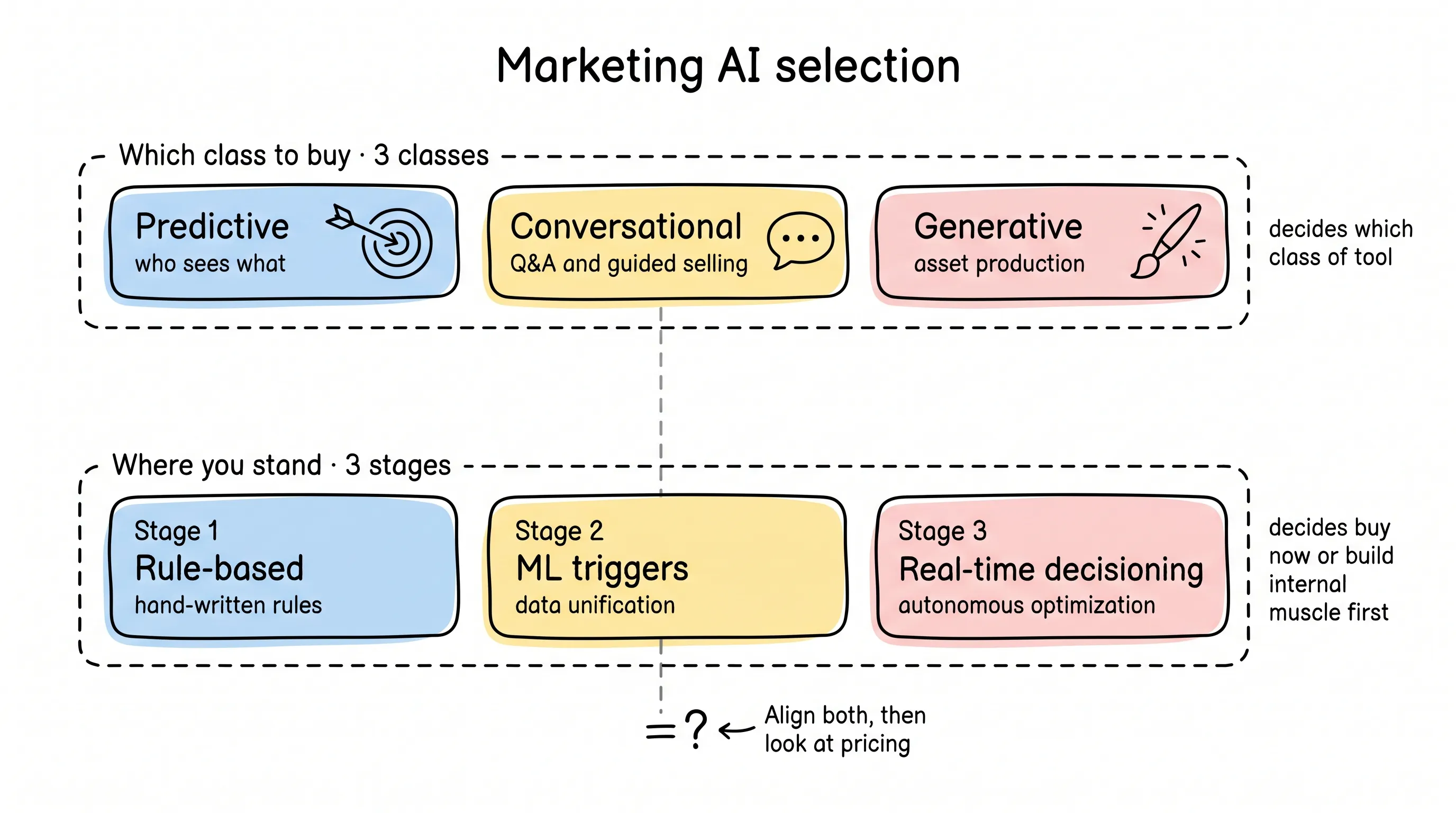
Personalization vendor CleverTap rounds up 10 AI personalization tools; the ranking itself points at its own product, but two frameworks are worth keeping. One is the three-stage maturity model: rule-based segmentation, machine-learning triggers, and real-time decisioning with autonomous optimization — use it to locate where you stand today. The other is four selection criteria: breadth of channel coverage, data unification (CDP-grade), AI autonomy, and integration plus cost. The list covers competitors like Braze, Insider, MoEngage, and Adobe Target, each with best-fit scenarios, mostly e-commerce and retail B2C. Vendor content; verify the conclusions yourself.
💬 At the selection meeting, hold off on comparing feature tables and use the three-stage framework to score your own operation first. Most teams' gap sits at stage two: the tools are all bought, but trigger rules are still hand-written by ops. Close the data-unification gap before you talk about switching platforms.
🔗 Further reading: Read the full article
Insider Sorts Marketing AI into Three Classes: Predictive, Conversational, Generative — Classify First, Then Name Names
Personalization vendor Insider One's tool guide, updated November 3, offers a genuinely usable taxonomy: marketing AI splits into traditional predictive (recommendations, dynamic content, on-site search), conversational (NLP customer service), and generative (content creation); tools are then surveyed by use case, covering website, app, email, and SMS omnichannel personalization. The three classes do different jobs: predictive answers whom to show what, conversational handles Q&A and guided selling, generative handles asset production — compare them in one pot and you'll likely pick wrong. The data-foundation section explains how browsing history, purchases, and social-media interactions automatically generate usable insights. The landing point is the company's own Individualize product, so the usual vendor-list caveats apply, but the taxonomy is a fast guided tour for non-technical marketers.
💬 Use this together with CleverTap's maturity framework from the previous item: Insider's taxonomy helps you decide which class to buy, CleverTap's stage map helps you decide whether to buy now or build internal muscle first. Align the two diagrams, then look at price quotes.
🔗 Further reading: Read the full article
NiCE's Glossary Page Drills Home One Principle: In-the-Moment Signals Are Worth More Than Historical Profiles
CX platform vendor NiCE's glossary page (updated in September) is more complete than the average word list, and it carries one principle worth stealing for any marketing personalization team: the signals from the current interaction matter more than historical profiles. A payment in the middle of failing, an unresolved ticket, an intent voiced seconds ago in a chat — those are the signals that should trigger action; pushing coupons off last year's profile is textbook bad personalization. Good personalization lowers customer effort; bad personalization feels intrusive, inaccurate, and inconsistent. Quality depends on identity, consent, data, and business rules — the model is the secondary variable. Compliance boundaries and measurement framing are covered too: use data within what policy and regulation allow, measure results by customer and business outcomes, and don't count how many experiences were customized.
💬 Run an audit of the trigger conditions in your automation flows and count how many rules still run on historical segments. Wire real-time signals like failed payments and ticket status into the trigger logic, and you'll typically see recovery-rate movement within a week or two.
🔗 Further reading: Read the full article
AEO Engine's List Delivers a Six-Dimension Weighted Scorecard for Choosing an Agency
AEO Engine's 2026 content marketing agency list ranks itself first — its self-interested nature stated upfront. The list's value lies in the evaluation framework: six weighted dimensions at AI search readiness 25%, commercial fit 20%, content quality 20%, SEO fundamentals 15%, distribution and authority 10%, and measurement 10%, plus buyer-perspective evaluation notes and an explicit promise not to fabricate scores or prices. Ten agencies each come with best-fit scenarios: for B2B SaaS thought leadership, Animalz; pipeline-oriented, Omniscient; commercial-intent content, Grow and Convert. The article's thesis: in 2026, a qualified content partner must produce assets that can simultaneously rank in Google, get cited by AI systems, and support sales conversations — editorial quality alone no longer cuts it.
💬 Teams switching or adding content agencies next year should copy this weighted table as a scorecard outright. For the AI search readiness column, remember to add a touchstone: have each candidate demonstrate live how they track your brand's appearance rate in AI answers.
🔗 Further reading: Read the full article
Beyond InnoVision's Four-Platform Comparison, One Warning About Idle Features
InnoVision Marketing Group's September enterprise marketing-automation selection piece pivots on a four-platform comparison: HubSpot goes the unified CRM and lead-management route, ActiveCampaign shines at multi-condition customer-journey triggers, GoHighLevel leads with high-velocity conversion, and Klaviyo is the first pick for DTC email. Two warnings are worth more than the list itself: first, enterprise software features routinely sit severely idle for lack of an internal technical management team — assess operating capability before you buy; second, bilingual or multi-market automation needs a cultural-adaptation framework, because straight translation is not enough. The rest of the piece funnels to the agency's own services.
💬 Perfect timing for year-end inventory season. First audit the idle-features list on your existing platforms and total up the modules you paid for but never use — that number usually persuades a CFO better than a new procurement budget, and the savings are enough to hire one automation ops person.
🔗 Further reading: Read the full article
🏷 Strategy and Cases
A Compendium of 25 Generative-AI Brand Cases: Fine as an Inspiration Index, Do Not Cite It as Evidence
DigitalDefynd, an education site, has compiled 25 generative-AI brand cases (2026 edition) spanning marketing, fashion, healthcare, finance, and more, each structured identically — company overview, objective, approach, impact, takeaway — for easy side-by-side comparison. The one that holds up best is Coca-Cola's Create Real Magic: partnering with OpenAI and Bain, the brand invited artists worldwide to co-create brand visuals with ChatGPT and DALL·E 2, with winning works shown on the big screens of Times Square and Piccadilly Circus; the brand says Gen Z favorability rose. The limits must be stated: all impact is qualitative description, with zero source citations or verifiable numbers, and some entries are old campaigns from years ago, repackaged.
💬 Flip through it as an inspiration index; don't quote it as a success-case library. When a client or the boss asks for case backing in a pitch, pull original data from the brands' official channels — these unsourced numbers fall apart the moment anyone checks.
🔗 Further reading: Read the full article
The Content-Marketing Hot-and-Fading Tactics List Is Useful — but This Intel Item Itself Looks Stale
Azarian Growth Agency's content-marketing strategy list gives a two-way calibration: on the rise are AI-assisted content workflows, pillar-cluster architecture, short-video summaries, and first-party-data-driven content; in decline are undifferentiated generic blogging, pure keyword stuffing, and pure traffic-bait content. The directions match current practice, and small-to-mid teams can use it as a quick scan. But mind the freshness problem: the article is labeled as 2026 trends yet was actually published in September 2024 — an old piece repackaged, no original data, with agency lead-gen written all over it.
💬 Use the declining-items side as a self-check list: open your content calendar, mark every topic built on a pure keyword target, and cut half. If you cite this piece, note its real publication date — don't get misled by the title-year gimmick.
🔗 Further reading: Read the full article
Google Ads and Meta Go Fully Automated: Media-Buying Seats Are Being Reshuffled
A January post from DigitalX Marketers Academy surveys the ad platforms' march toward full automation: Google Ads' Smart Bidding and Performance Max, plus Meta's AI-first advertising system, are all handing audience, bidding, creative, and optimization decisions to the platform. The argument: platforms process billions of signals per second, and manual optimization can't match that on either speed or precision — manual controls are being removed, and the marketer's role shifts from execution to strategy and oversight. The piece extends into skill transitions and 2026 career implications, arguing marketing education and job definitions must keep pace. No data, no cases, obvious agency funnel — a trend overview for entry-level readers.
💬 The trend read is right, but don't stop at anxiety. Media-buyer teams can start their transition with two moves: distill accumulated audience insights into strategy documents, and learn to read the platforms' automation delivery logs — oversight capability will become the new professional moat.
🔗 Further reading: Read the full article
💡 Today at a Glance
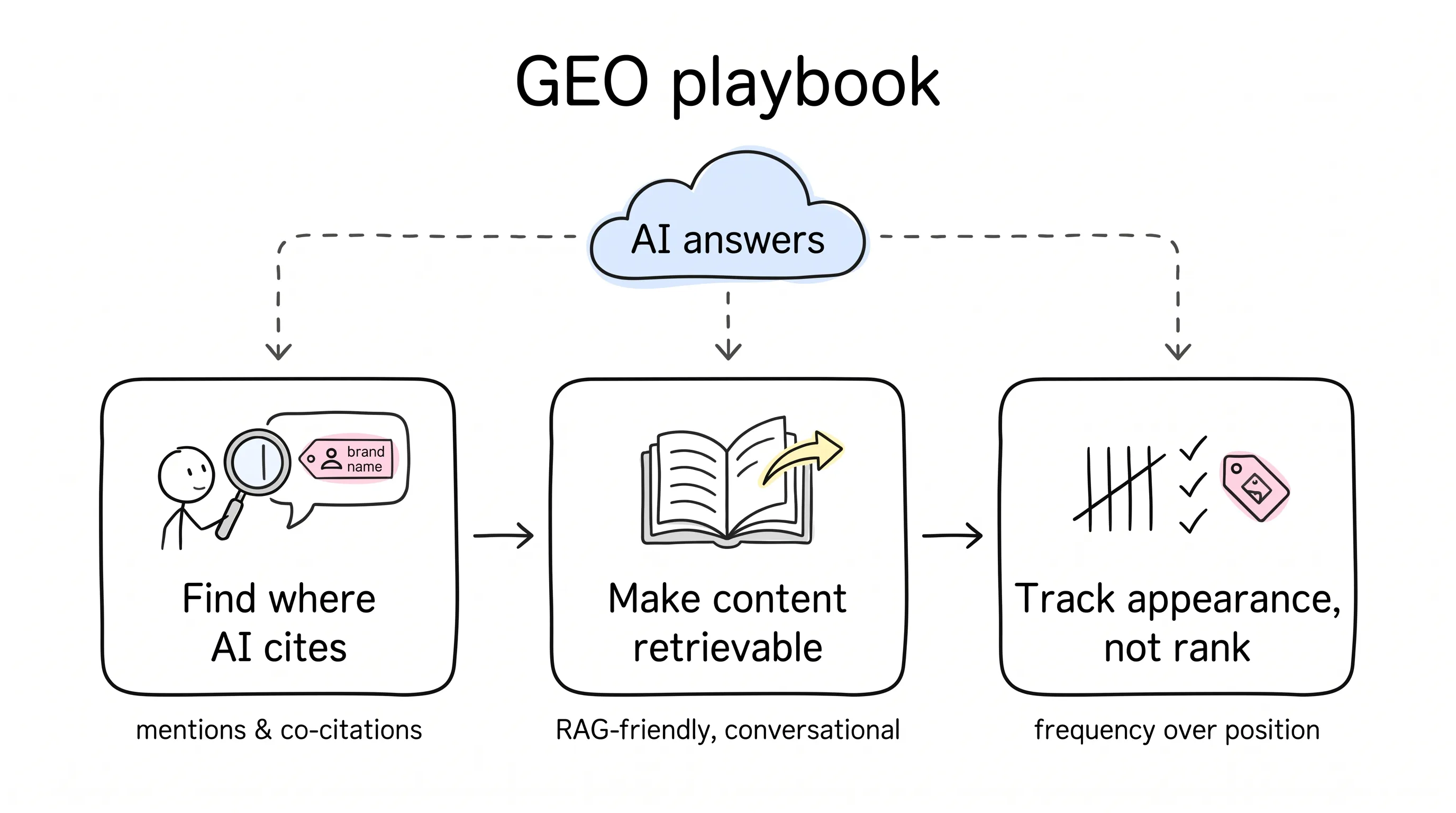
Lay today's 20 items side by side and the through-line is more concentrated than usual. More than half the items answer different facets of the same question: how exactly do you account for AI marketing's input and output. The four surveys located the fault line — usage up, earnings unexplainable; MarTech located where the process breaks down, with approval replacing writing as the new bottleneck; Jasper gave the widening gap, 94% adoption against 41% value verification; Invoca gave the blind spot, more than six in ten teams never mining call data. The answers are all on the table too: KPI first, a four-line cost ledger, three separate buckets for money saved, hours saved, and revenue added, and one 90-day test. The other through-line is buyer attention changing address. Semrush projects LLM traffic will pass traditional search by the end of 2027, AI Overviews swallow three to five out of ten first-screen search results, and Pew's data shows clicks on traditional results roughly halve when an AI summary is present. Today's three GEO guides assemble into a complete playbook: first find out where AI sources its citations (mentions and co-citations), then make your content retrievable (RAG-friendly, conversational structure), and finally track performance by appearance frequency rather than rank. One easily missed corner: NiCE reminds us personalization should watch in-the-moment signals — the same logic as the search side, where the buyer's question this very moment is worth more than a historical profile. Only one action recommendation for tomorrow: from today on, every AI work-hour you save must have somewhere to go — write it into the ledger, and don't let it become yet another unread draft.
Continue reading
Related articles
AI Marketing Daily · 2026-11-22
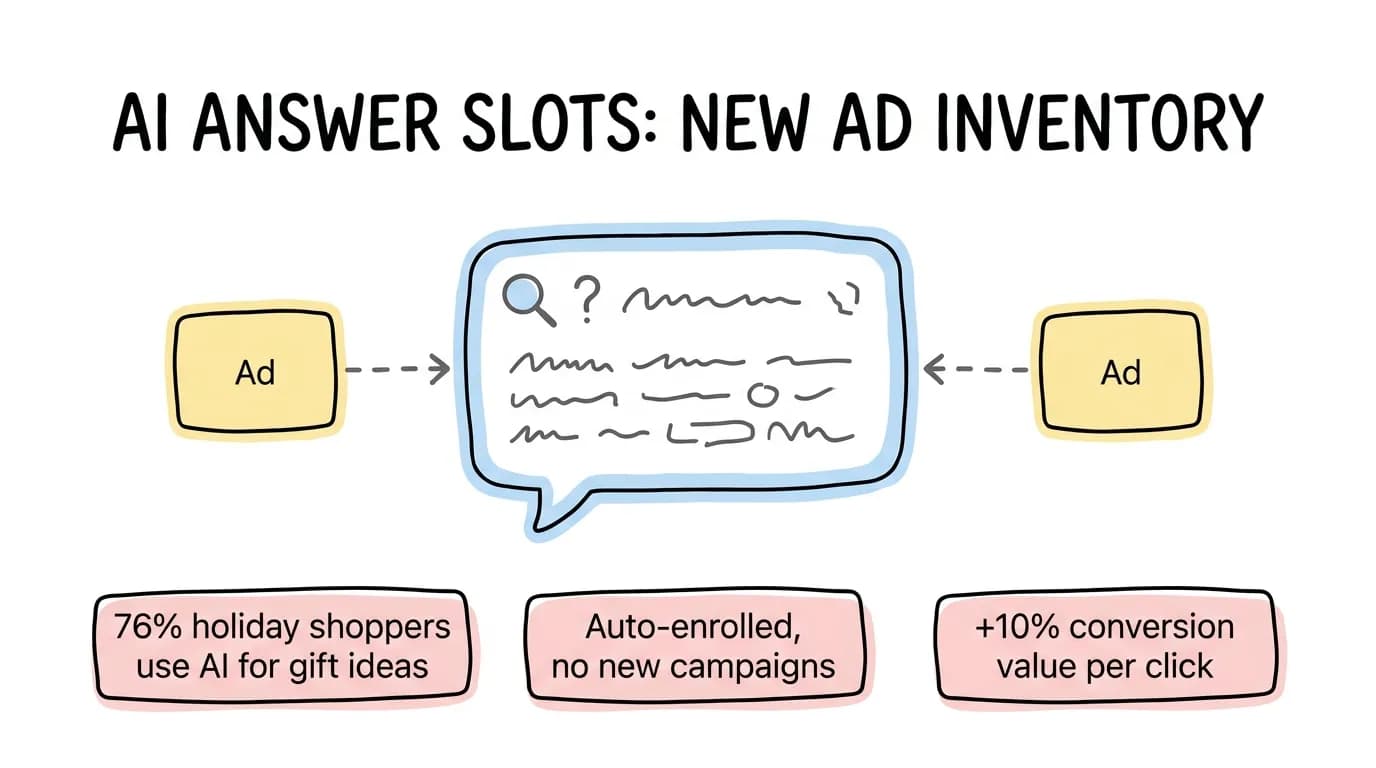
AI Marketing Daily for 2026-11-22 rounds up 20 items led by Microsoft opening Bing AI Overviews to ads and Google expanding AI Mode ads to ten countries, plus GEO guides, ad automation delegation guidance, AI Overviews CTR data, and a legal-risk checklist for AI-generated creative.
AI Marketing Daily · 2026-11-21
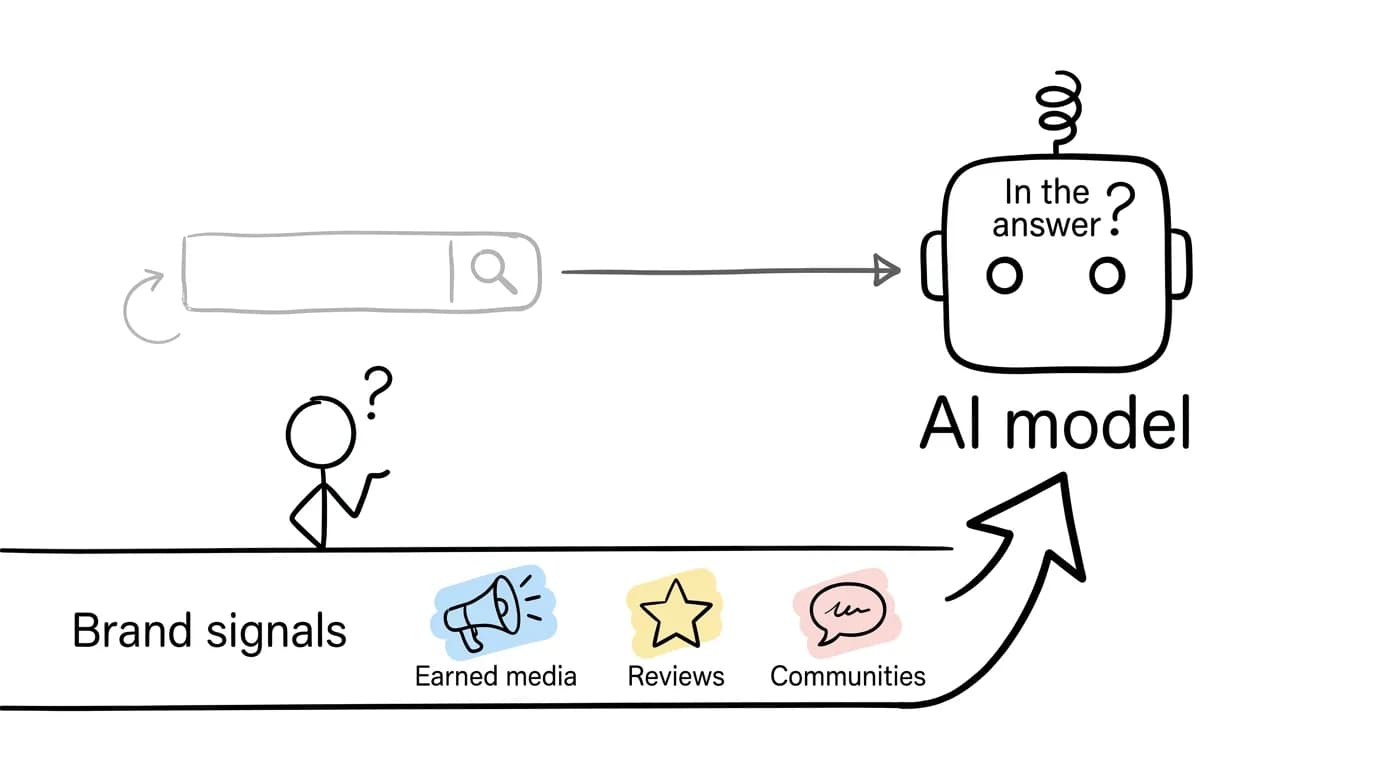
A November 21, 2026 AI-marketing daily covering AI search visibility, GEO methods, Google AI Mode ads expanding to ten countries, Meta's pre-Black Friday changes, agentic shopping, and industry adoption and ROI data.
AI Marketing Daily · 2026-11-20
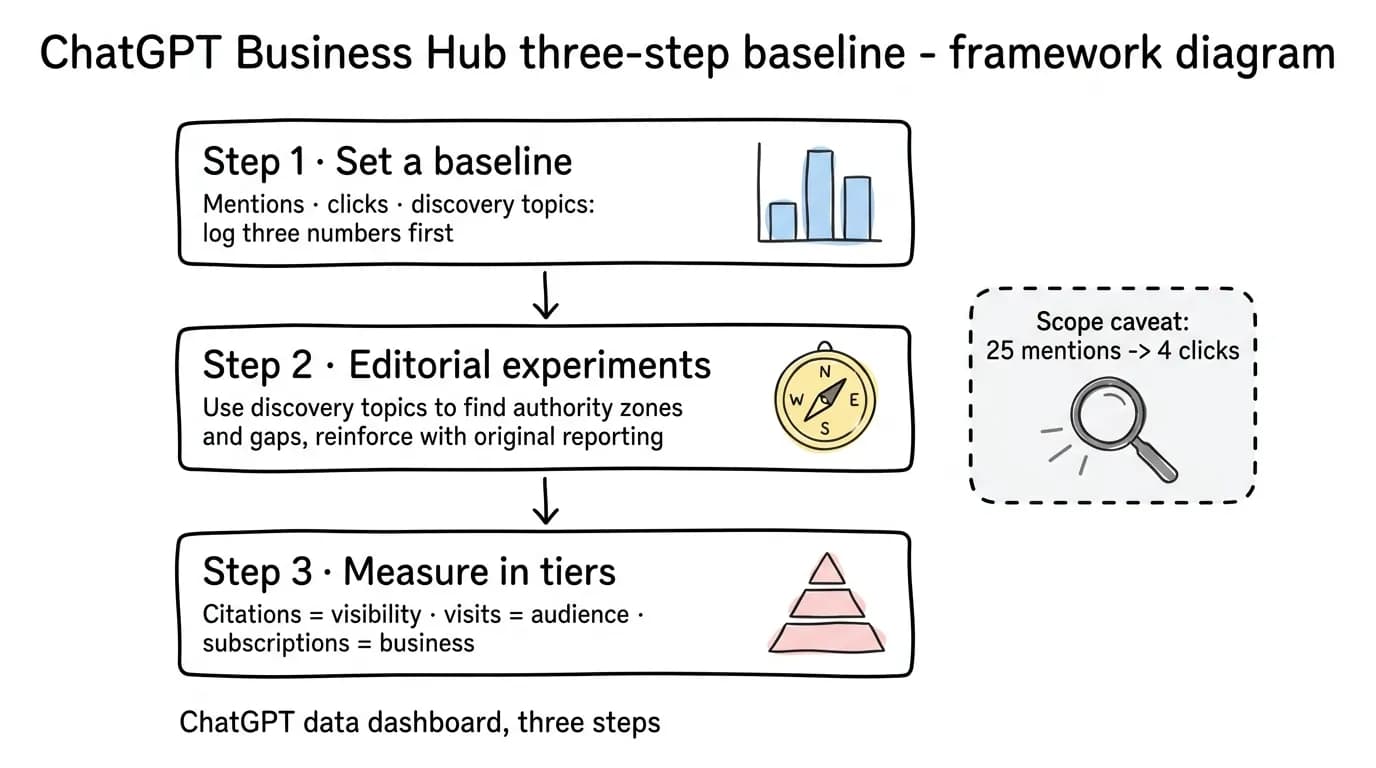
AI Marketing Daily for 2026-11-20 rounds up 19 items centered on measurement: OpenAI's ChatGPT Business Hub dashboard, EU rules for agent-mediated purchasing, Meta pausing four AI terms, and B2B data on shortlists and the dark funnel, each with action advice.