
Content Marketing: What's Still Growing, and What Has Quietly Died
A learn article on content marketing trends, contrasting declining tactics like generic content and paid traffic with growing areas such as voice search, AI-assisted writing, interactive formats, and personalization.
A few days ago, I had dinner with a friend who runs an e-commerce business. He looked exhausted and told me: ad costs went up again, ROI is falling, the content team produces every single day, yet the numbers keep getting uglier.
I asked him: so what's your plan?
He said: Add budget. Keep spending.
I said: you might have it backwards. Some things are growing, and some things are already dead. And you're still pouring money into the dead ones.
That's a harsh thing to say. But I think it's worth unpacking.
The pie itself is not small. I once came across an estimate: in 2025, the content marketing industry's revenue was roughly $82.3 billion. Nearly nine in ten organizations are using content for marketing.
A pie this big, yet the rules of the game are being rewritten. What's dying and what's growing — let's go through them one by one.
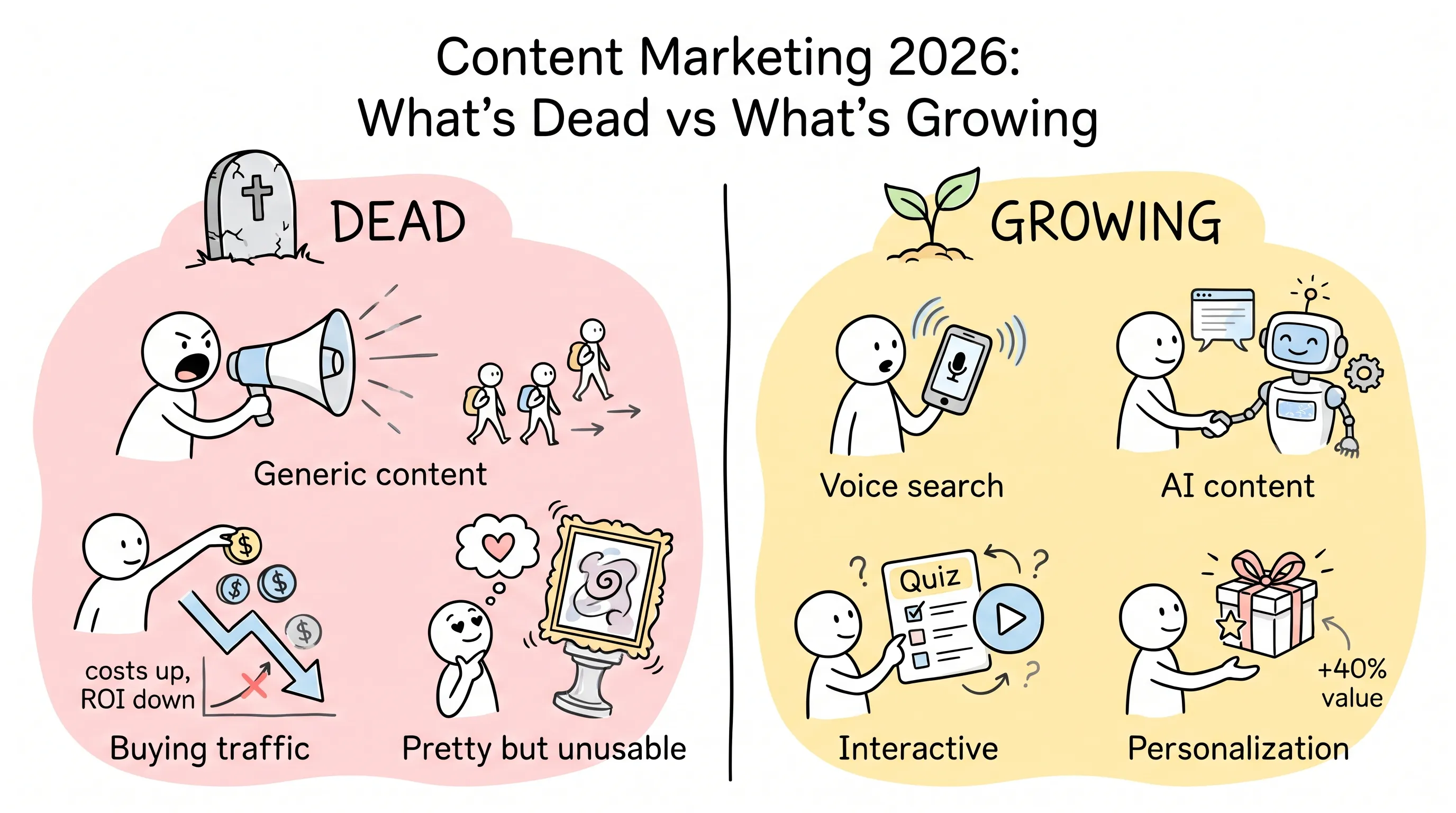
First, the dead ones. The most thoroughly dead: "generic content"
What is generic content? Content written for "everyone." One article that has to move moms, move programmers, and still make business owners think it makes sense.
The result is, whoever reads it thinks: this has nothing to do with me.
Don't blame the readers. The data tools in your hands are orders of magnitude stronger than five years ago — who's watching, what they're watching, what they do afterward, you know all of it. Consumers clearly respond more to brands that "get them"; if you're still writing one-size-fits-all stuff, that's just laziness on your part.
To put it plainly, this industry has evolved from "broadcasting" to "point-to-point." If you're still broadcasting, you deserve to lose.
The second one dying fast: throwing money at traffic
Ad fatigue — you've surely felt it. Out of ten pieces of content a user scrolls through, eight are ads, and they learned long ago to swipe away in one second.
What's worse, costs keep rising. The same click is considerably more expensive than a few years ago. Customer acquisition costs keep climbing, and the ROI math gets uglier by the day. That's exactly where my friend stands.
So where's the way out? Backwards. Make the kind of content people want to find and want to share: SEO, content your users create themselves, partnerships with creators, communities nurtured on platforms. These things are slow, but they're assets.
Ads rent traffic; content banks it. Rented traffic pays rent forever; banked traffic is actually yours.
The third death, the sneakiest: beautiful content that's unusable
Many teams fixate on "does it look good" and forget to ask "does it work."
Open one of their posts: gorgeous images, but on a phone the text is crammed into a wall, the main point is nowhere to be found, and loading is slow. Readers don't reason with you — they just leave. Bounce rates soar, conversion falls, and you're still wondering what went wrong.
"User experience" sounds mysterious, but it comes down to one sentence: don't make readers work. Whatever they want to know, let them see it within three seconds. Fail that, and no amount of beauty is anything but self-indulgence.
All right, the dead are done. Now the growing
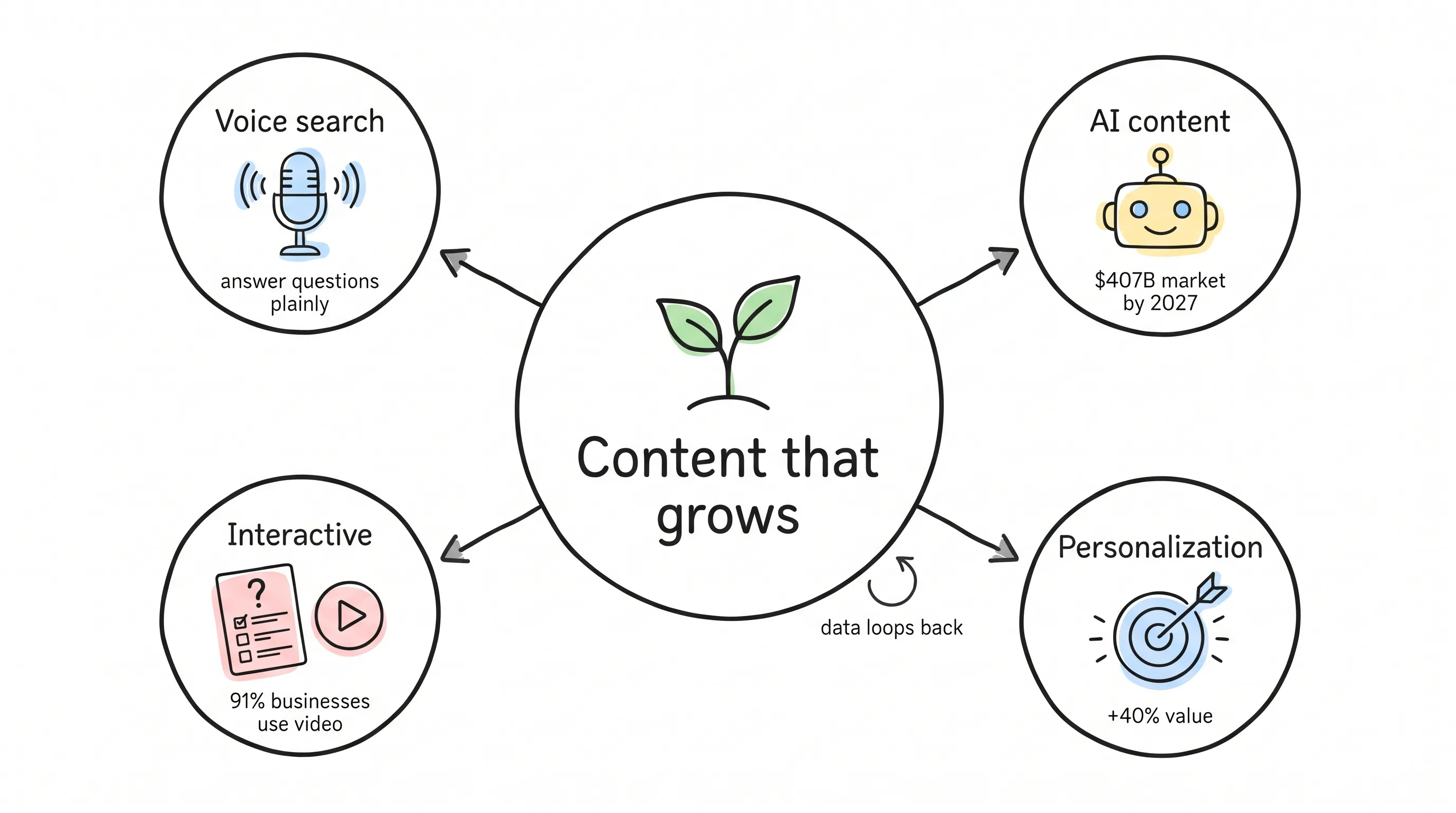
First: voice search.
What is voice search? Users stop typing and start talking. "Siri, which nearby café can still seat four people?"
Have you noticed? These questions and typed searches are entirely different species: more conversational, longer, more like a complete sentence.
That means changing your content. Stop stacking keywords; answer questions in plain human language and give the answer directly in one sentence. When a voice assistant picks an answer, it picks the one that sounds most like "normal speaking."
Second: AI-written content.
No setup needed from me — you get flooded with it every day. First, a number: Forbes once cited a prediction that the AI market will reach $407 billion by 2027.
Wow.
But one thing is easy to overlook: once the cost of "writing it out" is crushed to nearly zero and everyone can mass-produce, the focus of competition shifts. Only two things can still set you apart — your judgment, and your taste.
How to use it concretely? The mature plays fall into a few categories: draft with tools like ChatGPT, smooth out manuscripts with Grammarly and Hemingway, swap content in real time based on user behavior with engines like Adobe Experience Manager, and generate images and videos with tools like DALL-E.
The tools don't matter; what matters is whether you have "something to say" in your head.
One more bottom line: don't pass AI off as a real person and then get exposed. Audiences can accept a machine helping; they can't accept being deceived. What it shatters is trust.
Third: interactive content.
What is interactive content? Content readers don't just watch — they can also "play."
Quizzes and small polls cost almost nothing and work remarkably well. When a user finishes answering, you've also conveniently collected their preference data — two birds with one stone.
AR lets users "place" the product into their own homes to see how it looks; retail, real estate, and education use it most aggressively. In 2023, the AR hardware market was already worth $2.4 billion.
VR goes even further, pulling people straight into a scene: tour a home without visiting in person, preview a trip virtually before booking. One research firm has projected the VR market will climb from $20.8 billion in 2025 to more than $240 billion by 2032, a compound annual growth rate approaching thirty percent.
Interactive video, where viewers choose where the plot goes. Wyzowl's tracking shows 91% of businesses use video in their marketing — the highest share on record. The person watching is no longer an audience member, but a player.
Then there are livestreams and webinars. Real-time Q&A, answers on the spot — trust gets banked exactly this way, bit by bit.
Have you noticed? The beauty of interactive content isn't just holding attention. Every click, every choice, is data. And the data loops back to make your content sharper. It's a virtuous cycle.
Fourth, and the most valuable: scaling personalization.
What is personalization? Putting the user's name at the top of an email — is that personalization? That doesn't even clear the bar.
Real personalization is content that "predicts" a person's needs. Before they've said a word, you already know what they want.
McKinsey's research once put a number on it: companies that get hyper-personalization right capture 40% more value, and grow faster too.
Forty percent. That's not a small number.
How? No shortcuts — connect your data first. Social media interactions, site browsing, purchase records, support conversations: this data sits scattered across systems, and unconnected, each piece is an isolated island. Once it's connected, what you see is a living person, not just an ID.
Take an example. If your data tells you a segment of users loves video and skips long articles, then make them videos about the handful of topics they actually care about.
Personalization is slow work. But slow work is exactly what others can't copy.
Finally, back to my friend
As dinner was winding down, I left him three things.
First, cut the "written for everyone" content by half; put the freed-up hours into audience-specific work.
Second, ads don't need to stop entirely, but carve out a slice of budget to grow content — the slow asset.
Third, put AI to work. Don't use it to mass-produce filler; use it to pull yourself out of repetitive labor so you can do what machines can't: judgment, and telling the truth.
Content marketing is a long-distance run. It's slow, and it grinds. But every bit of trust you bank will speak for you at some moment you never expected.
Ann Handley has a line I especially love: good content isn't about telling a story beautifully; it's about telling a true story well.
Authenticity is the fastest path within slow work.
I'm reminding myself as much as anyone.
Continue reading
Related articles

It's 2026: Stop "Buying" AI Tools for Your Marketing Team — Start "Hiring" AI Agents
This learn article explains how AI agents differ from standalone AI tools in marketing, outlines three agent categories — build-your-own platforms, CRM-native agents, and vertical tools — and covers use cases across SEO, social media, advertising, and reporting, plus criteria for choosing one.

What Is GEO? How Your Brand Gets "Mentioned" in the Age of AI Search
An explainer on GEO (Generative Engine Optimization) for e-commerce and DTC brands: how it differs from SEO and AEO, why AI answers shape brand visibility, and eight practices covering question-focused content, consistent brand messaging, structured pages, external evidence, comparisons, and AI mention tracking.

AI Is Already Making Decisions for Your Customers. Are You on the List?
A learn article explains GEO (Generative Engine Optimization): why AI-generated answers now shape which brands customers see, and how SEO fundamentals, entity clarity, citable evidence, and monthly measurement affect visibility in AI answers.