
The Time AI Saved You — What Did You Do With It?
A learn article on measuring AI marketing ROI: tracking where saved time goes, keeping separate cost and revenue ledgers, and prioritizing assets closest to the deal such as comparison pages and sales enablement.
Last week over dinner, a friend of mine who runs marketing was showing off to me.
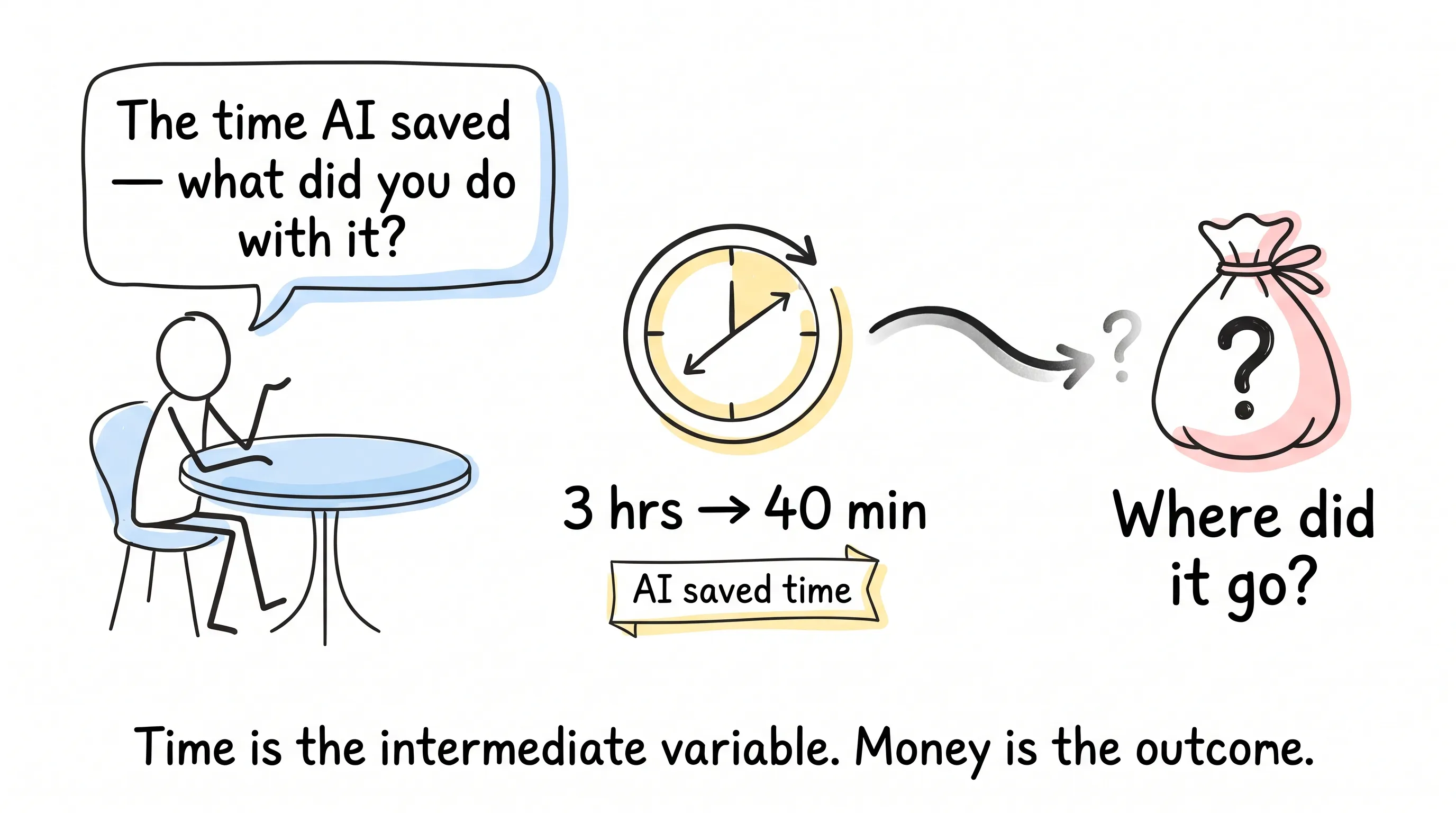
He said that since plugging AI into his team, he'd cut the weekly report from 3 hours down to 40 minutes. The whole team cheered.
I asked just one question: the time you saved — what did you use it for?
He said, writing a few extra articles, of course.
I asked again: those extra articles — how many inbound leads did they bring in?
He froze.
That pause was worth a lot of money.
Several surveys from 2026 tell the same story: nearly every team can prove that AI saves time, and almost no team can prove that AI makes money. The difference isn't whether the tools are good — it's one decision: what you do with the time AI saves you.
Most teams' answer: produce more content. Volume went up, cost went up, revenue didn't move.
My answer: spend the time where it's closest to the deal. Comparison pages, alternative pages, sales enablement. These assets sit close to the money, and the signal comes back fast.
Below are the numbers, the traps behind them, and the accounting method I use every day.
What Is AI's ROI, Really?
A lot of people think AI's ROI is "how much time you saved."
Wrong. Saving time is only the cost half of the equation.
Time is the intermediate variable; money is the outcome. Every hour you save either becomes a smaller number on an invoice, or becomes new revenue you can collect. If neither happens, those hours just… passed.
So the real question isn't "how much time did AI save me," but "where did that time go." Let's look at the numbers first, then do the math.
The Numbers First — Quite a Show
In spring 2026, The CMO Survey, published by Duke University's Fuqua School of Business and Deloitte, surveyed 308 US marketing leaders: AI is now involved in 24.2% of marketing activities, up from 13.1% in 2024. Generative AI alone jumped from 7.0% to 22.4%. The most common use case? Content — 73.9% of companies are using it.
Think about what these numbers say: how widely AI is used, not how fast it earns.
A team can absolutely let AI do a quarter of the work and make not one extra cent.
Now for one that stings more. On October 29, 2026, Emplifi released its State of Social Media Marketing 2027 report, asking 405 marketing managers in the US, UK, Australia, and New Zealand:
- 87% said AI boosted team productivity, and 38% considered the gain significant;
- 86% said the volume of content and campaigns increased;
- More than two-thirds save over 3 hours a week on reporting alone;
- Only 48% can confidently prove social media ROI to management.
First, one caveat: Emplifi sells social media software, and everyone surveyed does social media marketing. So read it with a grain of salt.
But what I really want you to see is the crack in this survey. This single survey slaps the whole industry's trap right in your face: everyone used the time they saved to produce more content. Output went up; the ability to prove the output is useful did not.
By the way, more output has a side effect: numbers that can't survive a fact-check flying everywhere. Before you cite any of them, read the next section first.
Every Number Right, Every Conclusion Wrong
I'm a heavy user myself. My writing runs in Claude Projects, I build things with Claude Code, I research with Perplexity. The workflow I trust most is writing data-driven articles: one skill runs the research, verifies every number one by one, checks tone of voice, even draws the charts in my brand colors.
But there are three things I never hand to AI.
First, the argument. What an article is going to say is mine before any tool touches it.
Second, final review. I open every link by hand and check every number against the original source.
Third, logins. No AI gets my passwords. The agent works in my browser while I'm around; when I'm not, it doesn't move.
Someone will say, watching everything that closely must be exhausting. Then let me tell you what my reviews have actually caught.
One article's first draft came out of a round of AI research. Every statistic in it checked out as correct. But four sentences were wrong: one attributed a conclusion to a study that never reached it; one tied The CMO Survey to a point it never mentioned; another used Comviva's data to prove my own framework. Every number right, the meaning wrong.
That's the recurring pattern: tools can get the numbers right and still get the meaning wrong.
So my fact-checking checklist has exactly three items:
- Open the primary source. Summaries drift. One widely circulated quote, traced back to its origin, came from a podcast's show notes that described the speaker's workflow as agentic — yet in the transcript, the speaker explicitly said it wasn't.
- Check the year, the sample size, and who paid for it.
- Confirm each sentence says only what the source said, not one word more.
Oh — and review time counts as work hours too. When we do the math later, it gets its own line.
The Cost Ledger Nobody Keeps
In June 2026, Comviva released its Global CMO Survey Report 2026, interviewing more than 200 senior executives in telecom, retail, and ecommerce:
- 90% increased their AI marketing investment over the past two years;
- Only 12% could use comparative methods to calculate how much extra revenue AI brought;
- 67% couldn't work out the total cost of their AI work;
- 86% were asked by the board or management to prove the money was well spent; only 16% could produce hard evidence.
No SaaS companies in the sample, so look at the pattern only — don't treat it as a SaaS benchmark.
But the pattern alone is frightening. Plenty of teams are adding budget; few can tally what it costs.
Cost is the easy half of ROI to calculate, and yet everyone skips it. If you don't even know what you spent, any ROI you report is a guess.
Subscription fees are easy to count. What really burned me was a different line. My Claude workflow ran for a full year without a hitch: research, verification, tone of voice, brand-colored charts — all held up by skills. Then a model update in September 2026 broke roughly half of it, and I had to rebuild.
Since that day, every workflow in my cost ledger gets four lines:
| Cost item | What to record |
|---|---|
| Tools | Subscription fees this workflow uses |
| Build | Hours spent setting it up the first time |
| Review | Hours spent checking every output |
| Rebuild | Hours spent fixing it whenever the model or tool changes |
That fourth line is there because I got burned.
This is also why I insist on human-led automation: repetitive grunt work goes to AI, but any step that touches customers or published conclusions, I'm in the loop, no exceptions. When the system breaks someday, someone who knows the job has to be able to stand it back up.
Three Ledgers — Never Add Them Into One Number
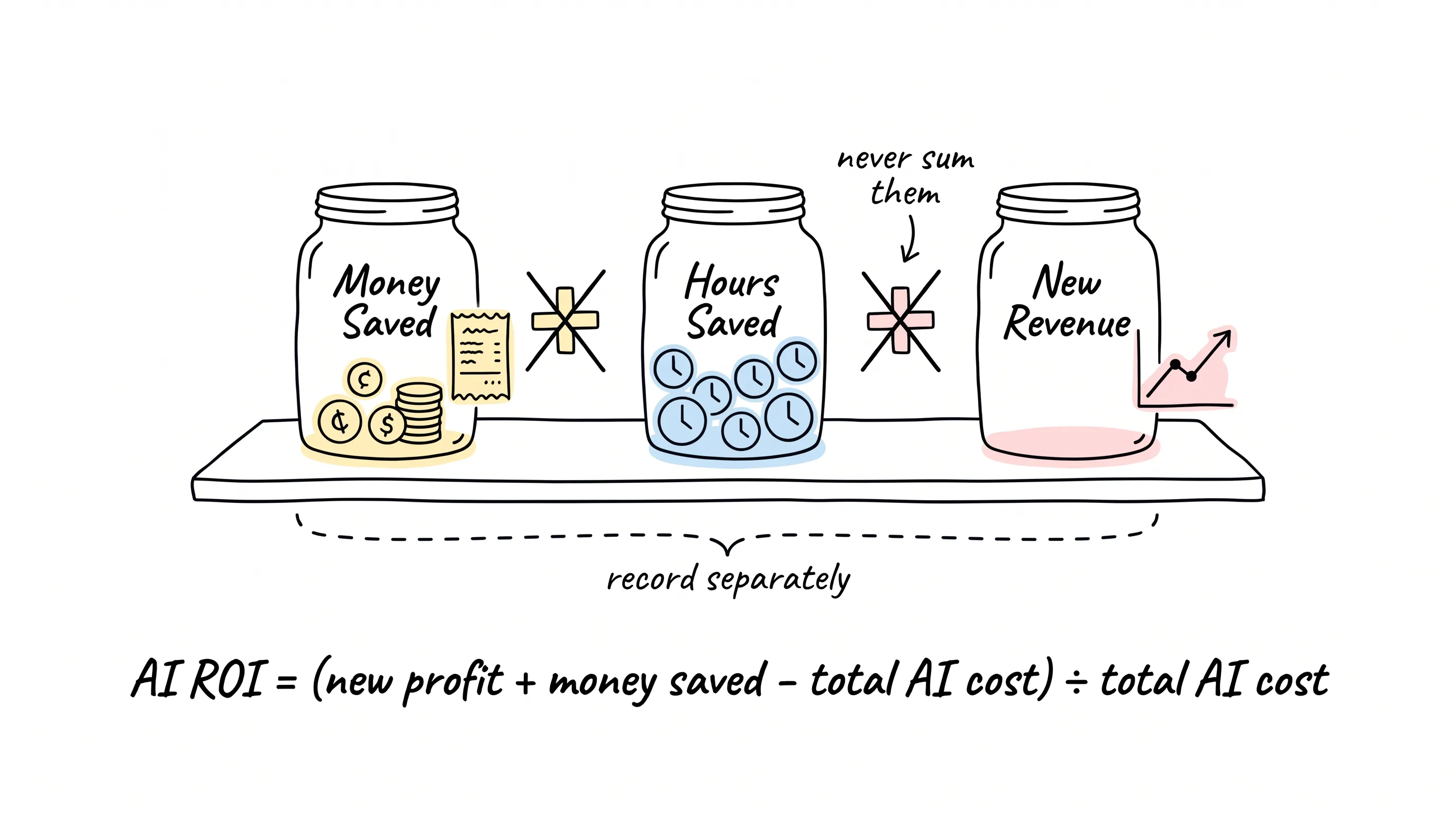
When I report AI's value, I split it into three buckets, and I never sum them into a total.
Bucket one, money saved. It only counts if the bill actually shrank: smaller outsourcing invoices, a tool canceled, less overtime. Nothing else counts.
Bucket two, hours saved. Counting the number isn't enough — write down where the time went. If wages and spending didn't change, those hours are capacity, not savings; savings are zero.
Bucket three, new revenue. Extra demo requests, signups, closed deals — and traceable to a specific AI-assisted change. Set up a control group whenever you can. The funnel is a signal; cash in the account is money.
Why refuse to add them up? Because once they're summed, the three ledgers contaminate each other. Hours saved get reported as money, capacity gets reported as profit.
Here's the formula:
AI ROI = (new profit + money saved − total AI cost) ÷ total AI cost
- New profit: new revenue minus the cost of delivering it. Agree on the definitions with finance before you start.
- Total AI cost: tools, build, training, plus every hour anyone spends reviewing AI output. Not one line missing.
Hours saved get recorded separately: hours before the change minus hours after, with review and rework included. Those hours get counted exactly once: either as savings, or as capacity for new revenue — never on both sides.
Quick example, numbers made up just for demonstration: in one quarter, a workflow generated €6,000 in new profit, outsourcing dropped €2,000, and total AI cost was €4,000 including build and review. (6,000 + 2,000 − 4,000) ÷ 4,000 — ROI is 100%. Also saved 60 hours? Separate line. Don't mix it in.
B2B Is Harder — So Where Do You Start?
In June 2026, BCG surveyed 300 CMOs and added 50 in-depth interviews: 31% of B2C CMOs and 20% of B2B CMOs said agentic marketing had already produced a significant, measurable impact on revenue. Only 8% were actually running multiple AI agents working autonomously across processes.
Why is B2B slower?
Long sales cycles, more signatures.
So my approach is simple: start where it's closest to the deal. Comparison pages, alternative pages, sales enablement. These assets sit close to the money — results can't hide.
Here's one observation from my own pipeline. Prospects who came through the AI assistant are noticeably better prepared than the ones from Google: they've read more, they understand the category, and their very first question is on point. But — they close more slowly, and they drive a harder bargain.
Small sample, no control group; I won't set strategy on it. But the pattern has repeated enough times that I no longer dismiss it as noise.
If it holds true for you too, then conversion research that only counts up to "signup" is measuring the wrong end of the funnel. So I track three numbers, split by first-touch source:
- Win rate;
- Days to close;
- Touchpoints to close.
A channel that delivers more educated buyers but closes more slowly has a cost you'll never see on a traffic report.
Series A to B Teams — Start Like This
Pick processes by three criteria: they recur, there's a "before" number, and quality can be checked. How much content a process can produce? Not on the list.
| Workflow | Cost to record | Revenue signals to record | Guardrails |
|---|---|---|---|
| Turning webinars and expert interviews into assets | Hours and cost per asset that passes review | Qualified replies and opportunities it generates | Record review time and every factual correction |
| Event reporting | Hours and error rate per report | Budget decisions made because of reports, waste cut | Verify the math and the data sources |
| Lifecycle emails | Build time, number of tests | Activation, conversion, upsell, against a control group | Keep audiences and offers consistent across groups |
| Sales enablement | Time to pass review, how many salespeople use it | Deals advanced, win rate | Differences are hints, not causation |
Run two at a time: one that should save time, one that should move revenue. That way your business case is more than "we produce more, faster."
Then comes the 90-day test.
Days 1–15: take the baseline. Pick two workflows, record output, hours, external costs, review load, and quality. Write down exactly what success and failure look like. Align the definitions with finance.
Days 16–45: run it. AI-assisted version against the old process, with time including review and rework. For revenue, use a randomized control group where possible. Change one variable at a time: audience, offer, budget, or process — not all of them.
Days 46–75: verify. Did quality hold? Did the bills drop? Where did the saved time go? Which changes came from the test, and which would have happened anyway?
Days 76–90: decide. Each workflow gets one of three calls:
- Scale: reproducible, stable quality, the math works;
- Fix: saves time, but the proof is too weak, or review is too heavy;
- Stop: cost, errors, or nobody using it outweighs the value.
For businesses with long sales cycles, day 90 answers only one question: does this workflow hold up. The full revenue comes later. Don't rush it.
Back to That Dinner
Later, I asked that friend again: with more content, did anything change at the top of the funnel?
He said, sure — traffic was up quite a bit.
I asked: and closed deals?
He said, well… I'd have to take another look.
You see — saving time is the gift AI gives to everyone. Turning time into money is your own craft.
And one more wish for you: may every hour you save go to the place closest to the deal.
Continue reading
Related articles

It's 2026: Stop "Buying" AI Tools for Your Marketing Team — Start "Hiring" AI Agents
This learn article explains how AI agents differ from standalone AI tools in marketing, outlines three agent categories — build-your-own platforms, CRM-native agents, and vertical tools — and covers use cases across SEO, social media, advertising, and reporting, plus criteria for choosing one.

What Is GEO? How Your Brand Gets "Mentioned" in the Age of AI Search
An explainer on GEO (Generative Engine Optimization) for e-commerce and DTC brands: how it differs from SEO and AEO, why AI answers shape brand visibility, and eight practices covering question-focused content, consistent brand messaging, structured pages, external evidence, comparisons, and AI mention tracking.

AI Is Already Making Decisions for Your Customers. Are You on the List?
A learn article explains GEO (Generative Engine Optimization): why AI-generated answers now shape which brands customers see, and how SEO fundamentals, entity clarity, citable evidence, and monthly measurement affect visibility in AI answers.