
AI Can Replace Just About Everything — But Not These Five Things
A learn article arguing AI cannot replace five marketing capabilities: strategic trade-offs, ethical and brand-safety judgment, lived experience, original storytelling, and human relationships. It outlines a human-led AI workflow, safe versus prohibited use cases, and a six-question pre-publish checklist.
A friend of mine who works in marketing took me out to dinner recently. Three drinks in, he asked me a question: with AI this capable, is our line of work about to run out of road?
I told him to put his glass down first. This one needs to be taken apart piece by piece.
Turn on the news and your screen fills up with "AI is going to replace marketers" and "agencies should be fully automated." Plenty of people are shouting it. But go look at what's actually happening, and you'll see an entirely different picture.
The World Federation of Advertisers (WFA) ran a study: on the agency side, generative AI adoption is in full swing; on the brand side, 66% rank legal risk as a major concern, 51% worry about ethical risk, and 49% about reputational risk.
How big is that? Nearly seven in ten brand owners aren't sleeping well.
Personally, though, I think this is a remarkably healthy signal. Brands aren't saying no to AI. What they want is AI they can explain, keep under control, and stand behind.
So the question becomes: which jobs will AI never be able to take over?
Let me walk you through five of them.
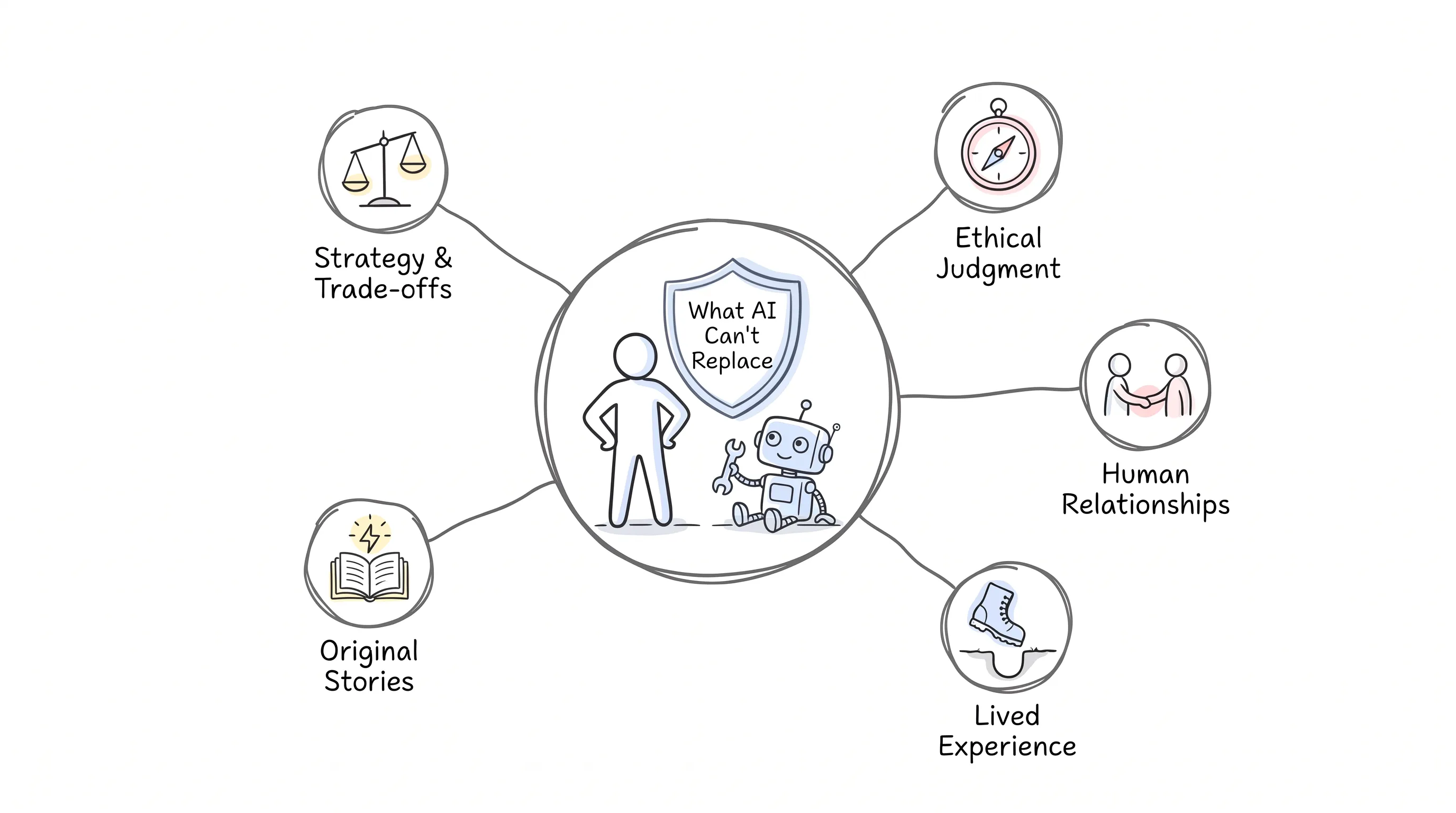
1. Strategy and Trade-offs
AI can offer advice. But the final call? That's yours.
Why?
Because the model doesn't know what your margins are, doesn't know how much delivery capacity you have left next quarter, and certainly doesn't know whether you, the founder, have the nerve to bet everything you own on a new market.
What is strategy? Strategy is deciding what not to do when resources run short.
None of these numbers exist in AI's training data. It has seen every business case in the world, but it never saw the argument in your office over whether to kill a product line.
Think about it: would you dare let it make those trade-offs for you?
2. Ethical Judgment and Brand Safety
The FTC has warned the marketing industry more than once: if you claim AI makes your product "smarter," "safer," or "faster," you'd better have the evidence. If you can't produce it, that's false advertising.
This is not a scare tactic. Compliance is fast becoming a discipline in its own right.
How do you manage it? The industry already has a ready-made framework: NIST's AI Risk Management Framework (AI RMF), with a dedicated companion edition for generative AI. How to set policy, how to run tests, who owns oversight — there's a documented playbook for the whole thing.
Some people find it a hassle. My view is the opposite: guardrails always cost less than a brand's crash-and-burn.
3. Experience You've Actually Lived
Google has long promoted a set of content guidelines called E-E-A-T: Experience, Expertise, Authoritativeness, and Trust.
AI can write your drafts. But it can't deliver a service on your behalf, can't see a thorny project through to the end for you, and can't earn real customer reviews for you, one at a time.
Why do users trust you? Because you've actually done it. The falls you took and the pits you stepped into are the costliest parts of your content.
That's why content built on real people and real stories is both a search-ranking advantage and a conversion advantage. These were always the same thing.
4. Original Stories
What is AI good at? Stitching things together. Rearranging and recombining existing material — and the result looks pretty passable.
But a brand's moat has never rested on "passable."
A good story has rhythm, tension, and those moments that make a reader want to send it to a friend. None of that can be assembled from ready-made material. However close the imitation, the raw material still belongs to someone else.
Think of the brands you remember. What you remember is the story they told — never the volume of content they generated.
5. Human Relationships
Referrals, local word of mouth, community events. These are all webs woven by people.
AI can't shake a client's hand for you, can't volunteer at the industry association for you, and can't mentor a newcomer for you.
If you run a local business, understand one thing above all: your physical signals — real storefront photos, staff profiles, review after review — all come from actually operating. No prompt can write a genuine review.
The kind that gets written is called fabrication. FTC fines exist precisely for that behavior.
So Where Should AI Actually Be Used?
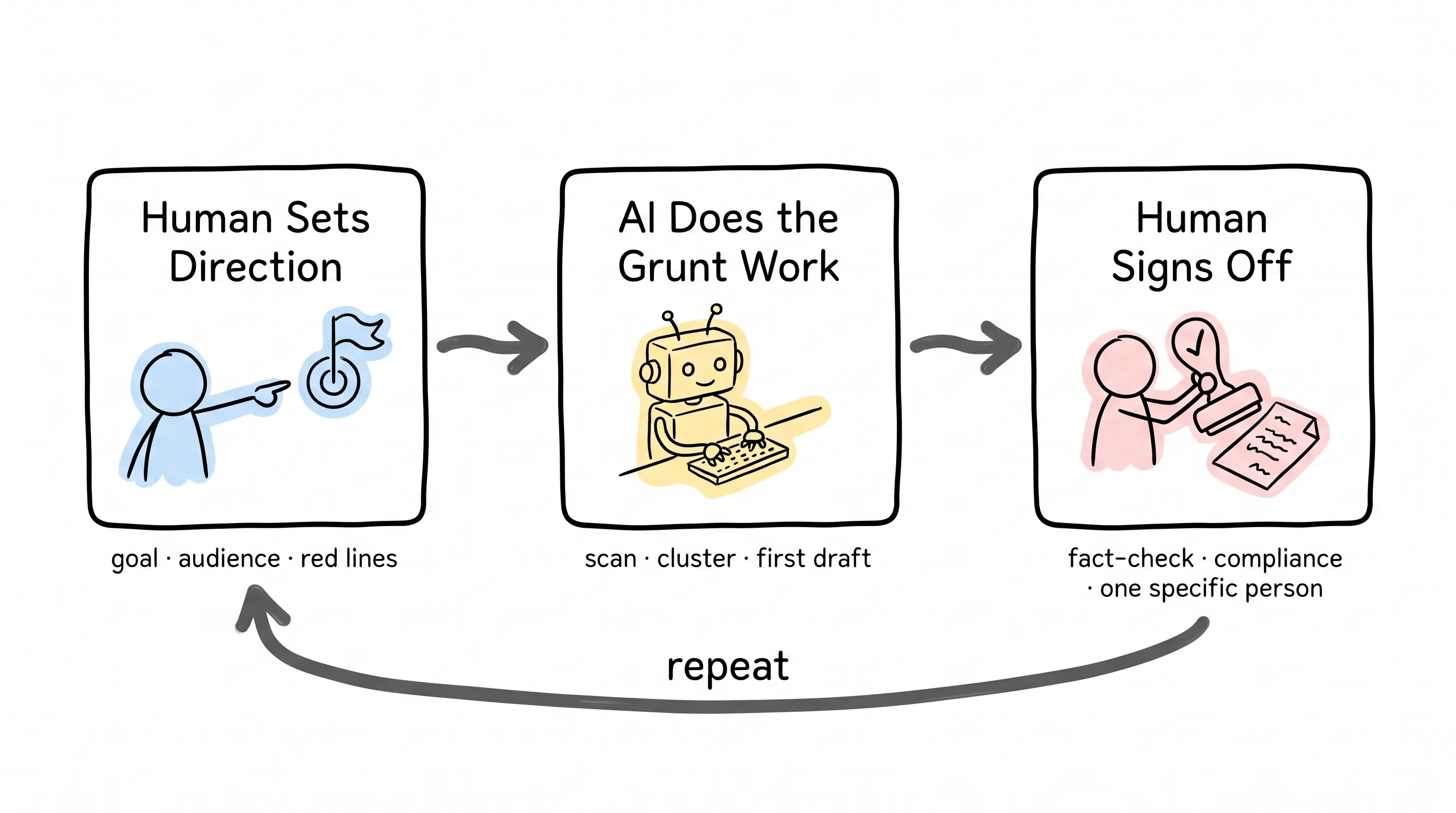
Start with an overarching principle: humans set the direction, AI does the grunt work, and humans sign off.
Teams that use it well tend to run a process like this: a person first states the requirements clearly — what the goal is, who it's for, where the red lines are; then AI scans public sources, clusters themes, and organizes questions, with a human verifying quality; a human decides the narrative angle; AI can take the first pass at the draft, but the edits need to be ruthless; fact-checking, sourcing, and compliance review are all human work; and finally, accountability for governance and disclosure must land on one specific person. Note: one specific person — not "AI is responsible."
What's safe to use? Synthesizing public information, paired with human verification; building FAQs from support records, reviewed by someone who knows the business; finding patterns in user reviews and competitor copy; turning long content into checklists.
What should you never touch? Fabricating customer reviews — that's fraud; publishing unreviewed AI copy under the brand's name; promising results you can't deliver; feeding sensitive data into tools with no governance process in place.
A First Step for Small Businesses
No need to overcomplicate it. Just two things.
First, write a one-page AI usage policy. Second, pick one low-risk use case — say, assembling FAQs — run it, look at the results, then expand.
Before you run it, check yourself against six questions; it takes five minutes:
- Why is AI being used for this task?
- Is the output useful to humans, or only useful to search engines?
- Is there evidence behind the key claims?
- Did sensitive data go into the tool, and is there policy authorization for it?
- Before publishing, has someone who knows the field reviewed it?
- Is it aligned with a governance framework, such as NIST's?
Pass all six, then publish.
Back to That Dinner
When the bill came that night, I told my friend: don't be afraid.
What AI changes is how we work. What it can't change is why we work.
Look at the brands that win in the end — it's not the one with the most automation, it's the one that earned the most trust.
The stronger the tools, the more valuable judgment becomes.
Here's to figuring AI out a day sooner — and to building up, that much sooner, a thicker reserve of the things AI will never learn.
Continue reading
Related articles

It's 2026: Stop "Buying" AI Tools for Your Marketing Team — Start "Hiring" AI Agents
This learn article explains how AI agents differ from standalone AI tools in marketing, outlines three agent categories — build-your-own platforms, CRM-native agents, and vertical tools — and covers use cases across SEO, social media, advertising, and reporting, plus criteria for choosing one.

What Is GEO? How Your Brand Gets "Mentioned" in the Age of AI Search
An explainer on GEO (Generative Engine Optimization) for e-commerce and DTC brands: how it differs from SEO and AEO, why AI answers shape brand visibility, and eight practices covering question-focused content, consistent brand messaging, structured pages, external evidence, comparisons, and AI mention tracking.

AI Is Already Making Decisions for Your Customers. Are You on the List?
A learn article explains GEO (Generative Engine Optimization): why AI-generated answers now shape which brands customers see, and how SEO fundamentals, entity clarity, citable evidence, and monthly measurement affect visibility in AI answers.