
AI Cut Turnaround from Three Days to Half a Day. Now What?
A learn article on why faster AI-assisted copywriting does not speed up campaign delivery when review and approval stay unchanged, and how managers can redesign workflows, delegate decisions, and measure end-to-end results.
A few days ago, I had dinner with a friend who works in brand marketing.
He told me that this year, AI has taken off across his company. First drafts of copy come faster, meeting minutes are ready in seconds, and a few enthusiastic colleagues have even built agents to help with the work. Usage reports keep climbing, and the team gathered to declare: AI is live. Success.
Congratulations, I said.
He gave a bitter smile: not so fast. Last month, the boss asked the CMO what all this usage had actually delivered for the business. The CMO had no answer. Campaigns weren't shipping any faster. Content volume had doubled, but nobody could say whether the extra output was actually performing better.
Ouch. That question hits home for far too many teams.
Why Are Drafts Faster, but Campaigns Aren't?
What does a productivity gain mean? A single step gets faster.
But a campaign travels from brief to launch through several stages: writing, reviewing, revising, sign-off. When it ships has never been decided by the fastest step — it's decided by the slowest one.
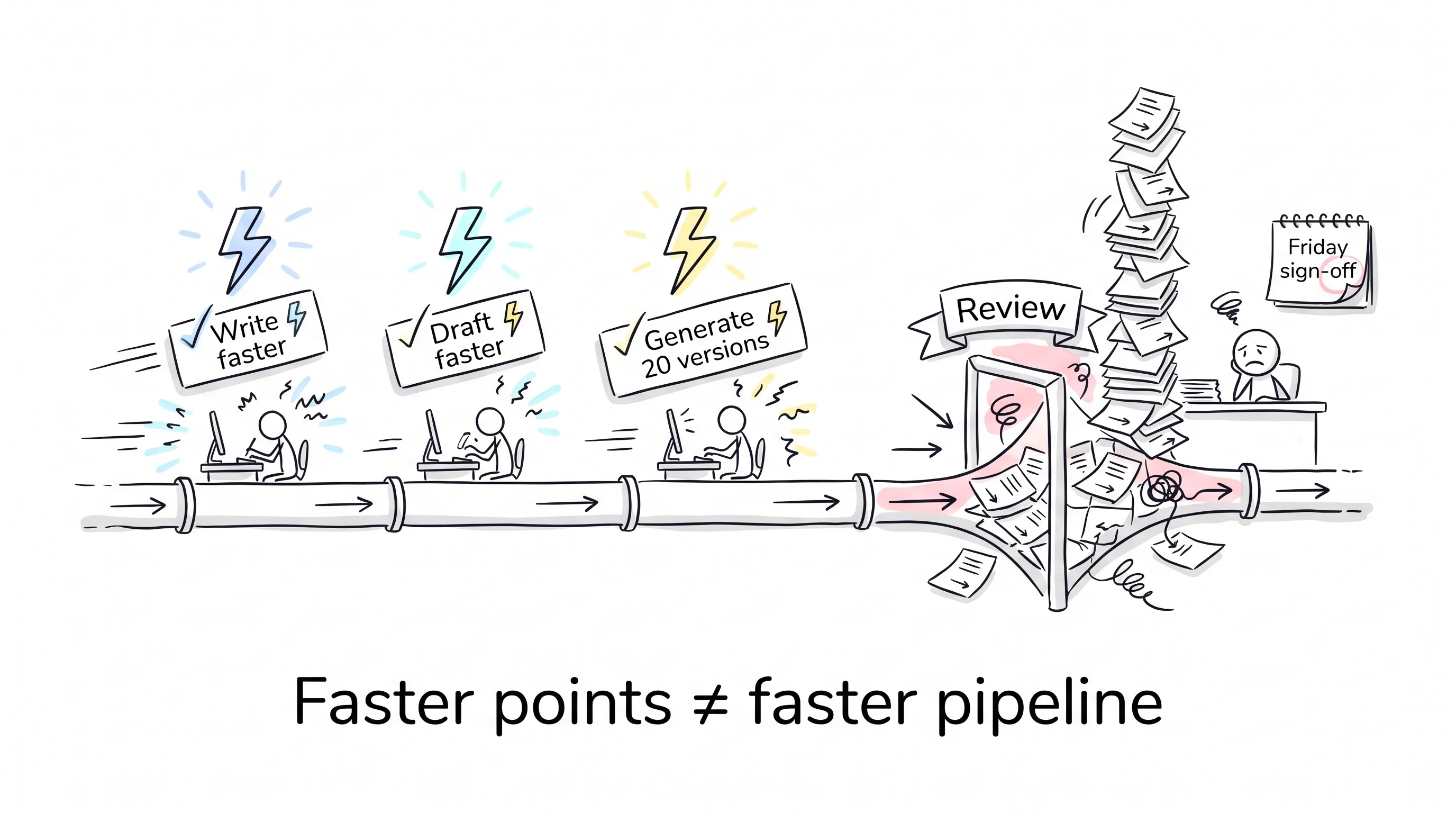
Double the upstream gate, and downstream there's still that same old pipe. The result? Water everywhere.
My friend walked me through a scenario. Producing multiple campaign variants used to take days of grinding; now they can generate twenty versions in a single afternoon, and every one of them looks passable. Then the whole pile lands on the creative director's desk.
Some versions repeat the same idea. Some sound plausible but have drifted off-brief. A few bold claims in the copy need fact-checking. The tone needs adjusting. And the creative director's time hasn't grown by a single second.
Even the versions everyone agrees are outstanding still have to wait in line for Friday's approval meeting.
The result: versions multiplied several times over, and the campaign's path out the door didn't speed up one bit.
The bottleneck has shifted from "can't write it" to "can't review it all."
This is not an isolated case. BCG's 2026 "AI at Work" survey found that 74% of frontline white-collar employees already use AI routinely. Budgets have followed: Gartner's 2026 CMO spend survey found AI initiatives consuming an average of 15.3% of marketing budgets. Yet only 30% of respondents consider their team's AI readiness genuinely mature.
The money is spent, the people are using it, but the process hasn't moved. The same people write the briefs, the same people review the drafts, the same people make the final call.
AI speeds up every point on the line, but the line itself stays the same. Faster points don't add up to a faster pipeline.
First, Get Clear on What the Speed Is For
So what do you do?
Don't rush to rally everyone to "use more AI." Start with a question: what is this speed actually for?
For this campaign team, the goal might be: on a flat budget, genuinely test three distinct creative directions. With that goal in place, twenty near-identical versions are pointless — they just clog the pipe.
Or maybe what you want is to launch earlier. In that case, generating versions faster is useless unless review and sign-off move earlier too.
Different goals call for completely different moves.
You also need to agree on what can't be sacrificed for speed. Claims in the copy must have substantiation; brand tone must not drift. Be fast — fast within those lines.
Then, measure the current process end to end. How many days from final brief to campaign launch? Where does the time go? At which station does work sit still — and why?
You may find that writing isn't the main bottleneck at all. It's that the product's selling points were never settled. That the brief got overturned halfway through. That three people each believed they held final approval.
Until those are solved, faster writing buys you nothing.
Hand Over the Keys
Once the goal is clear, then comes the real work: where AI fits, and how the process changes around it.
Take version generation. Before work starts, have ready the finalized brief, substantiated claims, brand examples, and the directions worth exploring. Then make clear: who picks the strongest versions? What gets checked? What counts as "ready for review"?
If every version floods toward the creative director, ask one question: why?
The people generating versions may not be able to tell good from bad. They may lack confidence. Or they may have been burned before: made one decision, took one scolding. So let them pick — and say why. Give feedback on their reasoning, then tell them explicitly which decisions they can make on their own, no sign-off required.
Especially the juniors. Early in a career, the grunt work — revising drafts, running errands — is exactly where judgment gets trained. Now AI has done the grunt work, and the practice reps are gone. If you don't give them another training ground, every decision still lands on the same few veterans. The team can write as fast as it likes; the bottleneck is still those few people.
And encourage people to push back on the process. When someone says "this draft won't do," don't rush to read it as resistance. That veteran may see a problem you don't. Have them point it out to you: where does it fall short? What would it take for you to actually use it?
Finally, look at approval itself. If work is ready on Tuesday, does it really need to wait for Friday's meeting? Which reviews could be dropped? Who actually needs to be there?
Writing fast is AI's skill. Getting the work moving is a manager's skill.
Accounting for the Time You Save
Once the process runs smoothly, someone has to decide how the time you save gets spent.
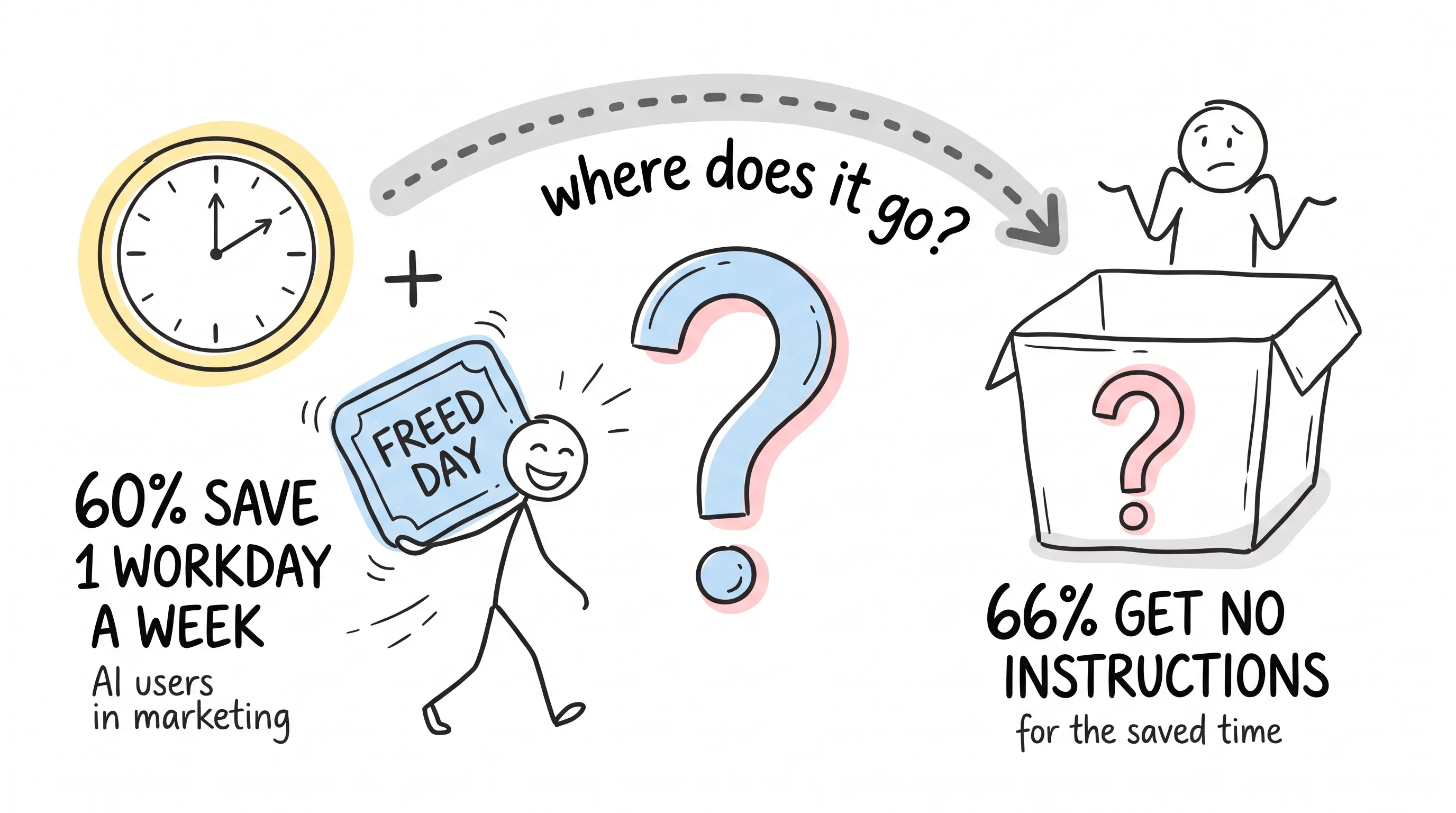
In the same BCG research, 60% of regular AI users in marketing roles say they save at least one workday per week. But 66% say no one has told them what to do with the time saved. BCG's conclusion: most organizations haven't yet learned to turn saved time into value.
60% of people are saving time, and two-thirds of them don't know what it's for. That math is left hanging in midair.
How do you make it real? Spend the time against the goal. If you want to test more directions, protect the testing time. If you want to launch earlier, pull delivery forward. If the team has been working overtime every day, then simply getting a campaign out the door before normal quitting time is itself an improvement worth celebrating.
You can also carve out part of the saved time for developing people. Have junior colleagues sit in on review sessions and hear why a slogan got killed. The judgment that grunt work used to teach them now has to be rebuilt in places like these.
Ask the people saving the time, too. Block out a fixed slot for learning — or simply let their days get a bit easier. If someone reports hours saved and all they get in return is one more task in their inbox, rest assured: next time, nobody will admit to saving any time.
One last thing: measure the entire process from end to end. Preparation, generation, review, rework, delivery — count the tool and token costs too, and compare against the old process: What got better? Did quality hold? Can this new process keep running long term?
Start with the Next Campaign
Don't try to fix everything at once. Pick one campaign process you run on a regular cycle, and ask your team two questions:
- Counting the checking and rework, at which step is AI actually helping us today?
- For that help to carry all the way through to the final launched campaign, which steps are still missing in between?
Use the answers to change the process, put one person in charge, and try it on the next campaign.
The next time the CMO gets asked "what did the business gain," you'll at least be able to point to a campaign that launched early and walk through the specifics.
Oh, and one more thing. When I saw that friend again, he said they'd tried this approach once. Friday's approval meeting didn't get canceled, but it gained one new rule: drafts ready on Tuesday don't wait for the meeting — they get a decision that same day.
And here's to your next campaign — may it not just be written fast —
but run fast.
Continue reading
Related articles

It's 2026: Stop "Buying" AI Tools for Your Marketing Team — Start "Hiring" AI Agents
This learn article explains how AI agents differ from standalone AI tools in marketing, outlines three agent categories — build-your-own platforms, CRM-native agents, and vertical tools — and covers use cases across SEO, social media, advertising, and reporting, plus criteria for choosing one.

Did the Money You Spent on AI Marketing Ever Come Back?
A guide to measuring AI marketing ROI across three layers: ad reports, sales pipeline, and the financial ledger. Covers metrics such as ROAS and CPA, eight dashboard metrics, industry benchmarks, and common measurement mistakes.

How to Pick a Creative Automation Platform: First, Figure Out What These Eleven Actually Do
A learn article sorts eleven creative automation platforms — including Bannerflow, Celtra, Smartly.io, and Storyteq — into four functional groups and proposes five evaluation questions covering publishing reach, automation depth, ease of adoption, team fit, and verifiable evidence.