
Which AI Personalization Tool Should You Pick? First, Figure Out Which Floor You're On
A learn article that frames AI personalization maturity in three levels—manual rules, prediction, and real-time self-learning—reviews ten tools such as CleverTap, Insider One, Dynamic Yield, and Adobe Target, and offers four questions to guide tool selection.
A while back, an old friend of mine who runs an e-commerce business took me out to dinner, and before long he started venting.
He said that a few days earlier, a customer had just bought an air fryer on their platform. The very next day, what the system recommended to that customer was — another air fryer. The customer didn't know whether to laugh or cry, and went to ask customer support: are you trying to get me to open a fryer shop?
I laughed when I heard this. But I wasn't surprised at all.
Because this kind of thing is everywhere. Have you ever noticed that the promo emails you receive keep pushing the very thing you just bought? Or that the homepage you see on your first visit to a website looks exactly the same as the one you see after three years of shopping there?
Why does this happen?
Because most of what's called "personalization" isn't personalization at all. It's rules written by hand. Marketers toil away in the back office configuring hundreds of "when a user does A, send B" rules, convinced they're being clever. But real users are endlessly varied, and you can never configure enough rules.
The rules can never keep up, and the users keep changing. That's the contradiction.
So what do you do? First, let's get one concept straight.
What exactly is an AI personalization tool?
Simply put, it's a "real-time decision-making brain" plugged into your marketing system. It decides for you: for any given person, what content to show them at this moment, when to send a message, and through which channel. It doesn't run on rules — it runs on prediction, guessing from oceans of behavioral data what a person will want to do next.
First, Figure Out Which Floor You're On
But don't rush off to pick a tool just yet.
I've seen too many companies buy piles of tools and get dismal results. The problem usually isn't the tool — it's that they never got clear on which stage they're at.
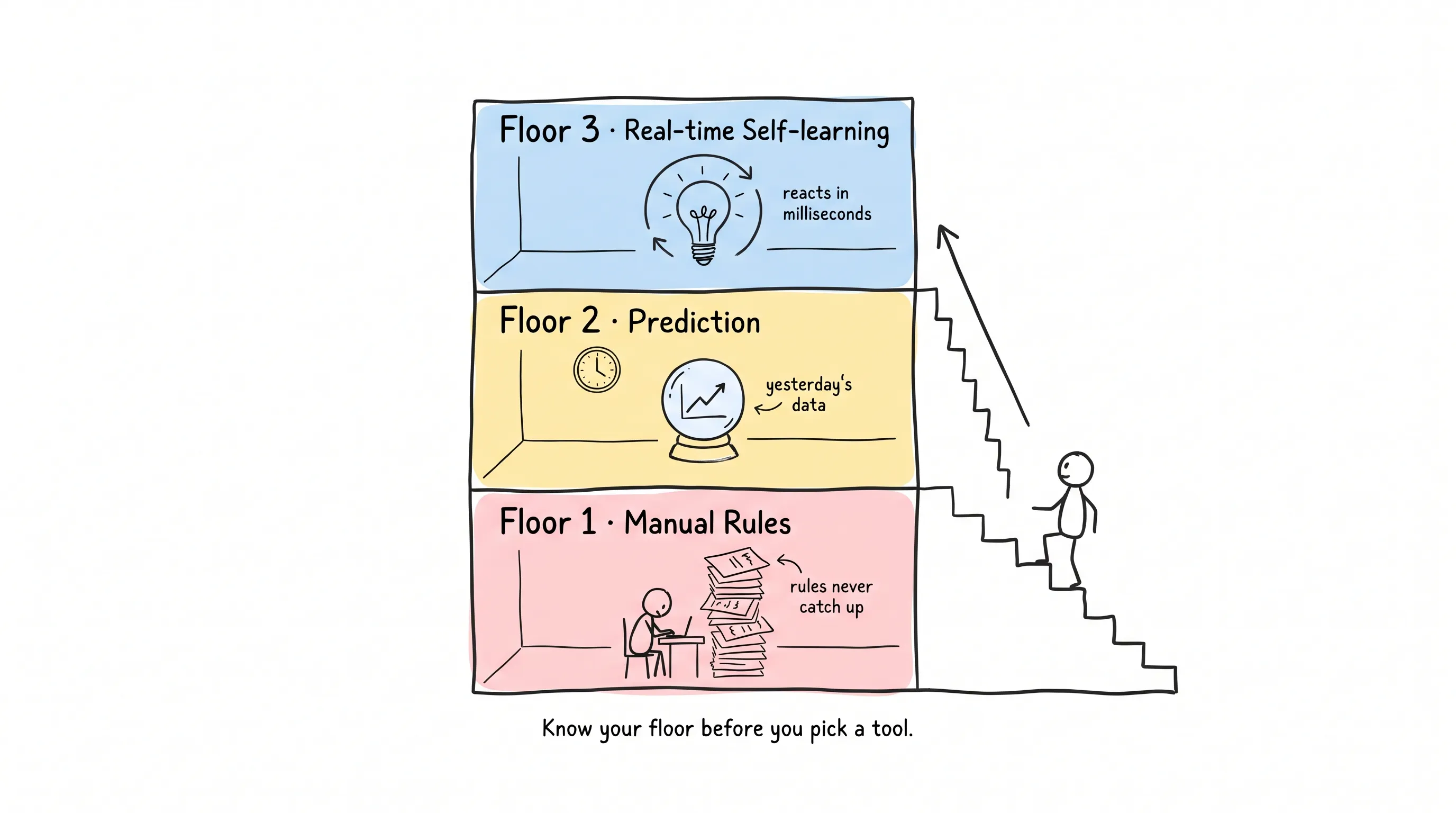
I divide AI personalization into three floors of a building. Figure out which floor you're on first; then decide whether to move.
Floor one: the manual rules floor.
On this floor, "personalization" is pre-set by marketers. Users are sliced into static segments, and every segment gets the same content. At heart it's still one-size-fits-all — the knife just cuts a little finer.
Where's the problem? Think about it: a user is on the subway at this very moment, just got paid, compared prices three times, and abandoned a cart. Can your rules capture all that context? They can't. Rules will never catch up with users.
Floor two: the prediction floor.
Here, the system starts to learn. It chews through the historical behavioral data you've accumulated and produces predictions: how likely is this person to order within the next 7 days? Will that one churn?
Then the platform personalizes based on those predictions. High-intent shoppers get new arrivals; hesitant ones get the well-reviewed picks. Much smarter than floor one.
But this floor has a soft spot: it usually runs in batches. Computed today, sent tomorrow. The prediction is a snapshot of yesterday's world. If the data isn't reliable enough, the predictions drift off course.
Floor three: the real-time self-learning floor.
Now this floor is something else. The moment a user acts, within milliseconds, the system adjusts content, swaps recommendations, changes offers on the spot. And the system uses reinforcement learning to review its own performance, getting more accurate with every step. The more data flows in, the smarter it gets — with almost no human babysitting required.
In one sentence: Floor one is hard-coded rules, floor two is yesterday's judgment, floor three is a conversation with the present moment.
You might ask: why not jump straight to floor three?
Because a meal is eaten one bite at a time. If your data isn't connected, your models aren't properly fed, and your team isn't ready, jumping straight to the third floor will end in a nasty fall. Only by knowing your own floor can you pick the right tool.
Ten Tickets
All right. Before you move floors, let me walk you through the ten mainstream tools on the market. For each one, I'll tell you where it's strong and who it's for.
First, one that "spans all three floors": CleverTap.
It grew out of user engagement and retention marketing, packing a customer data platform (CDP), real-time analytics, and omnichannel outreach into a single platform. Website, app, email, push, SMS, WhatsApp — one connected pipeline. Its homegrown TesseractDB processes behavioral events in the billions in real time, maintaining a "living profile" for every user.
What's a "living profile"? Every time a user clicks, the profile updates instantly and the prediction models recalculate on the spot. Only with this does millisecond-level personalization become possible.
It also ships with a full suite of built-in prediction models: churn risk, purchase intent, optimal channel, best send time — out of the box, no need to keep a dedicated data science team on staff. That matters a lot. It's not that many companies don't want to do prediction; they can't afford the team.
Even more noteworthy is its CleverAI agent layer. My first reaction on seeing it was two words: seriously strong. There are four types of agents inside. Decision Agents decide who gets what, and when; Creative Agents generate copy and can even run experiments automatically; Action Agents handle cross-channel execution and optimization; Strategy Agents are the most interesting — you ask in plain language, and it hands you insights. Describe a goal, and it builds the campaign itself, runs it, and optimizes it.
How well does it work? Two real cases.
Indian e-commerce platform Tata CLiQ used its real-time personalization and behavioral segmentation to target users who "browsed with intent to buy but didn't check out," pushing related products. Click-through rate hit 4x the original.
Restaurant reservation platform Eatigo used it for personalized recommendations and win-back, orchestrating 100+ personalized journeys and 10+ automated campaigns — doubling the probability that users complete a booking.
By the way, in Gartner's 2026 Magic Quadrant for Personalization Engines, CleverTap was named a Leader.
One more detail: its IntelliNODE continuously experiments across multiple journey paths, automatically steering each user to the most effective route.
Its positioning is simple: it doesn't hand you building blocks; it hands you the whole building. Best for companies that want to get there in one step and connect the full chain from data to decisions to outreach.
Second, Insider One.
It leads with "intent AI," orchestrating coordinated personalization across website, app, email, SMS, and WhatsApp. Based on massive behavioral signals, it computes intent scores for users, predicting who's likely to buy and who's about to churn — then treats them differently.
Two things impressed me. First, its Sirius AI: give it one plain-language sentence, and it can generate copy, creative assets, even an entire journey. Second, its drag-and-drop journey orchestrator Architect, which triggers complex cross-channel journeys off real-time events. Plus, it can personalize for anonymous visitors in real time. The person hasn't even registered, and it's already adapting content based on browsing behavior. Plenty of tools can't do that.
Third, Dynamic Yield.
Now owned by Mastercard, it calls itself an "Experience OS." Its strength is real-time experience adaptation inside websites and apps: building interest profiles on the fly from live behavior, adjusting content blocks and offers on the spot. It also comes with Auto Optimize, which uses machine learning to keep steering each user toward the best-performing version. Heavily used by e-commerce, finance, and media companies. Best for teams that want to go deep on the on-site experience.
Fourth, Adobe Target.
The personalization and testing component of Adobe Experience Cloud — an enterprise-grade player. Its Auto-Target lets machine learning decide, based on behavior and context, which version each visitor sees; the recommendation engine is powered by Adobe Sensei; and it can pull Real-Time CDP data in real time. It also has a visual editor, so marketers who can't code can still edit pages and run A/B tests themselves.
Already inside the Adobe ecosystem? Then it's practically a given. Outside it? You'll want to think twice.
Fifth, Salesforce Einstein.
One caveat first: Einstein isn't a tool you can buy on its own — it's a full set of AI capabilities that live inside Salesforce.
In Marketing Cloud, Engagement Scores predict each contact's probability of opening, clicking, converting, and unsubscribing, and can even compute each person's optimal send time; in Commerce Cloud, it personalizes product ranking and search results — even search suggestions are tailored per person. Generative AI is now woven throughout the platform, and enterprises can even plug their own models in through Enterprise AI Studio.
Your whole stack lives in Salesforce? It works beautifully. It doesn't? Then don't bother — it won't plug into anyone else's tech stack.
Sixth, Braze.
Born in mobile marketing, and it has filled out its AI stack nicely over the years. The Braze AI suite handles send-time optimization and channel selection, plus built-in churn prediction and conversion prediction scores. Its journey canvas, Canvas, also got AI-assisted experiments at scale. Very friendly for marketers to pick up; best for app-driven companies.
Seventh, Coveo.
Other tools handle "reaching people"; this one handles "finding things." It specializes in personalized search and content discovery: turning your content and products into vectors, turning user behavior into vectors too, then ranking a bespoke set of search results for every person, paired with 1-to-1 real-time product recommendations.
Its most impressive trick is session-level real-time. Within a single visit, every click updates recommendations and rankings on the spot, tracking the interest of "right now."
Is your pain point "users can't find what they're looking for"? Look at this one first.
Eighth, Nosto.
E-commerce to the bone, recommendations are its home turf: related products, best-seller lists, recently viewed — plug-and-play recommendation slots of every kind. It also fires pop-ups based on behavior. User hesitating on a product page? It hands over a size guide. Mouse heading for the exit? Up pops a retention offer. Segments are generated automatically, ready to run personalized campaigns straight away.
For small and mid-sized e-commerce shops that want to quickly turn "browsing" into "buying," it's a great fit.
Ninth, Mutiny.
This one plays the game differently: B2B website personalization, and no code required.
The moment a visitor lands on the site, it runs a reverse lookup on the IP address to identify the company, combines that with your CRM and Google Analytics data to figure out "who this person is," then swaps out the homepage headline, banner, even the entire landing page on the spot. You don't even have to write the copy — it generates new versions tailored to that industry.
Doing B2B and relying on your website for customer acquisition? Worth a serious look.
Tenth, Evergage.
It's been renamed Salesforce Marketing Cloud Personalization — acquired. It was born for "1-to-1 real-time": it reacts on the spot to every move a user makes on the page. Detect the mouse heading to close the page, and a relevant message pops up immediately.
Its segmentation is extremely granular: demographics, behavior, and traffic sources can all be combined. It also ships with a stack of prebuilt campaign templates — like "recommended for you" and "pick up where you left off" — launchable without writing code.
That's all ten. You'll notice a pattern: no single tool wins every scenario. Some cover the full chain, some go deep on-site, some specialize in search, some serve B2B only.
So in tool selection, what matters more than "which is strongest" is "what are you missing."
How to Choose? Ask Yourself Four Questions
Question one: does your scenario need "real-time"? If the core use case is reacting within a user's visit — on-site content changing on the spot, messages stopping the moment a user converts — then real-time decisioning is the hard requirement, and everything else waits.
Question two: can it carry your scale? Don't fall for the sales pitch; make the numbers talk: how many events and how many decisions per second? How many customers your size, in your region, running on it? Best of all, throw a wave of peak traffic at it in a POC.
Question three: are data, AI, and outreach connected? A good tool welds "data in, AI decides, multi-channel execution" into one assembly line. If you're assembling a modular stack, go verify how quickly and how reliably every interface connects.
Question four: is it enterprise-ready? Data security, compliance, permission management, after-sales support — none of these are small matters for a large enterprise. Also, take an extra look at its roadmap. AI moves fast; whether the platform keeps up matters a lot.
Finally, Back to That Dinner
At the end of that dinner, I walked my friend through this "three floors" framework.
He was silent for a few seconds, then said: so all this time we've been struggling away… we're still on floor one.
I said: knowing you're on floor one is the first step to climbing up.
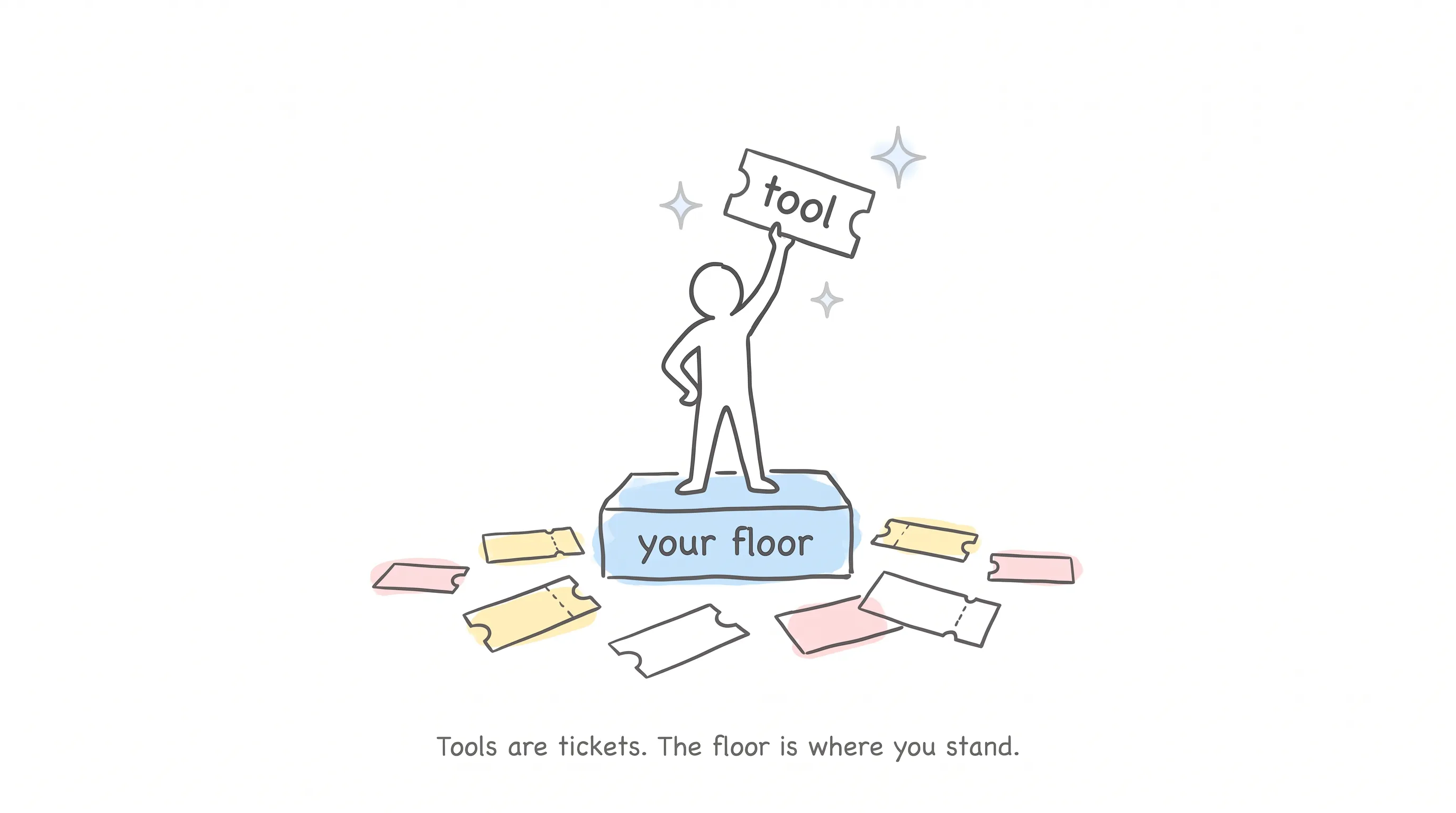
Tools are always just tickets; the floor is where you actually stand. Figure out which floor you're on first; then decide which ticket to buy.
Here's to climbing to the floor that's yours — soon.
Continue reading
Related articles

What Is AI Marketing Automation? It Starts With a 40-Point Gap
A learn article explaining what AI marketing automation is: how learning-based systems differ from rule-based automation, how AI decisioning optimizes message, channel, and timing choices, what data it depends on, and where it applies across the customer lifecycle.

Marketing Automation Is Shifting from "You Do It" to "You Say It"
This article explains how marketing automation is shifting from rule-based platforms that merely execute toward AI agents that plan, create, publish, and review campaigns, covering delegable tasks, underlying technologies, tool categories, adoption steps, and risks such as privacy and automating without strategy.

Rankings Are Taking a Dive, Customers Are Sprinting Ahead: This November, I Re-Ran the Numbers on AI Search
A learn article on how AI search reshapes marketing measurement, covering reported mismatches between rank-tracking tools and live Google results, ChatGPT's business profile test, single-page visitors as high-intent leads, and CRO plus GA4 tracking verification practices.