
AI Has Started Recommending Brands to Buyers — So How Do You Choose a Content Marketing Company?
Explains how AI answer engines are changing B2B content marketing: defines AEO, outlines an evaluation framework for content agencies, groups ten agencies by common pain points, and offers a pre-signing checklist for buyers.
A few days ago, a friend of mine who runs a B2B SaaS business invited me to dinner. Before the dishes had even arrived, he let out a sigh.
He said, "We haven't been slacking on content. Two blog posts a week, whitepapers too, all the SEO boxes checked, traffic looks decent." But a couple of days earlier, he had casually asked ChatGPT: "Recommend a few tools in this category?" The AI named five.
His company wasn't among them.
He refused to accept that. He went and asked Perplexity, then Gemini. Still nothing.
"We rank on page one of search engines — how come when it comes to AI, we're not even a candidate?"
I told him plenty of founders have been running into this lately. So today, let's untangle it: in the AI era, what exactly has changed about content marketing? And how should you choose a content marketing company?
What Is AEO? Let's Get the Term Straight First
What is AEO?
AEO stands for Answer Engine Optimization. Put simply, it means making your brand quotable — so that AI systems like ChatGPT, Perplexity, Gemini, and Claude will cite it when answering buyers' questions.
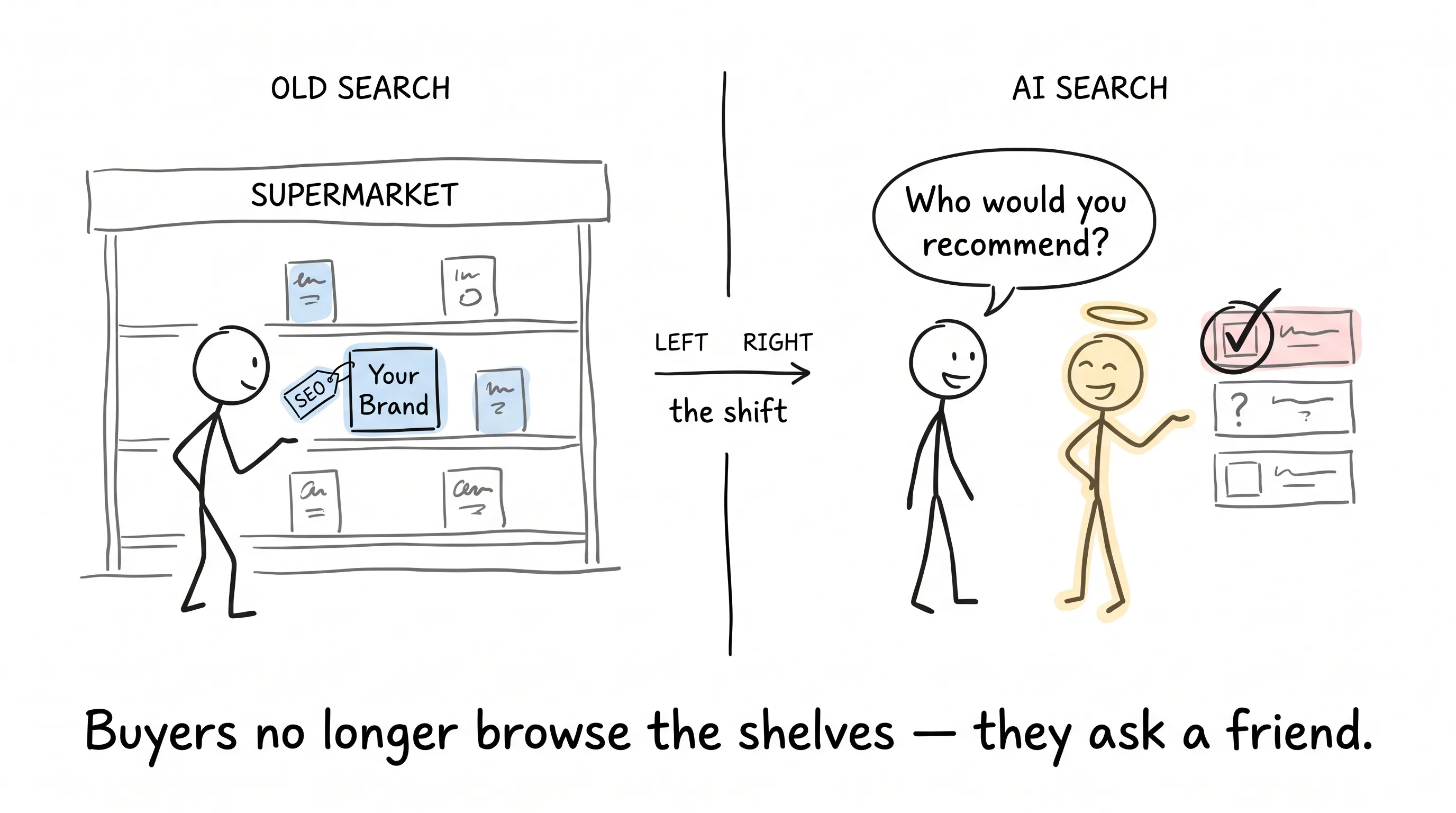
Search used to be like wandering a supermarket. Your content was a product on the shelf; do SEO well, sit your goods at eye level, and enough passersby would buy a few.
AI search today is like having a knowledgeable friend sitting next to you. Buyers no longer browse the shelves themselves; they just ask the friend: "In this situation, who would you recommend?" The friend rattles off three names.
If you're on that list, you get into this round of the pitch. If you're not, ranking first on the supermarket shelf is worthless.
That's why the yardstick for judging a content marketing company has changed completely.
What Must a Good Content Company Be Able to Do Now?
What did people used to look at when picking a content marketing company? Good writing, SEO savvy, reliable delivery.
These are still the baseline today. But on their own, they're no longer enough.
A competent content company now has to do several things at once: content that both ranks on Google and gets cited in AI answers, and that holds up the sales conversation — building trust before a buyer ever fills out a form.
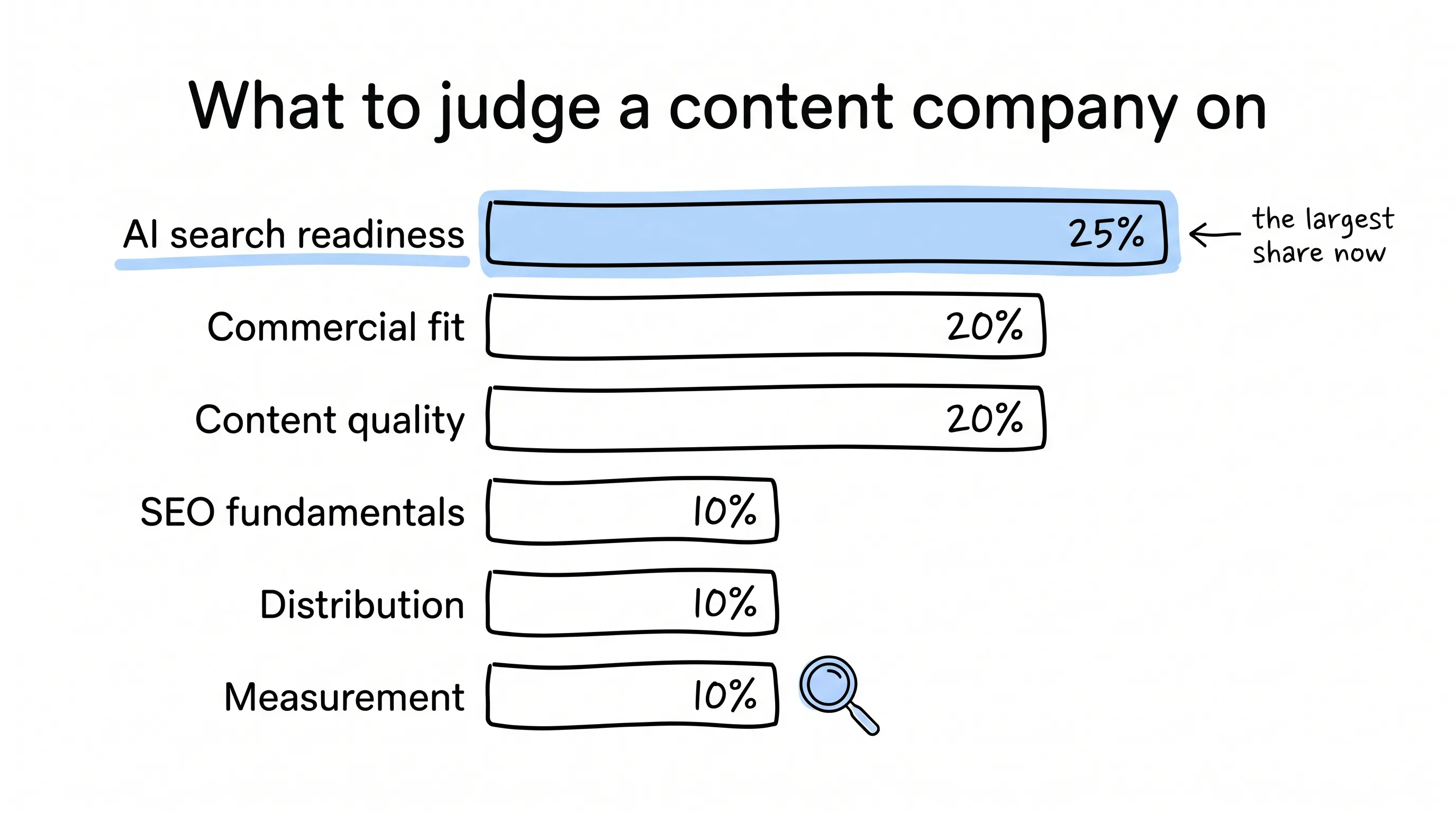
How do you judge that concretely? The industry's common evaluation framework has roughly six dimensions — and the weightings are interesting:
AI search readiness accounts for a quarter — the single largest share. It tests whether your content is clearly structured, well-sourced, and entity-explicit, so AI can easily extract and cite it.
Then commercial fit and content quality, at twenty percent each. The former checks whether your content maps onto the buying process rather than chasing traffic alone; the latter checks whether you produce original frameworks and original research, or merely reshuffle the articles already ranking ahead of you.
The rest — SEO fundamentals, distribution capability, and measurement — take about ten percent each.
Measurement deserves an extra word. Reporting impressions and pageviews doesn't cut it; you need reporting on AI citations, sentiment in AI answers, and share of voice in buyers' minds.
You see — the "measurement" criterion alone already filters out most traditional content companies.
So, Which Companies Are Worth Looking At?
Ten names come up often in the market. I've grouped them by your "pain point." Don't worry about who ranks first; ask yourself one question first: where does it hurt most right now?
Pain Point One: I Can't Be Found in AI
If your problem is that buyers ask AI for recommendations and your name isn't on the list, look for a company that specializes in exactly this.
One called AEO Engine does precisely this work: it first diagnoses where your brand is absent from AI answers, who has taken your recommendation slot, and which sources AI tends to trust; then it fills in the gaps layer by layer — pages, schema, citations, comparison content, internal links — so the brand becomes easier for AI to understand and recommend. Its target clients are B2B and SaaS brands with high decision costs.
One caveat: what it offers is managed SEO+AEO execution. If you're just looking for a cheap content vendor, this isn't your match.
Pain Point Two: Thought Leadership Is Thin, Content Lacks "Weight"
In the B2B SaaS space, two names stand out: Animalz and Omniscient Digital.
Animalz's editorial craft is widely recognized as its core strength — deep on content strategy, thought leadership, and SEO, and it now offers AEO services too. This year it published a guide to B2B SaaS content agencies, and there's a judgment in it I really like: practically every serious agency now has AEO and GEO on its lips; the real difference is whether its research methods, content structure, and measurement models have actually been rebuilt for the job. One sentence, and it separates the poseurs from the real thing.
Omniscient Digital takes a different path: strategy first. Tie content to pipeline, positioning, and growth goals before talking about output volume. On the B2B content road, pageviews aren't revenue — that perspective is right.
But you'll need to run one check for yourself: how exactly do the hard parts — technical SEO, schema, AI visibility measurement — land in its service offering?
Pain Point Three: No Authority, No Links
If your bottleneck is "the content is good, but nobody in the field mentions me," look at Siege Media.
Its strength is SEO content plus digital PR: crafting beautifully designed assets others want to cite, then helping you earn the links and mentions back. In the AI era this matters even more, because AI answers are often drawn from sources that already carry trust in the field.
One reminder: don't settle for top-of-funnel traffic content alone — commercial pages and AI visibility measurement need to be written into the plan too.
Pain Point Four: Big Traffic, Poor Conversion
Grow and Convert solves exactly this. Its playbook is called pain-point SEO: don't chase search volume, chase buyers' specific questions. Buyers doing research today ask increasingly specific questions, judged on fit for their situation and hardness of evidence — not grand abstractions like "top ten trends."
But this playbook has prerequisites: you need a clear ICP, a defined sales path, and explicit product use cases. Without those, even the best content has nothing to land on.
Pain Point Five: Content Gets Made, Nobody Sees It
Foundation Marketing handles distribution: how content travels through communities, social channels, and audience networks. In the AI search era this has gained a new layer of meaning — third-party mentions and source overlap now shape how AI "perceives" you beyond your own website.
A Few Other Situations — Find Your Match
First Page Sage does enterprise-grade thought leadership SEO with a highly systematic ranking methodology. One detail I find interesting: its 2026 B2B agency rankings page already lists GEO expertise as a scoring item. What does that tell you? That the shift has become industry consensus, not a gimmick.
Directive and NoGood suit teams that treat content as one link in the whole growth system. Directive does paid media, creative, and RevOps together; NoGood emphasizes growth experimentation. If your real problem isn't content quality but channel mix and experiment velocity, either of these two is the better fit.
Contently works differently — it's a content operations platform plus a talent network, managing approval, compliance, and collaboration: enterprise-scale processes. It suits large organizations whose bottleneck is governance, not creativity. But a platform is a platform — the demands around AI visibility still all need to be raised.
What Has Happened in the Industry This Year?
Two more signals and you'll have a feel for it.
The 2026 edition of the B2B content marketing research from CMI and MarketingProfs surveyed 1,015 B2B marketers. The conclusion: the winners won on two things — solid fundamentals, plus better use of AI. No shortcuts.
Conductor's AEO trends report points the same direction: brand reputation, sentiment in AI answers, agent workflows, and proprietary research are becoming content strategy priorities.
Two independent sources, pointing to the same place. The exam has changed — and AI now sits among the graders.
Before You Sign, Run Through This Checklist
No matter whom you end up talking to, I've organized the key questions into a list. Ask them one by one in the meeting; whenever an answer doesn't come, you'll know where you stand:
- Which buyer questions will you answer first? Why those?
- Beyond search volume, what else drives your topic selection?
- How do you measure content's impact on pipeline?
- How do you track AI citations, answer sentiment, and source overlap?
- What is your verification standard for claims before publishing?
- When content decays, how do you refresh it?
- 90 days from now, what will we know that we don't know today?
On that last question, I especially recommend you ask it. Companies that can answer it have genuinely thought things through; the ones who hem and haw are most likely still running the old script.
Finally, Back to My Friend
At the end of that dinner, I gave him one line:
Buyers no longer browse the shelves themselves — they're asking a friend. Your content either makes AI confident enough to recommend you, or it was written for nothing.
Choosing a content marketing company is, at bottom, not about choosing prose. It's about who has genuinely rebuilt their methodology in the face of this shift. Good writers are everywhere; companies that truly changed, far fewer.
May you, too, end up on AI's list.
Continue reading
Related articles

It's 2026: Stop "Buying" AI Tools for Your Marketing Team — Start "Hiring" AI Agents
This learn article explains how AI agents differ from standalone AI tools in marketing, outlines three agent categories — build-your-own platforms, CRM-native agents, and vertical tools — and covers use cases across SEO, social media, advertising, and reporting, plus criteria for choosing one.

What Is GEO? How Your Brand Gets "Mentioned" in the Age of AI Search
An explainer on GEO (Generative Engine Optimization) for e-commerce and DTC brands: how it differs from SEO and AEO, why AI answers shape brand visibility, and eight practices covering question-focused content, consistent brand messaging, structured pages, external evidence, comparisons, and AI mention tracking.

AI Is Already Making Decisions for Your Customers. Are You on the List?
A learn article explains GEO (Generative Engine Optimization): why AI-generated answers now shape which brands customers see, and how SEO fundamentals, entity clarity, citable evidence, and monthly measurement affect visibility in AI answers.