
I Went Through the AI Books of 12 Big Companies. There Are Really Only Three Plays
An overview of 12 generative AI case studies from major brands, grouped into three plays: opening creative tools to users, automating repetitive drafting to save time, and personalization at scale. Ends with advice for small sellers: embed AI in existing tools and start by saving time.
A while back, a friend of mine who runs a small online shop took me out for tea and asked me: AI is everywhere right now — I'm just a small seller, where on earth do I even start?
I told him: don't rush off to buy tools just yet. Sit tight, and let me tell you a few stories.
Recently I went through a whole stack of case studies on companies using generative AI. The cola sellers, the lipstick sellers, the furniture sellers, the filmmakers, the coders, the language teachers — everybody is in on it. When I finished, I picked out the 12 with the hardest numbers, and I'm going to walk you through the math on each one.
Read this and you'll see: AI isn't some mystical thing. It's a ledger.
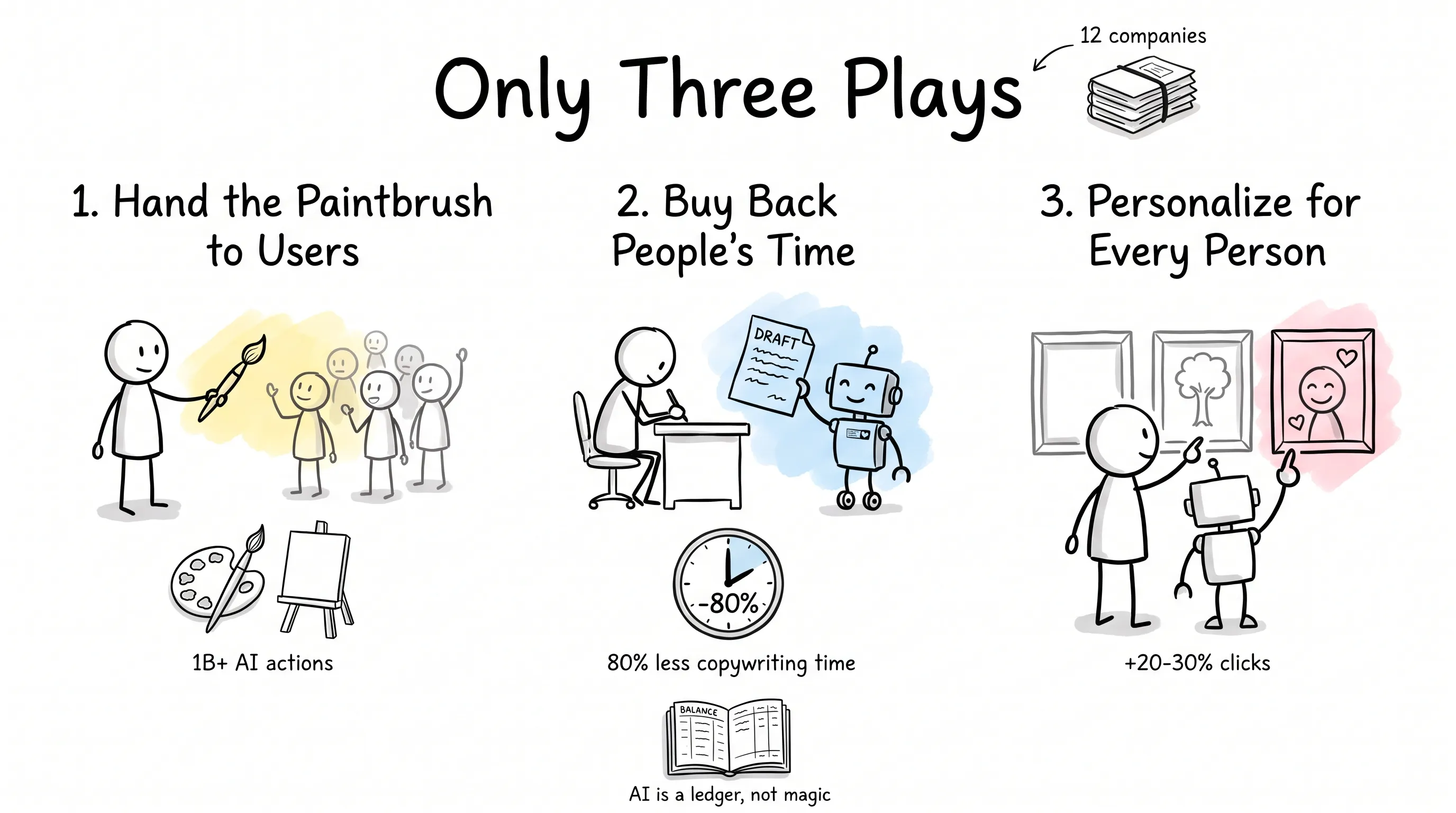
The First Path: Hand the Paintbrush to Users
Start with Coca-Cola.
Together with OpenAI and Bain & Company, it built a platform called Create Real Magic, opening up ChatGPT and DALL·E 2 to users around the world: come on in, paint Coke with AI. The curved bottle, the red-and-white color scheme, even Santa Claus — all fair game.
The result: creators from more than 100 countries poured in. The best work went straight up on the big screens of Times Square in New York and Piccadilly Circus in London.
Think about it: brand communication used to be "I talk, you listen." Now it's users supplying the ideas, machines supplying the images, and the brand supplying the stage. What do young people respond to most? Being seen. And after this campaign, the sharpest jump in brand affinity came precisely from Gen Z — the very people who never watch ads.
Impressive.
Canva took a different route: it baked AI right into its design tool, assembled a suite called Magic Studio, and now a single prompt can generate a whole design package, write copy, and edit images. In the first few months after launch, users ran AI-powered actions on the platform more than 1 billion times. Seventy percent of paying users said their work got noticeably faster, cutting content-production time by 60%.
Adobe's Firefly is even more staggering. In its first year after release, users generated 3 billion assets with it. Here's the clever part: it was trained only on content Adobe owns the rights to, plus public-domain material — so enterprises can use it commercially without fear of a copyright lawsuit.
The first wave of winners wasn't the companies hiding AI in the back office. It was the ones who, openly and confidently, handed the paintbrush to users.
The Second Path: Buying Back People's Time
What's AI's most tangible value? Not the wow factor — the time it saves.
Shopify has run the numbers on this one. Writing product descriptions is the most tedious chore for every store owner. Ten thousand products — are you really going to write ten thousand descriptions? Shopify embedded AI into the merchant back end: fill in a few basics, and the copy appears instantly, any tone you like, any language you need. The result: merchants cut their copywriting time by 80%.
Small sellers with no copy team can now go toe-to-toe with big brands on how polished their pages look.
Stitch Fix plays it even finer. This company sells a "styling service": every box it ships includes a styling note explaining why these pieces work together. That note is the company's soul — and a stylist's nightmare, because at scale there's simply no way to keep writing them. Its solution: have AI learn from every styling note its stylists have ever written, produce a first draft, and let the human edit. Stylists cut the time they spend writing notes by more than half. The beautiful part: customers didn't sense any change at all — satisfaction matched the purely human-written notes, and average order value for the whole box actually went up.
This isn't replacing people. It's giving everyone a tireless assistant.
IBM's Watsonx tackles the toughest material inside enterprises: mountains of documents, support tickets, and customer-service logs. After deployment, employees cut the time spent hunting for information by up to 70%, and customer service processed tickets 30% to 40% faster. What does 70% mean in practice? If you used to spend three hours a day digging through materials, you now spend less than one.
Salesforce packed the same logic into CRM. Its Einstein GPT writes follow-up emails for salespeople, reply suggestions for support agents, and ad copy for marketers. Productivity rose 40%, and click-through rates on marketing emails climbed 28%.
Humans own the judgment, machines own the first draft. That, as far as I can tell, is the common denominator of nearly every success story.
The Third Path: A Different Version for Every Person, Never the Same Twice
These are the best stories of the bunch.
Netflix generates recommendation artwork for every title. For the same movie, a romance lover like you sees warm-toned character stills; an action fan sees the high-energy shots. AI generates, tests, and picks the images automatically, and title click-through rates rose 20% to 30%.
One image, two or three in ten. Let that sink in.
Klarna is a payments company with 150 million users. Working with OpenAI, it put a shopping assistant inside its app — you can just ask it: any waterproof hiking shoes under 100 dollars? Among people who used this assistant, conversion rate was double that of ordinary search users.
Search is the user doing the digging. An assistant is the user simply asking out loud. Shopping is shifting from searching to chatting.
L'Oréal rolled this playbook out worldwide: AI-generated copy and imagery deployed across 25 languages in one go; after its AI beauty assistant launched, user engagement time rose 35% and conversion rate rose 22%; even product-content development cycles shortened by 60%.
A lipstick company running AI on a tech company's product-release cadence.
Done by hand, personalization is a luxury. Done by AI, it's a daily necessity.
A Few Bonus Numbers While We're Here
The New York Times uses AI to generate multiple headline variants for a news story, testing them in real time on its homepage and in email — click-through rates rose by as much as 17%. The one who makes the final call on which headline runs? Still an editor. Machines draft, humans hold the line.
Autodesk built generative design into Fusion 360: engineers feed in goals, materials, and manufacturing processes, and the machine pours out thousands of structurally sound designs in one go. Parts made this way saved as much as 40% in material and halved design-iteration time. Aircraft brackets and car frames have both used it.
Duolingo put GPT-4 to work as a conversation tutor, and learners' average session length grew by 30%.
The numbers themselves aren't the point. What matters is that they all point to the same place.
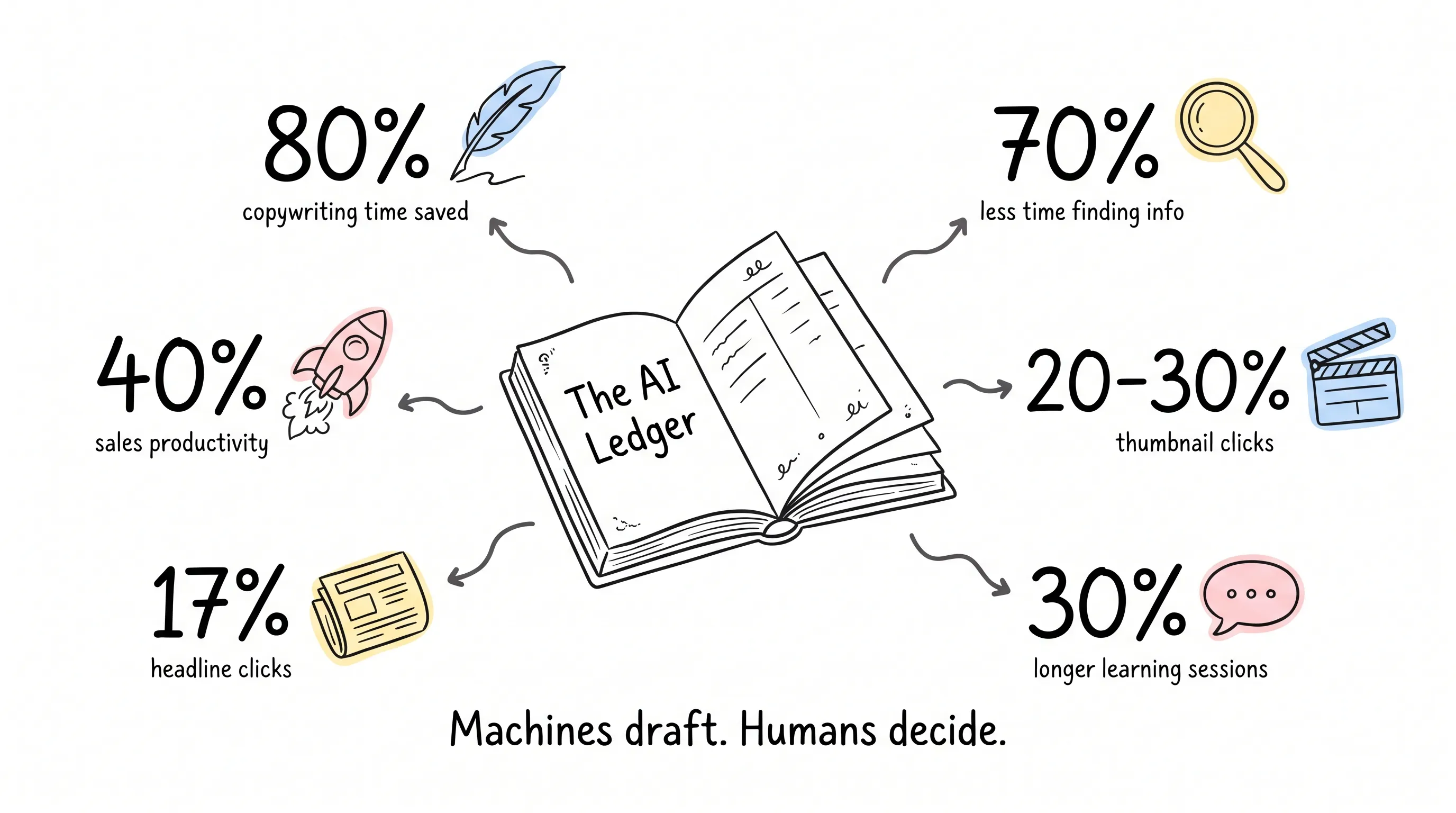
Twelve Stories, One Picture
After going through all the cases, I sat down and thought about it — these three paths are really one picture.
First, AI has to be embedded in the workflow, not bolted on. Shopify's store owners, Canva's designers, Netflix's operations folks — not one of them ever sets out to "go use AI." AI simply lives in the interface where they already work every day.
Second, humans stay on the field, machines never take the final call. The work that went up on Coca-Cola's screens, The New York Times' headlines, Stitch Fix's styling notes — in every case, a human had the final sign-off.
Third, the deeper your data reserves, the harder you can swing with AI. Adobe trains on its own copyright library, Netflix picks thumbnails from decades of viewing history, Stitch Fix teaches AI the voice of its historical styling notes. Public models are available to everyone; proprietary data is your moat.
AI produces ten options; a human picks one. That act of choosing is the new expertise.
So, back to my friend's question: where should a small seller start?
My answer is simple: pick the most tedious, most repetitive task in your work, find an AI that's embedded in the tool you already use, and start by saving time. Don't set out to disrupt anybody on day one.
Bank the 80% in time savings first. Then we can talk about the rest.
Here's hoping you soon turn AI into that tireless assistant — instead of a buzzword you keep dropping into conversation.
Continue reading
Related articles
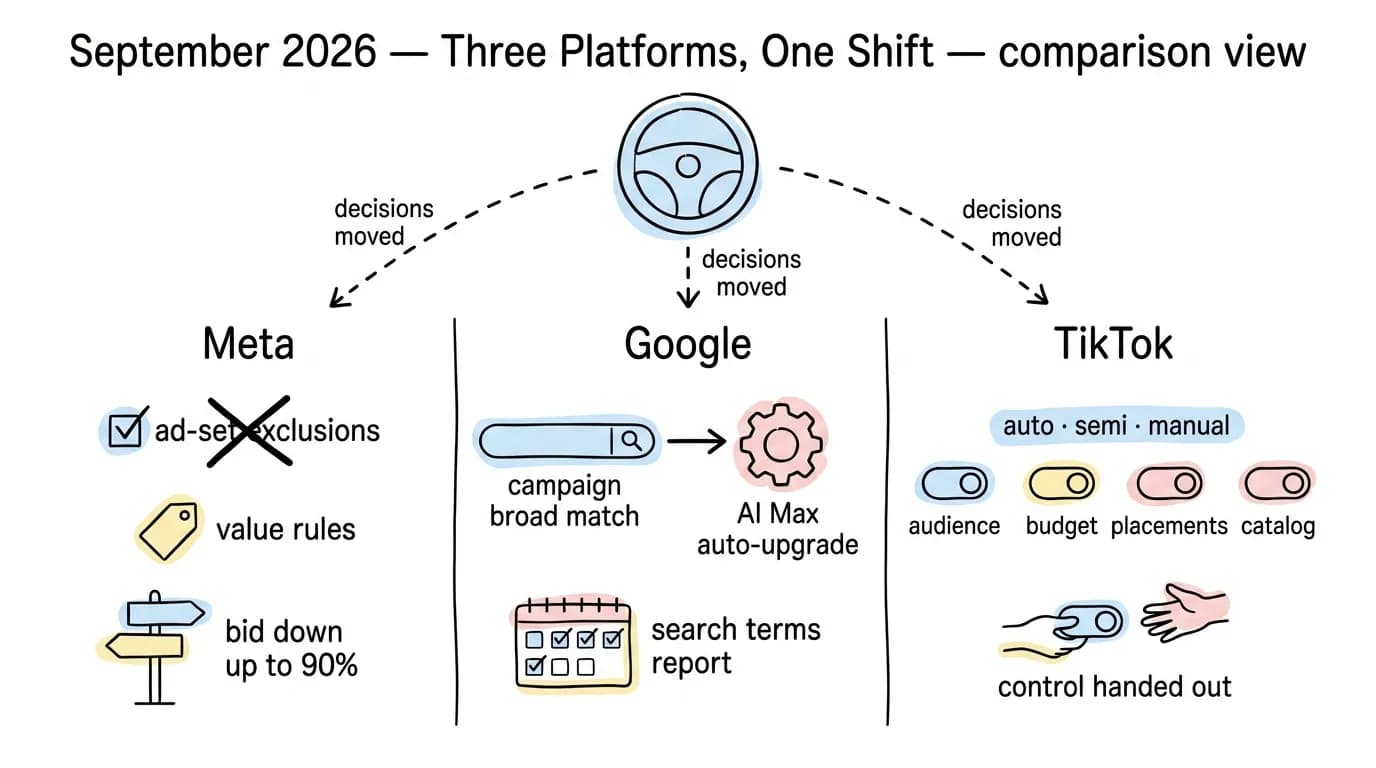
In September, Three Platforms Took Away Part of Your Steering Wheel
A few days ago, I went through everything the three big ad platforms did in September 2026. And I noticed a remarkably interesting coincidence.
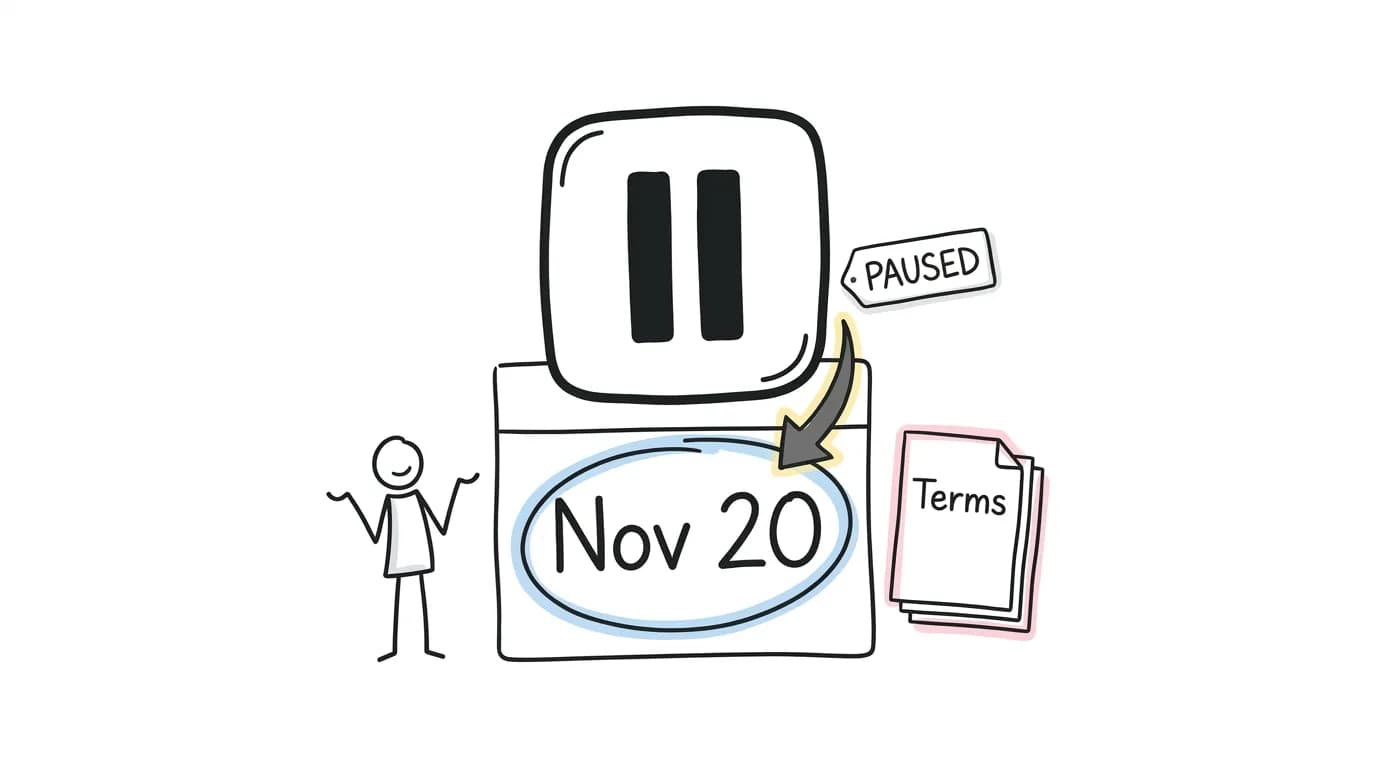
Meta's New Terms Hit the Pause Button on the Eve of the Effective Date
A while back, I was helping a friend of mine who runs a cross-border e-commerce business go through the compliance checklist for his ad account.
Google and Meta changed 17 ad rules this week. 6 of them need checking today.
A few days ago, I was helping a friend who runs a cross-border e-commerce business go through his ad accounts.