
The Sense of Proportion in Personalization: When AI Powers Customer Experience, Overdoing It Is the Biggest Risk
A learn article on AI-powered personalized customer experience: intelligent routing, context-aware service, and proactive support; why thicker customer archives fail, where the sense of proportion protects trust, and how to measure success by outcomes rather than customized touches.
A few days ago, I sat with a friend while he called to complain about his broadband. His connection had been cutting in and out for nearly a month, and this time he was determined to get some answers.
And how did it go? He got shuffled through three departments, recited his phone number three times, and told the story of the fault three times. By the third telling, he said: before I even got my first word out, I could predict exactly what the person on the line was about to ask next.
After he hung up, he asked me: they have every one of my records on file — so why does every call feel like we're meeting for the first time?
I kept turning that question over afterwards. Because behind it sits a single issue: personalized customer experience.
What is personalized customer experience? Put simply, it's using AI to take what you already know about a customer — who they are, why they're contacting you, what they've been through, where they are right now — and apply it to this service interaction, so the customer never has to start over.
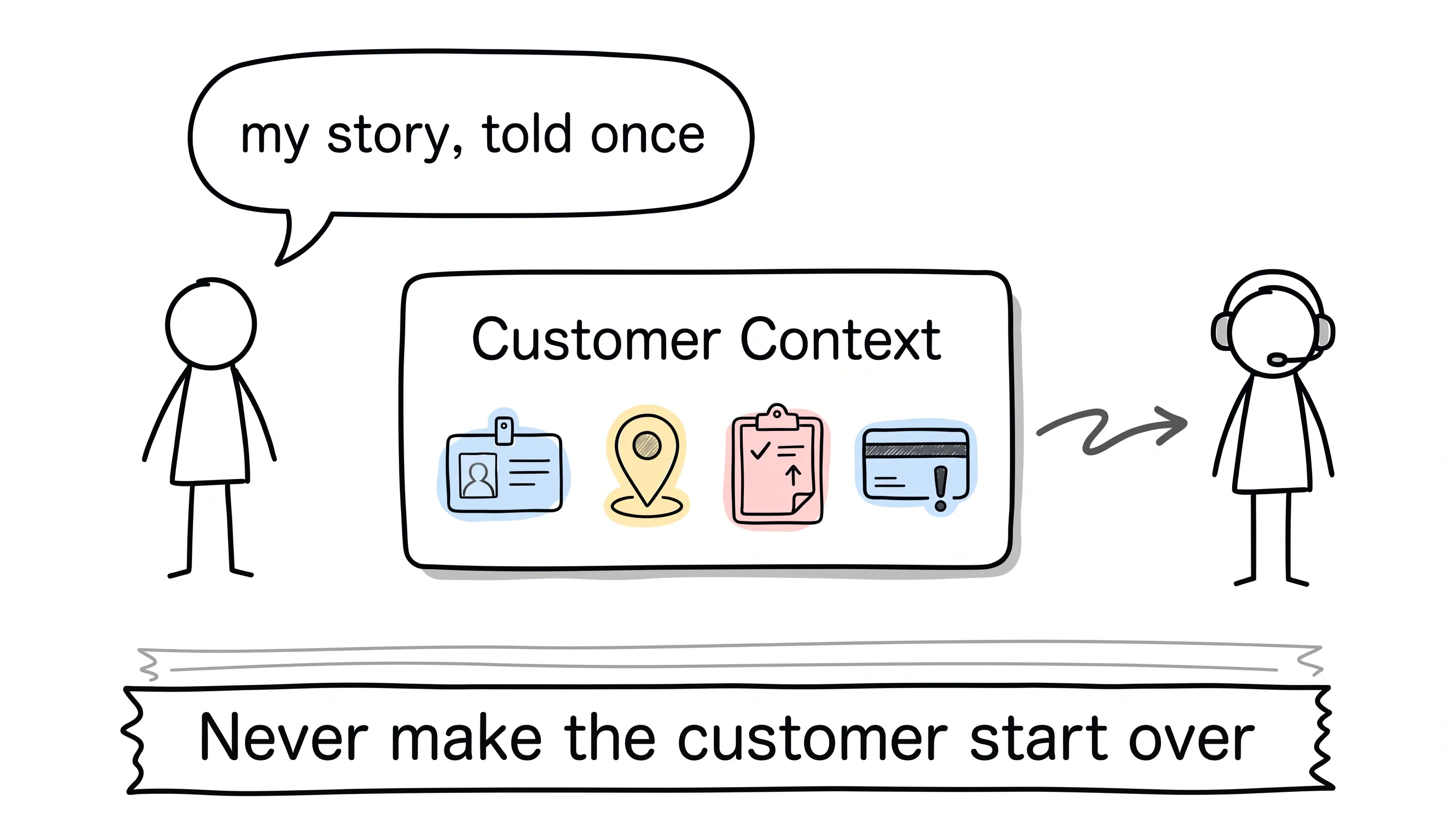
Note the premise there: you already know.
The data is sitting right there in your CRM, perfectly comfortable. But storing it and using it are two different things.
Which step is it most needed at? Think it through.
When a customer calls in, the system first reads their intent: is this a repair request or a general inquiry, and should they be moved up the queue or can they wait? This is called intelligent routing.
When a customer opens self-service, the answers they see should start from their own situation — not a one-size-fits-all manual.
On the agent's screen, the system suggests the next step directly: this issue is a common one, these tickets are related, and the customer's last phone call never actually got resolved.
Some things you don't even have to wait for the customer to bring up. A payment fails, and the system flags it proactively — solution in hand.
And then the two most basic things: whatever channel and language the customer is used to, let them stay right there.
Then there's what's known as context-aware escalation: when the system realizes it can't handle something itself, it hands the entire matter — together with all its context — to a specialist who can.
Notice that none of these sound magical. But every one of them, done properly, saves the customer a little effort.
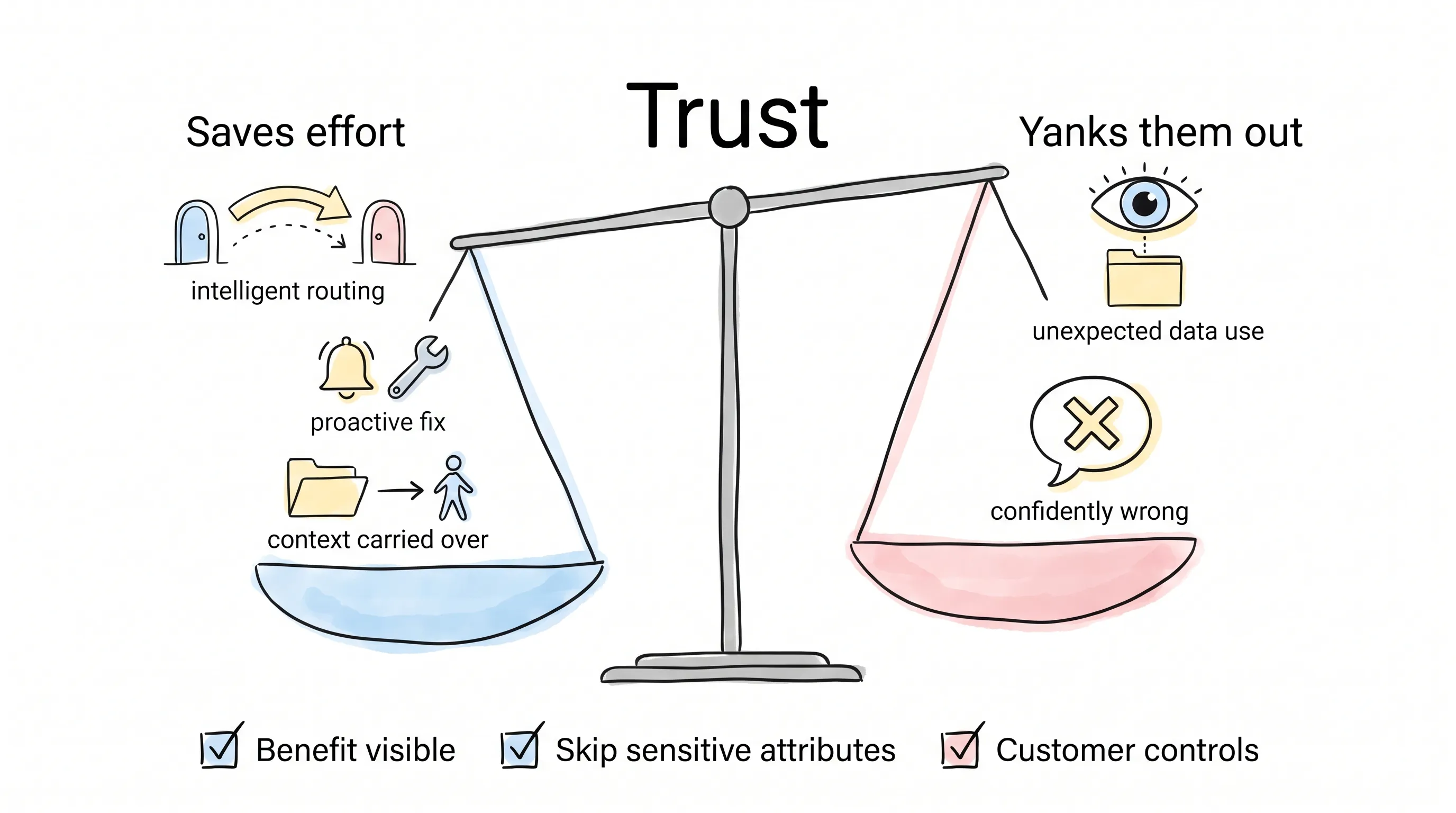
Good personalization saves the customer effort; bad personalization yanks them out of the experience.
So why do so many companies still get it wrong?
I've seen a common ailment again and again — I call it archive addiction.
The thinking at many companies goes like this: make the customer profile as thick as possible, then expect the system to leaf through it while serving the customer.
But the reality is exactly the opposite. Ten years of customer history doesn't mean those ten years have anything to do with today's call. The most important signal in today's call might be nothing more than a failed payment, a ticket that's still open, or a brand-new need the customer has just voiced.
It's like an old friend who knows you inside out: even they wouldn't drag you into reliving last year's trip while you're lying there with a fever.
Which data you use matters, too. Use it only within the scope relevant to the service goal, and only within what policy, authorization, and regulation allow.
One more thing. Many companies are holding sensitive information tightly in their hands — whether to use it is a question of restraint.
So, can't a rules engine do the job? Why insist on AI?
The old approach — rule-based segmentation, like "high-value customers take the VIP lane" — isn't useless. It has its merits: rules are written by people, explainable, controllable, and they work well when the situation is stable.
But customer intent and behavior are rarely stable. No matter how many rules you write, they were all written yesterday. Where does AI excel? It can combine far more signals into one picture, and adjust dynamically.
The cost? It demands more monitoring, more governance. If nobody is watching, it can drift off course and you'd never even know.
Now, on to the part I most want to talk about.
A sense of proportion in personalization.
When personalization goes wrong, what customers lose is trust.
When does it go wrong? Two ways. One: the company uses data the customer never expected to be used. Two: the system guesses wrong — and guesses with total confidence.
Picture the scene: the system greets you warmly by your full name, recommends something you have absolutely no need for, and the reasoning behind it is spectacularly wrong. That isn't thoughtfulness. That's creepy.
So there are three bottom lines: make the benefit clearly visible to the customer; steer clear of unnecessary sensitive attributes; and put the preference controls in the customer's hands.
And one thing I especially want to say:
Personalization exists to help customers get things done — not to show off how much data you've collected.
So what does a company that's serious about personalization need to have in hand?
I've counted them up; roughly, these are the pieces: reliable customer identity and context; CRM and journey data with clear permission boundaries; real-time intent signals; a governed knowledge base; workflows that can stitch systems together end to end; plus the business rules for eligibility, suppression, and escalation.
The last one is the most easily overlooked: analytics. Every personalization action needs to be reconciled against outcomes — otherwise you'll never know whether the investment was worth it.
By the way, NICE has built this entire stack into a single unified platform called CXone. Channels, data, end-to-end workflows, and enterprise knowledge live in one place, with domain AI underneath trained on vast amounts of customer service data. The philosophy matches everything above: personalization isn't a single-point feature; it's an end-to-end chain.
Finally, how do you judge whether personalization is actually done right?
Don't count how many experiences you've customized. Look at outcomes: task completion rate, resolution rate, customer effort score, conversion, retention. Compared against what? Against meaningful baselines.
And one more thing many companies never think of: watch for whether some group of customers consistently ends up with worse outcomes.
And one plain, simple standard: a personalization experience that's more attention-grabbing but less accurate is not an improvement.
As I write this, I think back to that complaint call.
What he wanted, really, wasn't much: give his phone number once, tell the story once, and have someone on the other end who could take it from there.
AI can do that today. Whether it gets done comes down to whether you've put the customer's "right now" into your system.
And here's hoping your next support call only needs your story told once.
Continue reading
Related articles

What Is an AI Marketing Agent? From "Using AI" to "Delegating to AI"
A learn article explaining what an AI marketing agent is, how it differs from rule-based automation, and which repetitive tasks such as lead qualification, reporting, and campaign monitoring can be delegated while humans keep key decisions.

Marketing Automation Is Shifting from "You Do It" to "You Say It"
This article explains how marketing automation is shifting from rule-based platforms that merely execute toward AI agents that plan, create, publish, and review campaigns, covering delegable tasks, underlying technologies, tool categories, adoption steps, and risks such as privacy and automating without strategy.

When AI Does the Creative, Mistakes Come in Batches Too
A learn article on the risks of using generative AI for marketing creative across brand, legal, compliance, and operational layers, with case examples and seven practices for review, rights clearance, documentation, and vendor governance.