
When Enterprises Buy a Marketing Automation Platform, the Most Common Mistake Is Starting with the Software
A learn article on enterprise marketing automation: it explains why software bought without an in-house team sits idle, outlines a needs-first selection framework, compares platforms like HubSpot, Klaviyo, and Zapier, and stresses that configuration and people determine success.
A while back, a friend of mine who works in enterprise services sent me a message in the middle of the night.
Last year, his company had rolled out a marketing automation platform with a yearly budget running into the millions. I asked: how's it working out?
He went quiet for a long time. Then, one line: "The login screen looks beautiful."
I laughed. Once I stopped laughing, though, I realized how typical this story is. So today, let's unpack it.
What is marketing automation?
Put simply, it means handing over to a system the repetitive, rule-based marketing actions — sending emails, following up on leads, tagging customers, reaching people across channels. Think of it as a company's central nervous system: it connects customer data scattered across the CRM, email, and social media, weaves it into one complete journey, and then runs on its own.
Sounds great, right? Enterprise needs are even more complex: dozens of stores, thousands of touchpoints, personalization required without diluting the brand. At that scale, a system genuinely can carry a lot of the load.
But.
What software can't solve is everything that happens after you buy it.
The industry has a name for this: the "implementation gap." What does it mean? The software has been purchased, features come in abundance, but there's no technically capable team inside the company to configure and manage it — so most of those features just lie dormant on a server.
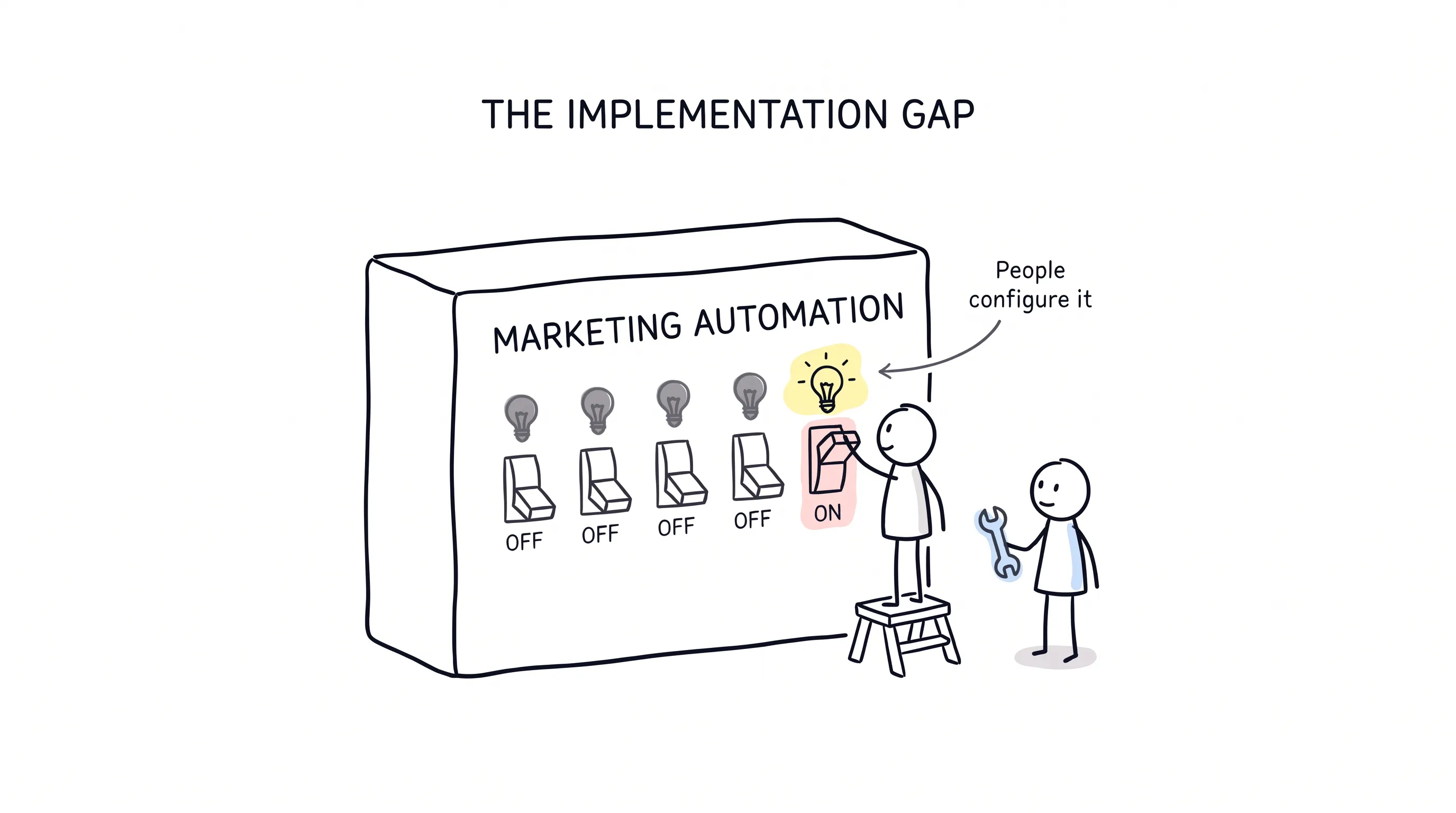
My friend is a textbook case. The problem wasn't the platform; it was that he treated software as a buy-it-and-done consumer purchase.
How do you avoid it? I recently studied how InnoVision Marketing Group, a San Diego marketing agency, approaches this, and found it illuminating. When they handle platform selection for enterprise clients, they hold firmly to two principles.
First: ask about needs before talking software.
Internally they use a selection framework called UREEL. Five letters, five steps: Understand — first figure out where the client's business is actually stuck; Research — investigate whether a tool can address that bottleneck; Educate — make sure decision-makers truly understand the system; Experience — run it on a small scale and let real data do the talking; Learn — review the results and iterate.
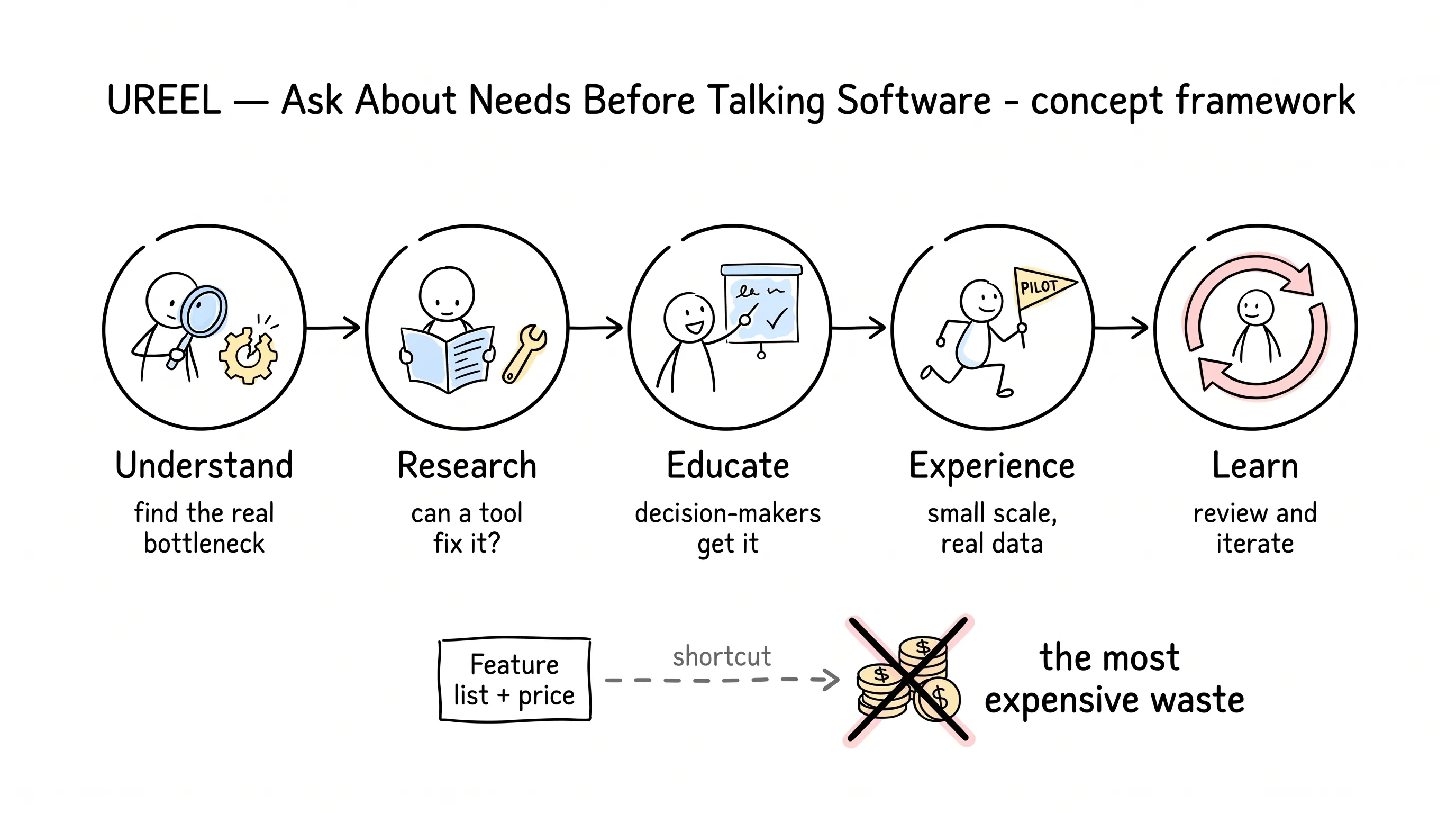
Why not just draw up a feature list and compare prices? Because paying for features is the most expensive form of waste. However complete the toolbox, if it can't solve a specific operational bottleneck, the money is wasted.
Second: your data must be managed by your own people.
InnoVision's model is interesting: they call themselves an "anti-agency™" — all technical configuration is done in-house, nothing outsourced. The reasoning is straightforward. An outsourced team doesn't understand your brand; misconfigure one trigger, and what goes out is a stream of automated messages that sound nothing like a human being wrote them. And with all your data in your own hands, that's practically a baseline requirement for privacy-sensitive industries like legal and healthcare.
The model has a side benefit: technical staff aren't billed by the hour, so the company doesn't pay for a consultant's learning curve. One side note — when you calculate platform costs, don't look only at the subscription price; the hidden costs of troubleshooting and integration downstream are the bigger chunk. Many enterprises save on subscriptions and lose where they can't see it.
So when it comes to actual selection, where exactly do the platforms differ?
Here's a rough breakdown by use case.
HubSpot Marketing Hub is the all-rounder. CRM, lead management, AI-assisted campaign building — all under one roof. Its biggest value is pulling sales and marketing data into one line; what large companies find most exasperating is these two teams operating in their own silos. It suits large enterprises that want "all-in-one."
ActiveCampaign specializes in AI triggers. It handles complex customer-experience automation workflows in fine detail, and the pricing is relatively friendly — a cost-effective choice for mid-sized companies.
Klaviyo is purpose-built for e-commerce. For the high-frequency transaction data of retail brands, it has dedicated trigger logic — who bought what, when to push what — and it reacts extremely fast.
GoHighLevel is built for speed. Lead generation and SMS marketing workflows run through it at a blistering pace. But to use it at enterprise level, someone has to assemble its capabilities to enterprise scale — InnoVision went so far as to create a dedicated division called Convert to do exactly that.
And there's Zapier — strictly speaking not a platform but glue. It wires together hundreds, even thousands, of apps. Zapier published a report on marketing automation software in 2026, and it, too, lays out the value of that connective layer.
One-line summary: Decide first whether you want "all-in-one" or "specialized," then talk brands.
Having covered how to choose, let's talk about how to fail. Enterprise automation fails in only a handful of ways, from what I've seen.
First: faking it with generic templates. Templates are convenient, but they sand away a brand's distinctive voice layer by layer, until the messages customers receive sound like they came off a call-center assembly line.
Second: subscription stacking. A pile of overlapping tools all renewing at once, with nobody able to say which one does what — that's how technical debt accumulates.
Third: outsourced configuration. Every time a third party revises a workflow, the data gains one more silo, until nobody dares touch the legacy system.
Fourth: multi-location brands without a unified data source. Dozens of stores each keeping their own records — the customer experience is bound to be a patchwork.
There's an even stealthier category: bilingual markets. When InnoVision entered the Spanish-language market, it built a dedicated brand, InnoVision Español, hammering on one message — literal translation is not localization. A Spanish sentence can be correct word by word and awkward sentence by sentence; Latino users can spot at a glance that "this was written for 'them,' not for us." Automated systems execute quickly, but get the culture wrong by one step, and they amplify the mistake just as quickly.
On multi-location expansion, InnoVision has cited the restaurant chain Huey Magoo's: you can't scale nationwide on software alone; what does it is a unified brand narrative plus region-by-region automated execution, backed by their CRM (Automated Sales Machine) tracking the complete customer journey. Stores operate dispersed; reporting is viewed centrally. Among their clients is a special category — tribal governments and casinos — which must additionally walk the compliance line, where player loyalty and legal boundaries are two things you can't afford to lose.
At this point, let's get back to my friend.
He did one thing: instead of switching software, he first assigned a two-person team inside the company to manage the platform full time, lighting up the idle features one by one. Within a quarter, leads generated by automated workflows more than doubled.
Software was never the answer; the people who configure it are.
Before choosing a platform, run yourself through those five UREEL steps first. If you can't answer them, don't swipe the budget card yet.
May every system you buy actually get used.
Continue reading
Related articles

What Is an AI Marketing Agent? From "Using AI" to "Delegating to AI"
A learn article explaining what an AI marketing agent is, how it differs from rule-based automation, and which repetitive tasks such as lead qualification, reporting, and campaign monitoring can be delegated while humans keep key decisions.

Marketing Automation Is Shifting from "You Do It" to "You Say It"
This article explains how marketing automation is shifting from rule-based platforms that merely execute toward AI agents that plan, create, publish, and review campaigns, covering delegable tasks, underlying technologies, tool categories, adoption steps, and risks such as privacy and automating without strategy.

When AI Does the Creative, Mistakes Come in Batches Too
A learn article on the risks of using generative AI for marketing creative across brand, legal, compliance, and operational layers, with case examples and seven practices for review, rights clearance, documentation, and vendor governance.