
Search Is Still Here. The Clicks Are Gone: Brands Have a New Discipline to Master, and It's Called GEO
A learn article introducing GEO (Generative Engine Optimization): how AI answer summaries change search and clicking behavior, why brand mentions in AI answers matter, how GEO differs from SEO, and monitoring and content practices brands can adopt.
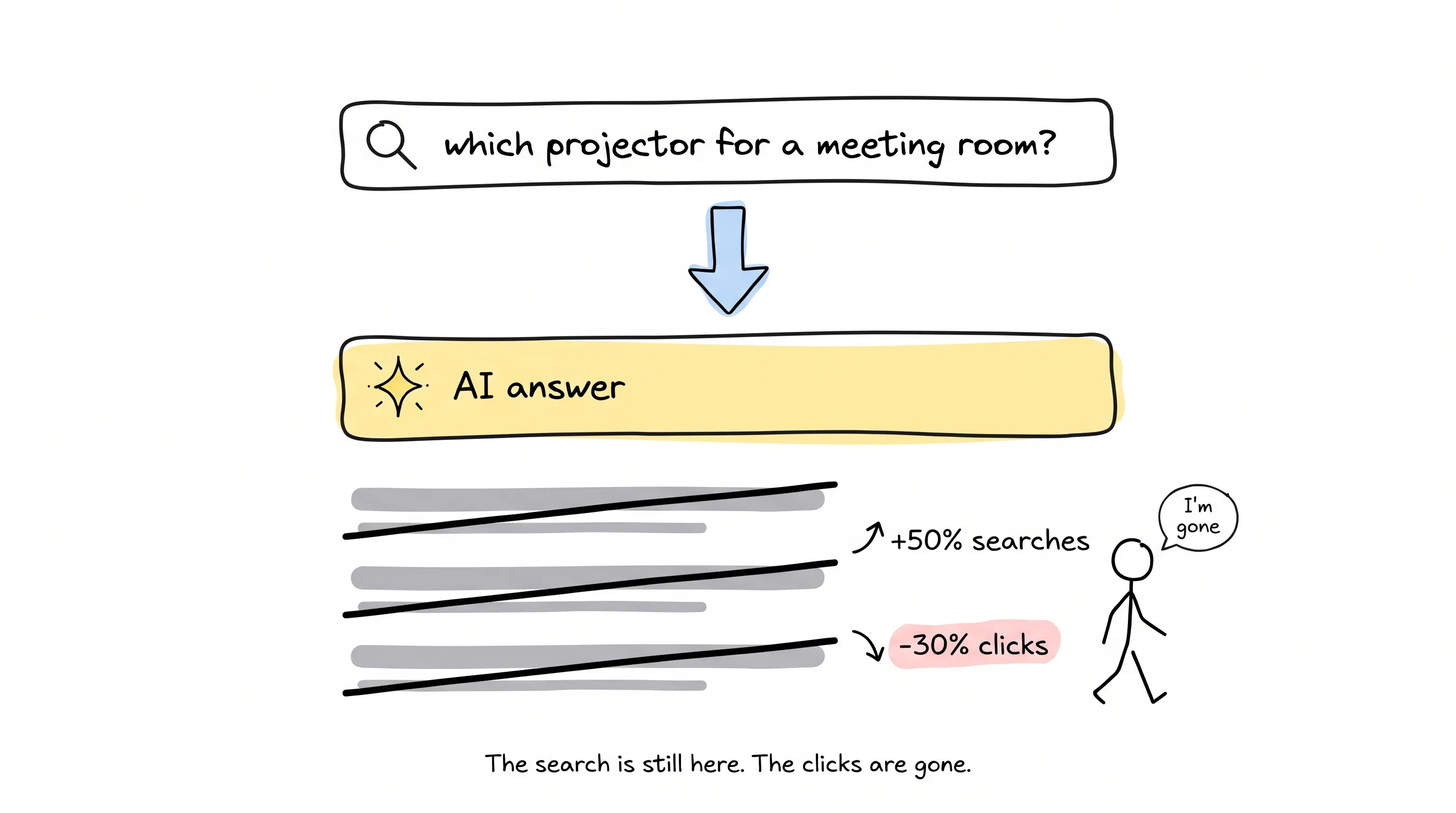
The other day I asked a friend for help: check which projector would suit a meeting room. Ten minutes later he came back with a message — comparisons, a conclusion, all in one. I asked where he'd looked it up. He said, I just searched; the AI summed up the answer for me, and I didn't click a single one of the links underneath.
It stopped me cold for a second.
Have you noticed that this is how you search now too? You type in the question, scan the AI summary at the top, and most of the time, that's all it takes — you're gone.
What does that mean?
It means that in that one search, some brands "existed," and some brands were never mentioned at all. And what decides who gets mentioned is a new discipline called GEO.
So what is GEO?
GEO, Generative Engine Optimization. Put simply, it means figuring out how to get your brand's content into the answer summaries generated by AI engines like ChatGPT, Google Gemini, Bing AI, Perplexity, and Claude — and as high up as possible.
Why has this suddenly become so important?
Two reasons.
First, AI summaries are becoming the entry point through which people learn about a brand. These summaries weave together authoritative sources from across the web and tell you the answer in plain language. Multiple studies in 2025 show that roughly 30 to 50 percent of search results now open with an AI summary, and the trend shows no sign of stopping.
Second, and more unforgiving: being mentioned in an AI summary is being endorsed. The summary tells you in a confident voice which ones deserve attention, and your brand gets written into the user's mind. If you're not mentioned, then in that search, you simply don't exist.
Being absent from the AI's answer is worse than being buried on page two of search results.
Traffic Didn't Grow — People Just Stopped Clicking You
You might think: more people are searching, so traffic has to rise eventually?
Exactly the opposite.
BrightEdge, an AI search optimization platform, published a study in May 2025: in the year after AI summaries launched, Google's search volume grew by nearly 50 percent, but clicks to websites across the whole web fell by 30 percent overall.
More searches. Fewer clicks. Where did the business go?
Another set of estimates hits even harder: for searches that produce an AI summary, 50 to 60 percent of users finish right there with the summary and never click a single link. The search is still there. The clicks are gone.
What's more interesting is that the act of searching itself has changed.
In May 2024, Google's AI summaries went live to the public. BrightEdge's data traced a steep curve: since then, the number of keywords people use per search, how colloquial their phrasing is, and how complex their questions are have all risen noticeably.
People used to search "projector recommendation." Now they search "a meeting room for fifteen people, bright daylight during the day, budget under 20,000 yuan — which projector won't need the curtains drawn."
The more specific the question, the more granular the material the AI needs to answer it. Where does it look? On the official websites of the various brands, for content that is clear enough, current enough, and authoritative enough. If your website doesn't have those details, the AI can only speak on someone else's behalf.
Your Website Needs Six New Things — and They're at War with Each Other
So how should a website change? A checklist circulating online says, in essence, to add six things: clearer expression, more bullet-point lists, more summaries, more conversational writing, more thorough background context, more long-tail keywords.
You might laugh when you read it: these six pull against each other.
Bullet-point lists mean fewer words — say it in three lines. Conversational writing and background context mean more words — take your time and build it out. One side tells you to cut, the other tells you to add. That is the real difficulty of doing GEO today: two things pulling in opposite directions, and you have to do both well.
But don't panic — SEO isn't obsolete.
Google's EEAT standards — Experience, Expertise, Authoritativeness, Trustworthiness — still decide how your pages rank, and they're still what the AI weighs when deciding whether to cite you.
It's just that the weighting has changed.
It used to be that how people came to know you depended mostly on what your own website said. Now, everywhere on the web that talks about you adds to your "authority": blogger reviews, forum discussions, short videos users shot themselves, whitepapers, review-site comments, posts on social media — even content behind paywalls gets crawled by the AI and factored in. The fresher the content, the more it counts.
TikTok, Reddit, YouTube, all kinds of review sites — they have all become your proving grounds.
Which brings us to the most fundamental difference between GEO and SEO:
With SEO, you hold the pen. With GEO, everyone else does.
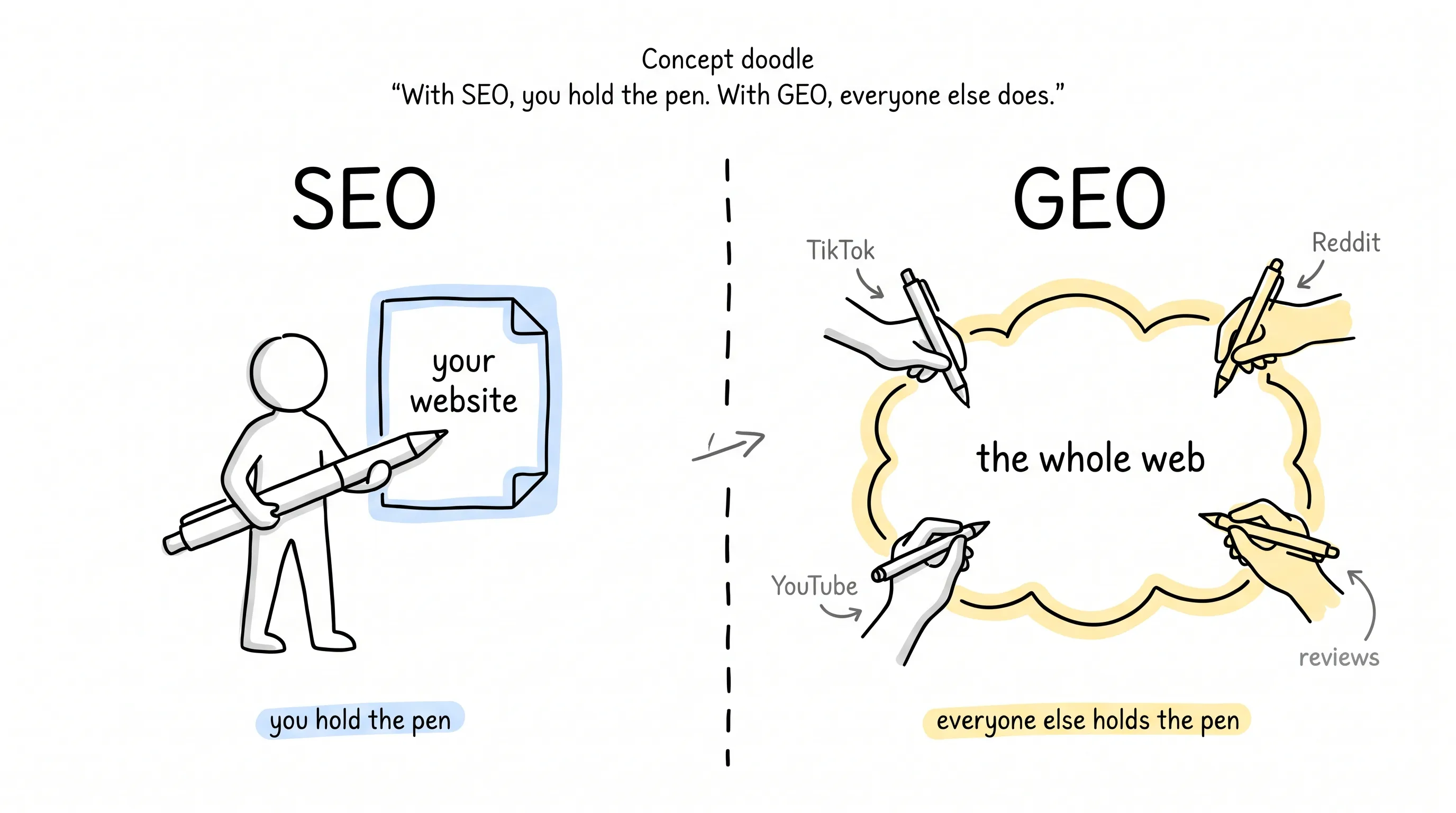
Doing SEO means changing your own website — the pen is in your hand. Doing GEO means changing what the whole world says — the pen is in everyone else's hand.
Let Me Run the Numbers for You — Three of Them
So how hard is it, really? Let me do three quick calculations.
The first: odds of exposure. In traditional search, squeezing onto the first page gives you a chance. Far fewer brands get mentioned in an AI summary than fit on a first page, especially for searches with transactional intent. According to Wordstream, when users search "what to buy"-type queries, the AI summary has only a 10 percent chance of mentioning any brand at all.
The second: winner takes all. In research published in May 2025, the marketing platform Ahrefs found a brutal pattern: the brand with the most mentions across the web can earn 10 times the AI-summary exposure of an ordinary brand. And a large share of AI summaries don't mention a single brand.
The strong get stronger. That's the table as it stands.
The third: you can't buy your way in. In traditional search, you could bid on a competitor's brand keywords and intercept their traffic. In AI summaries, that path is welded shut — there is no competitor-keyword bidding option.
So what can a brand do?
At least two things. One is monitoring: Moz assigns brands a brand authority score from 1 to 100, and you can watch how it moves; tools such as SEMrush, Profound, and Otterly.ai can tell you in which kinds of questions the AI will mention you, and how many times. The other is to lay down content the honest way: make your website more detailed and more conversational, and whatever coverage, user content, and multimedia material you can earn off-site, produce as much as you can — and keep it fresh.
You Think You're Just Staying Silent
The checklist is not hard to write. The doing is hard.
For a mature brand with a healthy budget, this is a matter of hiring a few more people. For a team of three or five, building a product and building content at the same time, it is a homework assignment they can barely turn in.
Of course, you can choose not to do it yet. Just think it through: when your customers, your resellers, and your potential hires all start asking AI — and the AI's answer doesn't include you — you think you're just staying silent, but you've already made your exit from their world.
Back to the projector story at the start. Three brands came up in the AI's summary, and my friend remembered them. What he ended up buying was one of them.
The brand that wasn't mentioned may never know at which exact step it lost.
May your brand always be in the answer.
Continue reading
Related articles

It's 2026: Stop "Buying" AI Tools for Your Marketing Team — Start "Hiring" AI Agents
This learn article explains how AI agents differ from standalone AI tools in marketing, outlines three agent categories — build-your-own platforms, CRM-native agents, and vertical tools — and covers use cases across SEO, social media, advertising, and reporting, plus criteria for choosing one.

What Is GEO? How Your Brand Gets "Mentioned" in the Age of AI Search
An explainer on GEO (Generative Engine Optimization) for e-commerce and DTC brands: how it differs from SEO and AEO, why AI answers shape brand visibility, and eight practices covering question-focused content, consistent brand messaging, structured pages, external evidence, comparisons, and AI mention tracking.

AI Is Already Making Decisions for Your Customers. Are You on the List?
A learn article explains GEO (Generative Engine Optimization): why AI-generated answers now shape which brands customers see, and how SEO fundamentals, entity clarity, citable evidence, and monthly measurement affect visibility in AI answers.