
AI Marketing Is No Longer Optional
A bilingual learn article introducing what AI marketing is, a five-question framework for choosing tools, and a seven-step adoption path, with a focus on how search visibility splits into classic SEO and generative engine optimization for AI answers.
A while back, I had dinner with an old friend who works in marketing. His team of about twenty people had bought more than a dozen AI tools over the course of this year.
I assumed he wanted to show off his haul. Instead, he sighed: the tools kept piling up, and the work kept getting messier. Plenty of money spent, nothing anyone could account for.
I told him: you're not alone.
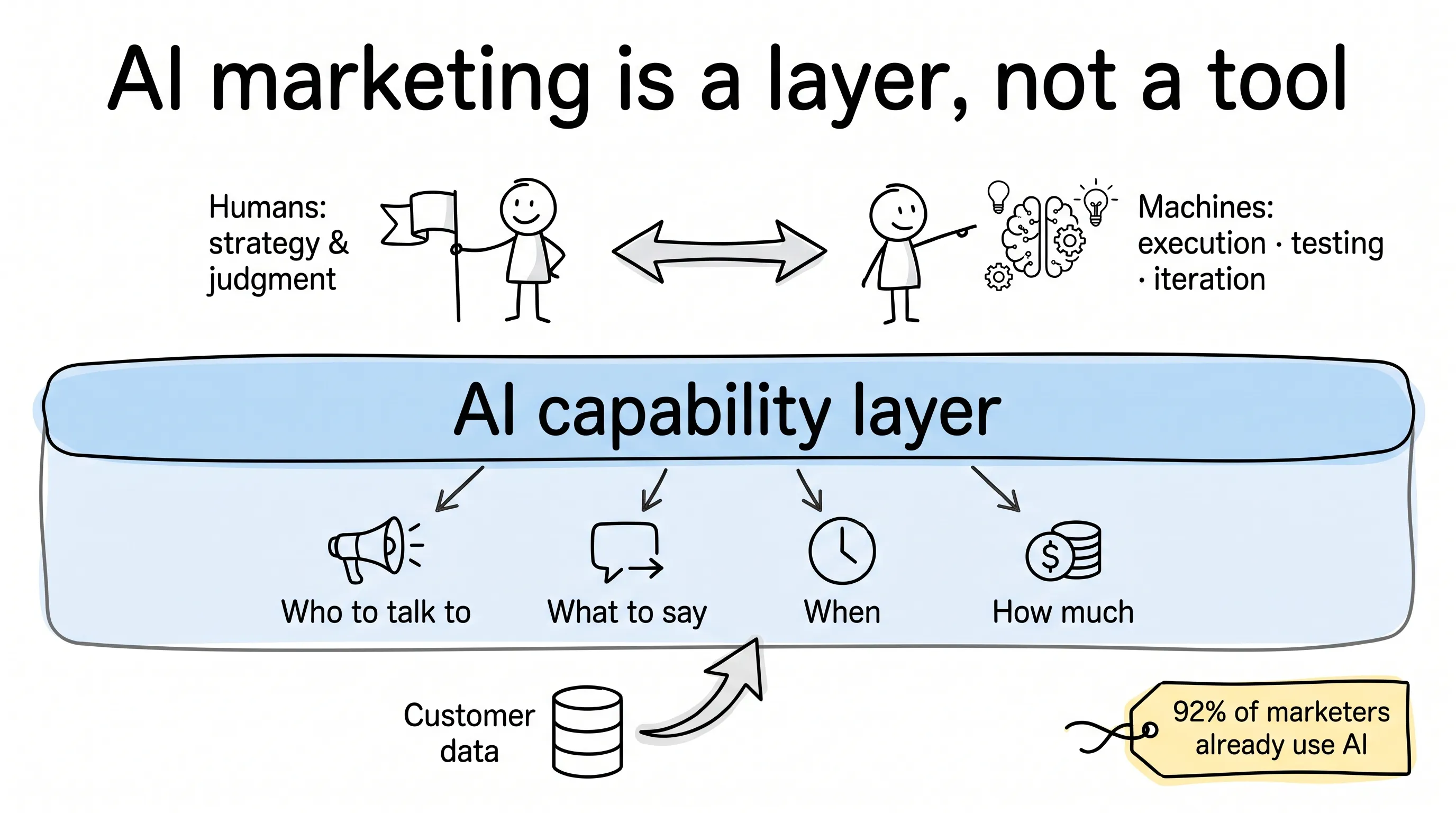
A 2025 survey by SAP Emarsys put it bluntly: 92% of marketers are already using AI in their daily work. That's right — everyone is using it.
If everyone is using it, why do so many teams still spend money they can't account for?
Today, let's unpack this once and for all.
What Is AI Marketing?
So what is AI marketing?
Put simply: humans set the strategy and make the judgment calls; machines handle execution, testing, and iteration.
Break it down, and three core capabilities do the work.
Machine learning finds patterns in your customer data and predicts who will buy and who will churn. Natural language processing and large language models can both read and write human language — analyzing reviews, classifying intent, drafting copy, all of it runs on them. Generative AI takes a brief and directly produces copy, images, or video.
Going a level deeper, there is predictive analytics, which computes next-best actions, customer lifetime value, and optimal send times; and computer vision, which handles product tagging, visual search, and asset analysis.
But you don't need to memorize any of that. Just remember one thing:
AI marketing is not a tool; it is a layer of capability. It sits across your entire marketing system and turns your own customer data into concrete decisions: who to talk to, what to say, when to say it, and how much to spend saying it.
How does traditional marketing work? You run campaigns by quarter, segment audiences by hand, and read reports at month-end, looking back at what happened last month.
How does AI marketing work? It runs in real time. Segments shift dynamically, and feedback comes back instantly.
That is the difference. A structural difference, not a software swap.
The Math on Tools, Done Right
Why was my friend in chaos? Because he mistook "buying tools" for "using AI."
Every year, a marketing technology observer called Chiefmartec counts the tools on the market. In 2024, roughly 1,200 of them had AI. By 2026, more than 3,800.
Two years, three times over.
Think about what that means: in almost every niche, dozens of tools are shouting "pick me." It also means that most teams are holding far more AI capability than they can actually put to use.
And what is the surplus? Cost, risk, and features nobody knows how to use, sitting idle.
The gap between adoption and results is where the money disappears.
Pick the wrong tool, skip the data foundation, or automate a process that was already broken, and AI will simply help you produce mistakes faster.
What Work Does AI Do for You?
So where does AI marketing actually make money?
Let me walk you through a few scenarios that are already proven.
-
Content production. Multiple 2026 surveys converge on the same number: about 80% of marketing teams using AI put writing content first. AI produces first drafts, variations, and localized versions in minutes. The real value is not just speed — it lets you run test volumes you could never afford before.
-
Personalization. Research from HubSpot and McKinsey points to the same conclusion: with a solid data foundation, AI-driven personalization delivers double-digit revenue lifts while pushing customer acquisition costs down.
-
Predictive scoring. Models rank leads by conversion probability, so sales calls the most worthwhile leads first and ad spend goes where deals are most likely to close. In B2B this is already standard practice.
-
Conversational lead capture. A chatbot staffs the front desk around the clock, answers questions, books meetings, hands hot leads to a human immediately — and it speaks several languages.
-
Programmatic advertising. Bidding, budget allocation, audience targeting, creative combinations — all tuned in real time. Even OpenAI itself is researching how to rebuild the advertising layer with AI. You can feel the whole playbook of advertising being rewritten.
How do you start? My advice is blunt:
Don't roll everything out at once. Pick one high-leverage scenario, run it end to end, get the evidence, then expand.
Choosing Tools: Ask Five Questions
When it comes to selection, how do you choose?
Don't read the feature lists. Feature lists only end with you buying five things that overlap.
Ask five questions:
One: Does it fit your data? Can it run on your own first-party data? And the data it touches — who does it ultimately belong to?
Two: Does it connect? Will it plug directly into your CRM, CDP (customer data platform), and analytics stack, or will you have to write piles of glue code?
Three: Is it controllable? Can its output be tuned to your brand? Can a human step in at any moment?
Four: Is it compliant? Where does the data go, and does it meet the rules where you operate?
Five: Can it be attributed? Does it bring results, or only "activity"?
Once those five are answered, one more fork: buy, or build?
For standard jobs like scheduling and transcription, buy. For processes that touch core competitive advantage and proprietary data, build it yourself, or build it with a partner. Most companies land on a hybrid answer: buy at the edges, build at the core.
Remember one sentence: if you can't articulate what results a tool brings, it isn't a capability — it is cost and risk.
The Next Step Up: Agents
The fastest-moving line in AI marketing in 2026 is agents.
What is an agent?
With a generative tool, you tell it to write, it writes a passage, then waits for your next instruction. An agent is different. You give it a goal — say, "fill the registrations for this webinar" — and it goes off to research, write content, schedule, launch, watch the numbers, and adjust in real time, pushing through one step after another. Only when something needs human judgment does it come knock on your door.
Its anatomy is nothing mysterious: a large model for thinking, a set of tools and interfaces for doing, a stretch of memory for holding context, and a set of guardrails as the safety net.
So the marketer's job is changing: from operating software to directing a system. What you need to practice is briefing agents, watching results, and ruling on judgment calls.
And something quieter is happening too.
Your customers are using AI as well. More and more buyers are letting AI do their research, screen vendors, and draw up shortlists. So a new homework assignment has appeared: organize your website, your data, and your product information into a form machines can read. Whether your structured data is clean, whether your parameters are machine-readable, whether your logic is clear — these directly decide whether AI puts you on that shortlist.
Some in the industry call this "optimizing for agents." The name doesn't matter. What matters is this: your next buyer may be a program.
Search Is Splitting Into Two Games
This is the part I most want you to remember.
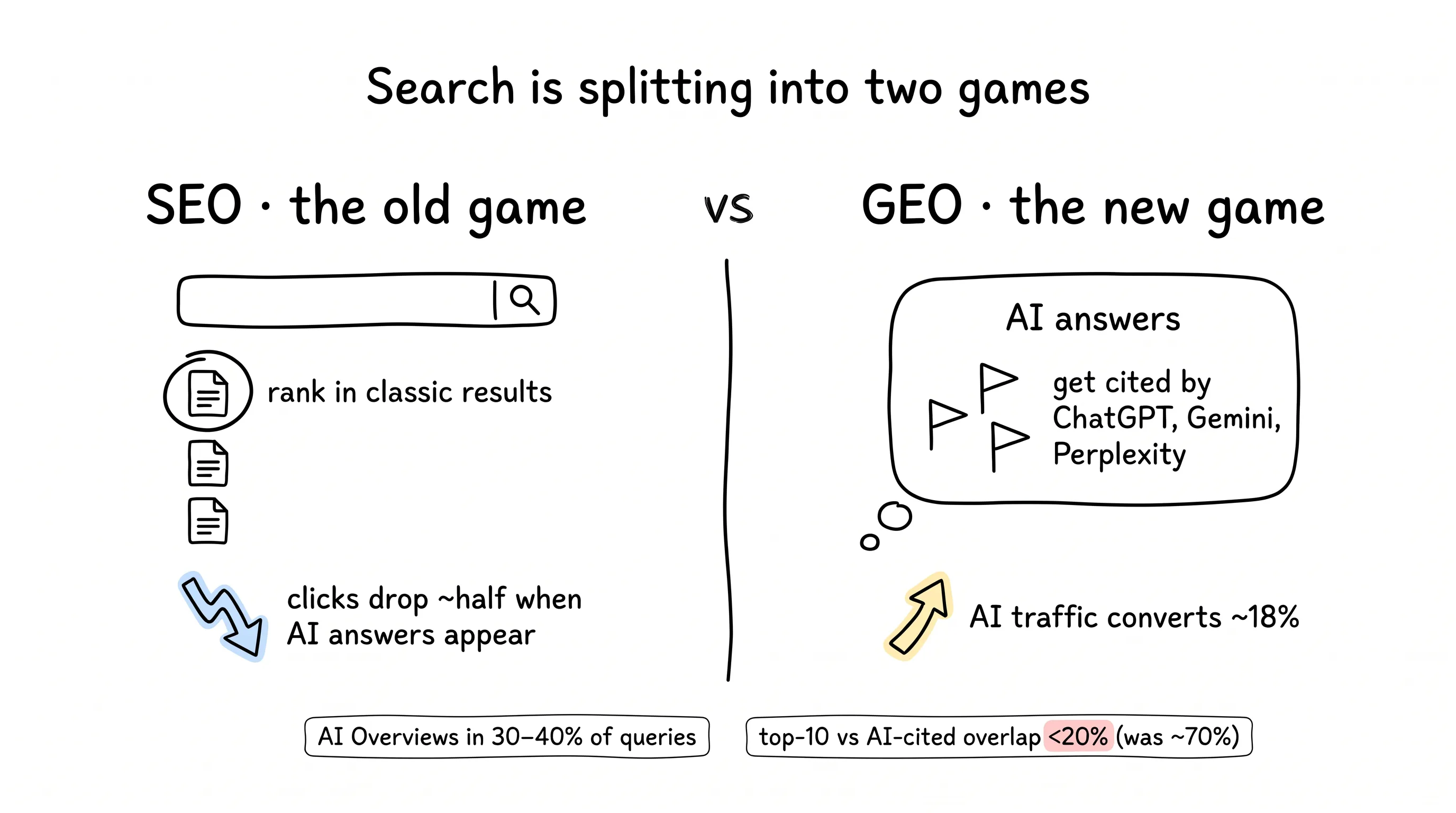
Gartner predicts that by the end of 2026, traditional search volume will drop by about a quarter. Google's own AI Overviews already appear in roughly 30% to 40% of queries. Pew Research found that once an AI summary appears at the top of the page, the probability of a user clicking a link drops by roughly half.
Where did the traffic go? Into the AI's answers.
So visibility is now two things.
One is the old-school SEO — ranking in classic search results. The other is GEO, generative engine optimization — getting your brand cited, mentioned, and recommended in the answers from ChatGPT, Gemini, Perplexity, and AI Overviews.
Some will ask: I rank well on Google — isn't it natural that AI cites me?
Quite the opposite. A 2026 analysis matched Google's top 10 results against the pages AI actually cited: the overlap was under 20%. Before, that number was around 70%.
In other words, the pages that rank high on Google and the pages that get cited by AI are nearly two different worlds now. These are two jobs, and they have to be done separately.
Is the traffic AI sends worth chasing? You might be tempted to say AI referral traffic is only about 1% of the whole web — set it aside for now.
Let's do the math.
Search Engine Land covered a study that ran 13 months: traffic referred by AI converts at about 18%. Adobe looked at US retail during the 2025 holiday season: AI-referred traffic converted about 31% higher than other channels. And about 31% of US users have already started using generative AI for search.
Small volume, extremely high intent. Users arrive carrying a question, and the AI has already done a round of screening for them.
How do you measure this new channel? The old scoreboard is no longer enough. There are three new metrics: how often you get cited, your mention rate inside AI answers, and the conversion of AI-referred traffic. These metrics are still young — treat them as a direction for now, not a precision instrument.
But the direction itself is clear: start GEO today. Brands already being cited by AI are building a lead that latecomers will find very hard to chase down.
Seven Steps to Land It — Skip None
OK, the theory is done. When it comes time to act, what do you actually do?
In order. Seven steps total.
-
Take inventory. List all your existing workflows, data, channels, and the steps that eat the most manpower. The most time-consuming tasks are your first automation targets.
-
Pour the foundation. AI's ceiling is the ceiling of your first-party data. Integrate your customer data, repair its quality, and assign ownership first; talk about models afterward.
-
Pick scenarios. Score candidate scenarios on value and difficulty; start with the high-leverage, low-risk one, and win there first.
-
Choose tools. Filter with the five questions above. Build the core, buy the edges.
-
Set the rules. Which decisions can AI make on its own, which must have human review, who signs off on brand voice, whether safety and compliance checks sit inside the process or after it. All of this gets decided in advance.
-
Set a baseline. Before you change anything, save the "before" numbers. Otherwise you will never be able to say how much you improved. Look at outcomes, not activity.
-
Then scale. Once one scenario works end to end, turn it into a template, hook up the next process, and grow toward a standing system.
Which step gets skipped most often? Step 2 and Step 5. And those two are exactly why most AI projects fall apart.
Day to day, how do you judge whether a task should go to AI? Three cases:
Repetitive and low-judgment: fully automated. High-volume but brand-facing: AI drafts, humans make the call. Strategic and high-risk: humans lead, AI advises.
Slow down and lay the foundation first, and it pays you back as years of compound interest. That deal is worth taking.
Do the Math Honestly
Finally, money and risk.
HubSpot reported a number: among marketing leaders who invested in AI, 75% are already seeing positive returns, and only 4% are negative. The direction is good.
But keep a wary eye on the pretty numbers circulating online. Take that "300% return" copied across dozens of blogs — go look for the original research. You won't find it.
So what do you do? Trust one ledger only: your own before-and-after. Save a baseline before you start, move as few variables as possible — ideally only AI itself — and track outcome metrics like revenue, acquisition cost, and conversion rate, rather than counting how many pieces of content you produced.
A gain you can't attribute is not your gain.
The risks? Here are the five most common.
Models will fabricate facts with a straight face, so every customer-facing output must pass human review. AI output nobody governs drifts off-brand — and it drifts at scale. Where does customer data go, and do the tools comply with GDPR, the UAE's PDPL, and rules like them — that has to be clarified. When training data is biased, models can unfairly target certain groups. And automating a bad process means scaling the mistakes too.
Regulation is tightening as well. The EU AI Act phases in from 2026 to 2027, and data rules elsewhere are following suit. Building governance now is far cheaper than reworking everything afterward.
The teams that truly use AI well are not the boldest ones. They are the ones who draw the guardrails clearly, then run flat-out inside them.
So, Will Marketers Be Replaced?
Every time this comes up, someone asks: is AI going to wipe out marketers?
No.
What AI replaces is the manual production and the back-and-forth coordination. What it cannot replace is strategy, taste, and judgment.
The role is changing: from the person operating the tools to the person directing the system. Marketers who learn to brief AI, supervise AI, and govern AI produce several times more than everyone else. Those who never learn are the ones who will truly be squeezed out.
A Harvard analysis of how AI is reshaping marketing reaches the same conclusion: the judgment stays in human hands.
Back to That Dinner
After that dinner, I told my friend: your problem is not that you bought too few tools — it is that the foundation hasn't been laid.
He actually went back and did one thing: got the customer data integrated properly, picked one scenario and ran it through, then expanded to the next one three months later. A while back he told me his team headcount hadn't changed, but output had multiplied several times over.
AI marketing isn't as hard as it sounds. Be clear about what you want AI to do for you, set up the data and the rules first, win with one scenario, then do the accounting honestly.
Think it through first, then buy tools. Get the order backwards, and everything you buy is noise.
And here is my wish for you: be the one who directs the system — not the one the system directs.
Continue reading
Related articles

It's 2026: Stop "Buying" AI Tools for Your Marketing Team — Start "Hiring" AI Agents
This learn article explains how AI agents differ from standalone AI tools in marketing, outlines three agent categories — build-your-own platforms, CRM-native agents, and vertical tools — and covers use cases across SEO, social media, advertising, and reporting, plus criteria for choosing one.

What Is GEO? How Your Brand Gets "Mentioned" in the Age of AI Search
An explainer on GEO (Generative Engine Optimization) for e-commerce and DTC brands: how it differs from SEO and AEO, why AI answers shape brand visibility, and eight practices covering question-focused content, consistent brand messaging, structured pages, external evidence, comparisons, and AI mention tracking.

AI Is Already Making Decisions for Your Customers. Are You on the List?
A learn article explains GEO (Generative Engine Optimization): why AI-generated answers now shape which brands customers see, and how SEO fundamentals, entity clarity, citable evidence, and monthly measurement affect visibility in AI answers.