
AI Is Already Making Decisions for Users — Is Your Brand in Its Answers?
A learn article introducing GEO (Generative Engine Optimization): why brands need to appear in AI-generated answers, how GEO relates to SEO, and a seven-layer playbook covering technical foundations, brand mentions, multi-platform presence, prompt testing, content structure, and AI visibility tracking.
A few days ago, I wanted to get a teleprompter for my studio. I didn't open a search engine — I went straight to ChatGPT: what are the good teleprompters in 2026?
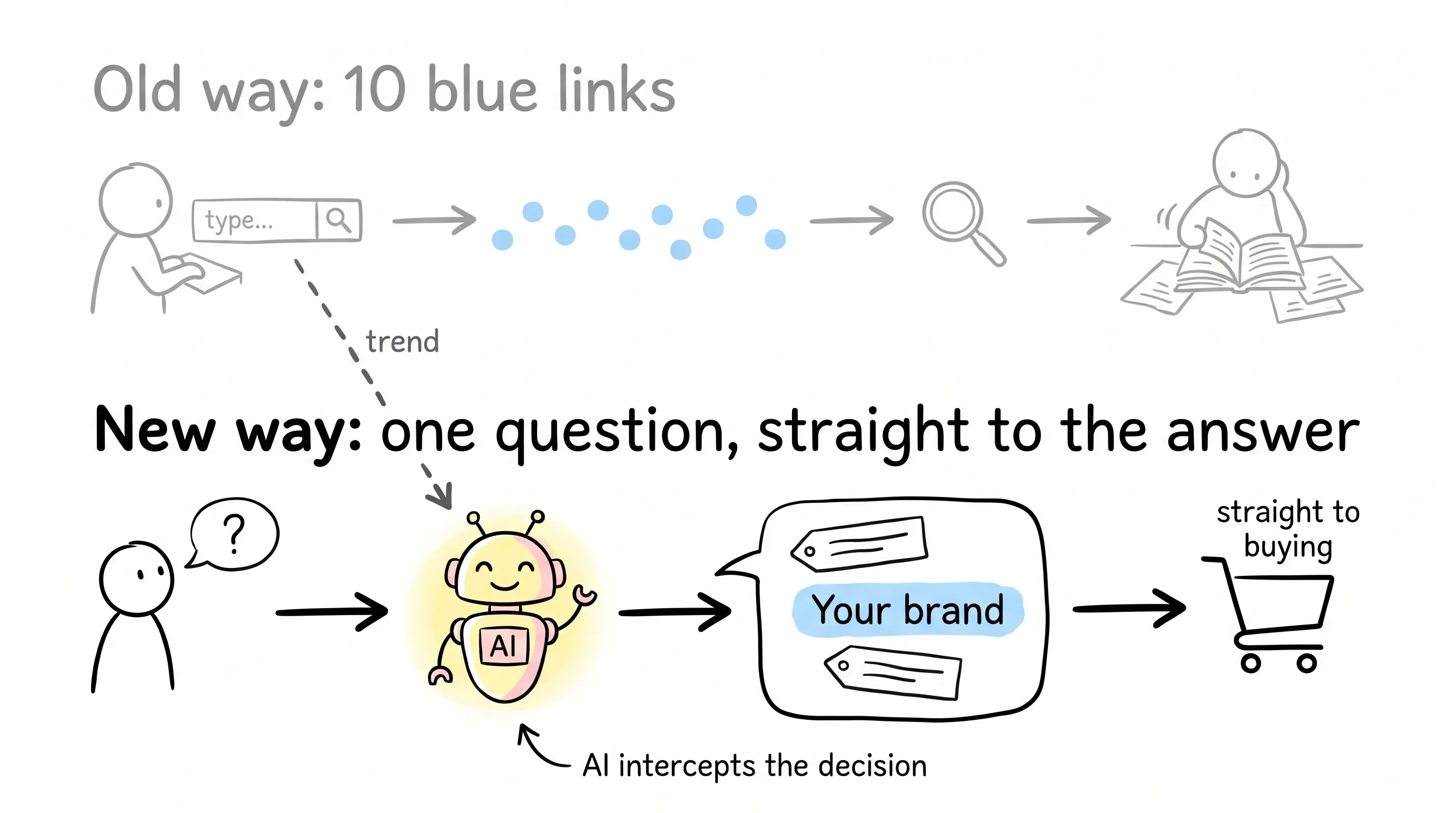
It didn't dump ten pages of blue links on me.
It just named a few brands. One of them, BIGVU, not only got called out by name — its official website was flagged as the source of the answer.
Wow.
In that moment it suddenly hit me: AI had intercepted the user's decision process.
Before, a person had to search, compare, click in, and read slowly. Now, they ask one question, the AI answers, and they go straight to buying.
Think about it: if your brand isn't in that answer at all, you don't even qualify to be in the race.
Today we're going to talk about one thing: how to get AI to mention you when it answers users.
This playbook has a name: GEO (Generative Engine Optimization).
First, Look at Some Numbers
A lot of people are still hesitating: is this wave of AI search all thunder and no rain?
Let's do the math.
ChatGPT. Launched in November 2022, it picked up 1 million users in its first month. Three months later, 30 million. By February 2026, 900 million weekly active users. At the time, it was the fastest app in history to reach 100 million users — bar none.
Google's AI Overviews. The marketing platform Semrush tracked a data set in 2025: at the start of the year, only about 6.5% of searches triggered them; by the end of the year, that had risen to 16%. Every month, the answers to billions of searches get summarized by AI and served straight to users.
Shopping. A survey in late 2025 showed that nearly one-third of American consumers have already started using conversational AI to help them buy things. Among people under 45, that number is 41%.
There's an even bolder projection: Semrush estimates that by the end of 2027, traffic from AI platforms will overtake traditional Google search.
You might say Google is still my biggest traffic source, and will remain so in the short term. Correct. But trends — by the time you see one with your own eyes, it's usually already too late.
The window of opportunity is visible right now.
What Exactly Is GEO?
Put simply, GEO does one thing: it makes AI systems able to find you, understand you, and trust you — and then mention you in their answers.
Break it apart and you get three moves.
One, publish where AI is most likely to dig around.
Two, build up enough positive mentions across the web — with or without links, they all count.
Three, make sure the technical door is wide open, so AI crawlers can get in and read your pages.
Notice a fundamental change. Traditional search hands a list of links to the user, and you fight for ranking. AI search? It scrapes material from all over the web and assembles an answer itself. In that answer, your brand may get named outright, or flagged as a cited source.
Your optimization target has changed from "ranking at the front" to "showing up in what it's about to say."
How Do GEO and SEO Relate?
You might say: isn't this just SEO in a new disguise?
Honestly, more than half of it really is.
Content quality, crawlability, a good reputation online — the three old standbys of SEO are exactly what AI uses to decide whether to cite you.
So if you've done your SEO solidly over the years, congratulations: you've already won half of GEO.
But the other half, you have to build new.
Because AI processes information differently from Google. How the job itself is changing can be summed up in five lines:
Before, SEO was Google search. Now, it's a multi-front battle across search, AI, and social platforms.
Before, success meant your keywords ranking. Now, it means you're in the answer when a user asks AI.
Before, SEO was a standalone job. Now, it has to be tangled up with brand, PR, product, and social media.
Before, backlinks were the hard currency. Now, brand mentions and co-occurrence are worth just as much.
Before, you watched one KPI: traffic. Now, you watch visibility and conversion across every touchpoint.
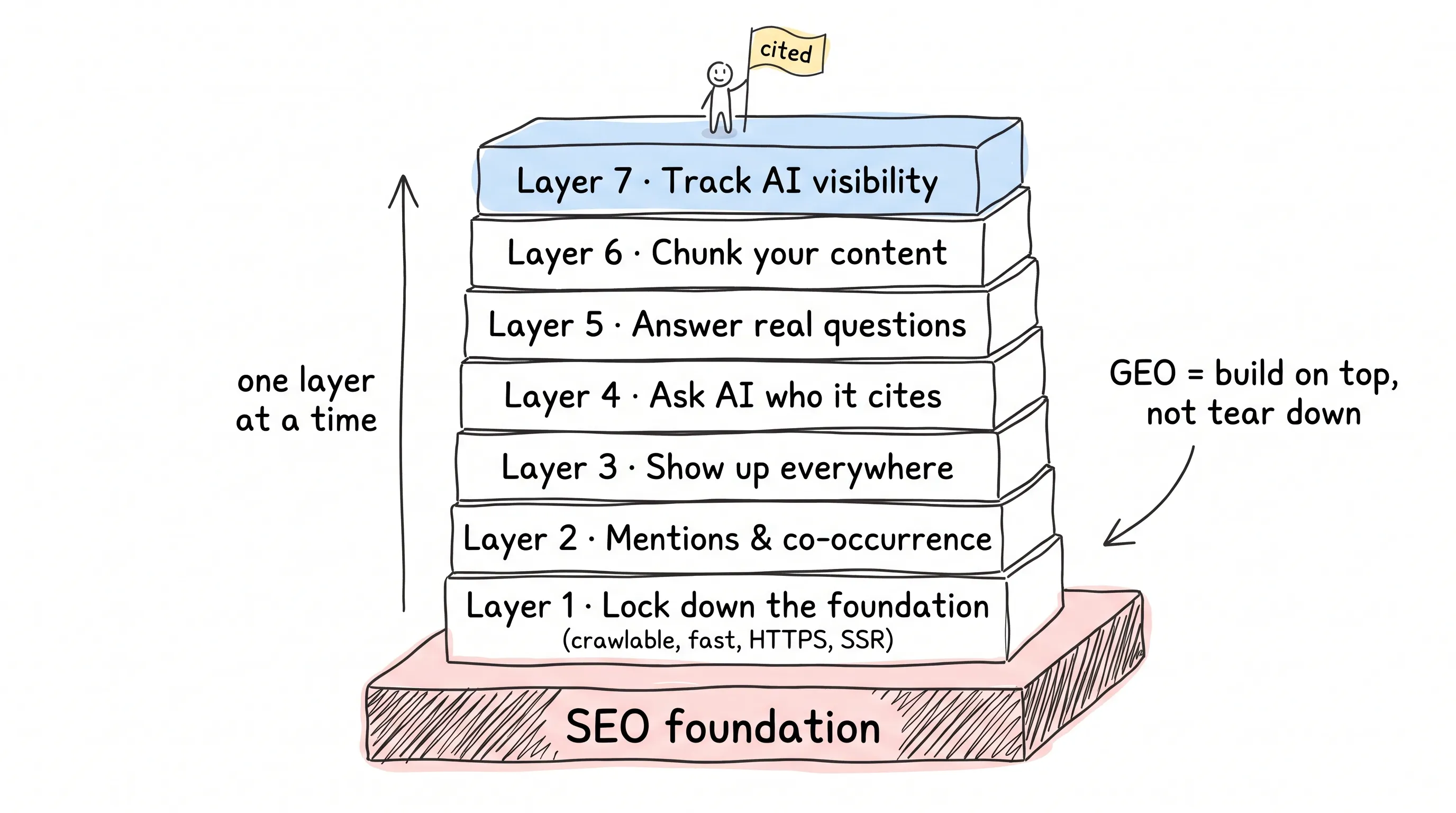
In one sentence: GEO doesn't tear SEO down and rebuild — it adds a new story on top of the old foundation.
You've already laid that foundation. How do you build the floors above? One layer at a time.
Layer 1: Lock Down the Foundation
Before AI can cite you, it has to be able to read you.
Four things — go run a check on your website.
Can it be crawled and indexed normally? If AI can't read your pages, everything after this point is wasted effort.
Is it fast? Does it even load on mobile?
Is HTTPS on? That's the baseline, not a bonus point.
Are key pages server-side rendered? Some AI crawlers can't chew through pages that lean heavily on JavaScript; server-side rendering is the safest bet.
Then, make AI find you credible.
There's a ready-made lens for this called E-E-A-T: Experience, Expertise, Authoritativeness, Trust. In practice: show real results and real user experiences; write only about what you genuinely understand, and go deep; pursue citations and commissions from well-known sites; publish real author bios, label your information sources, and put user reviews out in the open.
One thing to clarify: nobody has said these AI platforms run on any specific scoring system. But these signals make you look more credible. Credible things are easier to cite.
Layer 2: Stack Up Mentions and Co-Occurrence
This layer is the most counterintuitive part of GEO.
AI weighs you not only by how many backlinks you have. It looks at how many places across the web mention you — even when not a single link is attached.
Why? Because AI processes "entities," not web pages. It wants to know: who is this brand? Does it appear steadily and repeatedly online, side by side with certain people, certain topics, certain peers?
An example.
Monday.com, the online project management tool. Across the web, hundreds of articles mention it together with ClickUp and Asana, always in the context of "project management software."
After being mentioned this way a few hundred times, AI has learned: these three play in the same league, and they're all leading players in the category.
It works in reverse too. If unrelated sites like Forbes and Zapier all mention you, AI concludes: this brand is worth citing, and probably legit.
Definitions of "co-citation" still clash a bit from one source to another. Don't get stuck on definitions — just remember three lines.
Whoever you're frequently mentioned with, AI assumes you run with them.
Whatever topics you keep appearing next to, AI assumes that's your trade.
The more different websites mention you, the more credible AI finds you.
How do you actually stack them up?
Go where your competitors show up. When industry media run comparison roundups and listicles, find a way to be on the list.
Take part in industry research. When analysts publish reports, try to get included in the research — the backlink is a free bonus.
Lend real, hands-on help in communities. Answer questions on Reddit, post viewpoints on LinkedIn, contribute in industry forums. AI loves mining these places for "what real users say."
One reminder: don't throw away backlinks. They still work for SEO, and high-quality backlinks often bring high-quality mentions along with them.
Layer 3: Show Up Everywhere
"Don't fixate on Google alone" — SEO veterans have recited that line for years. Now it has turned from advice into a mandatory exam question.
Semrush ran the numbers in January 2026: among the citation sources of ChatGPT, Perplexity, and Google AI Mode, the two domains that appear most often are Reddit and LinkedIn.
Platforms where users produce their own content are AI's gold mines.
So where should you go?
YouTube. People go there specifically to learn how things are done — tutorials, reviews, and tool comparisons are all strong content.
Podcasts. Podcast content, transcripts especially, has already started getting cited by Gemini — a seat that isn't crowded yet.
TikTok and Instagram Reels. Young people already use them as search engines. Answer your industry's common questions with short videos, and AI will sometimes cite them directly.
Reddit. Find the subreddits where your users cluster, answer questions in earnest, and don't push sales. Be useful first; get cited after.
LinkedIn. If you do B2B, start publishing professional viewpoints — AI digs through here when it's looking for expert perspectives.
Multi-platform presence has another benefit: you're not keeping all your eggs in one basket. A single algorithm overhaul or a single wobbly traffic source can't shake you.
Layer 4: Go Ask AI Who It's Citing Right Now
Want to know what content you should make? The fastest way is to ask AI directly.
Open ChatGPT, Claude, and Perplexity, and ask — word for word — the questions you want to be answered with.
Watch three things: who does it mention? Does it mention you? Are platforms like Reddit or YouTube in the sources?
Then, vary the phrasing.
Ask it "what's the best email marketing software," and it mentions MailerLite. Change the question: "I'm a small company — which email marketing tool should I use?" The answer shifts: Mailchimp charges into first place, and three new faces appear — Constant Contact, Brevo, and ActiveCampaign.
Suppose you're MailerLite and want to win small-business customers. You'd have to figure out one thing: why did I vanish the moment the question changed?
Don't dismiss manual testing as dumb. The automated tools on the market (Profound, Peec AI, and others) can run prompts in bulk, but they aren't cheap. At the starting stage, running them by hand is enough.
By the way, this has nothing to do with company size.
If you're a solo consultant, check whether AI is citing platforms like Upwork or Dribbble. If it is, whether you have a profile there directly decides whether you can be seen.
If you run a local restaurant or fix pipes, check whether AI's answers feature those "service plus location" landing pages.
Layer 5: Answer What Users Actually Ask Out Loud
What users ask AI is not the same thing as what they type into Google.
On Google, they type "healthy meal prep ideas" — four words.
Asking AI, they say: "I'm trying to lose weight — what exactly should I eat for dinner?"
The interesting part is that both questions come from the same need. But the answers AI gives and the sources it cites are two entirely different sets.
For the former, the answers are nothing but listicles, single recipes, and videos. For the latter, the sources become forum threads and weight-loss guides, and the answer gives big-picture eating advice rather than a specific recipe.
As more users get used to searching in plain, conversational language, these long, specific questions will multiply.
This is an opportunity. Because most companies aren't making any content that answers questions like these at all.
The more specific the question, the thinner the competition, and the easier it is for you to become the credible answer in AI's eyes.
How to pick topics?
Listen to your customers. The raw, unfiltered questions inside support tickets, sales calls, and user feedback are the best topic library you have.
No customers? Go to Reddit, Quora, and industry forums, and watch what exact words people use to describe their troubles.
You can also use Semrush's Prompt Research tool: type in a topic, and it pulls out the actual prompts users have typed into AI platforms.
Layer 6: Chop Up Your Content and Feed It to AI
AI reads articles differently from people. It breaks content into one "chunk" after another, then judges how the chunks relate to each other.
So structure is your hit rate.
One paragraph, one idea. Put the point at the front; don't bury it in long sentences. By the way, this trick is just as friendly to human readers.
Whatever the heading says, deliver it right below — don't wander off topic. AI uses headings to understand what each section covers; if the goods don't match the label, you're hard to cite.
Break complex processes into numbered steps. When AI needs to explain a solution to a user fast, it loves pulling from exactly this kind of content.
There's another trick validated over and over by research: include quotes, include numbers. One study says pages carrying quotes and statistics are 30% to 40% more visible in AI answers. So don't write "email marketing might be a decent channel" — write "email marketing returns $42 on average for every $1 spent."
Of course, don't chase data for data's sake. Piled-up numbers convince nobody; it's content that genuinely helps the reader that adds hits.
On Schema markup (structured-data code that tells search engines what's on a page), I have to pour some cold water.
Google itself has said: structured data is not a ticket into AI search, and no special Schema guarantees you a spot in AI Overviews. Ahrefs ran a large-scale test: for pages that were already being cited, adding Schema barely moved the citation rate.
So do Schema if it's called for — that's solid SEO fundamentals. But don't expect it to knock open AI's door. What gets cited has always been good content, not good tags.
Layer 7: Keep Watch on Your AI Visibility
The last step, and the easiest one to ignore.
Which brands AI stands behind and which sources it cites will change. It may mention you today and drop you next month. So you have to keep watch.
Start with the manual method: take the same set of questions, ask them regularly on ChatGPT, Claude, Perplexity, and Google AI Mode, screenshot everything, and record who gets cited and whether the tone is praise or criticism.
But honestly, the manual method can't get you reliable conclusions. AI responses are inherently unstable — context within the same session and what you asked earlier both shape the output.
There's a fascinating study. The marketing analytics company SparkToro took 12 prompts and ran them nearly 3,000 times across ChatGPT, Claude, and Google AI Mode. The result: the probability of AI giving the exact same brand recommendation list is under 1%; the probability of a perfectly matching ranking is under one in a thousand.
This means the question "what's my rank in ChatGPT" doesn't even hold up. The right question is: across a big enough sample, how many times did my brand show up?
So don't get greedy. Pick 10 to 20 prompts that best represent how users really ask, run them in rotation across a few platforms on a schedule, and track how your mention rate moves. This directional signal is more solid than any "AI ranking" a tool reports to you.
If you want tooling, try Semrush's AI visibility toolkit, Profound, Peec AI — or Ziptie.dev, still early but with a fresh idea.
How to Pitch This to Your Boss
You might ask: how do I raise this with my boss or a client?
Here's a pitch that won't blow up.
Your SEO investment hasn't been wasted — it's still working.
But the definition of "visible" has changed: it used to be rankings; now it's "being mentioned and trusted inside AI's answers."
GEO isn't a new project — it's a layer added to existing assets.
Starting now costs the least.
Pitched this way, you don't have to start over — and you can still get the budget.
Finally
Back to that teleprompter from the start.
I ended up buying the one the AI recommended. I never once clicked a search result along the way.
That brand didn't crack any algorithm. It just put itself where AI could find it, understand it, and believe in it.
Windows of opportunity never ring a bell.
While everyone is asking "what happens to traffic in the AI era," the person who made AI know them first has already won half the game.
Here's to becoming, sooner rather than later, the name inside AI's answers.
Continue reading
Related articles

It's 2026: Stop "Buying" AI Tools for Your Marketing Team — Start "Hiring" AI Agents
This learn article explains how AI agents differ from standalone AI tools in marketing, outlines three agent categories — build-your-own platforms, CRM-native agents, and vertical tools — and covers use cases across SEO, social media, advertising, and reporting, plus criteria for choosing one.

What Is GEO? How Your Brand Gets "Mentioned" in the Age of AI Search
An explainer on GEO (Generative Engine Optimization) for e-commerce and DTC brands: how it differs from SEO and AEO, why AI answers shape brand visibility, and eight practices covering question-focused content, consistent brand messaging, structured pages, external evidence, comparisons, and AI mention tracking.

AI Is Already Making Decisions for Your Customers. Are You on the List?
A learn article explains GEO (Generative Engine Optimization): why AI-generated answers now shape which brands customers see, and how SEO fundamentals, entity clarity, citable evidence, and monthly measurement affect visibility in AI answers.