
What Can You See When You Lay 58 AI Statistics on the Same Table?
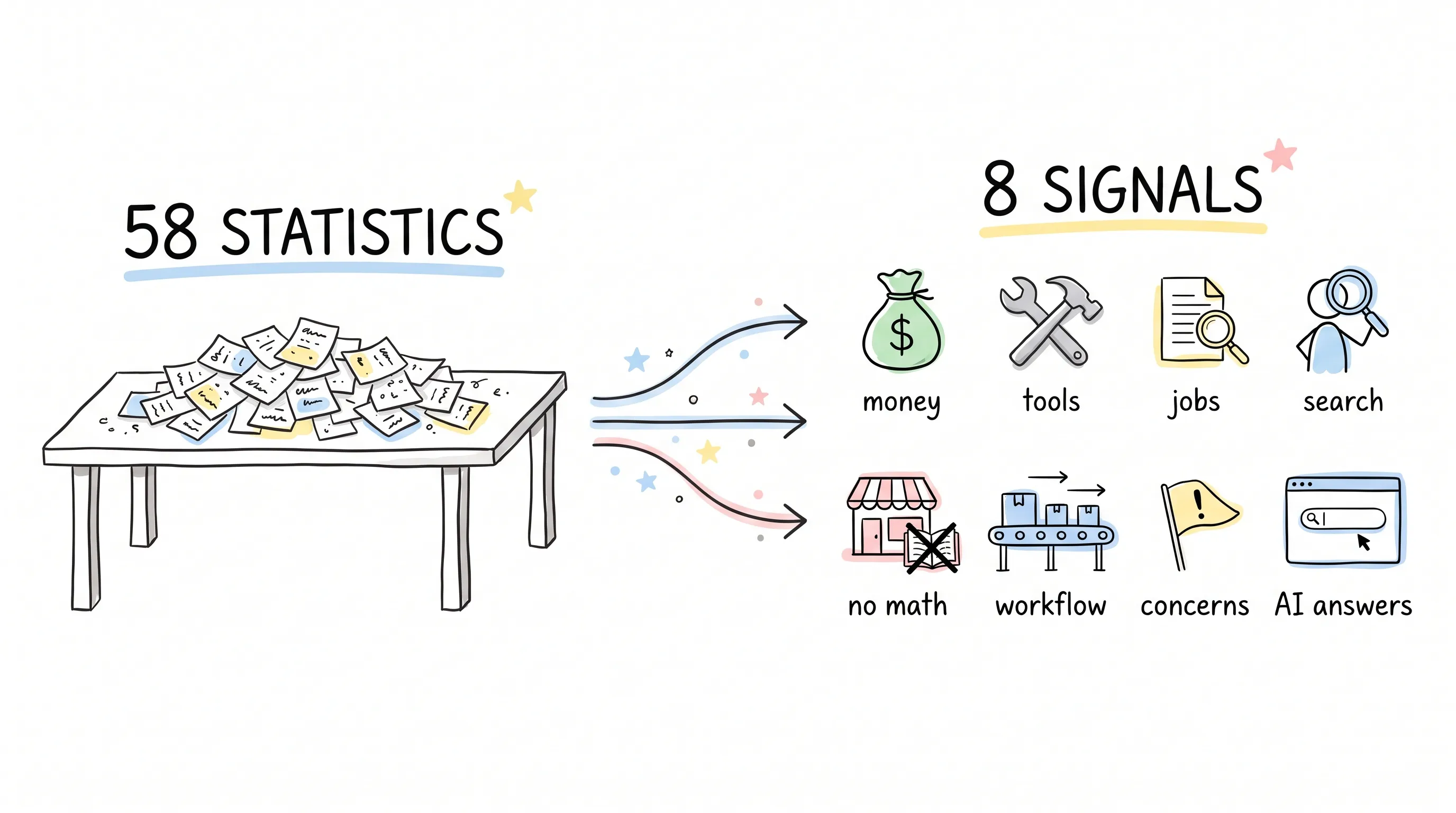
This article reviews Digital Silk's compilation of 58 publicly available generative AI statistics, summarizing eight signals on market growth, tool supply, hiring demand, consumer usage, measurement gaps, workflow adoption, deployment concerns, and AI summaries in search results.
A while back, I was flipping through industry materials when a piece of research stopped me cold.
An agency that specializes in branding and digital marketing, Digital Silk, did something that sounds clumsy but is actually quite clever: it fished out 58 publicly available statistics related to generative AI, one by one, laid them on the same table, and looked at what patterns they might form.
The compilation was published early this year. No lurid predictions, no talk of "disruption" — just a pile of data, paired with a few restrained observations.
But it's precisely this kind of unglamorous legwork that sees things most clearly.
When hype narratives fill the air, data is the most honest witness.
From 58 data points, eight signals emerge. Let me walk through them one by one.
1. The Money Is Still Pouring In
The first signal is about the market.
Different research firms use different estimation methods, but they all point in the same direction: at the current pace of investment and adoption, the generative AI market will keep getting bigger over the next few years.
Think about it: capital doesn't do sentiment. If a sector were all story and no returns, the money would have pulled out long ago. The money is still coming in — which means the math adds up.
2. The Tools Keep Multiplying
The second signal is that the number of usable tools is still climbing.
Creative, technical, operational — new tools are popping up for every kind of use case.
This tells you the number of people testing the waters is still growing. It's not just one or two giants playing around in the lab; teams of every size are experimenting with different tools.
3. A Few Extra Words on the Job Postings
The third signal is the most down-to-earth of all.
In the aggregated data, job descriptions in the United States increasingly mention generative AI skills. Employer demand for this capability hasn't let up.
What does real adoption look like? Not necessarily how many accounts a company bought. A skill truly enters an organization's bloodstream only when it shows up in job postings. No employer pays for a skill they can't use. If the postings are asking for it, then the work behind those postings is genuinely happening.
4. Ordinary People Started Using It Long Ago
The fourth signal comes from the consumer side.
Surveys compiled by Digital Silk show that a substantial share of American consumers has already used generative AI tools first-hand. Used for what? Mostly two things: search, and content-related tasks.
Ordinary people don't care what a large language model is. They reach for it while searching, reach for it while writing something. That's what real penetration looks like.
Using it without realizing you're using AI — that's when it has truly arrived.
5. Everyone Is Trying, but Almost No One Does the Math
The fifth signal is the one I find most sobering in the entire dataset.
Plenty of organizations say they're experimenting with generative AI. Fine.
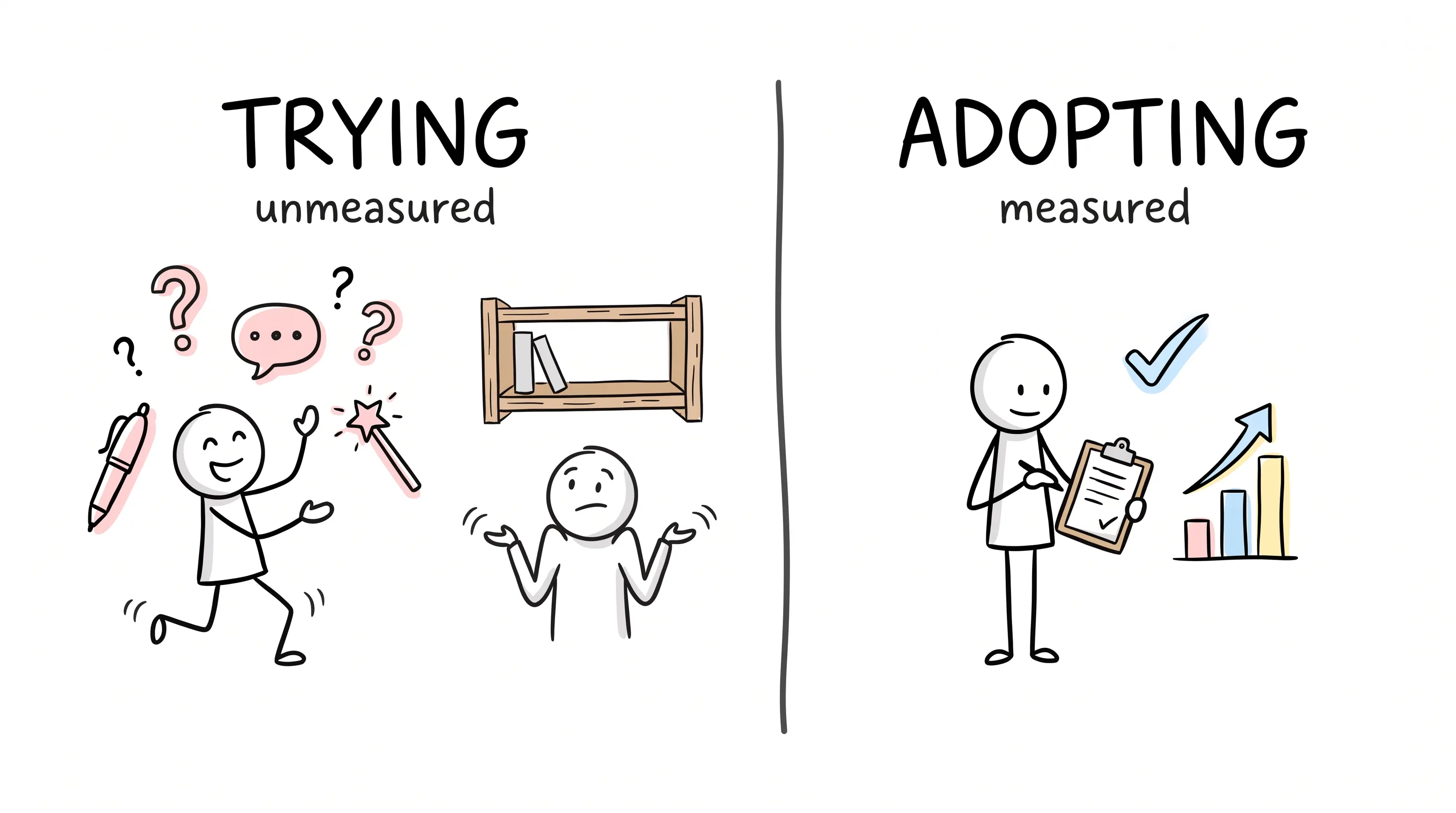
But how many organizations have built a formal measurement framework to evaluate how well it's going and whether the output is worth it? Few.
It's like opening a shop with steady foot traffic every day while nobody ever keeps the books. The bustle is real; whether it turns a profit, nobody knows.
Trying isn't adopting. Only the kind of trying you can measure is.
6. AI Has Quietly Entered the Assembly Line
The sixth signal is about how daily work actually gets done.
In roles like data processing, writing, and development, generative AI is showing up more and more often in discussions of workflow.
These roles share one thing in common: the work is repetitive, done in batches, and produces clearly defined outputs. That's exactly where AI bites first.
7. The Trouble Came Along With It
The seventh signal is the other side of the coin.
The concerns that get repeated are three: whether the data is accurate, whether deployment is hard, and whether internal policies can keep up.
When the data isn't reliable, AI output becomes nonsense delivered with a straight face. When deployment is too complex, even the best tools go nowhere. When policy isn't sorted out, employees want to use it but don't dare.
Between being able to use it and using it well lies a river.
8. Search Is Changing Its Face
The eighth signal is one you touch every day and may not have noticed.
On search engine results pages, AI-generated summaries are becoming more and more numerous.
Before, you searched and got a row of links — you clicked and filtered on your own. Now, you open the page and the first thing you read is an AI-written summary. The change looks small, but it moves the very foundation of information distribution: the user's job has changed from "going to find the answer" to "reading the answer handed to them."
This Is Not a Prophecy, It's a Snapshot
Finally, back to the research itself.
Digital Silk characterizes these 58 data points as a snapshot of the present: documenting where adoption is happening, not predicting what the future will bring. In their own words, the value of putting the statistics in one place is to see clearly which places are already using it and which organizations are still watching from the sidelines.
I have a deep appreciation for this restraint.
In recent years we've seen far too many AI reports, every one of them shouting "the future is here." This unglamorous compilation says only one plain truth: some are already running; many more are still weighing things up where they stand.
The dividing line isn't whether to use AI. It's whether, while using it, you keep that book of accounts.
Oh, and one more thing about snapshots: take another one in a while, and you'll know who was really running.
May your books be worth keeping.
Continue reading
Related articles

It's 2026: Stop "Buying" AI Tools for Your Marketing Team — Start "Hiring" AI Agents
This learn article explains how AI agents differ from standalone AI tools in marketing, outlines three agent categories — build-your-own platforms, CRM-native agents, and vertical tools — and covers use cases across SEO, social media, advertising, and reporting, plus criteria for choosing one.

What Is GEO? How Your Brand Gets "Mentioned" in the Age of AI Search
An explainer on GEO (Generative Engine Optimization) for e-commerce and DTC brands: how it differs from SEO and AEO, why AI answers shape brand visibility, and eight practices covering question-focused content, consistent brand messaging, structured pages, external evidence, comparisons, and AI mention tracking.

AI Is Already Making Decisions for Your Customers. Are You on the List?
A learn article explains GEO (Generative Engine Optimization): why AI-generated answers now shape which brands customers see, and how SEO fundamentals, entity clarity, citable evidence, and monthly measurement affect visibility in AI answers.