
AI Is Here. Should Marketing Centralize or Decentralize?
Explores whether marketing should centralize or decentralize in the AI era: shared data and scarce AI expertise pull toward headquarters, while AI tools let frontline teams move faster. Suggests deciding capability by capability, clarifying decision rights, and reviewing the balance regularly, citing a Gartner survey.
A few days ago, I had dinner with a friend who is a CMO.
He vented to me: his company is rolling out a centralized marketing platform, pulling data, tools, and experts into headquarters. The business unit heads are having none of it. One by one, they've come to pick fights with him: "Don't take our authority away. We're doing just fine on our own."
He said that in the past, this kind of thing could be smoothed over with habit and convention. But with AI in the picture, even he is bewildered.
Confused about what? He found that AI, of all things, supports two completely opposite conclusions at the same time.
I told him: this is not your imagination.
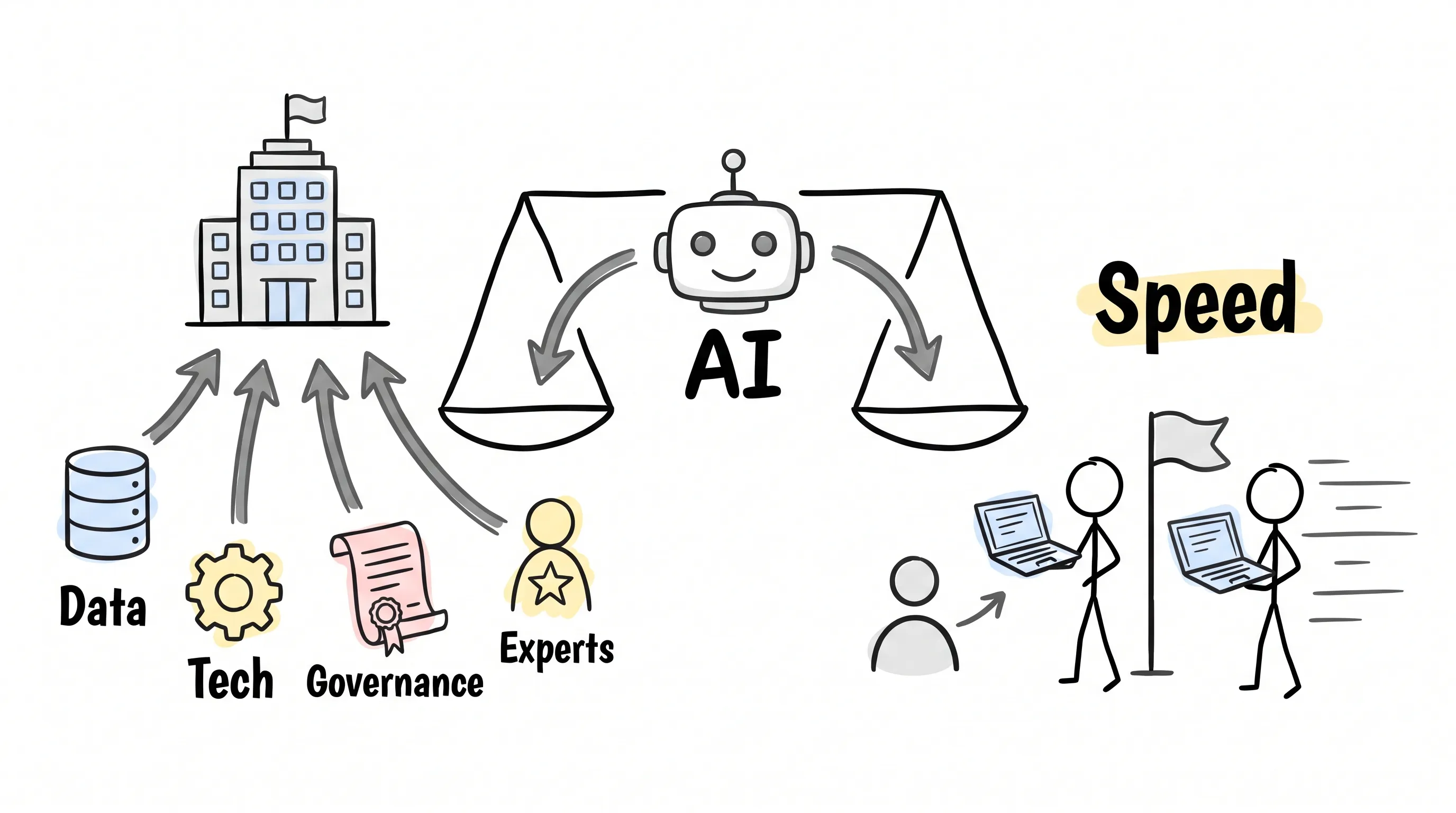
AI Is Pushing in Two Directions at Once
What is centralization? Centralization means gathering data, infrastructure, governance rules, and scarce experts under unified control at headquarters.
What is decentralization? Decentralization means leaving the freedom to act in the hands of frontline teams, so they work up close to customers and markets.
The old debate was an either/or choice. Now AI has added weight to both ends of the scale at the same time.
First, look at the force pulling toward the center.
For AI to run at all, it depends on three shared things: data, a technical foundation, and governance standards. If every region and every brand builds its own version of these three, the result is basically a disaster. Data won't line up, standards will clash, costs will double.
And there's one more: experts. Marketing talent that genuinely understands AI is scarce and expensive. Think about it: five business lines, each keeping two AI specialists of its own — ten people may still not be enough. Concentrated at headquarters, one lean team can serve the entire company. The math isn't hard.
But everything has a flip side.
AI is also giving frontline teams more room to move. In the past, when the field wanted to produce content or run analysis, they had to queue up and wait for headquarters, or pay an outside firm. And now? With AI tools in hand, they can do it themselves. The moment a market moves, they can respond the same day.
Speed. That is the single biggest benefit of decentralization.
So what does each end cost?
Too much centralization: decisions slow down, distance from customers grows, and business lines lose their sense of ownership.
Too much decentralization: duplicated builds, fragmented data, practices all over the map — and costs that end up higher, not lower.
Don't Ask About the Whole. Ask One Capability at a Time
So what should you actually do?
My view: stop wrestling with the big question of "centralize or decentralize." Take marketing apart, and ask about it one capability at a time.
Gartner ran a survey in which 73% of marketing leaders said their marketing function is already fully or largely managed in a centralized way — up 6 percentage points from the year before. That tells us most companies are indeed pulling toward the center overall. But how far to pull depends on each company's business model; there is no standard answer.
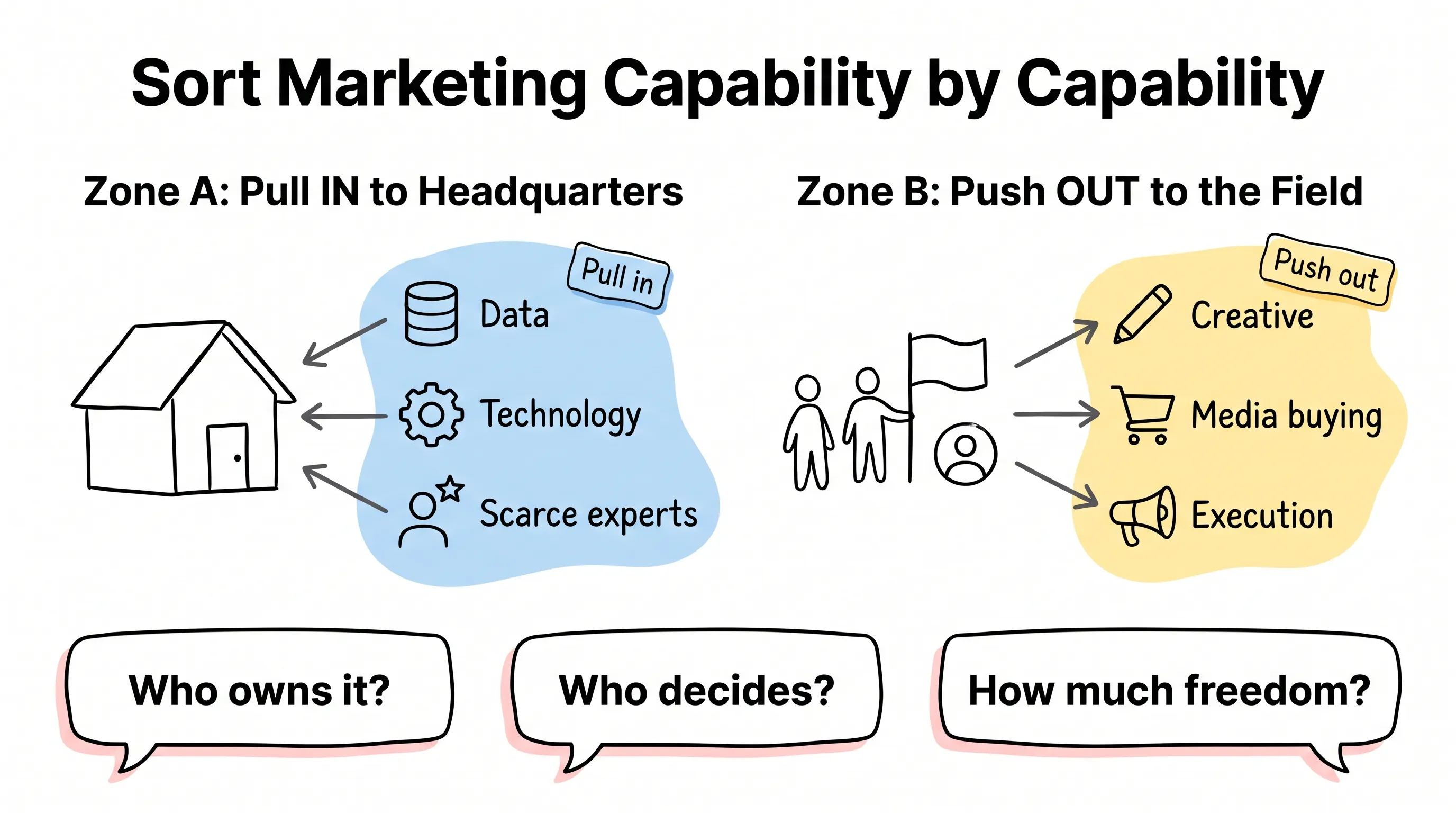
Capability by capability: data, technology, and scarce experts — these three should almost certainly be pulled in, because they feed on scale and consistency.
What about creative, media buying, and market execution? Customers differ by market, regulations differ, competitors differ — those should be pushed out and kept where the shots are fired, in the field.
So you see, what many companies end up growing is a hybrid structure: data and experts at headquarters, execution in the field.
But let me warn you: the hybrid structure has one big trap — unclear decision rights.
What belongs to headquarters, what belongs to the field, who makes the call, and how far does that call reach? If none of this is written down clearly, the hybrid model degrades into its worst form: headquarters and frontline teams bickering with each other, work done twice, everyone convinced that they are the one in charge.
So pull up what should be centralized, push down what should be decentralized — but every single item must be able to answer three questions: Who owns this capability? Who decides? How much freedom does the field keep?
Balance Isn't Something You Set Once and Keep Forever
One more thing — and it is so easy to forget.
Once an org chart is drawn, people start treating it like ancestral doctrine, never to be touched again. That is wrong.
AI capabilities are evolving fast. Work that today requires a headquarters team may, a year from now, be done better by a small frontline team on its own. And it cuts the other way too: the deeper everyone goes with AI, the more holes in governance and data get exposed — and at that point, you pull back toward the center again.
Gartner recommends revisiting this question at least twice a year. If business strategy changes, if the market shifts, if regulations move, if AI maturity changes — go back and take another look. What are you reviewing? Each capability's performance, cost, response speed, and risk — and then asking one question: does it still belong where it sits?
Keeping the status quo is also a legitimate answer.
But the precondition is that you can say two things out loud: why the status quo still holds, and what signal would make you reconsider it. If you can't say those two things, that isn't stability. That is inertia.
Back to That Dinner
After dinner, I left my friend with one sentence.
Don't treat the centralization project as a yes-or-no question. Lay marketing's capabilities out on the table and go through them one by one: if we pull this one in, what do we save? If we leave this one in the field, what do we gain in speed?
Think those through, and then — centralize what should be centralized, let go of what should be let go.
Structure serves the business — never the other way around.
I hope you, too, can argue your way into a good structure.
Continue reading
Related articles

What Is an AI Marketing Agent? From "Using AI" to "Delegating to AI"
A learn article explaining what an AI marketing agent is, how it differs from rule-based automation, and which repetitive tasks such as lead qualification, reporting, and campaign monitoring can be delegated while humans keep key decisions.

Marketing Automation Is Shifting from "You Do It" to "You Say It"
This article explains how marketing automation is shifting from rule-based platforms that merely execute toward AI agents that plan, create, publish, and review campaigns, covering delegable tasks, underlying technologies, tool categories, adoption steps, and risks such as privacy and automating without strategy.

When AI Does the Creative, Mistakes Come in Batches Too
A learn article on the risks of using generative AI for marketing creative across brand, legal, compliance, and operational layers, with case examples and seven practices for review, rights clearance, documentation, and vendor governance.