
So Many AI Personalization Tools — How Do You Pick? Start With Where Your Customers Drop the Ball
A learn-style guide that sorts ten AI personalization tools into three scenarios — omnichannel platforms, website-focused optimization, and single-point tools — and advises picking tools based on where customers drop off in the journey.
A while back, an old friend of mine who runs a cross-border e-commerce business invited me out for tea.
Before the tea had even cooled, he started venting. He said his company was now paying for five separate tools just for "personalization": one for product recommendations, one for A/B testing, one for email, one for a WhatsApp bot, and one for user segmentation.
Five tools, five bills, five sets of data that don't talk to each other.
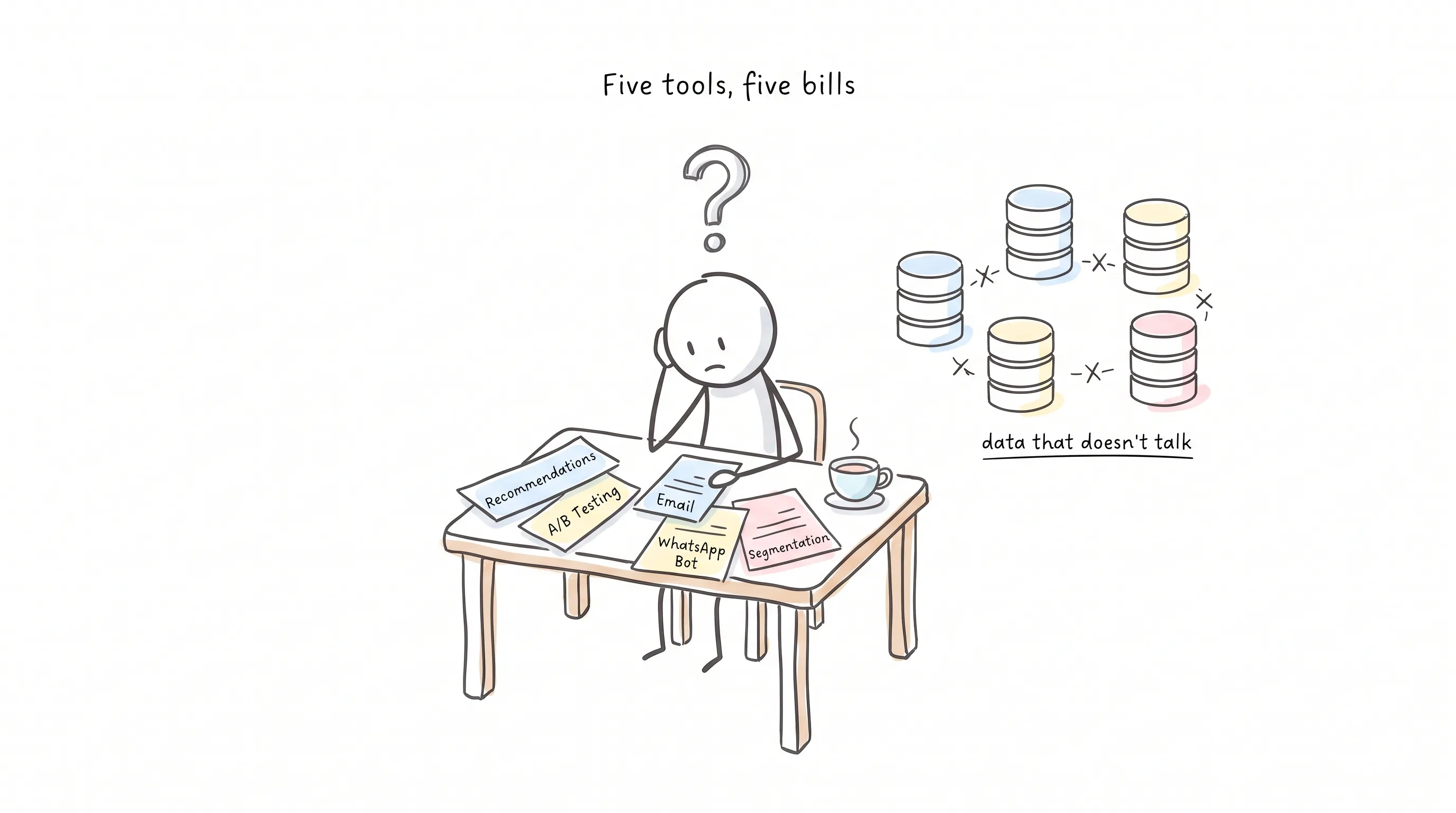
He asked me: isn't AI supposed to handle everything? How did it turn into a five-tool stack for me?
I told him he'd hit on exactly the right question. Most articles out there would just throw you a "Top 10 Tools" ranking, but a ranking won't solve your problem. So today I'm not going to rank anything. I'm taking ten mainstream tools and breaking them down by scenario — who each one is actually for. Then you can see where you fit.
First, Let's Be Clear About One Thing: AI Personalization Is Really Three Kinds of AI
What is AI personalization, anyway?
Put simply, it's letting the machine do one job for you: guess what a person will want next, and put the right content, product, or message in front of them before they ask.
But there's more than one way to "guess." The AI used in online business falls mainly into three types.
The first is old AI — the stuff that's been working for over a decade: product recommendations, dynamic website content, on-site search. When you open Amazon and see a homepage that seems hand-picked for you, that's the AI doing the work behind the scenes. The technology isn't new, but it's still the backbone of e-commerce personalization today.
The second is conversational AI. It relies on natural language processing (NLP) to understand what people are saying, then gives a decent answer back. That's what customer service bots are — like the ones inside Zendesk or Intercom, or the auto-replies on WhatsApp.
The third is generative AI, the newest of the three. You give it a sentence and it writes headlines, produces images, drafts campaign plans. Since ChatGPT made it famous, most marketing teams now use it to speed up campaign production.
Here's the trouble: you can hardly find a single tool on the market that does all three kinds of AI well.
That's exactly why my friend ended up with a five-tool stack. It's not that he's clueless — the market is just built that way.
Where Can AI Actually Do the Work for You?
Before you pick a tool, you need to know what AI can do. There are roughly seven jobs.
Content personalization on websites and apps. Category pages, banners, pop-ups — all can change per person. Done well, the whole site feels like it was built just for that visitor.
Product recommendations. Based on interests, browsing history, and past purchases, each person sees a different set of products.
Predictive segmentation. Traditional segmentation works from what you already know: region, device, purchase history. AI goes a step further and predicts: who is likely to buy, who is likely to churn, who responds to discounts.
A consistent omnichannel experience. The recommendation a user sees in an email says the same thing as the one they see when they open the app.
Journey orchestration. The right message, on the right channel, at the right time. AI can decide all those "rights" itself.
Automated experimentation. When an A/B test finishes, the AI analyzes the results and switches traffic to the winner on its own — no one babysitting it.
Two-way conversation. Using NLP to understand what users are asking, while chatting with thousands of them at once, without missing a beat.
Of those seven, you will not find one tool that does them all. Which is exactly why choosing matters.
Scenario 1: Many Channels, Big Business, Want One Platform to Run It All
The profile of this type of company: website, app, email, SMS, WhatsApp, push notifications — every channel has to work, none can be the weak leg. The answer here is the omnichannel platform tier.
Why does Insider One come first? Because of the ten tools here, it covers the most ground.
Website, app, email, SMS, WhatsApp, push notifications — all in one platform. Samsung, Coca-Cola, CNN, and Lexus all use it for cross-channel personalization.
It has a capability suite called Insider One AI. A few pieces worth highlighting.
On-site search, under the product name EUREKA. Here's a number to remember: on average, users search three to five times before they give up on a website. If they can't find what they want, they turn around and leave. EUREKA uses each user's historical behavior and predictive signals to rank the most relevant results at the top.
There's also a product called InStory, which adds Instagram Stories-style content to mobile, with the AI arranging different content for everyone who taps in. Dover Saddlery, a retailer of equestrian gear, made an extra $1.7 million with it.
The journey orchestration module is called Architect — a drag-and-drop interface for building automated flows. Three of its AI capabilities are especially practical.
One is STO — send-time optimization. The AI studies each user's behavior patterns, predicts when they're most likely to open a message, and times the send to that exact moment.
Another is automatic A/B test winner switching. Two journey paths run against each other, and once the test ends, the system routes all subsequent users to the winning path automatically — no one has to reconfigure things at midnight.
And there's one called Next-Best-Channel. Not sure whether to reach this person by email or SMS? The AI looks at their behavior patterns and picks the channel for you.
The generative AI part is even more convenient. The platform has more than 120 user attributes; building a segment normally means ticking boxes for ages, but now you type one sentence and it's generated — the vendor says it's 30x faster. Journeys, copy, images — you can generate all of them from a single sentence too.
How well does it work? A few numbers. Philips used it to personalize its website: conversion rate up 40.11%, average order value up 35%. Lenovo used web push aimed at anonymous visitors for cart-abandonment recovery, cutting the abandonment rate by more than 10%. And the sports brand Slazenger is more extreme still: after eight weeks of working together, customer acquisition up 700%, ROI at 49x.
Impressive.
One more word on WhatsApp. WhatsApp has 2.5 billion users, and open rates are scarily high. Insider One is a Meta-certified BSP (Business Solution Provider), and it can do conversational commerce: users browse the product catalog, add to cart, and pay — all inside the WhatsApp chat, never leaving the conversation. In between, the AI can chat back and forth with the user, understand what they want, and push the matching product straight to them.
One more reference point: in G2's ratings, Insider One is ranked the best-rated and easiest-to-use personalization engine, and it also ranks high in the e-commerce personalization software, CDP (customer data platform), and mobile marketing software categories.
Next, Braze.
It's a customer engagement platform that pulls the various channels together; its AI suite is called Sage AI, covering personalization, content generation, and optimization. Its strength is external channels: email, SMS, push. But its website personalization is weak — it can't compare with Insider One, Dynamic Yield, and the like. If your main battlefield is outreach rather than your site, it works. The other way around, don't jump on the bandwagon.
CleverTap.
It started in mobile marketing and has expanded into a full omnichannel platform. Its AI suite is called CleverAI, doing intelligent segmentation, product recommendations, and journey orchestration. Same playbook as Braze: strong on external channels, weaker on on-site and in-app personalization.
Adobe Target and Adobe Campaign need to be discussed together.
Because they both belong to Adobe Experience Cloud, and in practice they're often used as a pair. Target handles A/B testing and experimentation-driven personalization across websites, apps, and even IoT devices; Campaign assembles user data scattered everywhere into one complete profile, then runs cross-channel campaigns with it. This is a fit for companies already inside the Adobe ecosystem. If you're not, buying a whole Experience Cloud just for personalization — you'd better weigh the cost carefully.
Scenario 2: Your Main Battlefield Is the Website, and You Want to Squeeze Every Point of Conversion Out of It
Not every company needs omnichannel. For a lot of businesses, the money is made on the website, and making the website excellent is enough. This tier has four contenders.
Dynamic Yield. Website personalization is its center of gravity. Its signature is AdaptML, a self-training deep learning system that adjusts the site experience based on each user's behavior and preferences. Email is covered too — recommendations and targeting — plus one thoughtful detail: open-time-decisioning, which predicts when you'll open an email and times the send to match.
Klevu. Specializes in e-commerce search and recommendations. On-site search returns different results per visitor, recommendations change per person, and category pages can merchandise themselves automatically. What's interesting is that it has a search bot called MOI, powered by ChatGPT — when a user's search comes up empty, they can just ask it directly.
Monetate. It sells its product in three parts: Personalization, for automated personalization and segmentation; Discovery, for recommendations, search, and social proof; and Experimentation, for A/B testing. You can buy the whole thing, or pick only the piece you need. Website and app personalization, AI recommendations, search, predictive segmentation, testing — all there.
Intellimize. The website-optimization contender. Its AI Optimize shows different versions of a page to different visitors to raise the odds of conversion. It also has an AI personalization product that shows content and recommendations per person. Lighter than the ones above — but light has its advantages: it goes live fast.
Scenario 3: Only One Pain Point? Then Use a Single-Point Tool
Lyne. The simplest of the ten — it does exactly one thing: cold email personalization. For sales and marketing teams doing cold outreach, the most time-consuming step is researching each prospect's background, one by one. Lyne does the research for you and personalizes the opening lines. It also ships with a scraper that can pull lead data from LinkedIn Sales Navigator and search results.
Don't dismiss it for being simple. If your problem is a low cold-email reply rate, buying an entire omnichannel platform is pure waste.
Back to That Friend Over Tea
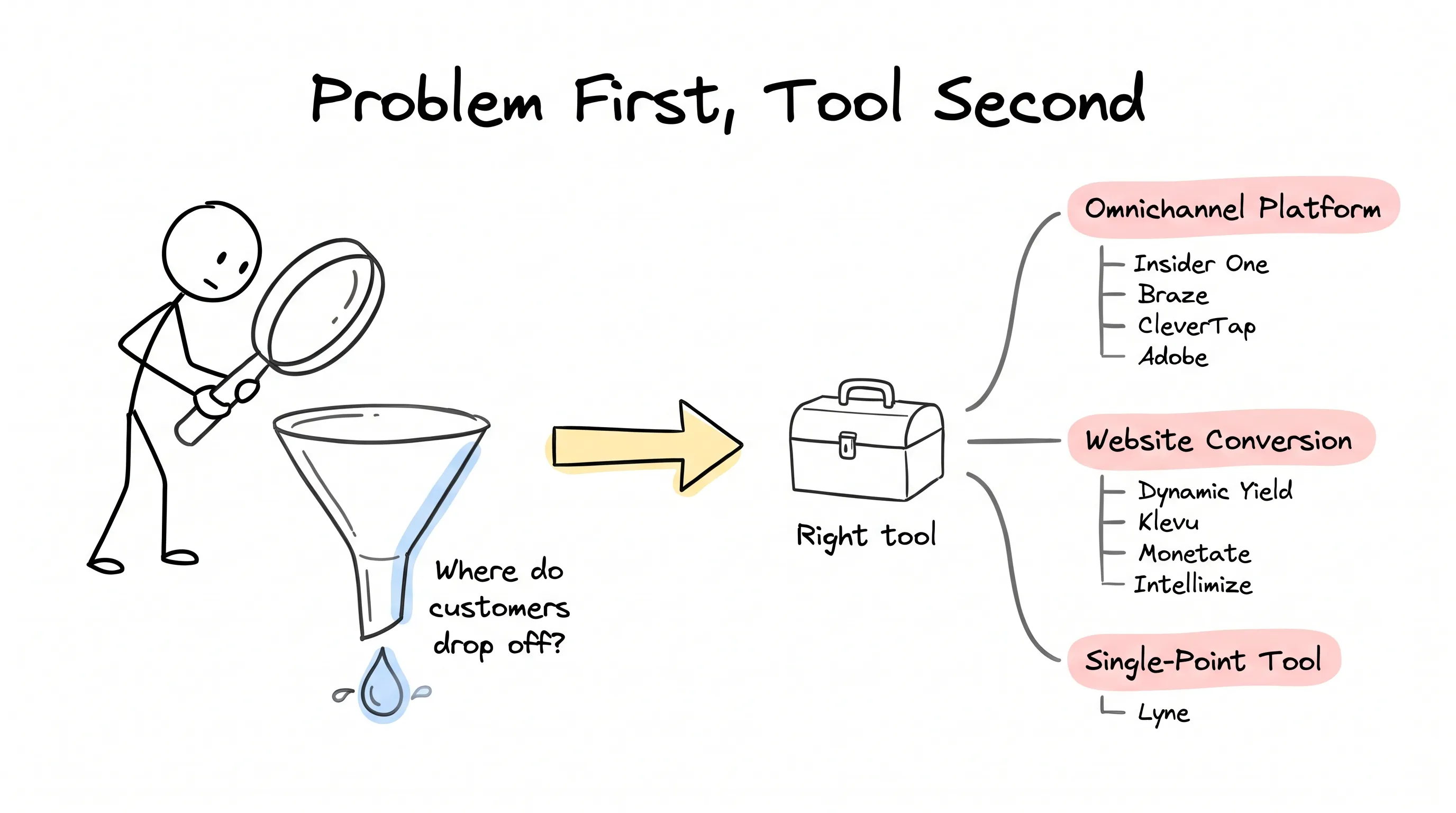
At the end of our chat, I asked him one question: in your customer journey, where do things break down the worst?
He paused for a beat, then said: cart abandonment.
See — the answer was already in his head. Cart abandonment means he should be looking at web push and cart-abandonment recovery. And among the five tools he'd bought, not a single one did that job well.
So my advice has always been one sentence: problem first, tool second. Get the order wrong, and even ten tools are ten wasted tools.
Tools are amplifiers, not strategy. First figure out where your customers are dropping off, then look for the tool that fills exactly that gap. For omnichannel, look at Insider One, Braze, CleverTap, Adobe. For website-centric work, look at Dynamic Yield, Klevu, Monetate, Intellimize. For a single-point problem, find a small knife like Lyne.
Here's hoping the next time you shop for tools, you arrive with a problem in hand — not with a ranking.
Continue reading
Related articles

What Is an AI Marketing Agent? From "Using AI" to "Delegating to AI"
A learn article explaining what an AI marketing agent is, how it differs from rule-based automation, and which repetitive tasks such as lead qualification, reporting, and campaign monitoring can be delegated while humans keep key decisions.

Marketing Automation Is Shifting from "You Do It" to "You Say It"
This article explains how marketing automation is shifting from rule-based platforms that merely execute toward AI agents that plan, create, publish, and review campaigns, covering delegable tasks, underlying technologies, tool categories, adoption steps, and risks such as privacy and automating without strategy.

When AI Does the Creative, Mistakes Come in Batches Too
A learn article on the risks of using generative AI for marketing creative across brand, legal, compliance, and operational layers, with case examples and seven practices for review, rights clearance, documentation, and vendor governance.