
Can AI Marketing Actually Make E-Commerce Better?
A learn article explaining how AI marketing applies to e-commerce — customer service bots, personalized recommendations, predictive analytics, and automated content — while weighing trust, data privacy, bias, and study limitations, and advising readers to start with low-effort use cases.
A few days ago, I had dinner with a friend who runs an e-commerce business. He vented: ad spend keeps climbing, conversion rates keep slipping, customer acquisition costs rise year after year — it feels like every dollar is going straight to the platforms.
I asked him: have you tried using AI for marketing?
He said: I did. We rolled out an AI-powered customer service bot. The results were mediocre.
I said: then you're probably using it in the wrong place.
As it happens, I recently finished reading a review published in 2024. The researchers pulled 60 articles on AI marketing from the Scopus database, filtered them again and again, and finally kept 50 — all to answer one question: does AI marketing actually move the needle on e-commerce sales?
Let me walk you through its conclusions in plain language.
Why Marketing, of All Places?
Start with a question: in a company, which department should adopt AI first?
The answer: marketing.
Why? Look at what marketing does every day — just three things: understand what customers want, match your product to that need, then persuade them to pay.
And these three things are exactly what AI is best at. It can read, in one go, more data than you could ever finish; it can spot the next hit product hiding in historical orders; and it never tires, never slips.
What is AI marketing? To put it plainly: letting machines take over the parts of marketing that are repetitive and based on guesswork.
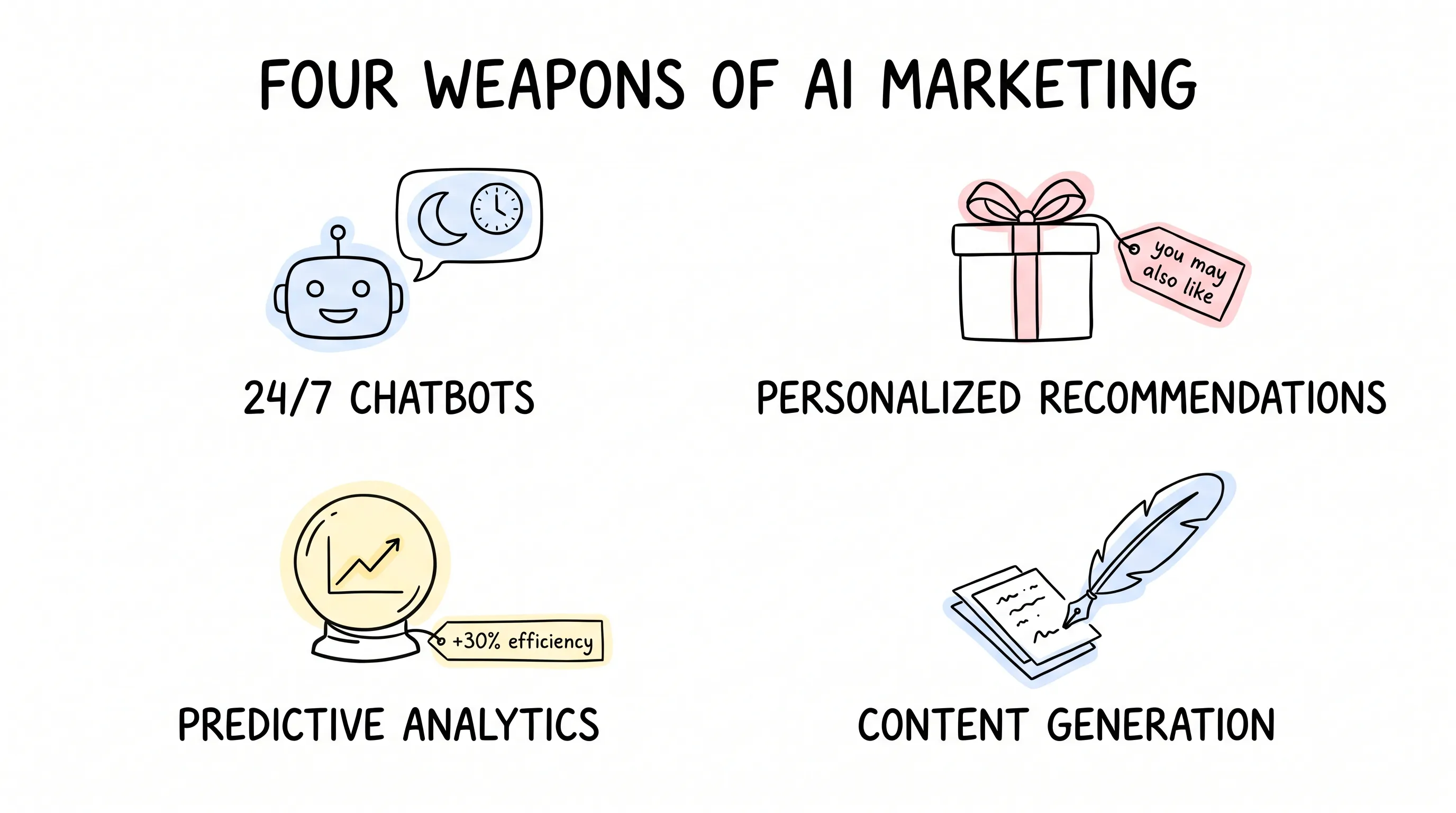
Which parts, specifically? Four weapons.
Four Weapons
First: AI customer service and chatbots.
It's two in the morning, and a buyer asks about sizing. Not long ago, that question would sit unanswered until the next morning — and the buyer would be long gone. Now a bot replies in seconds, and can process the order or the return while it's at it. Open all year round, unfailingly patient, and cheap to run.
Second: personalized recommendations.
Think about why Amazon and Netflix are so strong: they turned "you may also like" into a craft. Everyone who opens the page sees things prepared just for them. Personalization isn't pushing the same ad to more people — it's making sure that what each person sees feels tailor-made for them.
Third: predictive analytics.
Use historical data to predict the future: which product is about to take off, when to run a promotion, where to set the price. Davenport and Ronanki's 2018 research counted it: among companies using AI for predictive analytics, some reported marketing efficiency gains of 30%.
Thirty percent — what does that mean? Same team, a third more output.
Fourth: automated content generation.
Writing 100 product descriptions used to take a full copywriting team. Now tools like ChatGPT can mass-produce them in an afternoon, and the quality holds up. For small companies, it's almost like being handed, for free, the kind of market research only big companies could afford.
Behind these four weapons stands a model more than a century old: AIDA — Attention, Interest, Desire, Action, the four steps every customer passes through before paying. What AI does is tighten every step: personalized ads grab attention, recommendation engines and content generation spark interest and stir desire, dynamic pricing and exclusive offers close the deal.
China Construction Bank used exactly this playbook years ago, promoting online banking to university students. No hard-sell ads — instead, interactive, hands-on experiences that sparked interest and nudged people to act. The results were immediate.
Where Do You Save Money — and Where Do You Make It?
Marketing money flows in only four directions. Let me count them out for you.
First, conversion rate. Visitors arrive — how many actually place an order? Research shows that even a small lift in conversion pushes total revenue up noticeably, because recommendation engines turn "just browsing" visitors into "exactly what I need" buyers.
Second, customer acquisition cost. Traditional ad buying is like casting a net with big holes — you haul up piles of fish you never wanted. AI automatically concentrates the budget on the people most likely to buy, so the same money catches more fish. Automated customer service and CRM trim another slice off the cost of chasing leads.
Third, customer lifetime value. How much can one customer contribute to you over a lifetime? AI can watch years of behavior, anticipate what they'll want next, and get the experience right before they ask. Satisfied customers come back; repeat purchases make the number grow. One study used emotion recognition for exactly this: analyze how users feel on social media, then decide what to show them.
Fourth, marketing ROI. Calculating the books for one campaign used to mean half a day of wrestling with spreadsheets. AI hands you the full picture at a glance: how every dollar performed, where to double down, where to stop.
Want a more striking example? Here's one.
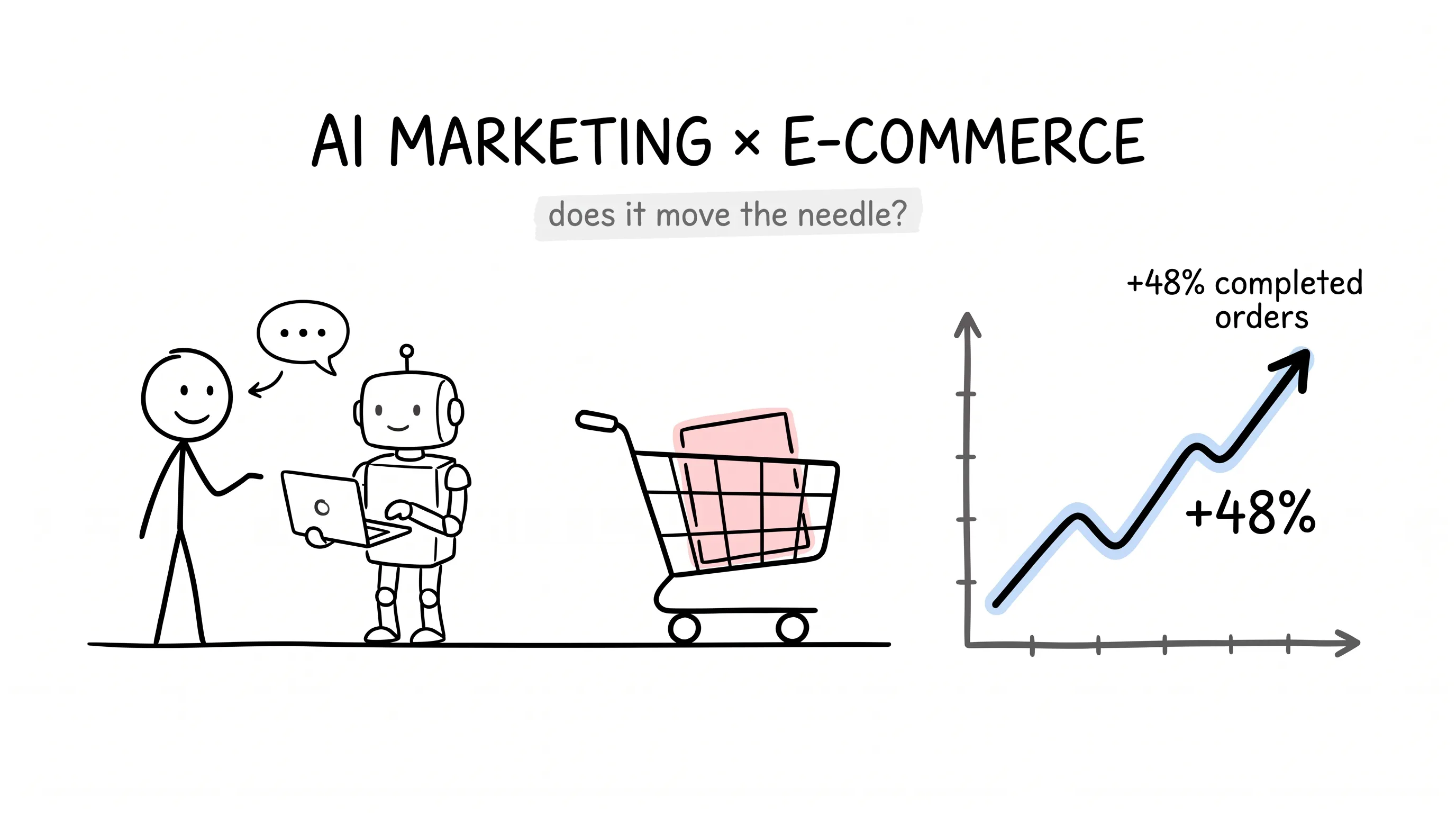
A company called Melatec saw completed orders jump 48% after adopting an e-commerce application — while complaints and returns actually fell. Forty-eight percent! Think about what that means.
Banking wanted in on the action, too. Several studies of banks found that after adopting AI, conversion rates, brand favorability, and repurchase intent all climbed. And Netflix goes without saying: by using AI to target customers with precision, its overall marketing efficiency jumped a full notch.
At this point you might ask: are these results AI's doing, or were these companies just strong to begin with?
Good question. That's a trap — and we'll get to it.
Trust Is the Invisible Threshold
There's an old theory called the Technology Acceptance Model, proposed back in 1989. It says whether people adopt something comes down to two things: is it useful, and is it easy to use.
Applied to AI marketing, it holds just as well. If users feel the recommendations "get them," they stay; if the service bot keeps missing the point, they walk.
A 2022 study focused on users' first impressions of chatbots, and its conclusion: whether it fits and feels smooth decides whether it's trusted.
Subtler still is the sense of proportion. A 2023 study watched frontline service robots and found something counterintuitive: the closer a robot gets to human, the higher users' expectations rise — and the moment it says something that doesn't quite sound human, satisfaction drops even faster.
Put simply: a robot can be a capable assistant. But if it insists on pretending to be human, users will pick it apart under a magnifying glass.
And there's a harder red line: data.
AI personalization is, at its core, fed on user data. Health, location, purchase history — the more you feed it, the sharper the guesses, and the more uneasy users feel. Europe's GDPR and California's CCPA are forcing companies to obtain explicit consent and offer clear ways to opt out.
Here's how I see it: consumers can accept that you don't understand them — what they can't accept is that you secretly do, and never say so. Guessing accurately is skill; being open about why you guess accurately is obligation.
Algorithms hide one more problem: bias. If the training data itself is skewed, the system will systematically shut certain groups out of offers and ads. That isn't science fiction — it's already happening. So before you launch, test it first: is my model discriminating against anyone?
Three Buckets of Cold Water
First bucket: chicken or egg?
Many of those "we used AI and results improved" studies suffer from endogeneity (in plain terms: a statistical trap where cause and effect can't be cleanly separated). Did AI drive the growth, or did companies whose marketing was already strong simply invest more in AI? Maybe both — but mixed together, the numbers can't be untangled. Every AI marketing study has to face this question, and you should put it to any vendor before you sign.
Second bucket: data quality.
AI is the cook; data is the ingredients. If the ingredients aren't fresh, no cook can save the dish. Feed it incomplete, error-riddled data, and even the strongest model puts out something crooked.
Third bucket: industry differences.
Categories like apparel and consumer electronics are born for AI: endless styles, abundant data, and personalization pays off the moment it switches on. Fresh groceries are hard: thin margins, little room to differentiate — people buy groceries once a week, and there's not much to personalize. Luxury is even fussier: AI has to personalize without eroding the sense of scarcity.
And don't forget — traditional methods have their own strengths. High-trust products, customers new to buying online, brand crisis management, and markets with strict data regulation: a reliable human being can still beat the smartest model.
So Where Should You Start?
Back to my friend.
My advice to him is the same advice that review gives everyone in e-commerce: don't start with a big project — pick the low-hanging fruit first.
AI customer service: deploy it first; the savings show up immediately. Predictive analytics: start with inventory; don't rush to forecast the whole company's fate. Once things run smoothly, wade into the deep end — personalized recommendations, dynamic pricing.
One more dose of honesty: every ounce of value AI delivers rests on clean data and clear boundaries. Dirty data bends the results; blurry boundaries collapse trust.
By the end of that dinner, my friend said he'd go back and tune up his service bot first.
I said: right. AI isn't here to make you do less marketing — it's here to free up your time for the things only humans can do. Like sitting down to a long, unhurried dinner with a friend worn out by rising acquisition costs.
Continue reading
Related articles

It's 2026: Stop "Buying" AI Tools for Your Marketing Team — Start "Hiring" AI Agents
This learn article explains how AI agents differ from standalone AI tools in marketing, outlines three agent categories — build-your-own platforms, CRM-native agents, and vertical tools — and covers use cases across SEO, social media, advertising, and reporting, plus criteria for choosing one.

Did the Money You Spent on AI Marketing Ever Come Back?
A guide to measuring AI marketing ROI across three layers: ad reports, sales pipeline, and the financial ledger. Covers metrics such as ROAS and CPA, eight dashboard metrics, industry benchmarks, and common measurement mistakes.

How to Pick a Creative Automation Platform: First, Figure Out What These Eleven Actually Do
A learn article sorts eleven creative automation platforms — including Bannerflow, Celtra, Smartly.io, and Storyteq — into four functional groups and proposes five evaluation questions covering publishing reach, automation depth, ease of adoption, team fit, and verifiable evidence.