
94% of Teams Use AI for Marketing — Only 41% Can Prove It Makes Money
A learn article examines why 94% of marketing teams use AI while only 41% can prove business results, citing missing metrics, hidden costs, and data quality. It also covers generative engine optimization and where human judgment fits alongside AI.
A few days ago, I had dinner with an old friend who works in marketing. The conversation turned to AI, and he lit up: AI adjusts his ad bids, AI writes his articles, AI handles customer service — even his weekly reports were AI-generated.
I asked: so, is it making money?
He paused.
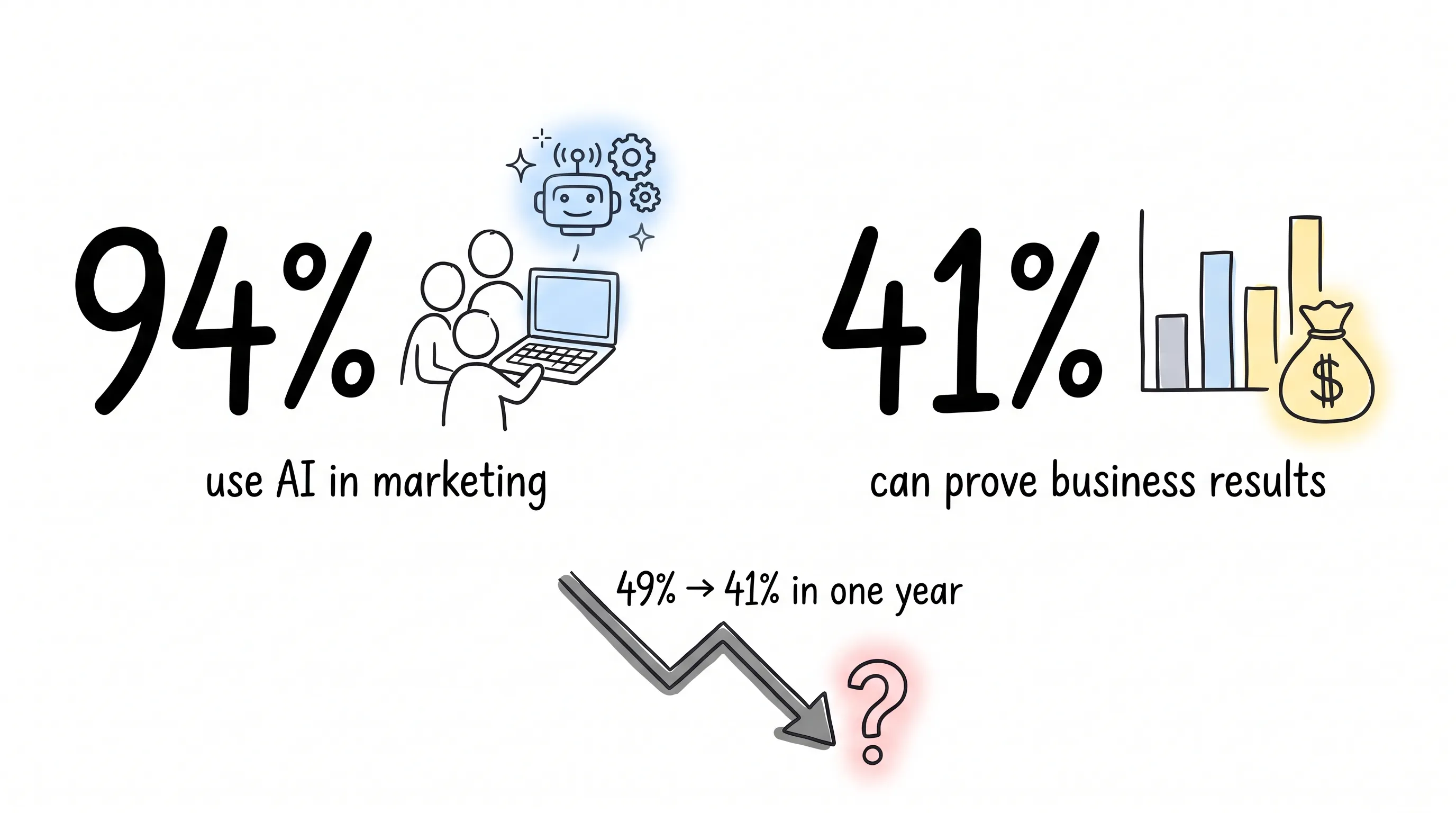
That pause is why this article exists. Jasper.ai published a report on the marketing industry with a stark number in it: 94% of marketing teams are using AI. But only 41% of teams can produce data proving that AI has driven business results.
And a year earlier, in 2025, that figure was still 49%. Eight points gone in a single year.
More teams are using it than ever, yet fewer can prove it pays off. What's going on?
What Is AI Marketing?
AI marketing means letting AI take part in the planning, execution, and optimization of marketing, while humans make only the key decisions.
Think of it as a change of identity: AI used to be a feature inside a marketing platform — a chatbot, an auto-bidding button — you used it and moved on. Now, AI has become the foundation of the whole system.
Salesforce's Agentforce, HubSpot's Breeze, and Adobe's Agent Orchestrator can already plan a marketing campaign on their own: find the audience, create the content, place the channels, adjust the budget — the whole thing runs by itself.
AI is no longer the hammer in your hand; it's becoming the entire construction site.
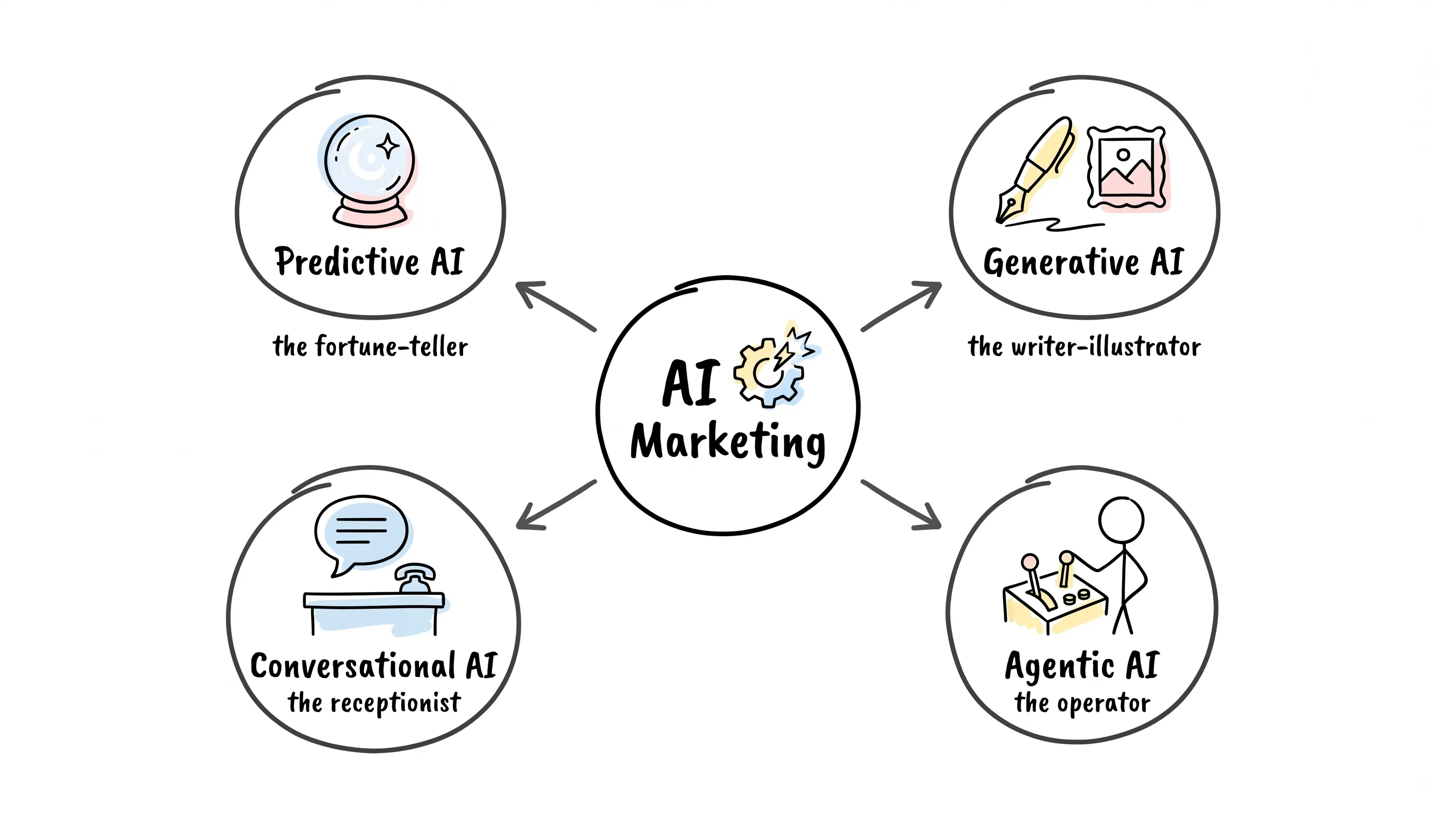
The AI in marketing comes in roughly four types. Let me translate them into plain language.
Predictive AI — the fortune-teller. It digs through historical data to guess which customer is about to churn and which lead will close.
Generative AI — the writer-illustrator. ChatGPT drafts email copy; DALL·E makes ad images.
Conversational AI — the front-desk receptionist. Drift's chatbot chats with visitors and, along the way, qualifies the leads.
Agentic AI — the operator. It doesn't just advise; it acts. HubSpot's Copilot can plan and launch an entire campaign on its own.
Most teams today mix them: generative for content, predictive for targeting, conversational for intake, agentic for orchestration.
Sounds great, right?
But there's always a flip side.
So Many Teams Use It — Why Do So Few Make Money?
Three reasons. Let me run the numbers one by one.
Reason one: the math was wrong from the very start.
In Averi.ai's survey, 81% of teams admitted they had never set dedicated metrics for judging their AI.
What does "no metrics" mean? It means counting "AI wrote 500 pieces for me" without ever asking "how many deals did those 500 pieces bring in?"
Counting activity, not business outcomes. That's the core reason the other 59% of teams can't prove value.
Reason two: the hidden bill is much longer than you think.
You think the cost of AI marketing is just tool subscriptions? Wrong.
Tally up a full six months and you'll find at least six line items: tool subscriptions, data cleaning and integration, team training, failed experiments, the opportunity cost of paused campaigns, and compliance reviews.
One cost example stuck with me: a team spent $50,000 adopting AI and saved 15 hours a week. Valued at $75 an hour in labor, the payback period is 10.3 months.
And of that $50,000, tool fees were only 20-30%. The bulk went to data preparation and opportunity cost. Plenty of teams budget only for the tools, run out of money halfway, wrap up hastily — and conclude: AI doesn't work.
Reason three: between the vendor's brochure and the real-world median lies a gulf.
The brochure promises efficiency gains of 40-60%. The actual median? 18%. Content output is supposed to grow 5-10x; in practice, without sacrificing quality, it's about 2.5x. ROI is advertised at 30-50%; the median is 12%.
That said, the best-performing teams do achieve 35% efficiency gains and 28% ROI improvements.
The gap isn't the tools. It's the fundamentals.
What Decides Winners and Losers: How Clean Your Data Is
What are the fundamentals? The first thing is data.
AI has one defining trait: it amplifies everything. Feed it clean data and it amplifies your insights; feed it garbage and it will just as faithfully amplify your garbage.
Let me tell you about the most common way this goes wrong.
A batch of long-neglected contacts sits in the CRM (customer relationship management system). The AI, ever diligent, grabs them for personalized marketing and sends warm, effusive messages to every old friend: "Long time no see — we thought you might like..."
The result? Unsubscribe rates soar. Those people changed companies ages ago.
So the only viable sequence is: health check first, AI second. Check how many contacts haven't been updated in over 90 days — if that's more than 15%, stop and clean the data first; if more than 5% of key fields are missing, fill them first; duplicate records, deduplicate first.
Rolling out AI on dirty data is like hiring a Michelin-starred chef to cook a pot of spoiled ingredients. The pricier the pan, the faster it burns.
Sometimes, You Shouldn't Use AI at All
Hearing that from someone who writes about AI marketing may seem odd. But it's the one sentence in this entire piece I most want you to remember.
There are a few scenarios where AI reliably fails.
A product on the market less than six months has too little historical data; the model is guessing in the dark. In heavily regulated industries like finance and healthcare, compliance reviews routinely take two to three weeks — whatever time AI saves is lost in the reviews. If a brand is repositioning itself, AI has learned nothing but the old messaging, and it will drag you back toward it. For small teams under 10 people, building data pipelines and running training costs more effort than it saves.
The test really comes down to one thing: do you have enough clean historical data for the AI to learn from.
If not, use rules and manual work to build up the data first.
AI is an amplifier, not a magic trick that conjures something out of nothing.
So Where Do You Start?
Don't jump straight into predictive models. Sequence matters.
Pick the low-hanging, high-certainty fruit first. Email send-time optimization runs on a few thousand subscribers and three months of data, showing results within weeks; AI-assisted writing with a human gatekeeper can be up and running in a week or two.
Step two: basic lead scoring. The bar is higher: more than 10,000 leads with known win/loss outcomes, and at least six months of history.
Step three is where the heavy artillery comes in: churn prediction, customer lifetime value. Those need thousands of customers and more than a year of accumulated data — you can't rush them.
First trade small wins for organizational trust, then trade that trust for big projects.
Oh, and one more thing has changed: your customers no longer just "search."
Marketing used to mean watching the ten blue links on Google's first page. Now? People ask ChatGPT, ask Perplexity, scroll TikTok, browse Amazon — even Google itself answers with AI right at the top of its results page.
What does that mean? It means you can rank first and still be invisible. If ChatGPT doesn't mention your brand when summarizing a topic, to the user you don't exist.
So there's a new piece of homework; some call it GEO (Generative Engine Optimization): getting AI to cite you. Mark up your structured data, put a 40-60 word direct answer under each subheading, keep your brand name consistent on authoritative platforms like Wikipedia and LinkedIn, and write content in a question-and-answer structure wherever possible.
The metrics have changed too. Don't just watch traffic; check whether AI's answers include you.
Finally, Where Do People Fit In?
Two more numbers from that same Averi.ai survey: 73% of teams chose "AI does the work, humans check it" — clearly outperforming the 5% chasing full automation — while a full half of the teams remain stuck in scattered, aimless experimentation.
Here's a story about how that gap opens up.
An e-commerce brand's AI looked at historical data and recommended doubling the Facebook ad budget — the channel with the highest historical returns. The CMO vetoed the recommendation and moved 30% of the budget to TikTok, a channel with zero historical data.
Eight weeks later, TikTok's ad ROAS hit 2.5x.
AI will never make that decision. It only searches historical data for the optimal answer — but breakthroughs happen precisely outside the historical record. When the market turns, when a brand repositions, when a PR crisis hits, AI is holding yesterday's map; it's humans who are reading today's road.
AI's job is to find the optimum in the known; people's job is to make the judgment calls in the unknown.
Back to That Dinner
After dinner, I asked my friend: did you ever set up a dedicated scorecard for your AI?
He said: no. We just count how many pieces it writes.
I said, then you don't make that 41% — and it isn't unfair one bit.
The relationship between marketing and AI has moved past "can we use it?" into "how do we account for it, and how do we govern it?" Technology stopped being the bottleneck long ago; organizational readiness is.
Here's wishing you a place among that 41%.
Continue reading
Related articles

What Is GEO? How Your Brand Gets "Mentioned" in the Age of AI Search
An explainer on GEO (Generative Engine Optimization) for e-commerce and DTC brands: how it differs from SEO and AEO, why AI answers shape brand visibility, and eight practices covering question-focused content, consistent brand messaging, structured pages, external evidence, comparisons, and AI mention tracking.

AI Is Already Making Decisions for Your Customers. Are You on the List?
A learn article explains GEO (Generative Engine Optimization): why AI-generated answers now shape which brands customers see, and how SEO fundamentals, entity clarity, citable evidence, and monthly measurement affect visibility in AI answers.

Google Is Stuffing Ads Into AI Search: These Recent Stories Are Really One Story
A news roundup linking recent AI marketing stories—Google adding ads to AI Mode, Amazon's Ads Agent, ChatGPT image updates, a UK startup tracking brand mentions in AI answers, and an AI ransomware warning—arguing that control over ad data and visibility is shifting toward platforms.