
AI Is Already Making Decisions for Your Customers. Are You on the List?
A learn article explains GEO (Generative Engine Optimization): why AI-generated answers now shape which brands customers see, and how SEO fundamentals, entity clarity, citable evidence, and monthly measurement affect visibility in AI answers.
A while back, I asked a friend who runs a business to try a little experiment.
He opened ChatGPT and typed: recommend a few vendors for business services.
The answer came back almost instantly. Three companies, with names, reasons, even a comparison. He stared at the screen for a long moment, then said one thing to me: I'm not on this list.
I asked him: so how are you doing on your website, SEO, keywords?
Pretty well, he said. Search our industry terms and we're on page one all year round.
That's exactly where the problem is, I told him. Your customers are now asking their questions somewhere else. And in that place, your name doesn't exist yet.
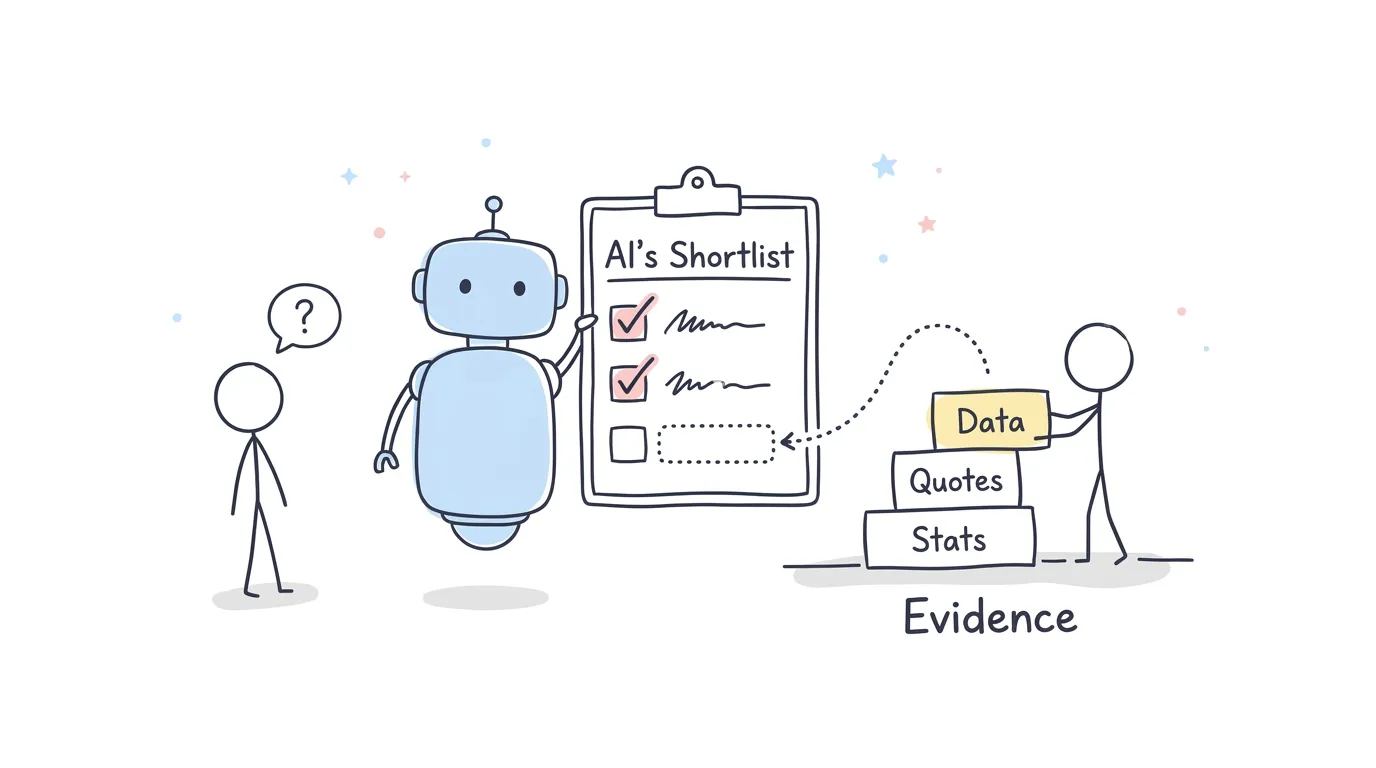
What Is GEO?
GEO — Generative Engine Optimization. That's optimization for generative engines.
Put simply: it's making sure that when AI answers a question, it knows you, gets you right, and is willing to mention you.
Think back to the experiment at the start. Before, customers walked to your front door carrying keywords; if you ranked on page one, you won. Now, the customer asks the AI first, and the AI serves the finished answer up on a plate. Before the customer ever sees you, the shortlist has already been drawn up by AI.
It used to be that customers searched you out. Now AI decides for them whether they ever see you.
How Urgent Is This?
Let's look at a few numbers.
OpenAI says that by August 2026, ChatGPT had surpassed a billion weekly users. AI Overviews are now a fixture in Google's search results. And in a 2024 study by SparkToro and Datos, 59.7% of Google searches in the EU ended with zero clicks. Users searched and left without touching a single link.
What does zero-click mean?
It means your ranking is still there, but the visitors are gone. The user's question gets answered inside the search results page by AI.
In March 2025, Pew Research tracked the browsing behavior of 900 US users: when an AI Overview appeared in the results, the chance of clicking a regular result dropped from 15% to 8%, and the chance of clicking a link inside the AI Overview itself was just 1%.
One percent. The rankings you've built over years are, in the face of AI, mostly window dressing.
But don't panic just yet. The playing field has changed. The foundation underneath hasn't.
Google Search Central says it plainly in its own guidance: from Google Search's point of view, optimizing for generative-AI features is optimizing for the search experience, so this is still SEO.
In plain terms: none of the fundamentals can be skipped — pages that can be crawled, content that's genuinely useful to people.
GEO doesn't replace SEO. It adds another story on top of the SEO foundation.
But AI's Answers Won't Sit Still
This is the part most people miss.
In November and December 2025, SparkToro recruited 600 volunteers to ask the same questions to various AI assistants over and over, and published the results in January 2026: the odds of two answers producing the same list of brands were under one percent. One round it names two or three companies; the next, it may reel off ten.
Same question. Today it recommends you; tomorrow it forgets you.
So lesson one: never treat a single test as a conclusion. If you want to test properly, prepare dozens of questions, run them every month, and watch the trend. If you run a local business, keep doing the fundamentals of local SEO — that's the basis on which AI answers questions like "which one's good near me?"
So What Do You Actually Do? Break It Into Pieces
Move One: Make AI Know You First
AI recognizes companies, not keywords. What it recognizes is the "entity": a name tied to a business, a location, a base of customers.
What's an entity? A comparison makes it obvious.
Keyword-style self-introduction: "SEO services Belgium marketing optimization."
Entity-style self-introduction: "We're a digital growth agency that helps SMEs in Belgium with advertising, e-commerce and AI adoption, mainly serving business owners in Flanders."
Only the second one is something a language model can remember and retell.
So write your company description in full sentences, and use the same wording everywhere — your website, your social accounts, your business listings. Be explicit about cities, regions, and who your customers are. Add structured data (Organization, LocalBusiness) to help search engines read your information accurately; Google has said its AI features don't strictly require it. And keep your Google Business Profile complete and fresh.
You have to speak with one voice, everywhere. AI listens for the choir, not the solo.
Move Two: Write Like a Human
So should you invent some special way of writing just for AI?
Google's Danny Sullivan answered this in a podcast in January 2026, in essence: we don't want people manufacturing content specifically for search.
No. Write for humans, and machines will understand it.
Researchers at Princeton published a GEO study in 2024, later presented at KDD. They tested nine writing styles, and the one called "fluent, easy to read" lifted a source's visibility in AI answers by 15% to 30%.
What counts as writing like a human? Give the answer in the first paragraph; don't warm up for three lines before the point. Talk directly to the reader; don't put on airs. Explain an abbreviation the first time it appears. Read the draft aloud when you're done; if it sounds awkward, fix it.
Compare:
"We maximize your ROI through innovative, customer-centric solutions powered by cutting-edge technology."
"Shop owners want more orders and less money wasted. So in advertising we focus on exactly one thing: bringing in sales."
The line you'd trust is the line AI will quote.
Move Three: Give AI Something Worth Citing
This is the single best-evidenced finding in all of GEO.
Back to that Princeton study. Of the nine writing styles, the three biggest movers were: citing sources, adding expert quotes, and providing statistics. On the main metrics, those three moves delivered a 30% to 40% relative improvement.
Why? Because citing is AI's whole game. It doesn't dare make claims without a source — but it loves to retell claims that have one.
Think one level deeper: instead of citing everyone else, become the source that gets cited. Your proprietary data, the methods you worked out yourself, the positions where you go against industry consensus — as long as the argument is solid, these are things AI can't copy from anywhere else and can only get from you. Write down the questions customers ask most, record what you actually measured in your projects, and set down what you can't stand about how competitors do things, and why. That's your unique angle.
One agency scanned 200 Belgian websites: classic SEO averaged 69 points, while AI visibility averaged just 39. What does that tell you? Most companies can pass the exam but can't introduce themselves. Companies that ace SEO are everywhere; companies that AI cites are few and far between.
Move Four: Get Others Talking About You
Working only on your own site isn't enough.
In November 2026, Ahrefs published a study covering 10,000 US brands and 260 million real user questions. The finding: brand mentions in three places correlated most strongly with visibility in AI answers — Reddit threads that rank in Google (correlation coefficient 0.75), regular web pages (0.70), and news coverage (0.67).
But a warning: more money doesn't automatically buy more visibility.
Ahrefs also found that a 10x increase in web mentions produced only about 3.7x more AI mentions, on average. The returns diminish sharply. So don't buy fake volume — Google has warned, too, that artificially manufactured mentions don't work that well. What you want is real discussion: give industry media something to write about (your own data, a well-argued position), and show up under your real name in the places where customers ask questions.
A separate word on video. In December 2025, Ahrefs studied 75,000 brands and found YouTube mentions correlated with AI visibility at about 0.74 — again, high. And Google itself reported that in October 2026, one in every five AI Mode searches worldwide used voice, images, or documents. AI is going multimodal, and your content should too: turn the questions customers often ask into short videos with transcripts; caption your own photos and charts; build comparisons and roundups as tables with proper header rows. In a SISTRIX study, tables with header rows were cited by AI 1.5 times as often.
Move Five: Do FAQs — But Make Them Real
In Q2 2026, SISTRIX analyzed 48,527 German-language pages that had been cited by AI and found: pages with FAQPage markup were cited 1.5 times as often; pages with a question in the title, 1.4 times; pages showing a visible update date, 1.3 times.
Sounds tempting — but first, two deflating facts.
First, correlation is not causation. Second, Google has been clear: showing up in AI Overviews doesn't require these markups, and since May 7, 2026, it doesn't even show FAQ rich results anymore.
So should you still do FAQs?
Yes. But the value isn't in the markup; it's in genuinely answering, one by one, the questions your customers actually ask — in email, on the phone, during inquiries — each answer leading with the conclusion, then the numbers and examples, updated when the market changes. What customers really ask is what AI really cites.
Move Six: Measure Like a Scientist
AI answers change daily. How do you measure anything?
Rand Fishkin, CEO of SparkToro, said something stinging in January 2026: trying to precisely measure your brand's presence in AI answers is a fool's errand.
His words are blunt; the logic holds. Any single result is pure noise, but the trend is real. Here's the method:
Lock in a set of questions your customers would genuinely ask, and put them to ChatGPT, Google AI Mode, Gemini, Perplexity, and Copilot. Record: whether you were mentioned, how you were mentioned, and who you appeared alongside. Then each month, run the same set again.
On tools: as of August 31, 2026, Search Console has made its generative-AI appearance reports available to all sites; platforms like SE Ranking can track your mentions across the various AI assistants; and there are dedicated monitoring tools — one called Veesie, for instance, checks weekly whether the AIs are recommending you.
One more thing: there is no reliable timetable for this. AI answers shift daily, and new pages still need to be crawled first. So start measuring on day one — not for the report card, but to know whether what you're doing is actually working.
Move Seven: Don't Waste Time on Snake Oil
Once GEO got hot, the folk remedies followed. Here's a minefield map.
The first: llms.txt. A legendary file you supposedly drop in your site's root directory to tell AI "please read me." Google's John Mueller said on Reddit in April 2025: as far as he knows, no AI service has declared that it uses it — check your server logs and you'll see they never come to fetch it. This thing is the keywords meta tag of our era. SE Ranking later scanned nearly 300,000 domains and found no correlation between llms.txt and AI citations. SISTRIX tested it too, and found no effect.
The second: keyword stuffing. In that Princeton study, stuffing keywords brought almost no improvement, and stuffing in "authoritative-sounding" words didn't help either.
The third: chopping your content into little pieces to feed the AI. Danny Sullivan again, on that same podcast, even more bluntly: we don't want you to do that. Really, we don't.
Stop studying how to please the AI. Spend the effort on evidence: a sourced data point or a named, titled expert quote in every passage beats ten extra keywords.
Why You Can't Wait
Finally — why this can't be put off.
An AI answer is built from what the web can find about you today: your website, how others mention you, your reviews, whether you show up in comparison articles. None of that accumulates in a week.
The ones who start late don't start from zero. They start from behind everyone else.
Lily Ray, an SEO expert, said in an interview in September 2026: if you truly understand how AI search works, you'll see that SEO matters more than ever — for AI search visibility, the best and most sustainable thing you can do is to do SEO well.
So if you want to run that experiment too, ask AI today who it recommends in your industry.
If you're in the answer: congratulations. Keep consolidating.
If you're not: don't despair. At least from today, you know exactly where to push.
AI doesn't watch your performance. It only looks at evidence. Starting now, lay the evidence in front of it, one piece at a time.
Here's hoping you show up on that list soon.
Continue reading
Related articles

It's 2026: Stop "Buying" AI Tools for Your Marketing Team — Start "Hiring" AI Agents
This learn article explains how AI agents differ from standalone AI tools in marketing, outlines three agent categories — build-your-own platforms, CRM-native agents, and vertical tools — and covers use cases across SEO, social media, advertising, and reporting, plus criteria for choosing one.

What Is GEO? How Your Brand Gets "Mentioned" in the Age of AI Search
An explainer on GEO (Generative Engine Optimization) for e-commerce and DTC brands: how it differs from SEO and AEO, why AI answers shape brand visibility, and eight practices covering question-focused content, consistent brand messaging, structured pages, external evidence, comparisons, and AI mention tracking.
Google Swapped Its Brain Three Times in Two Weeks — the Search Table Just Got Reshuffled
A learn article reviewing recent search-industry developments, including Google's rapid AI model swaps, AI Overviews and AI Mode expansion, ads entering AI search, and social platform updates. It advises marketers to track whether their brand appears in AI-generated answers.