
In August, Google Ads and Meta Made Some Quiet Moves. If You Run Ads, Go Take a Look Back
A roundup of August updates to Google Ads and Meta, covering new Gemini-powered AI tools in Ads and Analytics, an August 17 adjustment to Target CPA and Target ROAS bidding, and Meta changes including AI-generated content labels, tax calculation updates, creative pre-review, and expanded Smart+ campaign support.
A while back, I was helping an old friend who runs media accounts do a retrospective. As he scrolled through his dashboards, he kept sighing: these platforms just keep tinkering, week after week. You never know which morning you'll open the backend and find the rules of the game have changed.
I told him: change isn't the scary part. What's scary is finding out three months after the change happened.
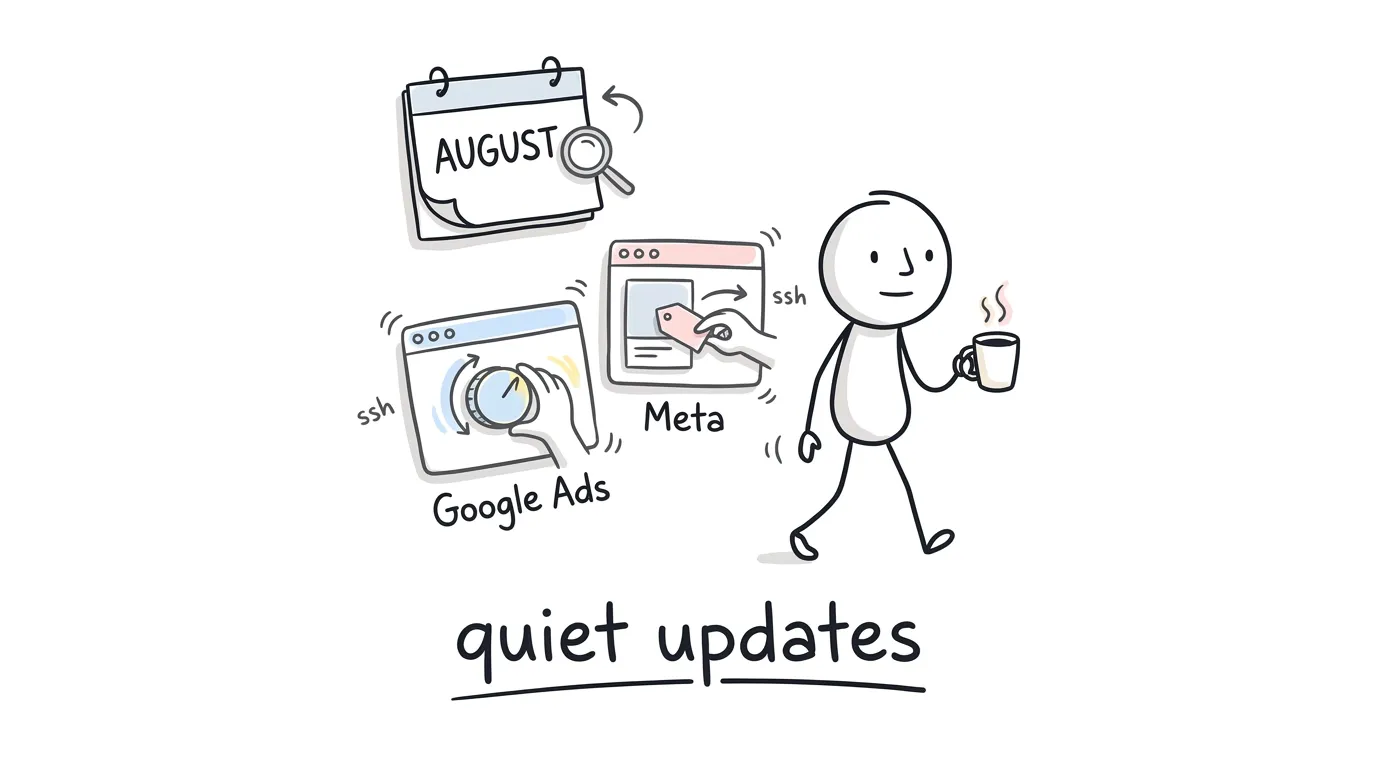
This August, Google Ads and Meta each made several moves of their own. None of them made much noise, but every single one touches your budget. Let me pick out the few worth your time and walk you through them.
First, Google: It Moved the Analyst Into Your Dashboard
Around August 10, Google rolled out a batch of new AI tools inside Google Ads and Google Analytics, powered by Gemini under the hood.
So what is AI Overviews?
An assistant that reads the numbers on its own and writes its own summaries. If traffic suddenly drops, sales data shifts, or your budget burns strangely, it flags the anomaly for you and attaches a short summary. These used to be jobs for a human staring at reports, cell by cell.
There's an even more powerful one, called Ask Advisor. In the past, when a metric fell, you had to guess: Is the creative fatigued? Did the auction dynamics shift? Did a competitor raise bids? Now you can just ask it, and it will break things down layer by layer to show you where the change actually came from.
Go one level further, and you get AI making charts for you. Describe the report you want in plain language, and Google Ads generates a visualization and talks you through the key trends. This capability is coming to Google Analytics soon, too.
Oh, and there's Benchmarking as well. You can take your own campaigns and compare them against the anonymous averages of merchants in the same industry and of the same size. That kind of data used to be something small companies could never buy at any price.
Think about it: what does it mean when these four things land together?
The "pull the reports, make the charts, hunt for anomalies" portion of a media buyer's job is being taken over wholesale by AI. From here on, a media buyer's moat comes down to three things: data quality, business goals, and strategic judgment. The platform takes over execution and leaves the judgment to you.
August 17: "Calibration Day" for Bidding Strategies
The second item is about bidding, and it takes effect on August 17.
Google adjusted target-based bidding strategies like Target CPA and Target ROAS, with the aim of making results hew more closely to the targets you set. Campaigns with tight budgets in particular should run more steadily.
Sounds like a good thing, right?
But there's a detail where many advertisers will get caught out: campaigns that are currently outperforming their targets will, after August 17, most likely get pulled back to somewhere near target.
What does that mean? Let me give you an analogy.
Before, the system was like a student eager to impress: you said the passing grade was 60, and he insisted on scoring 85. Naturally, you were delighted. But now the teacher has spoken: no exceeding the syllabus — run right at 60, stability trumps everything. And so 85 becomes 62.
Did performance get worse? No. It's just no longer overshooting; it's hugging the line. For budget-constrained advertisers, that's actually a form of certainty.
So around August 17, dig out every budget-constrained campaign and review it. Leave yourself four options: leave the target as is, adjust the target based on recent performance, switch to a different bidding strategy, or add budget and let it rip. Which one you pick depends on whether you want stability or scale.
Now, Meta: Labels, Tax Bills, and an Early Exam
Over at Meta, four things changed.
First, AI labels. Any ad that was created or edited with third-party generative AI tools will be labeled automatically by Meta. It relies on industry standards like C2PA (an industry standard that embeds provenance info in file metadata) to read the metadata inside files, and once it finds signs of AI generation, on goes the label. Users can see it by tapping the three dots in the corner of an ad and opening "About this ad".
What's your take on this one? Mine: don't fight it. If it's going to be labeled, let it be labeled — hiding it was never going to work anyway.
Second, taxes. If you're on monthly invoicing, pay attention: in Australia, India, Canada, and South Korea, the way tax amounts are calculated has changed. VAT, GST, and similar taxes are now computed based on the "Sold to" address in the ad account. The tax lines on your invoices may look different from before. Best to give your finance team a heads-up in advance.
Third, and I think the most practical: creative pre-review. Videos and banners can now be submitted for review before they officially go live. Think of it as a mock exam before the real thing — you find out up front whether you'll pass, instead of sweating it out stuck in review on launch day.
Fourth, Smart+ campaigns now cover more ground. The upgraded Smart+ supports Search ads, right down to configurable keyword settings; it also adds two new objectives, app promotion and lead generation, both available via the API. In short: the territory of automated advertising just got bigger.
Finally, Back to My Friend
When the retrospective wrapped up, I told him: platforms never send invitations for changes like these. They change on their own schedule while your account keeps running, and by the time you feel something, it's usually because performance is already wobbling.
The system won't notify you about every change. But your bills and your reports will.
So make a small habit of it. Pick a fixed time each month to go through the backend updates across your platforms — it takes about as long as finishing a cup of tea. When you spot a change, first ask what it means for your own account, then decide whether to act.
May your campaigns always run ahead of the changes.
Continue reading
Related articles

It's 2026: Stop "Buying" AI Tools for Your Marketing Team — Start "Hiring" AI Agents
This learn article explains how AI agents differ from standalone AI tools in marketing, outlines three agent categories — build-your-own platforms, CRM-native agents, and vertical tools — and covers use cases across SEO, social media, advertising, and reporting, plus criteria for choosing one.

Did the Money You Spent on AI Marketing Ever Come Back?
A guide to measuring AI marketing ROI across three layers: ad reports, sales pipeline, and the financial ledger. Covers metrics such as ROAS and CPA, eight dashboard metrics, industry benchmarks, and common measurement mistakes.

How to Pick a Creative Automation Platform: First, Figure Out What These Eleven Actually Do
A learn article sorts eleven creative automation platforms — including Bannerflow, Celtra, Smartly.io, and Storyteq — into four functional groups and proposes five evaluation questions covering publishing reach, automation depth, ease of adoption, team fit, and verifiable evidence.