
What Is an AI Marketing Agent? From "Using AI" to "Delegating to AI"
A learn article explaining what an AI marketing agent is, how it differs from rule-based automation, and which repetitive tasks such as lead qualification, reporting, and campaign monitoring can be delegated while humans keep key decisions.
A few days ago, I had dinner with a friend who works in marketing.
He complained to me that for his team, the most time-consuming thing day in and day out isn't coming up with ideas — it's hauling data. Researching one topic means opening five different tools. When leads come in, someone copies them from the form into the CRM, then copies them again into a spreadsheet. To write the weekly report, you click through the backends of six platforms one by one, take screenshots, and paste them in.
He said: "I feel like we're not doing marketing. We're doing hauling."
Hauling. I told him that word was exactly right.
Marketing has always been a long assembly line. Research your users, produce content, launch campaigns, read the data, qualify leads, write reports — every link connected to the next. And in the traditional way of working, between every two links, there had to be a person manually carrying the output of the previous link over to the next one.
Now, something has started to take over that "hauling."
It's called an AI marketing agent — AI Marketing Agent.
What Is an AI Marketing Agent?
First, think about how you usually use AI.
You say, "Write me 5 social media captions." It writes them. And then? Then there's no "then." You still have to pick, edit, and publish everything yourself.
That's a tool.
An agent is different. You can give it a goal: "Get the promotion for our new service ready for next week." Then it goes off on its own — researches your target audience, digs through your past campaign data, finds the topics, writes the first draft, picks the channels, organizes the assets, and finally lays everything out in front of you, waiting for you to make the call.
Count how many steps happened in between. And every one of those steps was taken by the agent, from nothing more than a single goal you gave it.
A tool is something you reach for. An agent is something you hand your work over to.
This is the most substantive change in marketing over the past two years: AI has gone from something you "use" to something you can "delegate to."
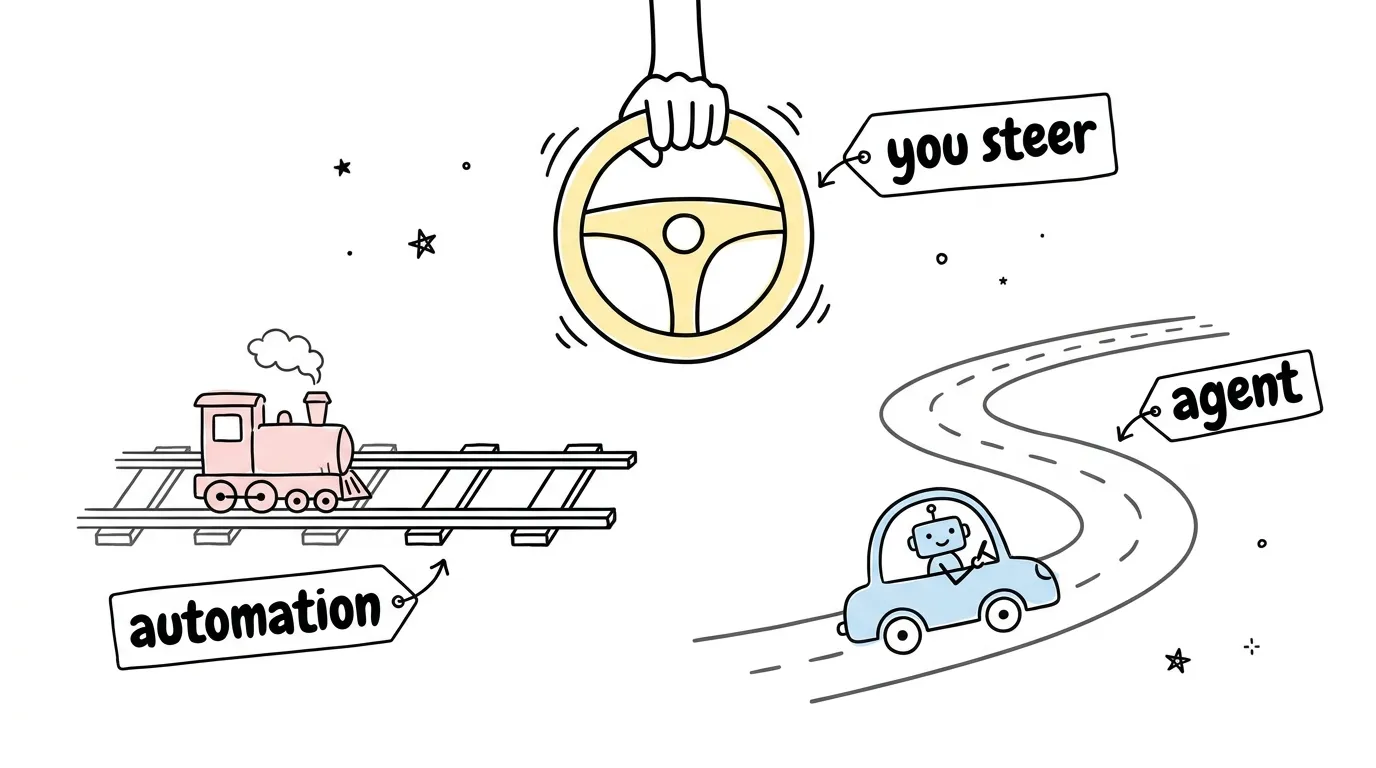
But let's be clear about one thing: delegating doesn't mean handing over the keys. Handing your entire marketing department straight to AI? Not a chance. The play that actually works is: pick out the processes that are repetitive, data-intensive, and step-chained, and hand those to the agent. The steering wheel stays in your hands.
Automation vs. Agents: What's the Difference?
A lot of people can't tell two things apart: automation, and agents.
What is traditional automation? It's a train. The tracks are laid down and fixed: a form gets submitted, it's added to the CRM, an email goes out, sales gets notified. Every single item runs along the same track, without the slightest deviation.
What is an agent? It's a driver. When the same lead comes in, it first looks at what the person filled in, judges what kind of customer this is, and then decides what to do next: complete profiles go to high priority and get pushed to sales; incomplete ones get an automatic follow-up; obvious mismatches get a polite decline; anything uncertain gets paused and brought to you.
Automation runs on rails. An agent reads the road.
And precisely because it has the freedom to adapt to circumstances, it also needs a much tighter rein than automation does. More on that later.
So where do people fit in? People's position has moved up.
Before, people were the hands on the assembly line, moving things along. Now, people are the brains standing outside the assembly line: setting goals, establishing rules, approving key decisions, reviewing results, handling exceptions, and refining the playbook.
Honestly — which of those six jobs isn't worth more than hauling data?
Which Tasks Can You Hand Over?
Let me give you the ones that left the deepest impression on me.
First: qualifying leads.
Think about it. A hundred inquiries come into your website in one day. In the past, a person would read them one by one: What industry? How big is the company? What service do they need? What's the budget? How urgent is it? Then classify them, then assign them to sales.
Now, the agent runs through them one by one against the criteria you set. High-priority ones go straight to sales; incomplete ones get followed up automatically; mismatches get a polite reply. Sales time is spent only on the people who actually deserve it.
Second: producing reports.
What did the old weekly report look like? "Traffic went up 12%." That's it. Why did it go up? Nobody could say.
The report an agent produces looks like this: "The traffic increase came mainly from organic search, with two service pages contributing most of the growth, while direct traffic stayed flat."
The first one is data hauling. The second is data interpretation. That one difference alone is worth the price of admission.
Third: watching for anomalies.
What's the scariest part of running ads? It's not bad data — it's data going wrong without you knowing. An agent can keep a constant eye on click-through rates, conversion rates, and cost per lead, and call you the moment something looks off: "Campaign A's lead volume has dropped well below its recent baseline. Worth a look."
If you wait until your weekly meeting to find out, the budget has already been burning for an extra week.
There's also SEO audits: keywords that shifted, which high-value page lost visibility, which article is short on internal links, which new topic nobody on your site has covered yet — it can all be laid out in a checklist, ranked by priority. And there's social media operations: from finding topics, building the calendar, drafting posts, and adapting one draft for multiple channels, to monitoring engagement and running retrospectives — the agent can lend a hand across the whole loop. That said, anything brand-sensitive, crisis PR, and public statements must pass human review. Not a single one of those can be let go.
These tasks all have one thing in common: repetitive, data-heavy, step-chained.
Which is exactly the agent's home turf.
A Capable Agent Stands on Six Layers
But I want to remind you of one thing: behind a capable agent, there isn't just some magical large model.
It stands on at least six layers of things. A model that can reason and generate. Context that understands your business — what you do, who your customers are, what your policies are. All your data sources — CRM, analytics backends, product catalogs. The tools it can operate — email, CMS, social media, spreadsheets. And above that, two layers that are the easiest to overlook and the most dangerous to ignore: permission boundaries defining what it can and cannot do, and a review mechanism that guarantees a human is checking things at the critical moments.
The agent guidelines that vendors like Google Cloud and Shopify have been rolling out all boil down to the same two points: get your data ready, and keep your governance up to speed.
An agent that's connected to a pile of tools but hasn't been fed enough business context and has no boundaries set will cause more trouble than it saves.
The Biggest Mistake: Wanting to Automate Everything
"The marketing department with no people" — sounds thrilling, doesn't it?
My advice comes down to one line:
Repetitive work, hand to the agent. Complex work, let it assist. Major decisions, humans make the call.
Weekly reports, organizing data, classifying leads, content research — hand those to the agent. Adjusting ad budgets, responding to customer complaints, setting prices, issuing public statements — let the agent help, but humans decide. Brand positioning, strategy, creative direction, key client relationships — don't even think about it. Those belong to people.
Why so cautious?
Because an agent only knows "what happened." It doesn't know "why it happened."
Conversion rates suddenly dropped. Maybe a competitor is running a promotion. Maybe the website went down overnight. Maybe it's just the season. Maybe a big news story pulled the traffic away. Maybe the tracking is broken. Or maybe the product really does have a problem.
Spotting the anomaly — that, it can do. Judging whether the anomaly matters, and what's behind it — that takes a human.
It's responsible for seeing. You're responsible for understanding.
How Much Does It Cost? Wrong Question
People often ask me: how much does it cost to get a marketing agent up and running?
There's no single answer to that question. On the light end, one workflow — model API calls plus an automation platform, and you're running. On the heavy end, you're looking at custom development, hooking up a pile of systems, building databases, setting up monitoring and security, and maintaining a support team. The gap between the two is orders of magnitude.
So don't ask "how much." Ask a different question:
Once this workflow runs smoothly, how much time does it save me? How many mistakes does it prevent? How many opportunities does it stop from slipping?
Run those numbers clearly, and whether it's worth it — you'll know on your own.
Start With One Minimal Workflow
Want to try? How do you start?
Whatever you do, don't start by "transforming the entire marketing department." Start with one minimal, most-measurable workflow.
Step one: find the single most time-consuming repetitive step in your team's work. Step two: map out the current process — what comes in, who makes the judgment, which tools get used, what goes out. Step three: split it into three parts — which parts are fully automated, which are AI-assisted, and which must stay human-only. Step four: give it only the data it truly needs, and nothing more. Step five: set the guardrails — what it can do, what it can't do, when it must ask for approval, and what to do when information is missing. Step six: run it in a small scope first, review every decision it makes, fix all the failure cases, and only then scale up bit by bit.
Take lead handling as an example. Before: a form comes in, an employee checks the email, copies it into the CRM, reads through it, writes a follow-up, assigns it to sales, updates the spreadsheet, and maybe remembers to check back two days later.
Now: a form comes in, the agent verifies the information, digs through CRM history, grades the lead, updates the record, drafts a personalized follow-up, notifies the right person, keeps an eye on the next step, and escalates on its own whenever something looks off.
The difference isn't just a few fewer clicks. It's that information now flows between systems on its own.
Whether It Works, Let the Business Metrics Speak
One last thing: how do you judge whether this actually works?
Don't measure it by excitement. Measure it by business metrics: how many hours saved? How much faster? What's the error rate? How much output needed human rework? Any change in leads, deals, retention? Is running one task cheaper or more expensive than the old process?
A successful deployment can always show you the numbers.
If you can't run the numbers, it's just a story.
After That Dinner
Oh, and one more thing I should add. Don't expect an agent's first draft to be publishable. From my own experience, a machine's first draft lands at about seventy out of a hundred. But what a seventy-point draft saves you is the climb from zero to seventy. The last thirty points — judgment, taste, the brand's voice — that's exactly where human value lives.
As dinner was wrapping up that night, I told my friend: the craft of marketing in the future won't be a world without people. There will be fewer people hauling data, and the people who set the rules and make the calls will be worth more.
What AI agents take over is the operational layer.
The steering wheel is still in your hands.
Here's hoping you get up from the hauler's spot soon.
Continue reading
Related articles

Marketing Automation Is Shifting from "You Do It" to "You Say It"
This article explains how marketing automation is shifting from rule-based platforms that merely execute toward AI agents that plan, create, publish, and review campaigns, covering delegable tasks, underlying technologies, tool categories, adoption steps, and risks such as privacy and automating without strategy.

When AI Does the Creative, Mistakes Come in Batches Too
A learn article on the risks of using generative AI for marketing creative across brand, legal, compliance, and operational layers, with case examples and seven practices for review, rights clearance, documentation, and vendor governance.
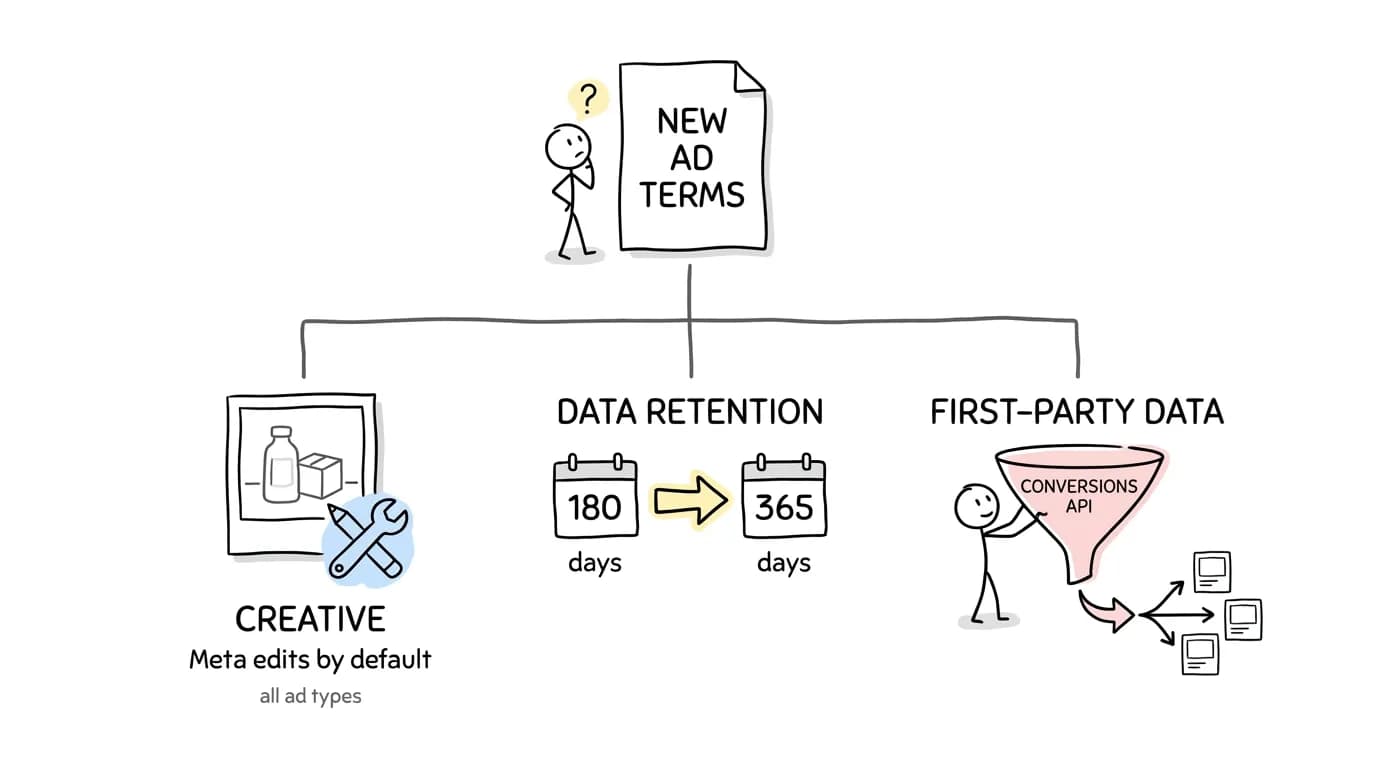
Meta Changed Its Ad Terms: Your Creative, Your Data, and Your 365 Days
This learn article explains Meta's updated advertising terms, covering default automatic creative edits, a conversion data retention window extended from 180 to 365 days, and broader use of first-party data, plus configuration checks for advertisers. It notes reports that the terms were reportedly suspended before the