
Stop asking what GEO is. In 2026, start asking how to do it
A deep-dive guide on treating SEO, AEO, and GEO as one craft, arguing that structured data and entity markup are the highest-value investments for visibility in AI-generated answers. It also covers CMS capabilities, common audit mistakes, and a practical starting checklist.
A while back, I sat through two webinars back to back — one for a European audience, one for North America — both on the same topic: search in the age of AI.
The Q&A sessions said it all.
Not a single person asked "What is GEO?"
Everyone wanted to know: how, exactly, do you do this? How do you build the content? How do you lay the technical foundation? How should the CMS be set up?
One attendee who filled out the post-session survey put it more bluntly: too shallow.
It was a polite complaint, but an accurate one. So in this piece, I want to go deep on what lies beneath that "shallow." Four things, mainly: how to treat SEO, AEO (answer engine optimization), and GEO as one craft; why structured data is the single best investment you can make right now; how your CMS is either helping you or hurting you; and the old mistakes even mature teams are still making.
One Craft, Three Audiences
Plenty of clients' first reaction is: "We need to get a GEO strategy in place, fast."
Every time I hear that, I want to hit pause.
What is GEO? GEO stands for generative engine optimization — getting AI systems like ChatGPT, Perplexity, Gemini, and Claude to mention you and cite you when they answer questions.
The term wasn't invented on a marketing whiteboard. It comes from a paper published in November 2023 by researchers at Princeton, Georgia Tech, the Allen Institute for AI, and IIT Delhi.
In one experiment, adding citations, statistics, and expert quotes to web content boosted its visibility in generative answers by up to 40%.
They also tried keyword stuffing.
It didn't work.
My first reaction reading this: isn't this exactly what the SEO old guard has been preaching for a decade? Cite your sources, bring data, bring authority, write like a human.
Yes. The playbook hasn't changed. The audience has.
SEO serves rankings in traditional search results. AEO serves featured snippets, People Also Ask, and the increasingly common AI Overviews — a direction search engines have been moving in for years. GEO serves being cited inside generative answers.
The underlying skills overlap heavily. But the people in the seats are different.
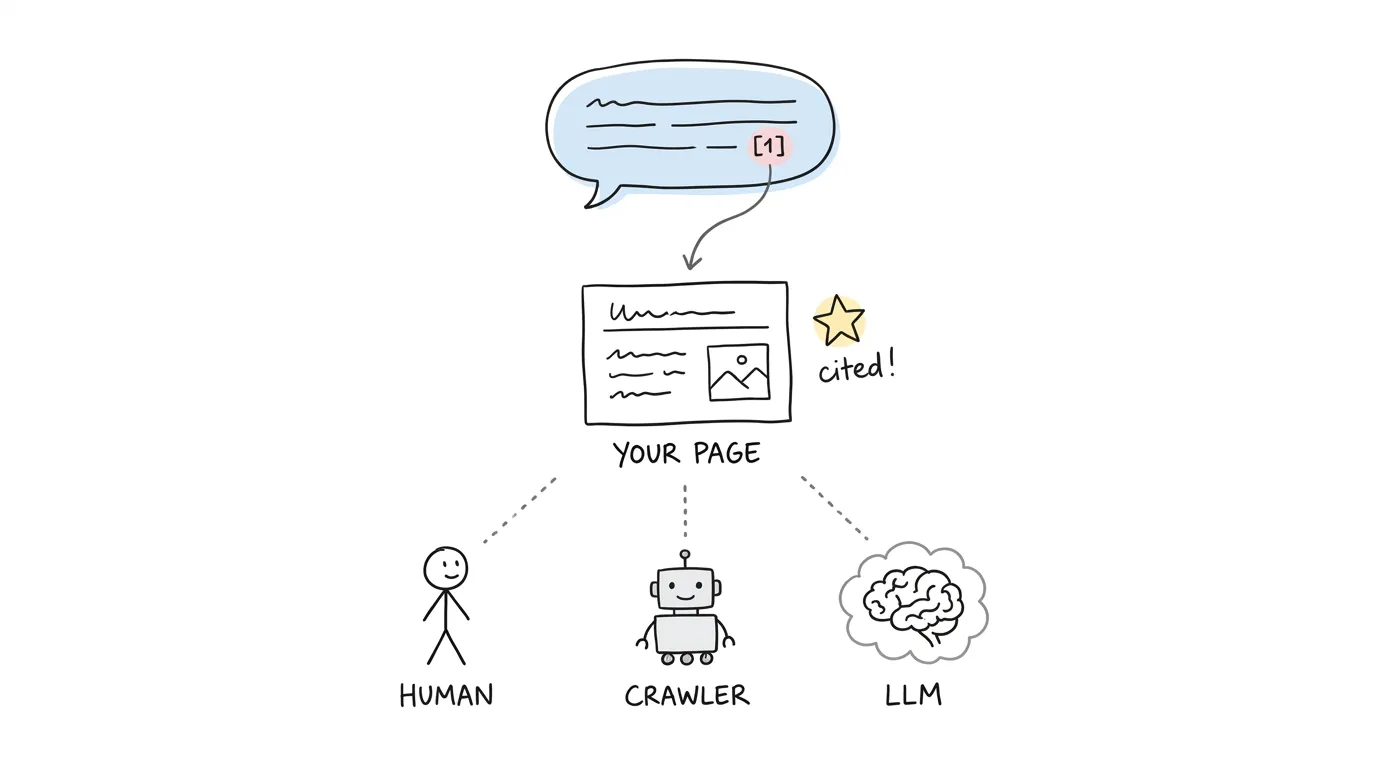
Here's a mental model you can self-test with. Picture a human reader, Googlebot, and a large language model looking at the same page, one after another. All three should walk away with the same understanding. Whichever one doesn't — that's your gap.
So where exactly do LLMs and crawlers differ? Crawlers read rendered HTML; LLMs lean far more on structured data, semantic markup, authoritative citations, and topical depth. Same toolbox — just a different priority order for every tool in it.
So don't spin up a separate "GEO strategy." What you should do is take the work you were already doing — and do it more rigorously.
The Awkward Question: If AI Already Gives the Answer, What's in It for Us?
In the North America session, one question came from an attendee who sells insurance in the US:
"If AI Overviews just give the answer away, aren't we losing clicks? Why bother being cited at all?"
Good question. Before you rush to pessimism, let's do the math.
Google handles roughly 14 billion searches a day. ChatGPT? About 37 million.
210 to 1.
The shift to AI search is real. But the traditional search pie is still enormous. So the answer isn't either-or — you do both.
Now the bad news. Once an AI Overview appears on a page, click-through rates on traditional results take a beating:
Ahrefs measured 300,000 keywords: the #1 position lost 58%. Seer Interactive ran long-term tracking on informational queries: organic click-through rate fell 61%. And BrightEdge measured one ratio in early 2026: roughly 48% of Google searches now trigger an AI Overview — and that share is still climbing.
Sounds pretty bleak?
Now look at one more number. From that same Seer research: brands that got cited inside AI Overviews actually earned 35% more overall organic clicks on those queries.
Think about what that looks like.
It's like being called out for praise in a meeting. After the meeting, more people come find you. Being cited isn't being replaced — it's a visibility card, and trailing behind it is click intent in the very next query.
So this multiple-choice question is actually simple. If a query is going to trigger an AI Overview anyway, you have exactly two options:
Be cited: your brand is in the room, captures some clicks, and earns compounding returns after.
Be absent: zero visibility, zero clicks, zero compounding.
Being cited beats being absent.
But don't get greedy. The head terms that are pure definitions — "what is X" — may already be out of reach. Put your effort into commercial-intent mid- and bottom-funnel terms; that's where the return is highest.
One more thing: a metric that's being swapped out. We used to watch rankings and click-through rates. On the generative side, the core metric is now the reference rate: of a given set of queries, in how many do generative answers mention or cite you? Tools like Profound, Scrunch, and Peec AI give you this number directly.
If your team is still only watching rankings, you're measuring half the conversation. The other half happens where the concept of "ranking" doesn't even exist.
Concrete action: list your 25 to 50 most important commercial terms and watch two things — how often an AI Overview appears, and of those, how often you get cited. Prioritize the terms where there's an AIO but it isn't you. For terms with no stable AIO, plain traditional SEO still works just fine.
The Single Best Thing to Do in 2026: Get Your Schema in Order
Why schema, of all things?
Because search engines can execute JavaScript and infer your page structure. LLMs are much weaker at both. Structured data is the clearest, most stable signal they can get.
One question from the webinars would not have stung this much a year ago: what happens to FAQ content that's collapsed inside an accordion and only expands when a user clicks?
Google has always said content behind a user-initiated expand is fine. But an LLM may never execute that JavaScript at all. Which means the answers you hid away — it never saw them.
That's exactly where schema earns its keep: with JSON-LD, question-and-answer pairs go into the page source, independent of the visual interface. You can hide it from users and still lay it out flat for machines to read.
There's also a badly underrated use: entity recognition. Structured data doesn't just help crawlers index — it helps LLMs turn your brand, products, and authors into entities they "know" internally. Pin your Organization with an @id, point sameAs at social profiles and Wikipedia entries, mark up authors with Person. What shows up again and again in practice: brands with clean, consistent entity markup get cited in generative answers at a markedly higher rate than brands that live only in body text.
Entity clarity may be the least glamorous and most valuable part of GEO.
So where should schema live? A few ground rules:
Organization schema: exactly once site-wide, on the homepage or the About page, referenced by other blocks via @id — stop copy-pasting it everywhere. FAQPage: goes where the page content goes, managed by editors inside the CMS, never hardcoded into templates. Article, BlogPosting and the like: templates define the structure, content fields supply the values, generated dynamically. For everything else: Product for products, Event for events, Course for courses.
One content type, one matching schema. That's the principle.
One change deserves its own paragraph. As of May 7, 2026, Google no longer shows FAQ rich results in search, and the accompanying reports and tool support are being retired over the following months. But the FAQPage type itself remains valid, and Google has said explicitly it will keep using it to understand pages.
For SEO, you lost one display slot. For GEO, the signal to LLMs is still there — and it might even be worth more now.
While we're here, let's untangle two things that get confused.
SEO schema and GEO schema draw from the same vocabulary, but you pick differently. On the SEO side, you're bound by Google's list of rich result types. That list is closed, and shrinking: HowTo rich results were retired in 2023, FAQ rich results this May. Types outside the list earn no display treatment no matter how cleanly you mark them up. On the GEO side there is no list — value comes from entity clarity and facts that are easy to extract, so properties matter more than types: bind Organization and Person tightly with @id and sameAs; give Article a named author and a publish date; lay FAQPage question-and-answer pairs out in JSON-LD; then use about, mentions, and citation to attach your content to entities the models already know.
In one sentence: SEO schema wins you a display slot; GEO schema makes sure a system that never runs your JavaScript can still recognize you, unambiguously.
Most pages need both.
The CMS layer is moving too. Sitefinity 15.4 added AI-Friendly Structured Content, which auto-generates Schema.org JSON-LD from your existing content fields, taxonomies, and relations. Adobe Experience Manager, Drupal's Schema.org module, and various WordPress plugins are all heading the same way. What matters here isn't which tool — it's two things they share: first, editorial teams can manage schema themselves in the admin instead of queuing up for engineering; second, page-level and content-level schema render as two separate JSON-LD blocks, which is what Google's guidelines call for.
If you take away only one thing from this piece, make it these four steps:
One: confirm Organization and WebSite each appear exactly once site-wide. Two: confirm WebPage is on every page. Three: give your high-value content types their matching entity schema. Four: validate everything with the Schema.org documentation and Google's Rich Results Test.
Finally, three writing habits that make it easier for LLMs to "lift" from your pages:
Lead each section with the conclusion, then the evidence. Anything countable becomes a list — three reasons, five steps. Summary sentences that open with "In short" or "The key point is" are exactly what LLMs love to quote.
Honestly, this is all old-school editing craft. It just has a machine audience in the seats now.
Your CMS Might Be Your Ceiling
However good your strategy and content, a CMS that keeps everything locked down can waste half the effort.
The choke points usually come down to three.
First, schema management. If structured data can only change through template edits, the business team can't iterate. Sitefinity recently moved to auto-generating schema from content fields, AEM uses structured content models, Drupal has a ready-made module. Different tools, strikingly aligned direction.
Second, semantic structure. Some platforms leave you nothing but hardcoded HTML to pile up, with heading hierarchy and metadata gated behind developers. Pages full of semantically bare tags are hard for crawlers to read — and harder for LLMs.
Third, page-level control. Titles, descriptions, canonical, robots, Open Graph — editors should be able to set these per page without pulling in engineering. When you pick a CMS, these need to be native features, not something stitched together from plugins.
Next time you evaluate a platform, whoever you end up choosing, throw these five questions at them:
Can editors manage schema per page and per content type without a deployment? Is the Schema.org markup it outputs valid and current, and do the page-level and content-level layers stack correctly? Can editors set canonicals, redirects, and noindex on their own? Do the built-in components and widgets emit semantic HTML by default? Is AI-assisted optimization native, or does every gap demand a bolt-on tool?
By the way. People love to complain that "marketing and IT can't collaborate." From what I've seen, most of that friction is actually stuck at the CMS layer. When the tools work, nobody even feels like arguing.
The Mistakes Even Mature Teams Make
Marketing treats SEO as a content problem. Engineering treats SEO as a configuration problem.
Both are right, and both are incomplete. The cost of the mismatch is opportunity leaking through the cracks.
The three most common errors in audits have little to do with which CMS you run:
Hardcoded copy in templates. One "Learn more" button as static text, and personalization, localization, and search optimization all die together. The fix works on every platform: descriptive text goes through content fields, no exceptions.
Looks like a heading, actually a paragraph. Style a p tag into an H1 costume, and crawlers and LLMs will only ever see the tag — they don't grade on looks. This mistake is expensive. Audit templates by their tags, not their screenshots.
Custom components that never had an SEO checkup. Tabs, accordions, carousels, modals — every single one needs its own pass: can it be crawled? Is the semantic structure right? Does it carry structured data?
At the root, all three errors are really the same error: unclear ownership. Marketing thinks it's engineering's job; engineering thinks it's marketing's. When there's credit to claim, everyone rushes forward; when there's blame to assign, everyone points elsewhere.
Jocko Willink, a former Navy SEAL, has a one-word catchphrase: "Good." Project went sideways? Good. Now you know — and now you can fix it.
I love that attitude. An audit report shouldn't be a list of blame. It should be a list of opportunity.
And the implementation costs nothing: 30 minutes a month, marketing and engineering in one room, one engineer on rotating duty, walking through new templates and components before they ship. That's all it takes.
Don't Lose the Fundamentals
The European Accessibility Act has pushed accessibility into the spotlight. But let's be clear about one thing: the first people alt text serves are screen reader users. The SEO benefit is a side effect.
Audits turn up two familiar problems. One is keyword-stuffing irrelevant stock photos — a low-quality signal. The other is the sadder one: the images that actually carry information — product shots, diagrams, screenshots — sit there with empty alt attributes.
Write alt text like body copy. A practical test: imagine describing the image to someone over the phone. Write exactly what you'd say.
Same for anchor text. Descriptive anchor text helps screen reader users navigate, helps search engines understand link context, and helps LLMs follow the citation chain. "Click here" carries zero information for anyone.
And heading hierarchy: one H1 per page, in the right place. Multiple H1s show up in audit after audit — and this is one content teams can fix themselves, no developers required.
Canonicals are a perennial question in the Q&A. Most modern CMSs, Sitefinity included, auto-generate canonicals as the detail-page URL plus the content item URL. The question you actually need to ask is: can the same content item be reached from multiple detail pages? If yes, a single canonical must be designated. Build a checklist of every dynamic content type and confirm each one. Automation tools can help; manual spot checks cannot be skipped.
Three more small things. When you migrate, map every 404 in the logs to its new address — don't wait for rankings to drop before you remember. Generate sitemaps automatically and revalidate whenever the structure changes. Check robots.txt at least once a year: are the right things blocked, and the right things allowed?
None of this is sexy. But the easiest wins are all buried right here.
AI Assistants Grown Inside Your CMS: What They Can and Can't Do
In 2026, every CMS vendor is stuffing an AI assistant into the editor. Sitefinity shipped two in 15.4 in one go: the SEO Agent and the Brand Agent. Adobe, Contentful, and Drupal are all pushing similar things.
What they're good at: checking content against SEO best practices point by point inside the editor, catching problems before publish. For teams with high content volume — one human SEO simply cannot review every page — this is genuinely useful.
What they can't replace: strategy. Schema architecture. Topic clusters and content roadmaps. Canonical decisions. Anything that requires judgment about brand stance and business priorities.
Here's the positioning I'd give them: a senior editor who reads every page for you. Very good, and very much worth it. But an editor is not an editor-in-chief.
Don't confuse them with another category. External monitoring platforms like Profound, Scrunch, and Peec AI — with SEMrush and HubSpot now entering too — answer a different question: across the whole AI ecosystem, which queries do you show up in?
In one sentence: assistants inside the CMS mind what you ship; external monitoring tells you what to ship next. Teams serious about AEO and GEO need both.
Don't Know Where to Start? Start Here
One: audit your structured data coverage — Organization and WebSite once each site-wide, WebPage on every page, entity schema on high-value types, validated with Rich Results Test.
Two: if your CMS supports native schema generation, turn it on — then check the quality of what it outputs.
Three: backfill the accessibility fundamentals — alt text, anchor text, heading hierarchy. For sites serving Europe, the European Accessibility Act makes these non-negotiable; the SEO and GEO benefits come free.
Four: put your 25 most important commercial terms under AI Overview and citation tracking. Without data, GEO investment is just guessing.
Five: audit canonicals and redirects — one canonical per thing, redirect chains kept clean.
Six: put a standing monthly 30-minute meeting between marketing and engineering on the calendar. You don't have to buy anything — one rotating owner is enough.
Seven: has it been more than 12 months since your last serious SEO audit? Do another one. The standards changed more in the past 18 months than in the decade before that combined.
Finally
Remember those two webinars at the start? Everything people asked at the end was really the same question phrased two ways: present, or absent.
AI Overviews are going to appear whether you like it or not. You can choose to be cited — or to look the other way.
AI keeps getting to the search answers first. Your job is to make sure that when it does, it mentions you.
Here's to always being present.
Continue reading
Related articles

It's 2026: Stop "Buying" AI Tools for Your Marketing Team — Start "Hiring" AI Agents
This learn article explains how AI agents differ from standalone AI tools in marketing, outlines three agent categories — build-your-own platforms, CRM-native agents, and vertical tools — and covers use cases across SEO, social media, advertising, and reporting, plus criteria for choosing one.

What Is GEO? How Your Brand Gets "Mentioned" in the Age of AI Search
An explainer on GEO (Generative Engine Optimization) for e-commerce and DTC brands: how it differs from SEO and AEO, why AI answers shape brand visibility, and eight practices covering question-focused content, consistent brand messaging, structured pages, external evidence, comparisons, and AI mention tracking.

AI Is Already Making Decisions for Your Customers. Are You on the List?
A learn article explains GEO (Generative Engine Optimization): why AI-generated answers now shape which brands customers see, and how SEO fundamentals, entity clarity, citable evidence, and monthly measurement affect visibility in AI answers.