
Google Swapped Its Brain Three Times in Two Weeks — the Search Table Just Got Reshuffled
A learn article reviewing recent search-industry developments, including Google's rapid AI model swaps, AI Overviews and AI Mode expansion, ads entering AI search, and social platform updates. It advises marketers to track whether their brand appears in AI-generated answers.
A few nights ago, I sat down and went through the past 90 days of search-industry news, start to finish.
When I was done, I just sat there for a moment.
Not because there was no news. Because there was too much. How much? In 90 days, Google alone confirmed 16 algorithm updates. 42 moves related to AI Overviews. 37 on AI Mode. 52 on ChatGPT.
And that's just the search side of things.
The more I read, the more I felt that a lot of people in marketing may not have realized what the table looks like now. Today, in plain language, let me walk you through what happened over the past two weeks.
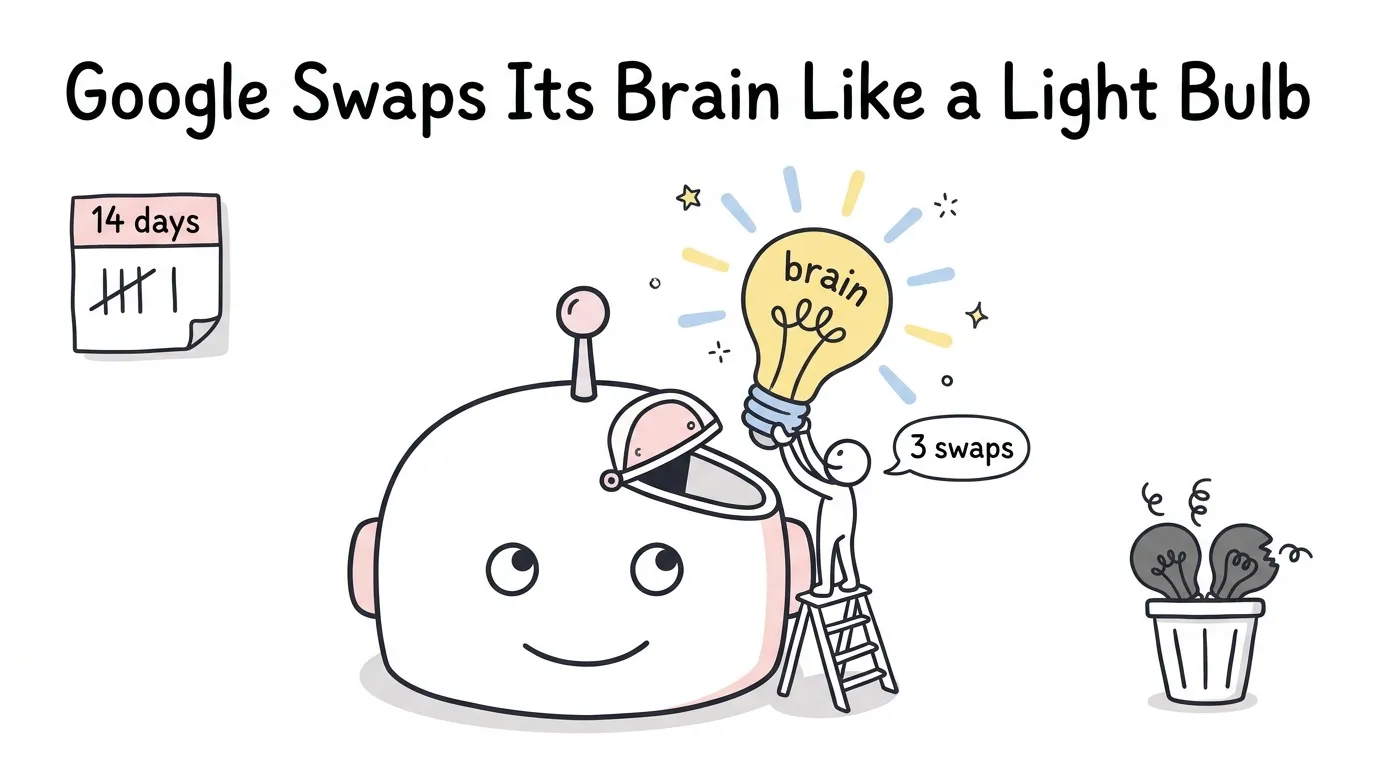
One: Google swaps models like changing a light bulb
On November 10, Google rolled out its third core update of 2026. Officially, a rolling rollout that can run up to two weeks.
You know core updates by now. But this time, the story isn't the core update itself.
It's the speed at which Google is swapping out the "engine" of AI search.
What do I mean by engine? The large model behind the scenes that generates answers for you.
On November 12, a model called Gemini 4 Hydrogen became the global default for AI Mode. The same day, Google said it had begun taking over "the hardest questions" in AI Overviews. And note — free users get it too; Auto mode picks it for you automatically.
Three days later, Carbon arrived. A few days after that, Neon shipped. Meanwhile, Argon, until then on the model roster, was gone.
The previous generation barely had time to warm up before it went into the recycling bin.
In the AI era, models aren't products. They're consumables.
One more number. The data firm SISTRIX tracked 1 million keywords in the UK and found that AI Overviews now cover more than 80% of them — with retail keywords gaining exposure fastest.
Eighty percent. Sit with that number for a second.
Keep in mind, back in 2023, AI Overviews was just a beta known as SGE. Three years later, 2.5 billion people use it every month.
Two: Where the traffic goes, the money follows
As always: where the traffic flows, the ads follow.
In November, Microsoft put out an announcement: ads can now run next to Bing's AI Overviews. All markets except China. No need to build new campaigns — existing campaigns just keep running.
OpenAI moved even faster. They named Aleph the exclusive reseller for ChatGPT Ads across 44 countries.
Forty-four countries.
So are people actually buying things on ChatGPT? There's a data point. SparkToro's research panel shows that among the prompts US users send to ChatGPT, 6.9% are brand research done before a purchase.
6.9% doesn't look like much. But flip the perspective: where did that research used to happen?
In Google's search box.
The entry point for buying decisions is moving house. That's the most valuable piece of information this month.
Three: The entry point is no longer a box
Search used to be a box. You opened your browser, typed a question, and got ten blue links.
And now?
On November 19, Robby Stein, Google's VP of Search, announced: the desktop homepage now has a collapsible sidebar listing your recent AI searches, rolling out globally. Meaning: AI search is no longer a feature you have to "go find" — it sits right at the front door.
AI Mode itself is morphing too. Temporary chats have arrived: no history saved, no personalization, ask and walk away. Why build this? Because there are always questions you'd rather not leave a trace of.
Connected Apps goes further still. Apps like Adobe, Calm, and Peloton are now plugged into AI Mode. Google Wallet has become a Gemini connected app. And as of November 17, Google's help docs show these connected apps have started appearing inside AI Overviews.
What does that mean? You say, "Help me plan my return-to-training schedule," and the AI doesn't just answer — it pulls up your Peloton data.
Gemini Live landed on Apple CarPlay. You talk in the car; it answers.
Gemini for Mac also learned to "operate the computer": clicking buttons on its own, filling in forms on its own, across apps and across the web. Currently open to paid users in the US.
Notice something? AI is no longer a tool you "go use." It's working its way into every node of your daily routine.
Four: Social media hasn't been idle either
Don't assume this is only happening in search.
X pushed three updates to its open-source ranking code this week. In the 68th update, one parameter stands out: the weight for shares via copied links was restored from 0.0 to 20.0. What's the signal? The platform is rewarding "copied and forwarded" content again.
LinkedIn says it rolled out a new classifier built specifically to push down "slop comments" — that is, the spammy, bot-flavored filler comments.
Instagram did two things. First, it gave creators content protection: when an original video gets re-posted, you can now trace who did it, hide it, or ask for credit. Then, Amazon became Instagram's official affiliate program — product links can now be attached in Reels, posts, and carousels in the US.
Content is the shelf. On Instagram, that line came true.
Five: So what should you do?
By now you might be feeling a little anxious. Updates this dense — can you really keep up?
My take: you can't chase every single update, and you don't need to.
Because the density itself is the new normal. Google runs three core updates a year and swaps models every month. This isn't an anomaly; it's the new rhythm.
Instead of chasing news item by item, keep your eyes on a few questions.
Does your content show up in AI answers? AI Overviews already covers 80% of keywords — is your brand inside that 80%?
Can you keep pace with the migration of the decision entry point? 6.9% of ChatGPT prompts are already shopping research. I can't say where that number lands next year, but the direction, most likely, is up.
And: are you being "fed" to the AI? Adobe can plug into AI Mode — can your service?
Stop asking what the algorithm updated. Ask: when AI goes looking for answers, does it find you?
One Last Thing
That night, by the time I finished the running log of news, it was past midnight.
I remembered the early days, when everyone did the same thing — staring down Google's Panda and Penguin updates like a five-alarm fire. And then? Then SEO became table stakes, and nobody shouts about it every day anymore.
AI search will probably walk the same road. From news, to common sense. From opportunity, to baseline.
The only question is: before common sense arrives, those who see it first get the dividend first.
Here's hoping you're one of them.
Continue reading
Related articles

It's 2026: Stop "Buying" AI Tools for Your Marketing Team — Start "Hiring" AI Agents
This learn article explains how AI agents differ from standalone AI tools in marketing, outlines three agent categories — build-your-own platforms, CRM-native agents, and vertical tools — and covers use cases across SEO, social media, advertising, and reporting, plus criteria for choosing one.

What Is GEO? How Your Brand Gets "Mentioned" in the Age of AI Search
An explainer on GEO (Generative Engine Optimization) for e-commerce and DTC brands: how it differs from SEO and AEO, why AI answers shape brand visibility, and eight practices covering question-focused content, consistent brand messaging, structured pages, external evidence, comparisons, and AI mention tracking.

AI Is Already Making Decisions for Your Customers. Are You on the List?
A learn article explains GEO (Generative Engine Optimization): why AI-generated answers now shape which brands customers see, and how SEO fundamentals, entity clarity, citable evidence, and monthly measurement affect visibility in AI answers.