
What Is AI Marketing Automation? It Starts With a 40-Point Gap
A learn article explaining what AI marketing automation is: how learning-based systems differ from rule-based automation, how AI decisioning optimizes message, channel, and timing choices, what data it depends on, and where it applies across the customer lifecycle.
A couple of days ago, I was flipping through a survey report — Braze's 2026 Global Customer Engagement Report. One set of numbers had me staring for a long time.
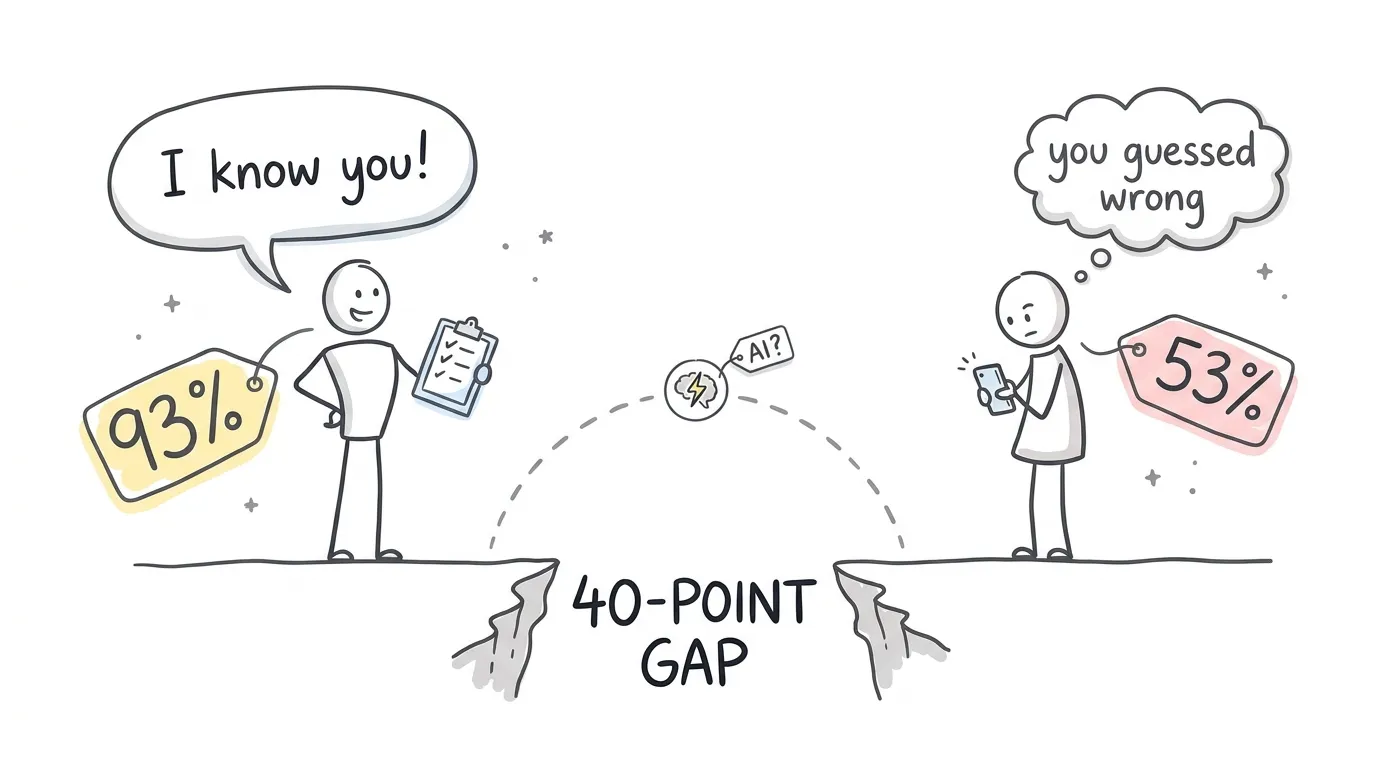
93% of marketing leaders say AI has made their insight into customer preferences far more accurate than before.
But in that same survey, only 53% of consumers feel that brands truly guess what they want.
93% versus 53%. A 40-point gap in between.
What does that mean? On one side, marketers are convinced: I've got you completely figured out. On the other side, more than half of consumers are thinking: you guessed wrong.
That 40-point gap is what I want to talk about today. What is AI marketing automation? How does it earn the right to close that gap? Let's take it one layer at a time.
First, a Scene That Will Make You Laugh — and Wince
Let me paint you a scene.
You're scrolling one night and come across a video from a plant-based food creator. You spot a recipe you like and save it. The next day, you open a different app — and the ad slot serves you a butter-fried chicken cutlet.
You, a vegetarian, getting served chicken every single day.
You scroll a little longer, and a web push notification pops up: Subscribe now! You dismiss it — and delete the app while you're at it.
Behind this process, it's not that there's no system. There is one — but the system is "dumb." It only follows rules a human hard-coded: viewed content, so push an ad; a few days of silence, so push a subscription. As for who you actually are and what you really want, the rules have no idea.
That's the ceiling of traditional marketing automation.
Traditional Automation Is, at Heart, a Megaphone
Traditional automation, to put it plainly, is a megaphone. A human thinks up a set of rules first: if the user does X, send Y. Signed up? Send a welcome email. Abandoned a cart? Send a reminder. It executes fast and precisely — a million messages a day without breaking a sweat.
But it has one fatal weakness: rules are dead.
The rules were written three months ago. In those three months, customers changed, channels changed — but the rules don't know. They only read from the script, and anything not written in the script leaves them with no lines at all.
McKinsey has a data point: 71% of consumers expect personalized experiences from brands, and 76% get frustrated when they don't get one.
On one side, customers waiting to be understood; on the other, a system that can only recite an old script. That's where the gap comes from.
What Is AI Marketing Automation?
AI marketing automation is fitting this system with a "brain that learns."
Traditional automation, plus machine learning, predictive analytics, and real-time decisioning. Put together, the system is no longer just dispatching messages by the book. While it runs, it learns from every customer interaction: What did this person just do? What will they most likely do next? What's the best thing I should do right now?
Back to that earlier scene. Swap in AI automation — what changes?
You saved a vegetarian recipe. The system notes it: this is someone with a sustained interest in plant-based eating. The next touchpoint brings new vegetarian content, timed to the window when you usually browse the app, and arrives as a lighter nudge — not a hard-sell ad.
Every interaction is new information. The system takes that new information and re-decides the next step.
The more it interacts, the better it guesses.
That's the most fundamental difference between it and a traditional system.
The Difference Isn't Speed — It's Who Makes the Decision
Many people assume AI marketing automation is just "faster automation." It isn't.
The difference isn't speed, isn't scale — it's who makes the decisions, and how.
In traditional automation, decisions are made by humans in advance. The marketing team thinks through every possibility, writes the rules, lays out the workflows. From then on, the system follows the book — until someone comes back to manually change the rules. Segments are static, paths are pre-drawn, and optimization relies on after-the-fact A/B tests: run a round, wait a few days, revise.
In AI automation, decisions are made by the model in real time. It analyzes behavioral data, predicts outcomes, and decides the next action — no need for marketers to pre-draw every path. Segments update in real time as behavior changes, and cross-channel orchestration replaces the manual test loop.
Here are the key differences, side by side:
| Traditional Automation | AI Automation | |
|---|---|---|
| Trigger | Pre-set rules | Real-time predictive signals |
| Segmentation | Static, manually updated | Dynamic, continuously self-adapting |
| Personalization | Rules swap in content | Predicts content, timing, and recommendations |
| Optimization | Manual A/B testing | Continuous automatic learning |
| Scale | Harder to maintain the bigger it gets | Built for high volume and constant change |
Of course, rule-based automation isn't dead. For simple, highly deterministic flows — like a welcome email after signup — rules are good enough, and cheap.
But if you're managing complex journeys across millions of users and dozens of touchpoints, the rule book starts to buckle.
The Bolder Step: AI Decisioning
This is, to me, the most interesting part — and the most advanced approach I've seen so far, such as Braze's BrazeAI Decisioning Studio.
A typical predictive model optimizes one thing at a time: which product to recommend, or which coupon to offer.
AI decisioning is different. Using a reinforcement learning approach (learning by trial, reward, and correction), it optimizes all variables at once: which message to send, which channel to use, what timing, what frequency, which creative, what incentive — computed in one go.
Powerful.
More importantly, its decision granularity is the "individual," not the "audience." Not "women aged 25–34 like this," but "Jane, right now, should receive this exact message." It learns with every interaction — no need to stop and retrain.
From guessing about a whole segment to guessing about this one person. That's a qualitative leap.
Once You Fit the Brain, What Actually Changes?
I've counted — at least three things.
First, from hindsight to foresight. It used to be: campaign ends, read the report, then adjust. Now the system reads behavioral signals in real time: this person is close to converting — give them a nudge now; that long-time customer shows signs of churning — act while the relationship is still alive. The same information, known a week earlier versus a week later, is worth a world of difference.
Second, people get freed up. Marketing teams used to spend huge amounts of time building workflows, tweaking segments, re-running tests. Hand those jobs to the system, and people can finally return to what they should be doing: strategy and creativity. The system keeps optimizing in the background; the person plots the next move out front.
Third — and the easiest to overlook: compounding. Manually maintained automation plateaus. The day the rules are finished writing is the smartest day of its life; everything after is slow decay. An AI system is the opposite: every extra day it runs is another day it learns, and the more it runs, the more accurate it gets. The gap between it and static rules isn't fixed — it keeps widening.
This is compounding inside a machine. The longer it runs, the harder it hits.
But There's a Catch: Feed It Well, or It Won't Deliver
AI isn't magic. How smart it is depends on what data you feed it. Four things, none of them optional.
First-party behavioral data. What customers directly do with you: what they browsed, what they bought, when they opened the app, whether they clicked the email. These behaviors are worth far more than demographic labels, because they expose intent and preferences directly. The more complete the behavioral record, the more accurate the predictions.
Event-level data. "History" alone isn't enough — you need the "moments." Viewed a product, abandoned a cart, renewed a subscription, opened a support ticket: every specific event is raw material for AI's on-the-spot judgment.
Real-time availability. Data that arrives a few hours late takes a nosedive in value. You view a product at 9 a.m.; getting a relevant reminder that same afternoon versus three days later is two completely different experiences. The first feels like "they get me." The second feels like "they're haunting me."
Compliance and trust. The deeper the data, the heavier the responsibility. When customers leave their behavior with you, they expect to be served, not to be gamed. Collecting openly, with consent, and holding the line on privacy compliance isn't just staying legal — it is the business itself. Data obtained the right way is actually better in quality, because it comes from a real relationship, not from exploiting loopholes.
This Stuff Works Across Every Stage of the Journey
In new-user activation, first impressions nearly decide life or death. AI can see which early experiences win over which types of users, then let each person take a different on-ramp instead of squeezing onto the same assembly line. Anyone showing churn risk gets pulled back early.
In the active-and-converting stage, AI watches behavioral signals: what they're looking at, how often they return, which categories they browse. With that, outreach is no longer calendar-blast messaging — it's "you're interested, and I happen to speak to exactly that." Messages that reflect real interest naturally convert better than "guessed interest."
Then the retention stage. Churn almost never happens suddenly. Session frequency is dropping, purchase intervals are stretching, email opens are thinning — these signals speak long before the user does. Predictive models can see it coming, letting the team step in while the relationship is still salvageable — and in a way tailored to each person.
And here's the interesting part: these stages aren't isolated. Insights from the new-customer stage feed the conversion strategy; behavior during conversion exposes churn risk early; lessons from retention loop back to improve how new customers are welcomed. The whole lifecycle connects into one web, with every stage supplying ammunition to the others.
The system gets smarter with use, and the business gets smoother to run.
Finally, Back to Those 40 Points
93% of marketers feel they understand their customers; 53% of customers feel understood.
The missing 40 points aren't about attitude — they're about tools. They come down to whether your system is a set of rules hard-coded three months ago, or a model that's still learning right now.
Rules are dead, customers are alive. Chase living people with dead rules, and you fall further behind; walk alongside living people with a system that learns, and you draw closer with every step.
Here's to a system that understands your customers a little better every day than it did yesterday.
Continue reading
Related articles

Marketing Automation Is Shifting from "You Do It" to "You Say It"
This article explains how marketing automation is shifting from rule-based platforms that merely execute toward AI agents that plan, create, publish, and review campaigns, covering delegable tasks, underlying technologies, tool categories, adoption steps, and risks such as privacy and automating without strategy.

Rankings Are Taking a Dive, Customers Are Sprinting Ahead: This November, I Re-Ran the Numbers on AI Search
A learn article on how AI search reshapes marketing measurement, covering reported mismatches between rank-tracking tools and live Google results, ChatGPT's business profile test, single-page visitors as high-intent leads, and CRO plus GA4 tracking verification practices.
6 Days to Black Friday: These 5 Meta Ads Changes — Learn to Tell Real Growth from Report Growth
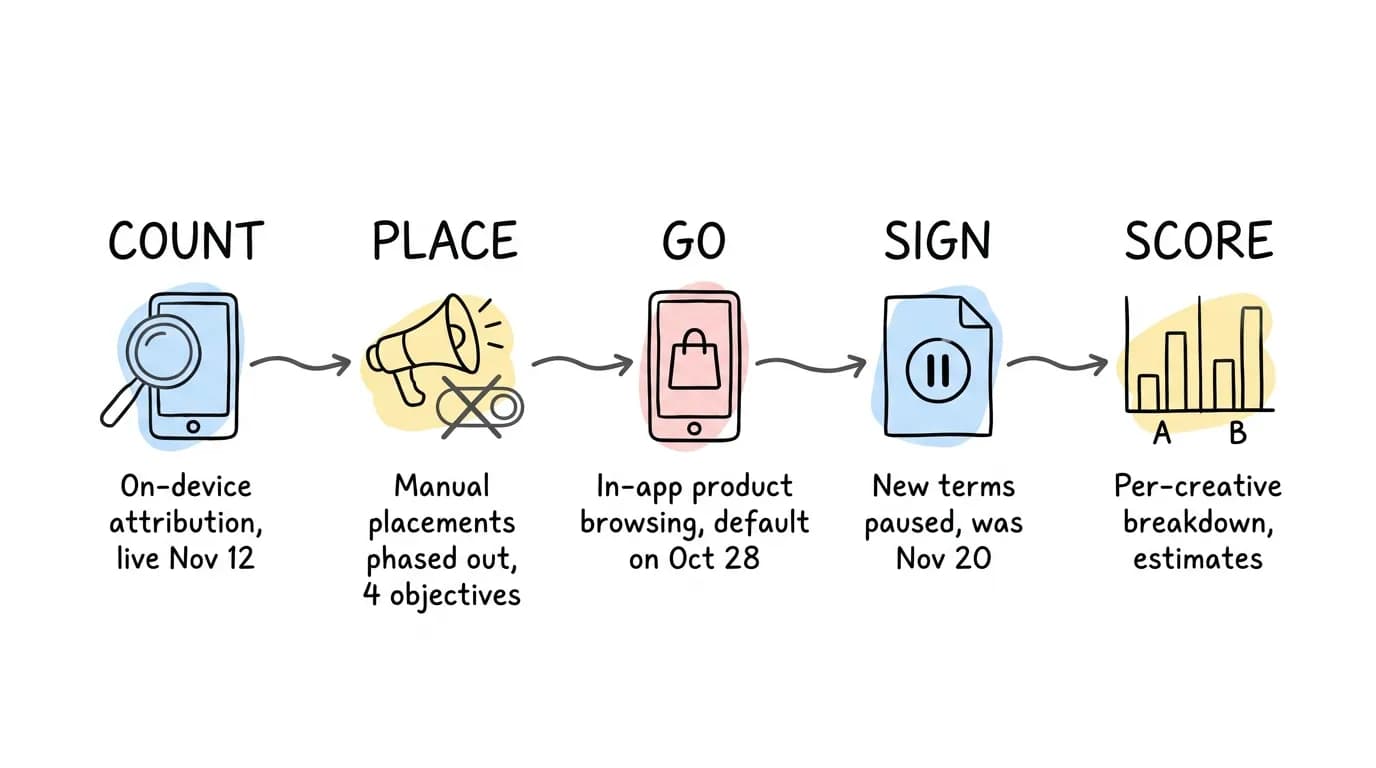
A pre-Black Friday walkthrough of five November Meta ads changes: on-device attribution, placement automation, in-app product browsing, paused terms, and per-creative breakdown reporting. It stresses reconciling platform reports against order data before judging performance.