
Rankings Are Taking a Dive, Customers Are Sprinting Ahead: This November, I Re-Ran the Numbers on AI Search
A learn article on how AI search reshapes marketing measurement, covering reported mismatches between rank-tracking tools and live Google results, ChatGPT's business profile test, single-page visitors as high-intent leads, and CRO plus GA4 tracking verification practices.
Let me tell you a story first.
A few days ago, the founder of a digital marketing agency shared a case study. It left me staring at the screen for a long while.
Their backend had received an inquiry. The visitor clicked into the website, viewed a single page, then went ahead and completed the contact form. One visit, one page, one completed form.
If you'd seen data like this a while ago, what would your first reaction have been?
Is this visitor a bot? A mis-click?
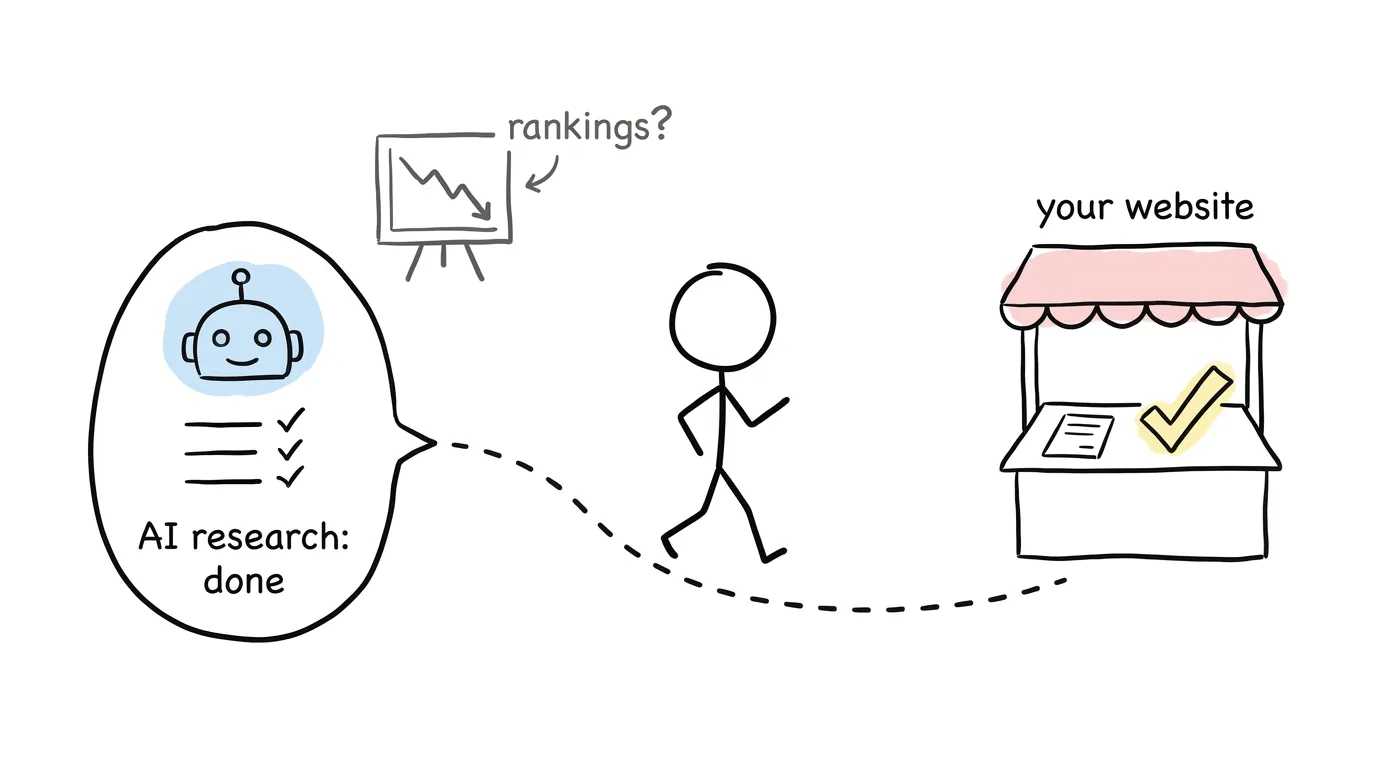
Neither. Before ever reaching your website, this person had already run you through ChatGPT inside and out: who you are, how good your work is, whether you're worth being entrusted with. The research was finished somewhere other than your website. They arrived with the answers in hand, ready to fill out the form.
My first thought at the time: this one story is worth more pondering than any industry report. And as it happens, a few things that echo each other happened in the search world this November. I put them together and re-ran the numbers. Here's what came out of it, said straight to you.
The First Calculation: Google's Rankings May Be "Performing" for You
What is SERP poisoning?
SERP is the search results page. Poisoning means someone has been tampering with what shows up on that page.
Lately, a strange phenomenon has been circulating in SEO circles: the results rank-tracking tools like Semrush pull from Google don't match what a real human sees when searching. In other words, the tools may have been recording a tampered report card all along. The ranking curve you stare at every day may have been performing for you from the very beginning.
So if rankings suddenly plummet, does that mean something has happened to your website?
Don't rush to act. Google has still not publicly admitted this is deliberate, but the risk on the reporting side is very real: you think you've dropped out of page one, when in fact nothing happened. Or the reverse.
So, when you hit an inexplicable ranking swing, do one thing first: reconcile the accounts. Take the third-party tools' rankings and cross-check them against Google Search Console performance data, traffic in GA4, plus real closed deals — a three-way verification.
The tools still have their place. But remember:
Dashboards can deceive you; closed deals won't.
The Second Calculation: What Does Your Business Look Like Inside ChatGPT?
ChatGPT is currently testing a feature called Businesses in ChatGPT. In short, businesses can claim their own profile page. It's a bit like claiming your storefront on a review site.
After claiming, what can you do? Verify your identity, update business information, add product details, and even see some customer insights.
Honestly, my first reaction to this news was: claim it, and do it now.
But there are two "buts."
First, this feature is still in testing and not open to everyone.
Second, claiming your profile doesn't mean you'll rank near the top inside ChatGPT. What it gives you is accurate information, plus a small slice of direct AI search data. That's all.
Accurate information is only the passing grade. To get chosen, what counts is useful content, and a reputation that holds up under follow-up questions.
The Third Calculation: The Visitor Who Views Only One Page May Be Worth the Most
Back to the story at the beginning.
What's truly striking about this is that it overturns a formula we've defaulted to for a long time: the more pageviews, the higher the lead quality.
Really?
At least at that agency, the conclusion was the opposite. The most decisive buyers were precisely the ones who looked at the least. Because they arrived carrying their conclusions; your website was just the checkout counter where they sealed the deal.
What does this mean?
It means metrics like "high bounce rate" and "single-page visit" need to be reinterpreted. Don't judge based on website behavior alone; read it together with the conversations on the sales side and the real quality of the leads. What happened before the click isn't in the data — you have to go ask people.
Traffic Has Become Precious — Now What?
Two things. One about conversion, one about measurement.
Conversion first.
The logic is simple: your customer has done the homework elsewhere, and by the time they reach you, all that's left is the final flourish. Fumble that last step, and everything before it goes to waste.
That's where CRO comes in. CRO — conversion rate optimization — in plain terms means watching the visitors you already have and finding where they get stuck: Is the messaging foggy and confusing? Do they want to throw their phone halfway through the form? Is the button too easy to miss? Is it simply impossible to browse properly on mobile?
Find one, fix one. Start with an audit, then prioritize by how solid the evidence is, how big the impact is, and how much effort the fix takes. Without buying one more visitor, leads can still grow.
Now, measurement.
Decisions run on data, and data runs on tracking. Installing GA4 is just the beginning.
To actually make it trustworthy, you need to walk through the whole configuration: how the property is set up, how tracking is installed, whether form submissions and key events are actually being recorded, whether internal traffic is filtered out, whether attribution is correct, whether reporting tools are connected. Installed without verification equals not installed.
And think about it: the customer's path is becoming harder and harder to see. The part you can measure has instead become the only handle you've got. If even that part is inaccurate, you're driving with your eyes closed.
Every metric you can measure deserves to be measured right.
One Checklist to Bring These Calculations Together
The matters above have actually already been distilled by someone into a search and AI visibility Do's & Don'ts checklist, built specially for the two-front war of "traditional search + AI answers."
The priorities in the checklist are plain: answer your customers' real questions, put your expertise on display, make key information easy to crawl and easy to read, and don't let the website go stale or fall into disrepair. Then, put AI visibility into the same report as organic traffic, conversions, and business results.
No showing off — all of it is unglamorous, grinding work.
But in the AI search era, that unglamorous work is precisely the moat.
One Last Thing
An agency owner who has been in the business for many years was recently on a podcast, talking about AI, growth, and management. One point in it I particularly like: Using AI to expand capacity — fine. Understanding financial statements — must. Listening to advice from all sides — should. But the hand that presses the decision button has to be your own.
Technology keeps changing. But leading people well, keeping the accounts clear, making the right calls — these never need a version update.
Next time, when your backend pops up a visitor who "filled out the form after viewing just one page," don't frown yet.
That might just be your best customer of the month.
Here's wishing you visitors like that — and soon.
Continue reading
Related articles

It's 2026: Stop "Buying" AI Tools for Your Marketing Team — Start "Hiring" AI Agents
This learn article explains how AI agents differ from standalone AI tools in marketing, outlines three agent categories — build-your-own platforms, CRM-native agents, and vertical tools — and covers use cases across SEO, social media, advertising, and reporting, plus criteria for choosing one.

What Is GEO? How Your Brand Gets "Mentioned" in the Age of AI Search
An explainer on GEO (Generative Engine Optimization) for e-commerce and DTC brands: how it differs from SEO and AEO, why AI answers shape brand visibility, and eight practices covering question-focused content, consistent brand messaging, structured pages, external evidence, comparisons, and AI mention tracking.

AI Is Already Making Decisions for Your Customers. Are You on the List?
A learn article explains GEO (Generative Engine Optimization): why AI-generated answers now shape which brands customers see, and how SEO fundamentals, entity clarity, citable evidence, and monthly measurement affect visibility in AI answers.