
Google Is Stuffing Ads Into AI Search: These Recent Stories Are Really One Story
A news roundup linking recent AI marketing stories—Google adding ads to AI Mode, Amazon's Ads Agent, ChatGPT image updates, a UK startup tracking brand mentions in AI answers, and an AI ransomware warning—arguing that control over ad data and visibility is shifting toward platforms.
I've been catching up on what's been happening in the AI and marketing world. At the end of October, Google released its earnings and announced it would add more ads to AI search; Amazon launched an agent that can buy and run ads on its own; and a UK startup raised £1.2 million to track whether AI ever mentions your brand.
Five news items that look completely unrelated. But the more I read, the more obvious it became: they're all really about the same thing. Control is shifting — out of your hands and into the platforms'.
What do I mean by control? Hold that thought — let's go through them one by one.
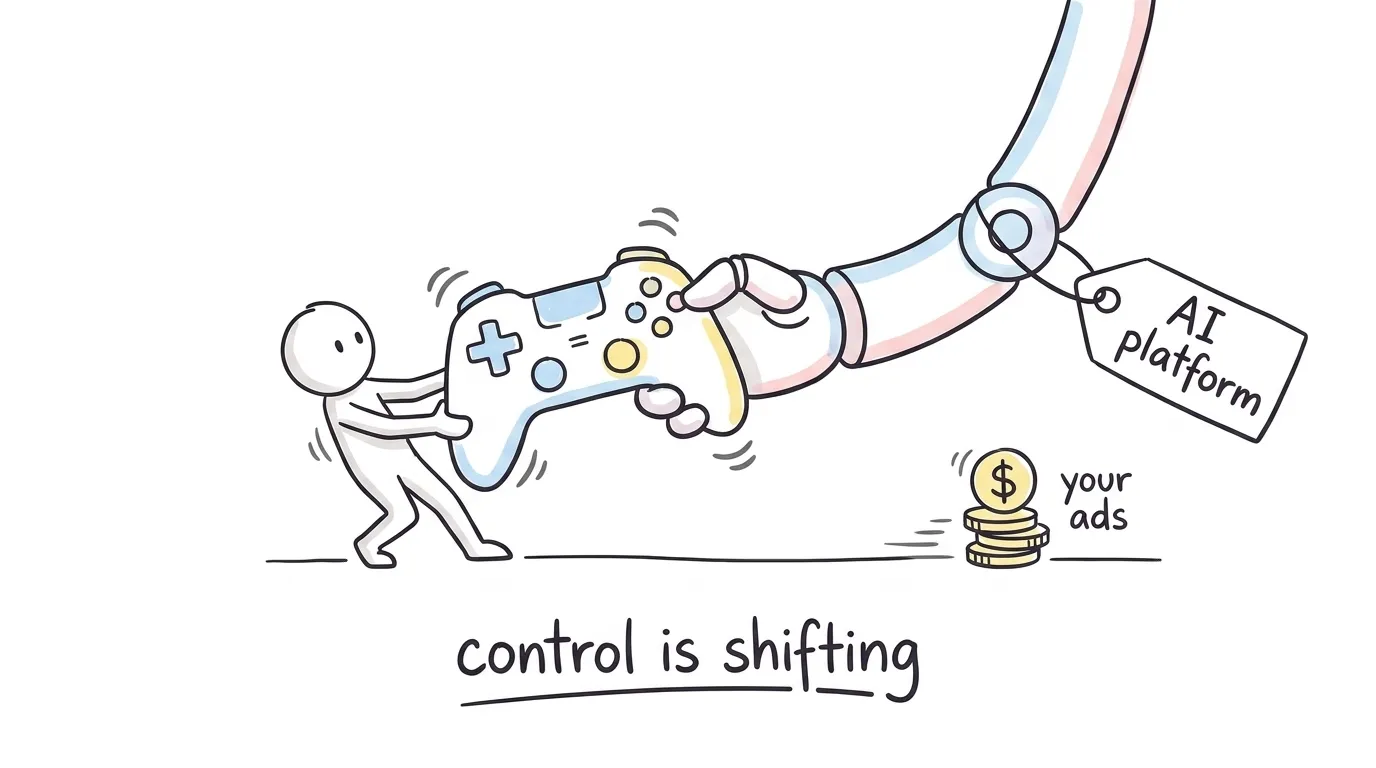
1. Google Is Stuffing Ads Into AI Mode, and You Can't Turn Them Off
On October 28, Google published its quarterly earnings and, along the way, announced two things: ads in AI Mode are expanding to 10 countries; and in the US, the follow-up questions are starting to carry ads too.
What is AI Mode? It's the conversational side of Google Search — the part that goes back and forth with you and hands you a direct answer.
The interesting part is a line in the earnings report. Google itself admitted that AI Mode currently monetizes below traditional search, and it's dragging down search revenue growth.
So what's the fix? Google's answer is blunt: run more ads.
Advertisers have already noticed that a single AI-generated answer can carry up to 4 ads underneath it. And according to industry sources, this will roll out to the UK before the end of the year.
If you're running Google ads, there are three facts you'd best know right now:
- Your Search, Shopping, and Performance Max campaigns automatically enter AI Overviews and AI Mode — no opt-in required.
- You can't separate AI Mode from regular search in your targeting, which means you can't opt out of it on its own.
- Google won't hand you a separate report on AI Mode performance either.
In plain terms: the traffic gets blended, the numbers get blended, and you can't tell which clicks came from an AI answer.
So what can you do? Black Friday is right around the corner. Before the ad placements change much, save a baseline copy of this month's data: clicks, cost per click, conversions. Then check which campaigns are running broad match or AI Max, and give your negative keywords another pass. When AI Mode ads spread out, you'll have something to compare against.
Without a baseline, you can't even see that things got worse.
2. ChatGPT's Image Generation Upgrades to 2.6, Available on Every Plan
OpenAI's Images 2.6 has rolled out to all ChatGPT plans. It can make animated images, and it can generate new ones based on a reference picture.
For small teams, social media graphics, simple motion pieces, and product sketches are now fast and cheap.
But keep something in reserve. AI images are good for ideas, backgrounds, and quick visuals you need yesterday; your team's faces, what your storefront looks like, real photos of your products — keep using real photos for those. Users are getting better and better at telling real from fake. And honestly, a short video casually shot on a phone still beats polished but cookie-cutter visual content.
3. Amazon Launches Ads Agent: It Spends Your Money, Then Reports Back to You
Amazon has released a new Ads Agent. According to reports, it can plan campaigns by itself, place and run the ads by itself, and then produce the reports itself.
Convenient? Truly convenient.
But think about this scenario: one platform spends your money for you, and keeps score of your results for you. It sets the exam, and it grades the exam too.
This is not automation. This is grading your own homework.
So whichever ad platform you use, keep a ledger of your own outside of it: inquiries and closed deals should live in your own CRM, booking system, or Google Analytics 4. Whether a platform is worth it comes down to a single question: how many real customers did it actually bring you?
4. "AI Visibility" Has Become a Business, but Getting Started Costs Nothing
A UK startup called Obsero raised about £1.2 million to do exactly one thing: track whether your brand gets cited in AI answers.
What is AI visibility? What you used to care about was where you ranked on Google; now there's one more layer: when someone asks an AI assistant "who's the best [whatever] service in my neighborhood," does it say your name?
Someone raised money for this business, which tells you the demand is real. But the getting-started part, you can do yourself today without spending a penny: open ChatGPT and Gemini, ask every question a customer would actually ask, and note whether you show up.
To get AI to mention you, it still comes down to the same three old fundamentals: your information written consistently everywhere, reviews earned genuinely, and mentions on those trustworthy local websites.
5. UK Cybersecurity Agency: AI Ransomware Is Coming for Critical Infrastructure Before 2028
The UK's cybersecurity agency has issued a warning: AI is helping attackers find targets and vulnerabilities faster, and by 2028, AI-driven ransomware is expected to hit critical infrastructure.
What does something at big-agency scale have to do with small businesses?
Here's the connection: as attackers get faster and cheaper, the cost barrier built on human labor is gone. The dirty work used to require hiring people, so hackers were picky about targets; now AI does the grunt work, and whoever is weakest gets hit.
The to-do list isn't new, but it has to actually be done: turn on two-factor authentication (2FA) for email, your website's admin panel, and your social accounts; keep your website software and plugins updated; back up regularly, and actually rehearse a restore; and if you can, go through the UK government-backed Cyber Essentials certification.
Two Quick Extras
First, in early November, AI stocks took a sharp tumble, as investors started doubting how fast AI infrastructure is burning money. The marketing tools in your hands aren't affected, but the arguments about AI pricing will only get louder from here.
Second, new models keep shipping nonstop — OpenAI even released a batch of safety-focused models. For most small businesses, using the tools you already have to the fullest is far more useful than chasing every release.
Finally, Back to Control
Now let's string these stories together.
Google stuffs ads into AI answers and won't give you a separate report. Amazon lets AI spend your money, then grade itself. Even "did AI mention me" has spawned a brand-new business.
The more automated the platforms get, the less they're willing to let you see. Don't get me wrong — this isn't some conspiracy. This is just the business model itself.
So what do you do? In one sentence: Your data, your customer list, and your read on your channels — keep them in your own hands, always.
What platforms give you is traffic. What keeps customers coming back has always been your own ledger.
Continue reading
Related articles

What Is GEO? How Your Brand Gets "Mentioned" in the Age of AI Search
An explainer on GEO (Generative Engine Optimization) for e-commerce and DTC brands: how it differs from SEO and AEO, why AI answers shape brand visibility, and eight practices covering question-focused content, consistent brand messaging, structured pages, external evidence, comparisons, and AI mention tracking.

AI Is Already Making Decisions for Your Customers. Are You on the List?
A learn article explains GEO (Generative Engine Optimization): why AI-generated answers now shape which brands customers see, and how SEO fundamentals, entity clarity, citable evidence, and monthly measurement affect visibility in AI answers.
Google Swapped Its Brain Three Times in Two Weeks — the Search Table Just Got Reshuffled
A learn article reviewing recent search-industry developments, including Google's rapid AI model swaps, AI Overviews and AI Mode expansion, ads entering AI search, and social platform updates. It advises marketers to track whether their brand appears in AI-generated answers.