
Ad Platforms Are Taking Back the Wheel: 148 Updates This Year, and I Read Only One Message in Them
A review of this year's updates from Google, Meta, Microsoft, and TikTok, arguing that ad platforms are reclaiming control through creative clustering, changed defaults, and stricter data and AI disclosure rules, and advising advertisers to keep data clean and make creatives genuinely distinct.
Last month, a friend who has been running ad campaigns for six years invited me out for tea.
The moment we sat down, he said: "Man, I haven't touched a thing, and my CPM jumped more than 30%."
Same creatives, same budget, same targeting. He combed through his account inside and out, like a schoolkid double-checking an exam paper — and couldn't find a single wrong answer.
I told him: you probably really didn't do anything wrong. Your opponent isn't a fellow advertiser. It's the platform itself.
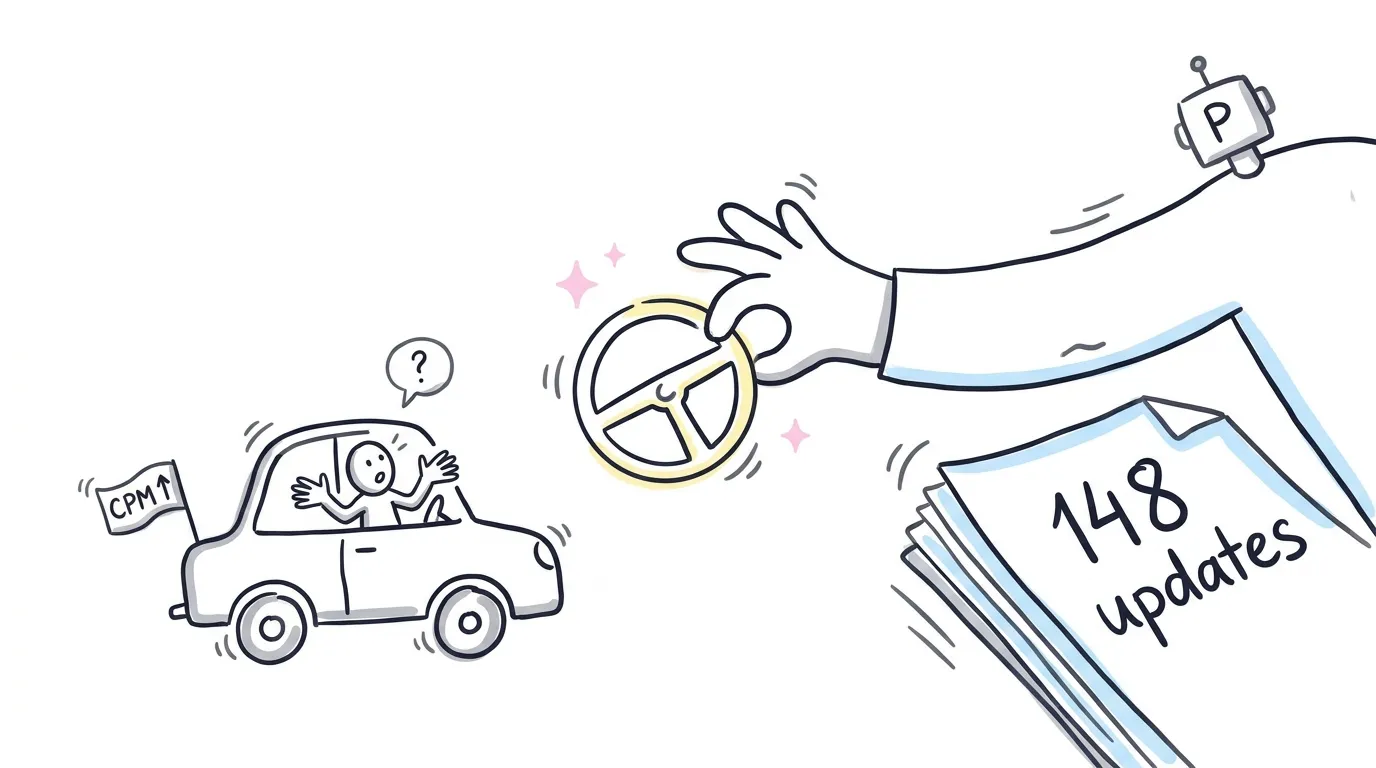
This year I went through the algorithm and product updates from the major platforms, one by one: Google Search, Google Ads, Meta, Microsoft, TikTok — 148 in total. Read one at a time, each is perfectly ordinary product news. Stack them together and a chill runs down your spine. This is, quite plainly, a notice:
The platforms are taking back the wheel.
Let's Start with My Friend's 30%
So what is Entity Clustering?
Meta's Andromeda 2.0 retrieval engine, launched on June 18 this year, groups similar creatives into the same Entity ID. The whole cluster gets one bidding ticket.
What does that mean?
Those 100 creatives of yours — swap the background, tweak the headline, adjust the color scheme — and in the system's eyes, it's one creative. The higher your account's similarity, the more easily it gets compressed into a single ticket. CPMs for highly similar accounts rose 25% to 40%.
My friend ran straight into this one.
The mainstream playbook of the past few years was: once a creative performed, copy it 20 times for A/B testing and let the system do the filtering. The human only produced variants; everything else was left to the algorithm.
Now the platforms have put it plainly: variants don't count as creativity. Tweaking is not creativity; repetition is the original sin.
The Front Door Changed First
To talk about the wheel, we have to start with the entry point.
At Google I/O this May, AI Mode became the default interface for over a billion users. The traditional search box has given way to an intelligent, multimodal entry point. On queries where a generative interface appears, click-through rates fell 34% to 58%. Some estimates put zero-click searches at around sixty percent already.
How big a deal is that?
SEO used to be about fighting your way "to the top." A user searched a question, and if you ranked first among the ten blue links, the traffic was yours.
Now, the user finishes a search and gets an AI-generated answer right away. Your page may have been read, but nobody comes. Even if you sit at the top of the results page, you're only a footnote to the answer.
Right after that, Google took the FAQ rich results documentation down from its developer portal. The Q&A structured data you worked so hard to mark up no longer generates summary cards — because AI Overviews now answers those questions directly.
At the same time, Google launched "Preferred Sources." Only when a user actively follows you in settings will your content get priority citation in AI answers, with a little badge attached.
See the pattern? Brand loyalty has, for the first time, been written into the ranking factors.
Traffic used to be bought, or seized. From now on, it may have to be requested by name.
Defaults Are the Most Expensive Price Tag
Now the ads side. The most thought-provoking thing this year isn't any new feature — it's that the "defaults" all changed.
Microsoft's AI Max became generally available in August, on by default for new Search campaigns. It expands your keywords, generates ad copy, and dynamically rewrites landing-page routing.
Over at Google, from December 4, new Performance Max campaigns have image scraping on by default — the system will go scrape assets from your landing pages. Note this: even if you turn this switch off at the account level, new campaigns still default to on. To turn it off, you must explicitly opt out at the campaign level.
Think about what that means.
The platforms were never changing the features. They were changing the default options. Once a default flips, whoever does nothing is automatically enrolled into the new world. Even sitting it out is a vote.
Meta went further. From June 1, Andromeda demoted manual interest targeting and demographic targeting to "soft suggestions." The system matches audiences using visual and semantic analysis of the creatives; your manual settings are just a reference. Meanwhile, Meta fed the anonymized conversational intent of more than 1.6 billion Meta AI chat users into Advantage+ delivery optimization. The official numbers: ROAS up 18% to 22%, CPA down 17%.
Oh, and there's another ledger entry many people have never done the math on.
Google's BTO (budget target optimization) took effect on August 17. The rule: budget-constrained campaigns are no longer allowed to "over-deliver on efficiency targets." You set a target CPA of 100, and the system actually ran it down to 70 — that used to be a pleasant surprise. After August 17, the system will pull your bids back toward 100.
Upset that your costs went up? Sorry — that's because you didn't change your target.
In the face of automation, "getting one over on the platform" is being reclaimed, item by item.
Data: Like Water and Power — You Only Find Out When the Whole Building Goes Dark
Out front, the defaults are changing; behind the scenes, the data rules are moving faster — and cutting deeper.
On June 15 this year, Google unified how Consent Mode is enforced. You used to have two switches: the Google Signals toggle in GA4, and Consent Mode on your website. After June 15, the GA4 switch is dead — the ad_storage signal sent from the web page became the single master switch.
What does that mean in practice?
It means that if your cookie banner is installed wrong, conversion counts, remarketing lists, and all that data quietly collapse together, and Smart Bidding fails along with them. No popup, no warning, no text message to tell you. A month later, you simply discover that performance is sliding across the board.
Data is like water and power: things are fine until they stop — and then you learn the whole building stopped.
There are a few more hidden pits like this. The old offline conversion import channel — CSV uploads that only recognized GCLID — must migrate to Data Manager, with a hard deadline: full shutdown in March 2027. Granular performance data is kept for only 37 months; hourly data from before May 2023 has already been deleted. If you want to keep it, export it to BigQuery yourself.
Two more items deserve a slow, careful read.
The new Google Ads terms of service effective July 1 state it plainly: the creative assets and inputs you upload may be used to train its generative advertising models. The new Merchant Center terms effective June 15: your marketing emails are indexable by default, and your product data is pre-authorized for Gemini-powered agentic shopping. Over at Microsoft, in-chat checkout in Copilot already covers 500,000 merchants — users place the order right inside the conversation.
On one side, the platforms are reclaiming control; on the other, what you hand over keeps growing. Chew on that. Chew on it slowly.
AI Can Take the Job, but You Have to Sign for It
Some will say: fine, if I hand everything over to AI automation, won't I be keeping up with the platforms?
Quite the opposite. In this year's round of updates, the most uniform, deliberate set of moves is the platforms "laying down rules" for AI.
TikTok now mandates that AI-generated creatives embed C2PA content credentials; anything without a label gets flagged, or even rejected in review. TikTok in the US also bans pure AI voices for selling in livestreams, and bans AI-generated likenesses of real people for commercial endorsements. Meta likewise uses C2PA metadata for automatic detection — ad creatives with deep AI involvement must be disclosed.
Google is tightening the other end: it explicitly bans the so-called "GEO optimization" that manipulates AI answers. Recommendation poisoning and mass-generated fan-out pages face demotion or manual penalties from June 15. The AI content guidelines were updated too — the scope of fact-checking now extends from the body text to headlines, summaries, structured data, and image alt text.
Stack all of these up, and the platforms' position is actually clear:
Use AI all you want. But every AI output needs a real human to sign for it.
Tools can be automated. Responsibility cannot.
What Can You Still Hold On To
With the wheel taken away, does that make you useless?
Here's what my friend did next. He deleted all 100 similar creatives and kept only 4 genuinely distinct creative concepts. Two weeks later, his CPM came back.
He said something on the phone that I've kept to this day: "I used to compete on hand speed. Now I compete on whether I'm holding something nobody else has."
After the wheel is taken back, there are really only two things left to you.
One, get your data clean. Install the consent signals right, keep your conversion feeds humming, fill in the offline data. The harder automation feeds, the harder bad data bites back.
Two, make your creativity truly have ideas. What the system merges is similarity — it can never merge genuine difference.
With clean data and true creativity, your brand becomes the answer that AI is willing to cite and users ask for by name.
The algorithms will keep changing forever. But what makes your product good, whether your data is clean, whether your creativity truly has ideas — only you can answer that.
Next year, when the platforms drop another 148 updates, you'll just read the news and get on with your day.
Here's wishing that you never have to stare blankly at your CPM in the middle of the night.
Continue reading
Related articles

What Is GEO? How Your Brand Gets "Mentioned" in the Age of AI Search
An explainer on GEO (Generative Engine Optimization) for e-commerce and DTC brands: how it differs from SEO and AEO, why AI answers shape brand visibility, and eight practices covering question-focused content, consistent brand messaging, structured pages, external evidence, comparisons, and AI mention tracking.

AI Is Already Making Decisions for Your Customers. Are You on the List?
A learn article explains GEO (Generative Engine Optimization): why AI-generated answers now shape which brands customers see, and how SEO fundamentals, entity clarity, citable evidence, and monthly measurement affect visibility in AI answers.

Google Is Stuffing Ads Into AI Search: These Recent Stories Are Really One Story
A news roundup linking recent AI marketing stories—Google adding ads to AI Mode, Amazon's Ads Agent, ChatGPT image updates, a UK startup tracking brand mentions in AI answers, and an AI ransomware warning—arguing that control over ad data and visibility is shifting toward platforms.