
Last Month, 44% of Our Search Impressions Came From Machines That Never Click
A learn article reporting that 44.1% of one B2B site's attributable search impressions came from machine queries with zero clicks, then introducing GEO: how generative engines pick sources, on-page and off-site tactics for earning citations, AI visibility measurement, and a 90-day plan.
The other day I was digging through our analytics dashboard — and somewhere in there, I froze.
The dashboard was Google Search Console. The site was one of our own B2B websites. From October 3 to 30, 2026 — a full 28 days: 169,597 impressions, 393 clicks.
Click-through rate: 0.23%.
Don't feel sorry for me just yet. That's not the bad part.
Google has a rule: for some searches, it will tell you what the user actually typed. These impressions are called attributable impressions. In October we had 100,466 of them. I pulled all those hundred-thousand-odd queries out one by one and sorted them by what they looked like.
When I finished sorting, a chill ran down my spine.
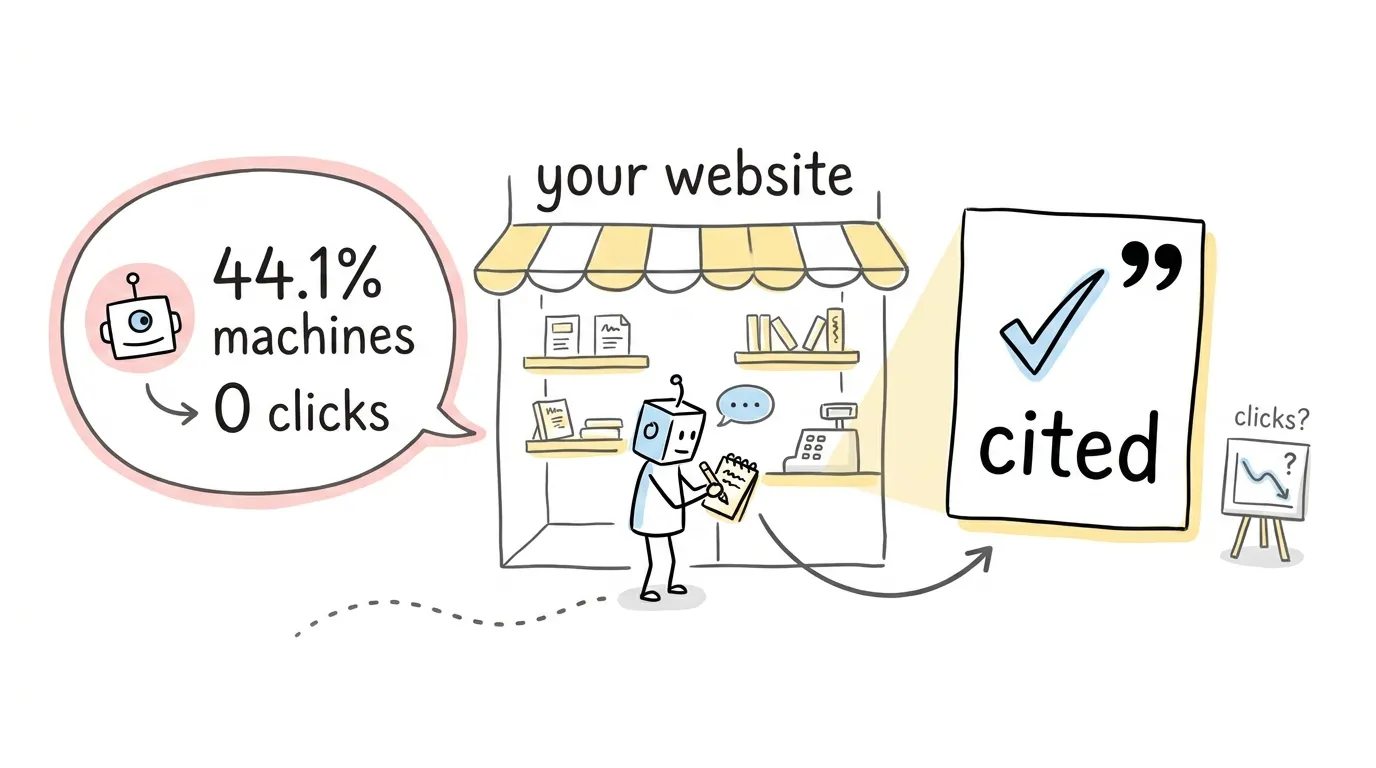
44,285 of them came from machines. That's 44.1%.
What is a machine query? It's one no human typed. Before an AI assistant answers your question, it runs off to search engines to gather sources first — the trade calls this grounding, which boils down to "do your homework before you speak." There's another category too: tools that help companies track "how much presence do I have in AI's eyes." They fire pre-set queries at search engines, thousands upon thousands of times.
Here's a real query straight from the dashboard:
"Which keyword rank tracking tool tracks positions most accurately every day? My location is Wilmington, California, USA."
Guess how many clicks it brought us.
Zero.
And it's not just that one. All 44,285 of them, added together: zero.
Machines Are Doing Your Buyers' Homework
Let's do the math. Those 44,285 machine queries break down like this:
35,564 were prompt-style — long questions of ten words or more, unmistakably AI assistants hunting for material — 35.4%. Another 8,226 were probes from rank-tracking tools, queries that open with a string of digits, their calling card — 8.2%. The remaining 495 were search operators and crawler fetches — 0.5%.
Strip out the machines and 56,181 queries look like they came from humans — 55.9% — bringing 88 clicks. The other 305 clicks came from impressions whose queries Google refuses to disclose; there was no way to classify those, so I didn't force it.
One more detail, and it's creepy. Among long queries of ten words or more, 28% contained the phrase "location is." That's tracking tools geotagging their own questions, so the results look like a local is asking.
Dig one level deeper. These machine queries touched 141 pages on our site in total. But two of those pages — two tool comparison reviews — ate up 49% of all long-query impressions.
Why those two in particular?
Because our customers are exactly the people who use AI visibility tools. When machines do homework for buyers, this is the kind of page they flip through.
So how should you read this data? My reading: machines have already started coming into your store and going through your shelves. The browsing is real. Whether they buy is another matter.
One pitfall while we're at it. If you use your site-wide 0.23% click-through rate to judge how good your headlines are, the machines will skew your read. Strip the machines out and look only at human short queries of five words or fewer: the click-through rate is 0.17%. Mix the machines back in, and it drops to 0.09%. That's nearly a two-fold gap. Judge your headlines on the human part only.
Oh right, one more thing the dashboard can't do: it can tell you "AI came and picked things up," but it can't tell you "did AI end up writing you into the answer." Getting picked up and getting shelved are two different things. More on that later.
What Exactly Is GEO?
This new homework has a name in the trade: GEO, Generative Engine Optimization.
The term wasn't invented by content farms. In 2023, Aggarwal and his colleagues wrote a paper, formally published at the 2024 KDD conference, studying exactly one thing: how to make content easier for generative engines to find, understand, and cite.
What is a generative engine? ChatGPT, Perplexity, Claude, Copilot, Google's AI Overviews — all of them. The difference from traditional search: traditional search hands you a list of links and you pick for yourself; a generative engine hands you an answer directly, with a few citations hanging off it.
The market has a few other names for it too: AEO (Answer Engine Optimization), LLMO, AI SEO. They're all roughly the same thing — different names, different emphases, no need to fuss.
The point is this: the goal has changed. What you used to fight for was "ranking first." What you fight for now is to be one of the few sources the model reads, trusts, and is willing to cite by name.
The finish line of search is shifting from "ranking first" to "being the paragraph that gets cited."
Why This Can't Wait
Three numbers, one signal.
First number. In October 2025, OpenAI itself announced: ChatGPT had surpassed 800 million weekly active users.
The place where 800 million people ask questions is becoming the place where 800 million people look for answers — and look for vendors.
Second number. In March 2025, Pew Research Center ran an experiment: tracking 68,879 real Google searches by 900 American adults. The finding: when an AI summary appeared on the results page, the share of users clicking traditional organic results was only 8%; when there was no AI summary, it was 15%.
So what were users clicking? The share clicking the link inside the AI summary: 1%.
The moment a summary shows up, nearly half the people stop clicking traditional results. And the summary itself sends almost no one out the door.
Third number. Ahrefs took 300,000 keywords and measured this twice, end to end. First pass, comparing March 2024 and March 2025: when an AI summary is present, the top-ranked page's click-through rate is 34.5% lower. Second pass, widening the window, comparing December 2023 and December 2025:
58%.
From 34.5% to 58% — this trend is not moving at a constant speed. It is accelerating.
Even the platforms themselves have started showing their hand. On February 10, 2026, Microsoft launched a report called AI Performance inside Bing Webmaster Tools, where you can see citations, cited pages, and grounding queries. The official wording: this is "an early step toward GEO tools."
The platforms have started handing out report cards. This thing is now officially in the game.
If you're in B2B, one more brutal point: buyers' candidate lists are increasingly pre-written by AI assistants. If you're not on the shortlist, you never even get a chance at what comes after.
How Does an Engine Decide Whom to Cite?
You might ask: on what grounds does the AI cite one site and not another?
Break it apart and there are just four steps.
Step one, query fan-out. The engine takes your one-sentence question and splits it into several searches. Google's own documentation admits that AI Overviews and AI Mode use this "query fan-out" technique, casting a wider and messier net than the classic results page.
Step two, retrieval. Each engine has its own crawler, and it borrows third-party data sources too. ChatGPT uses its own OAI-SearchBot and says openly it will lean on third-party search services; Copilot sends its generated queries to Bing; Perplexity has its own PerplexityBot; Google uses its own index. Nobody publishes the full recipe. So the safe play is: Google's index and Bing's index — you need to be in both.
Step three, passage selection. Note carefully: what the model reads is not "your website," it's a small passage of your article. A passage that can stand on its own within the first two sentences has a far higher chance of being cited than one whose point doesn't show up until the fourth paragraph.
Step four, synthesis and attribution. The model writes out the answer and attaches sources to the specific facts it used.
So is there any special switch you can press to get into AI answers? Google's answer is blunt: no. Being indexed and eligible for summaries is qualification enough. There is no file or markup dedicated to serving AI features.
So the first step of GEO is not some new magic — it's the old trade: make sure your pages can be crawled and indexed normally. If the foundation isn't solid, everything after it is a castle in the air.
Which Tactics Actually Work? Someone Tested the Answers
Enough theory. Time for the experiment.
Back to that Aggarwal paper. The team built a test set called GEO-bench — 10,000 queries, 9 rewriting tactics, tested one by one. Which tactics make your content stand out in generative answers? The results (baseline: 19.5 points):
Add quotations: 27.8 points, 42.6% above baseline. Add statistics: 25.9 points, 32.8% higher. Improve fluency: 25.1 points, 28.7% higher. Cite your sources: 24.9 points, 27.7% higher.
So which tactic is harmful?
Keyword stuffing. 17.8 points — 8.7% lower than doing nothing at all.
In front of AI, that old-SEO bag of word-stuffing tricks fares worse than not trying at all.
The finding I find most heartening in this study: on the website ranked fifth, the single tactic of "citing sources" lifted visibility by 115.1%. Meanwhile the site ranked first dropped by 30.3% on average.
Why? Because the model rewards the passage with the sturdiest evidence, not the site with the biggest domain.
For the first time, small companies get a chance to beat big brands head-on — on evidence.
Of course, two honest caveats first. This experiment ran on a research generative engine, not production ChatGPT or Gemini; the paper's authors themselves admit the effects "vary by domain." Treat these numbers as a direction, not a guarantee.
Nine On-Site Moves to Make Your Pages "Quotable"
How exactly to change things? In our hands-on work it comes down to nine items. Do them in order:
- At the start of every section, deliver the answer in one or two sentences. Even if that passage gets lifted out on its own, it has to make sense.
- One section answers one question. Our working yardstick is 130 to 170 words per section, a complete self-contained block. Note: this is our own field-tested number, not an official standard.
- Numbers must come with a source and a year. "The top-ranked page's click-through rate is 58% lower (Ahrefs, comparing December 2023 and December 2025)" — that's quotable. "Clicks have dropped a lot lately" — that's not.
- Include attributable quotes. Named, verifiable statements give the model something to cite and someone to credit. Prefer outside experts' quotes; for your own team's views, honestly label them as in-house opinions.
- Link back to primary sources. Claims link to papers, regulations to official bulletins, prices to the vendor's page.
- Build a real FAQ. However users ask, that's how you set the subheadings. Don't stuff the FAQ with marketing talk.
- Keep entity information consistent. Company name, author name, product name — one spelling site-wide, paired with Organization and Person structured data. Don't make the model guess "are these two the same entity?"
- Say things plainly. Short sentences, one idea per sentence, and explain every term the first time it appears.
- Be honest about update dates. Actually change the content first, then change the lastModified date. Refreshing the date without changing the content is fabricating evidence for the machines.
People ask me, which of the nine works best? Honestly, I can't say. They're not nine loose tricks; they're one whole system.
Here's a before-and-after pair.
Before: "AI summaries are hitting organic traffic hard, and many websites are getting fewer clicks than before."
After: "According to Ahrefs' comparison across 300,000 keywords, when an AI summary appears in search results, the top-ranked page's click-through rate is 58% lower (comparing December 2023 and December 2025)."
What's the difference? The second sentence gives the answer first, carries numbers, names its source and sample, and stands on its own even when lifted out. That's what a "quotable passage" looks like.
There's a line in the GEO paper that puts it plainly: generative engines are a black box, they change fast, and content creators have almost no control over when or how their content is displayed.
Right. You can't control the black box. But evidence and structure are the parts you can control.
My most visceral feeling on this comes from the dashboard data at the top: the pages machines love to flip through most are our two comparison reviews with the densest evidence — prices verified, tables complete, sources named. Not the pages with the most backlinks.
So my summary is one sentence: GEO is SEO with the evidence bar raised one notch.
Off-Site: Get Other Websites to Speak for You
At this point you may have spotted a painful question: the websites AI cites when writing answers — more than half of them aren't yours at all.
A company called Profound tallied 680 million AI citations from August 2024 to June 2025 and found that each platform favors completely different sources.
ChatGPT's favorite to cite is Wikipedia, 7.8% of all its citations, followed by Reddit (1.8%) and Forbes (1.1%). Google's AI Overviews: the top three are Reddit (2.2%), YouTube (1.9%), Quora (1.5%). Perplexity: the top three are Reddit (6.6%), YouTube (2.0%), Gartner (1.0%).
See the pattern? Your own official website doesn't show up on a single one of these lists.
So what do you do? In one sentence: get other websites to mention you.
Ahrefs ran a correlation study covering 75,000 brands (May 2025, AI Overviews only): brand mentions across the whole web had a correlation coefficient of 0.664 with AI-summary visibility. Branded anchor text: 0.527. Brand search volume: 0.392. Domain authority: 0.326. Backlinks?
0.218. Dead last.
Backlinks — the hard currency of the old SEO era — ranked last on this list. Let me be clear first: correlation is not causation, and this study covers AI Overviews only. But the direction is clear enough: what the model reads is how the whole web talks about you.
Five concrete things to do. All of them plain grunt work.
Get into third-party comparison reviews. For questions like "the best X tool," the engines take their material from exactly those list pages — the dashboard data at the top confirms this too. Go pitch the editors, let facts do the talking, and never trade money for a "review."
Publish original data others want to cite. Do Digital PR with your own numbers; even mentions without a link count.
Accumulate reviews where buyers will actually look. G2, Capterra, Google Business Profile, or the platforms of your industry.
Show up in communities in good faith. Reddit, LinkedIn, industry forums — answer questions under your real name and real identity. Don't use sock puppets to pose as random passersby; it gets seen through at a glance.
Clean up your entity information. If you're notable enough, maintain a good Wikidata entry and use sameAs to cross-confirm against your official site.
Scarier Than "Nobody Mentions You" Is "They Get You Wrong"
When risk comes up, what most people think is: what if I don't get mentioned?
I want to point you in a different direction: you get mentioned, but described wrongly.
An AI assistant might report a product you stopped selling three years ago, report an outdated price, or even mash you and a similarly named company into one.
And AI answers can differ on every generation. So one wrong answer might just be noise; the same error showing up over and over — that's a signal.
If you find yourself being described wrongly, five steps:
Write down the exact wording, along with the engine, the date, and which URLs it cited at the time.
Go fix the source, not the answer. If what it cited was your own page, fix the page; if it was a third-party directory or review, contact them to update.
Publish the authoritative facts. A clear About page, pricing page, and comparison page give the engine a better passage to pull from.
Align entity data. Structured markup, Wikidata, sameAs — names, history, service descriptions, all consistent.
Use the feedback buttons that ChatGPT, Perplexity, and Google provide, then wait a few weeks and test again.
One road to never take: manipulation. Hidden text for AI crawlers (that's essentially prompt injection), fake reviews, sock-puppet posting. Hidden text and fake content are already within the spam-policy crosshairs of every search engine. Betting all your trust for one citation — the math never works out in your favor. We don't do it, and we advise clients not to touch it.
The Technical Side: Open the Right Doors, Not Every Door
The technical stuff makes a lot of heads spin the moment it comes up. Really it's one thing: figure out what each crawler is for, and open the right doors.
The crawlers divide up the labor. OpenAI's family: OAI-SearchBot handles search crawling, ChatGPT-User is the fetch triggered only when a user clicks, GPTBot handles model training. Anthropic's family works the same way: Claude-SearchBot, Claude-User, ClaudeBot. Perplexity's PerplexityBot — officially stated — is not used to train foundation models. Google's side: Googlebot handles search, Google-Agent acts on user requests, and Google-Extended is the control switch for training. Microsoft is the simplest: just one Bingbot, and to govern Copilot you use the NOCACHE and NOARCHIVE meta tags.
Several of them have put their cards on the table. OpenAI says websites that block OAI-SearchBot won't appear in ChatGPT's search answers. Anthropic warns that turning off Claude-SearchBot may lower your site's visibility and accuracy in user searches. Google says turning off Google-Extended doesn't affect your inclusion in Google Search. Microsoft says content marked NOARCHIVE won't enter Bing Chat (now Copilot) and won't be used for training.
See it now? Training and search are two separate switches.
You can keep training off and search on, and still get cited. Our choice is everything on. The logic is simple: for a company that earns its living on expertise, being in the training data is itself presence.
As for llms.txt? A proposal Jeremy Howard put forward in September 2024 — a Markdown-format site guide for AI. Google has said that to get your content into its AI features, you don't need to create any new machine-readable file or markup.
Then why do we still host one? Because it's cheap, and it's convenient.
Just never treat it as a ranking lever. It isn't one.
How to Measure It? First, the Bad News
A company called SparkToro ran an experiment: 600 volunteers ran the same prompts 2,961 times. The conclusion: ask the same question 100 times, and the probability that two of those runs give you the same brand list is under one in a hundred.
Founder Rand Fishkin put it more bluntly: any tool that tells you "where you rank in AI" is BS.
He's right. AI answers are probabilistic — it cites you this time, next time maybe not. So don't stare at single results. Stare at one metric: lock in a batch of prompts, run them repeatedly, and count in what share of the answers you appear. That's the visibility rate.
Five signal streams in particular, read together:
An AI visibility tracking tool, running 50 or more fixed prompts every day, watching the mention rate. This is your master trend line.
Bing Webmaster Tools' AI Performance, free, showing which of your pages Copilot cites.
The 10-plus-word long queries in Search Console, showing what machines are picking up from you. Short queries of five words or fewer, showing whether real humans still click on you.
Visits from domains like chatgpt.com and perplexity.ai in your website analytics, showing whether citations are turning into visitors.
One blind spot to disclose first: GA4 can't distinguish "traffic that clicked in from an AI summary," because that also counts as Google organic traffic. And chatgpt.com referrals only become visible when a user actually clicks a citation link. So "being cited" and "bringing visits" must be treated as two signals, recorded separately.
How do you build your prompt list? My method: collect from three places — customers' own words on sales calls, the questions in RFP documents, and those 10-plus-word long queries in the dashboard. For each one, record five things: which engines it was sent to, whether you were mentioned, which URL was cited, which funnel stage it belongs to, and how it describes you. For example, "the best such-and-such provider for mid-sized Spanish companies" came straight from a sales call.
The tools themselves aren't expensive. Entry tiers run $17–29 a month; the ones with broad coverage run around $300 a month. Compared to the labor of reworking pages, the tools are the small line item.
90 Days. Here's the Play.
How long until this pays off? Our cadence is 90 days. One month to baseline, one month to do the work, one month to measure results. Fair warning: this is our own working rhythm, not an industry standard.
Month one, baseline. Collect 50 to 100 prompts from sales calls, RFP documents, and dashboard long queries. Run them daily, logging the mention rate and how you're described. While you're at it, verify Bing Webmaster Tools, check robots.txt, and see whether any search crawler got blocked by mistake.
Month two, do the work. Pick the 10 to 15 pages that most need to answer these prompts and rework them per the nine rules above. Pay down the technical debt: indexing, canonical tags, structured data, internal links from hub pages to detail pages. Start the off-site work at the same time.
Month three, measure results. Compare every prompt against the baseline. Find the prompts where competitors get cited and you don't, and fill in the content. When you report to the boss, report GEO and SEO together — don't list it separately. It's another floor built on the same foundation, not a replacement.
Back to That 44.1%
That opening ledger — let's run it once more.
In October 2026, nearly half of the attributable search impressions on our site came from machines, without a single click.
What some people see is: the traffic is gone.
What I see is: machines are already doing your buyers' homework.
That it comes to flip through your shelves is, in itself, an opportunity. The question is whether, after it finishes flipping, it's willing to write your name into the answer it hands to a human.
In the age of search, you optimized for the rankings. In the age of answers, you optimize for the citations.
Machines come asking now. They don't click. They only cite.
Here's to becoming the name that gets cited.
Continue reading
Related articles

It's 2026: Stop "Buying" AI Tools for Your Marketing Team — Start "Hiring" AI Agents
This learn article explains how AI agents differ from standalone AI tools in marketing, outlines three agent categories — build-your-own platforms, CRM-native agents, and vertical tools — and covers use cases across SEO, social media, advertising, and reporting, plus criteria for choosing one.

What Is GEO? How Your Brand Gets "Mentioned" in the Age of AI Search
An explainer on GEO (Generative Engine Optimization) for e-commerce and DTC brands: how it differs from SEO and AEO, why AI answers shape brand visibility, and eight practices covering question-focused content, consistent brand messaging, structured pages, external evidence, comparisons, and AI mention tracking.

AI Is Already Making Decisions for Your Customers. Are You on the List?
A learn article explains GEO (Generative Engine Optimization): why AI-generated answers now shape which brands customers see, and how SEO fundamentals, entity clarity, citable evidence, and monthly measurement affect visibility in AI answers.