
What Is GEO? How Your Brand Gets "Mentioned" in the Age of AI Search
An explainer on GEO (Generative Engine Optimization) for e-commerce and DTC brands: how it differs from SEO and AEO, why AI answers shape brand visibility, and eight practices covering question-focused content, consistent brand messaging, structured pages, external evidence, comparisons, and AI mention tracking.
A few days ago, a friend of mine who runs a cross-border e-commerce business invited me to dinner. Halfway through the meal, he pulled out his phone and showed me something.
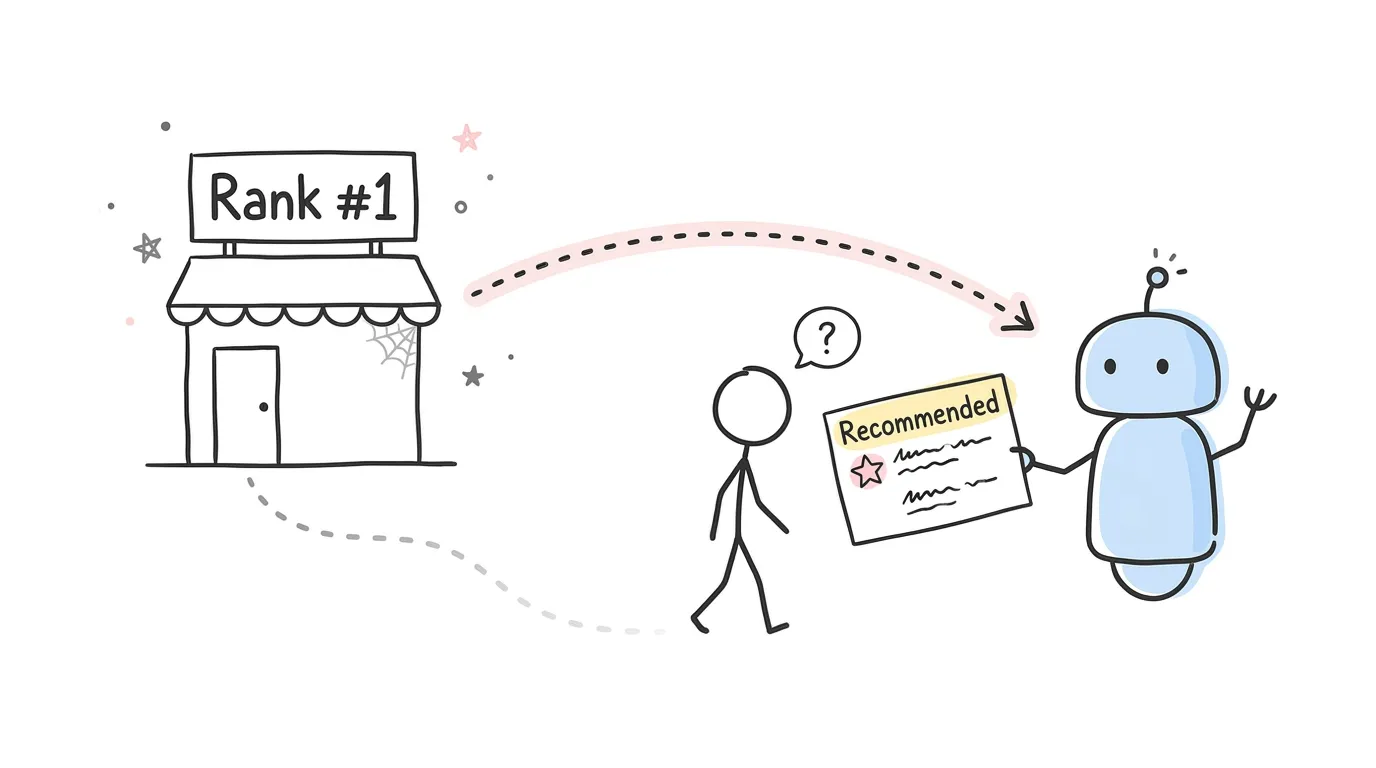
He said, look — my keyword has ranked number one on Google for three years straight. But last month, a longtime customer told him: "I don't search anymore when I buy things. I just ask ChatGPT." The AI listed three brands for him. His wasn't among them.
I asked: so where do you rank in ChatGPT's answers?
He said: there's no ranking. His brand wasn't mentioned at all.
I said, then for three years, the SEO you've been doing has been guarding an entrance that's being bypassed.
After that dinner, I kept turning this over in my head. Today I want to walk you through it, thoroughly.
What Is GEO?
GEO — Generative Engine Optimization. Put simply, it's about making your brand more likely to appear in AI-generated answers.
You might ask: we already have SEO — why has another acronym popped up?
Let me use an analogy.
SEO is opening your store at a prime spot in the busiest part of the mall, where heavy foot traffic means you win. AEO (Answer Engine Optimization) is writing your store's signage and shelf labels so clearly that customers find what they want the moment they walk in. And GEO? GEO is the mall's top sales associate.
More and more, customers don't browse the stores anymore. They walk straight up to the associate and ask: "Recommend me an AI content tool for Shopify brands." The associate names three brands without missing a beat.
Who the associate recommends doesn't depend on whose storefront is best — it depends on who's in their head, and who they trust.
SEO gets your page found. AEO gets your answer extracted. GEO gets your brand recommended.
You'll need all three in 2026. But GEO has a trickier wrinkle: the material AI engines pick from is often not the same set of pages that rank on Google. It may dig through comparison articles, review sections, community discussions, product docs, third-party reviews. No matter how well you rank, if you're absent from those places, you're absent from the answer.
Why Is This Urgent Right Now?
Because the way buyers ask questions has changed.
Some people ask ChatGPT which tool is best. Some ask Gemini for a comparison. Some have Perplexity put together a list. And some never even scroll — they bump into Google's AI Overview before they even scroll down.
AI doesn't hand you ten blue links. It hands you an answer — with citations, comparisons, and recommendations.
Note that word: an answer.
Users may never click through at all. They glance at the answer, remember two or three brands, and leave.
That's where it gets interesting — and a little scary. A brand can rank well on Google yet be invisible in AI answers. Meanwhile its competitor, with clearer content, more reviews, and denser third-party mentions, is the one the AI recommends.
So your visibility today hinges on three questions:
One, can search engines crawl and understand your content?
Two, can answer engines extract ready-to-use answers from your pages?
Three, do generative engines trust you enough to say your name in an answer?
So What Do You Actually Do? I've Broken It into Eight Things
Let's go one by one.
First, shift your content from "keyword thinking" to "question thinking."
What are AI engines for? Answering questions. So your content should be shaped to answer those questions.
Don't fixate on terms like "AI product content tool." What you need to answer is: How does an e-commerce team produce product content at scale? How does a Shopify brand keep AI-generated content on brand? How do you know whether your brand is being mentioned in ChatGPT and Perplexity at all?
A good page can't just say what my product is. It has to make clear: what problem you have, in which scenarios the problem shows up, what to look at when deciding, and what results you get after using it.
Second, say "who you are" in the same words, everywhere on the web.
This sounds like common sense, but I've seen too many brands fail at it.
The website says one thing, the product page says another, the social bios say a third, and third-party reviews describe them beyond recognition.
How does AI get to know you? By piecing together these signals. If the puzzle doesn't fit together, it can't recognize you — let alone recommend you.
So you need to answer the same set of questions, over and over, everywhere: What brand is this? Who is it for? What category does it belong to? What problem does it solve? Which platforms does it integrate with? What makes it different?
A brand that's easy to understand is a brand that's easy to mention. Remember that line.
Third, restructure your pages the way AI reads.
AI reads articles differently from people. People don't mind winding prose; AI does.
It works by scanning, classifying, summarizing, extracting. The more easily your content can be cut into clean "answer blocks," the more likely you are to be cited.
Clear H2s and H3s, short definitions, direct answer paragraphs, comparison tables, FAQs, steps, and the schema markup that belongs — add all of it.
Here's a writing technique I love, called layering: give the answer in one sentence first, then the background, then an example, then the evidence. When you explain GEO, the very first sentence should be the definition. No detours.
Fourth, don't just tend your blog — feed your product pages too.
Many people assume AI only reads blogs. Wrong. Product pages, category pages, docs, review sections — AI reads them all.
For e-commerce and DTC brands, this one is especially make-or-break. When AI answers a shopping-related question, it reads your product names, attributes, descriptions, reviews, size information, inventory signals, structured data.
A product page designed purely for conversion rate — gorgeous images, eye-catching buttons — but AI can't read out who it's for or what makes it different. What a waste.
ShopOS's approach here is to help brands turn product content and brand content into versions AI can read — at scale.
Fifth, build evidence. AI only trusts other people saying you're good.
A brand that only praises itself on its own website is hard for AI to cite. A brand that's mentioned everywhere — on review platforms, in comparison articles, communities, case studies, podcasts, industry reports — has external endorsement.
This is the most overlooked item of all. Many brands' instinct is to publish more blog posts. But AI looks precisely outside your own website. If it can't find you across the web, it can't find you in the answer.
So what you should build in 2026 isn't a content calendar — it's an evidence ecosystem.
Sixth, proactively create comparison content.
Users love asking AI to do one thing: compare.
"Compare these two tools for me. What's the difference? Which one should a company my size pick?"
If you don't state clearly where you stand, which scenarios you fit, whom you should be compared with, and what the differences are, AI will use other sources to say it "for you." And that's risky.
Don't write pages that attack competitors. Write concrete, fair, well-structured comparisons: which scenarios to choose you, which scenarios to skip you, and what the trade-offs are.
Seventh, treat AI visibility as something to be measured.
You can't manage what you can't measure.
Traditional SEO tools give you rankings, traffic, backlinks. But AI visibility isn't in Google Analytics. A user asks an AI, reads the answer, then searches your brand name directly afterward — the process in between is blind to your analytics tools.
So you need a dedicated layer of monitoring: which questions you appear in and which you don't; how often competitors are mentioned; which sources AI is citing; how it describes you.
ShopOS has a product called Big Head that does exactly this: helping e-commerce brands see where they stand in AI answers, where competitors win mentions, which questions matter, and where the blind spots are.
To be honest, a tool shouldn't just hand you reports. A good GEO tool should tell you what to change next.
Eighth, treat GEO as a quarterly meeting, not a one-time renovation.
The AI search landscape changes fast. New models are coming out, Google's AI experiences keep changing, ChatGPT's search behavior is shifting, Perplexity's cited sources rotate, and the way users ask questions keeps evolving.
So every quarter, sit down and review: question visibility, brand mentions, competitor mentions, citation sources, content gaps, product pages, schema, evidence signals, FAQs, new comparison opportunities.
One more thing: GEO shouldn't rest solely on the SEO team's shoulders. Content, product marketing, brand, e-commerce, social media, PR, paid media — pull them all in. Because AI gets to know you through the sum of all the signals across the web.
The New Shelf for E-commerce
Since we're on e-commerce, let me say a bit more.
AI is rewriting "browsing." Customers who want to know what gift to give, what skincare routine to follow, or which brand can serve as a substitute now just ask AI. So which brands get recommended, which products appear in shopping answers, which selling points the AI repeats over and over, and who gets compared with whom — these are becoming the new shelf.
And that spot on the new shelf has to be earned and maintained.
Let me run some numbers for you — all real results from ShopOS customers: Derby Jeans used AI content production to hit 2.22x ROAS, cut content costs by 40%, and eliminated two studio photo shoots a month. SHEIN cataloged over 5,000 SKUs in a month, with 88% fewer generations and went live in half the time. Van Heusen turned three holiday shoots into 10,000 personalized retail ads. And Crafeed manages 120+ brands and $30M+ in ad spend, with an average ROAS of 5.2x.
See — this isn't a concept. It's a business that's already running.
The Biggest Pitfall
The biggest pitfall I've seen is brands assuming: AI is so smart, surely it'll figure out who I am on its own?
It won't.
If you don't give it clean signals, consistent context, reliable evidence, and structured answers, it guesses. And when it guesses, you're not in the answer.
Other common ones: stuffing keywords without answering questions; publishing blog posts with no original insight; product pages without depth; brand messaging that contradicts itself across channels; no FAQ; not tracking question visibility in AI; treating GEO as a one-off project and walking away once it's done; publishing AI-generated content without anyone reviewing it; forgetting technical SEO and structured data.
Where Do You Start?
No need to tear everything down. GEO grows best when it grows out of your existing SEO, content, brand, and e-commerce workflows.
My suggested steps: first, list your most important buyer questions. Then go to each AI engine and ask those questions one by one. Note who gets mentioned, what sources the AI cites, and where you're missing. Then fill the gaps: revise the pages that need revising, add FAQs, schema, comparison content, and thicken the evidence. After that, review again every quarter.
A friend who works on Shopify started exactly this way: he listed every question — product recommendations, category comparisons, alternatives, gift-giving scenarios, sizing, shipping, returns — asked AI each one, then fixed the pages one by one. Three months later, he started showing up in the answers.
Finally
Back to that friend from the beginning.
What did he do? He went back, listed his 20 most critical buyer questions, asked each one in the AI engines, went through every citation source, and started with his product pages and FAQs.
Last month he told me a new customer said they'd found him in an AI's recommendation list.
In the future of search, the contest isn't about who ranks higher — it's about who is understood more clearly.
In the AI era, rankings win traffic. Understanding wins recommendations.
Here's wishing you a spot in AI's answers, too.
Continue reading
Related articles

It's 2026: Stop "Buying" AI Tools for Your Marketing Team — Start "Hiring" AI Agents
This learn article explains how AI agents differ from standalone AI tools in marketing, outlines three agent categories — build-your-own platforms, CRM-native agents, and vertical tools — and covers use cases across SEO, social media, advertising, and reporting, plus criteria for choosing one.

AI Is Already Making Decisions for Your Customers. Are You on the List?
A learn article explains GEO (Generative Engine Optimization): why AI-generated answers now shape which brands customers see, and how SEO fundamentals, entity clarity, citable evidence, and monthly measurement affect visibility in AI answers.
Google Swapped Its Brain Three Times in Two Weeks — the Search Table Just Got Reshuffled
A learn article reviewing recent search-industry developments, including Google's rapid AI model swaps, AI Overviews and AI Mode expansion, ads entering AI search, and social platform updates. It advises marketers to track whether their brand appears in AI-generated answers.