
In September, Three Platforms Took Away Part of Your Steering Wheel
A few days ago, I went through everything the three big ad platforms did in September 2026. And I noticed a remarkably interesting coincidence.
A few days ago, I went through everything the three big ad platforms did in September 2026. And I noticed a remarkably interesting coincidence.
Meta, Google, TikTok — three platforms that normally compete tooth and nail did the same thing in the same month: they took away part of the steering wheel that advertisers were holding.
You might say: platform overhauls happen every year. Is it really worth the fuss?
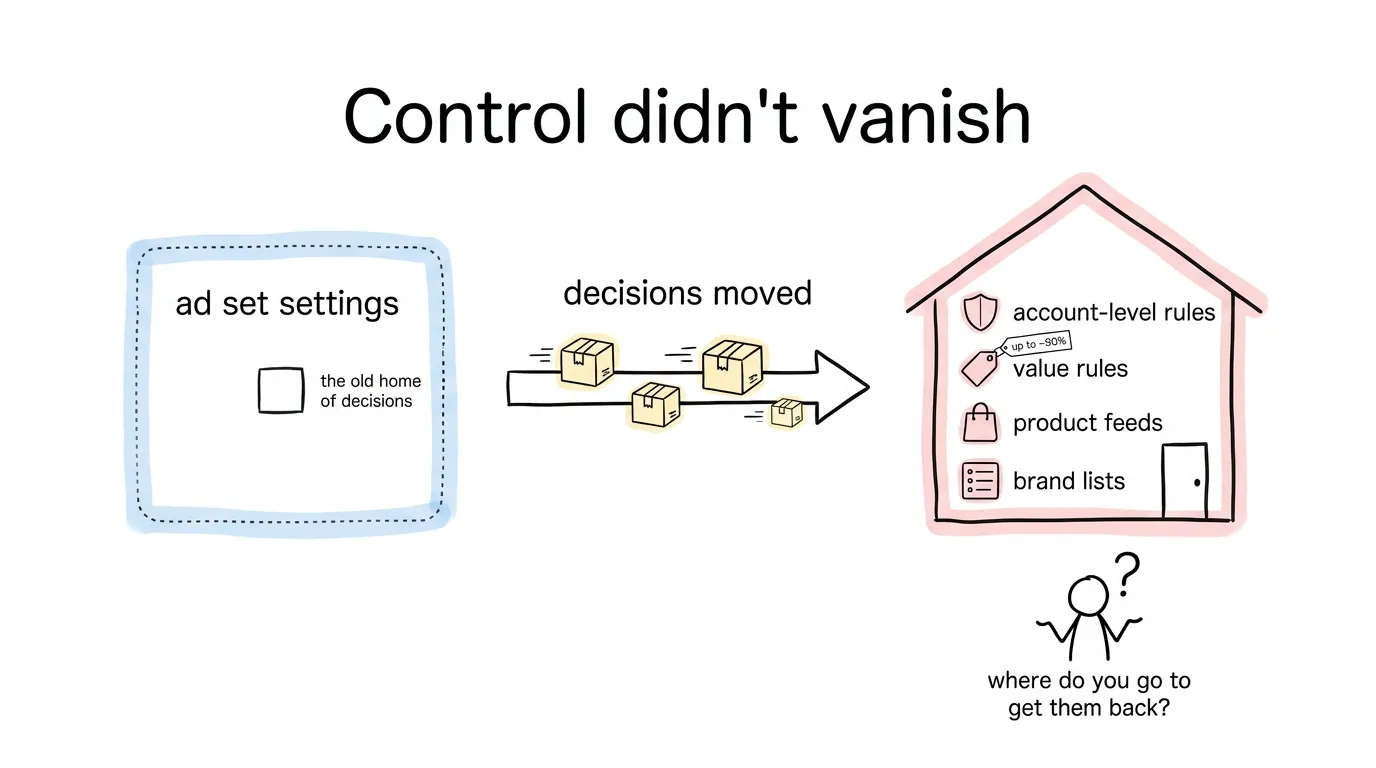
It is. Because what got taken away this time wasn't "operations" — it was "decisions." When operations are gone, you just find the new button and click it again. When decisions are gone, where do you go to get them back? Which brings us to what each of the three did in this window in September.
Let's start with Meta.
Meta: The Only Thing You Can Still Control Is Whether It's Cheap
On or around August 19, many advertisers saw a notice pop up inside Meta's ad tools: ad-set-level placement exclusions are no longer available. Placements, devices, operating systems — options you used to be able to casually strike out inside an ad set, now you can't.
No official announcement. Meta didn't hold a press event, didn't send emails; it just quietly changed things. The first rollout covered only the Sales and Leads objectives, and sensitive industries were temporarily exempt.
So if you can't exclude anymore, what about the traffic that stumbles in anyway?
Meta's replacement is called value rules. You can lower your bid for a given placement, by up to 90%.
What does that mean? The placement you wanted to switch off entirely can now only be bought at a discount — but buy it you must.
Think for a second about how big that difference is.
An exclusion is a wall — the traffic can't get through. A lowered bid is a discount — the traffic still comes; you're just less willing to pay for it. If your goal is brand safety — say, certain placements should never carry your brand in the first place — then "appearing there cheaply" and "not appearing at all" are two completely different things.
Meta changed "don't let it appear" into "make you less willing to have it appear."
Where did the real hard limits go? They moved to the account level. The placement rules in Advertising Settings cover every campaign across the entire ad account, including newly created ones running automatic placements. So if you genuinely have placements that must not show your ads, stop looking inside the ad set — set it once at the account level, and be done.
Meta One and Muse: You Pay for AI, and AI Spends for People
On September 15, Meta launched Meta One, a paid subscription. Higher AI usage limits, more expressive features, covering Facebook, Instagram, WhatsApp, and Meta AI. Core features stay free as always; the business tier starts at $14.99 a month, adding a verified badge, publishing and analytics tools, team seats, and more usage of Meta Business Agent.
There's a detail worth chewing on. In Meta's announcement, there was not one word about any change to ad delivery or Ads Manager.
What does that mean? It means this is not a product that improves your ad performance. Whether you buy it depends on how many hands and how much polish your operations need — not on how much your ROI will rise.
A week earlier, on September 8, Meta released Muse, a personal AI agent. Users can use it in a standalone app, or simply talk to it inside WhatsApp. It can run errands on a user's behalf, including checking out. When it's time to pay, Muse generates a one-time virtual card through Link by Stripe, so the user's real card number is never exposed to the merchant. It has launched in the US only, and only for adults. At the Connect conference on September 23, Meta announced plans to expand the agent further.
For advertisers, Muse is not an ad product. But it's like a tentacle reaching out ahead of time, telling you something is happening: the visitor browsing your site and the message landing in your inbox may no longer be a person, but software running errands for a person.
When that day comes, the one reading your clear product details, upfront pricing, and fast, accurate replies will be AI — and your answers will need to be readable by AI too. That homework should start now.
Google: Auto-Upgrade, and a Coupon That Expires
Starting September 1, Google did something even more direct: it began auto-upgrading search ads.
Which campaigns get upgraded? Those using campaign-level broad match, or using standalone auto-created assets. The migration happens in batches throughout September, upgrades in place, settings kept equivalent, and the existing brand inclusions and exclusions carried over as-is. Dynamic Search Ads lag one step behind, set for February 2027.
What is campaign-level broad match? Pay attention to that qualifier.
Broad match set at the keyword level does not trigger the upgrade. Only when an entire campaign has broad match on does it get pulled over. This boundary is one many people get wrong.
What happens after you're upgraded? AI Max will expand the search terms your ads can appear for. And if you were using auto-created assets, even your ad copy may be expanded automatically. So in the first weeks after migration, the search terms report and brand controls are two things worth checking every week.
The same week, on September 16, Google also shipped a set of agentic commerce updates for the holiday season. The AI-powered insights in Merchant Center expanded to Australia, Canada, India, New Zealand, and the United States, letting you see your brand's share of voice on AI surfaces like AI Mode and AI Overviews. The Business Agent embedded in YouTube ads opened a US beta. The Universal Commerce Protocol also expanded, and one item in it is particularly interesting: a shopping cart can be handed off directly to a merchant's own website to complete the transaction.
Put these together and they point to one conclusion: product feeds are doing far more work than they were a year ago. Google is explicitly encouraging retailers to add conversational attributes to their feeds and connect loyalty data, so the AI shopping experience can recommend your products and show your members-only prices. If your feed only fills in the most basic fields, then at the fastest-growing entrance, you may simply be invisible.
One more thing — you can call it unflattering, or you can call it reality.
Some advertisers reported that promotional coupons in Google Ads were voided after they had finished spending the required amount. The money was spent; the coupon was gone. Ads Liaison, Google's official ads liaison account, acknowledged receiving these reports but offered no broader explanation.
So that old advice now needs to be said more bluntly: set your budget at full price. Treat a coupon that hasn't landed as if it doesn't exist.
TikTok: The One That Went the Other Way
Interestingly, in the same September, TikTok's direction ran opposite to the other two.
It opened the upgraded Smart+ to small and mid-size advertisers, and made it modular: audience, budget, placements, product catalog — four modules, and for each one you can choose fully automatic, semi-automatic, or fully manual. It also added anchor links, letting organic videos attach Smart+ paid content, connecting free content with paid campaigns.
See it? While Meta and Google are pulling control back, TikTok is handing it out.
And handing it out in fine detail. Not a one-size-fits-all "do you want automation?" but module by module: are you comfortable handing this one over? Do you want to keep tuning that one yourself?
That's actually a rather good posture. Automation isn't a matter of faith — the degree is the craft.
In September TikTok also shipped two vertical products. Growth Max: Mini Games promotes playable mini games right inside TikTok. For streaming platforms there's Streaming Ads, driving performance via product catalogs, paired with Smart+, plus a New Title Launch package built for major new releases.
Notice the pattern here — it's cast from the same mold as the other two: underneath it's the same automation layer, with different industry skins on top.
Oh, and one easily overlooked thing. TikTok's 2026 advertising policy changelog was updated again in September, with changes in finance, prediction markets, alcohol, weight management, incentivized games, and other categories. If you're in a regulated industry, don't read this log once a year — flip through it before every major push. An ad rejected in peak season wastes more than money; it wastes time, and in peak season nothing is more expensive than time.
What All Three Moved Is Actually the Same Spot
Lay out all three platforms' September moves side by side and you'll see they were shifting the same thing.
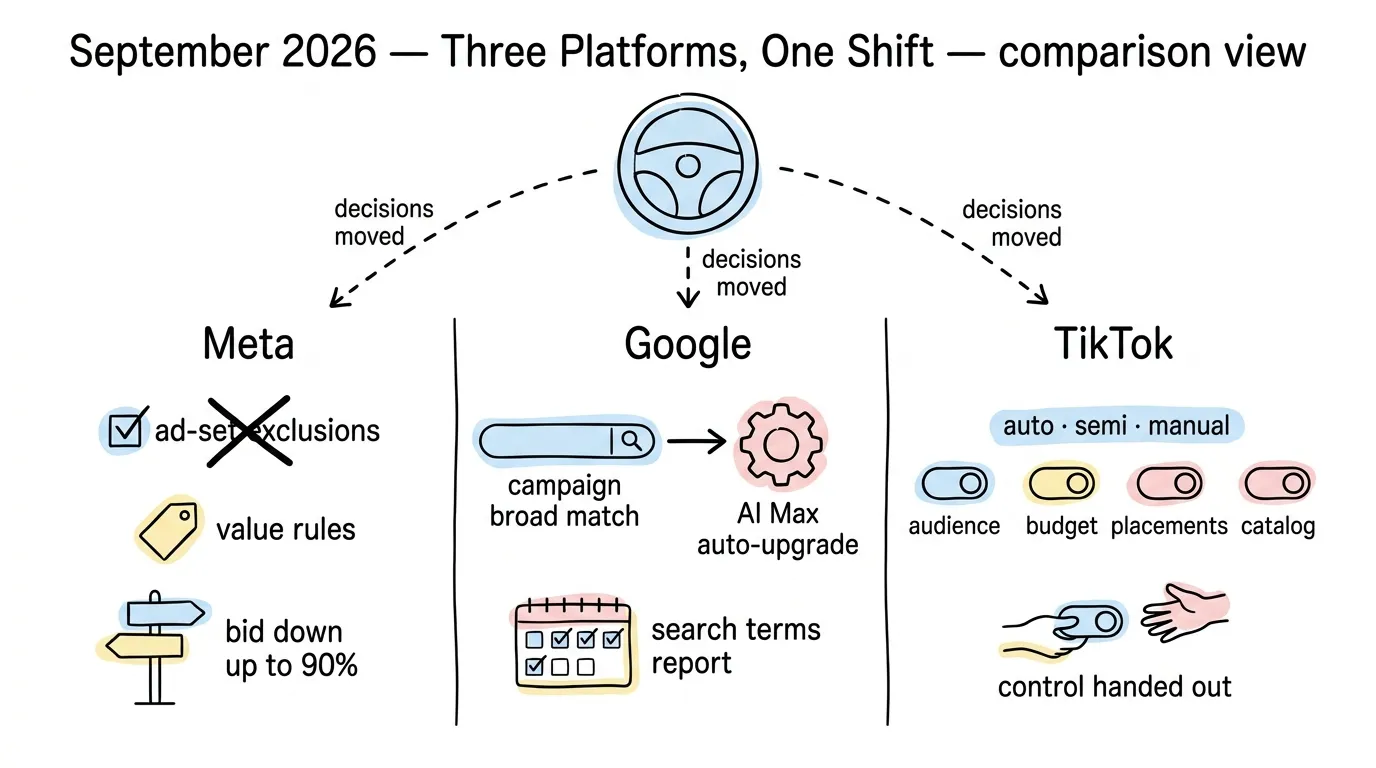
Shifting what? The level where decisions live.
Before, many decisions happened inside an ad set's settings: which placements to exclude, what match type to use, how to split audiences. Now those decisions are being carried into automated systems. So where did the people who used to manage them go?
Control didn't vanish — it just moved house. Into account-level rules, into value rules, into feeds, into conversion data, into brand lists.
On the other side, AI agents are surfacing on both ends of the transaction at once. On the merchant side, agent-powered customer service is taking in visitors; on the consumer side, people are starting to shop through agents. Muse and Business Agent in September both point this way.
For advertisers, this means your attention needs to relocate too.
Fewer and fewer wins and losses depend on which box you ticked inside an ad set. More and more depend on how clean everything outside the ad is: whether the data is clean, whether the feed is accurate, whether the account is stable, whether the landing page complies, whether payments run smoothly.
The bar for running ads has shifted from knowing how to set up campaigns to knowing how to run a shop.
A Catch-Up Checklist
It's been two months since September. If you haven't dealt with these things yet, there's still time to catch up before the heaviest weeks of the year-end season arrive.
On Meta's side: move your standing placement restrictions to the account level, then look back at which ad sets are currently leaning on value rules.
On Google's side: list the search campaigns affected by the AI Max upgrade, and check the search terms report and brand controls once a week.
Merchant Center: add conversational attributes to your product feed, and check whether the AI-powered insights are live in your market.
TikTok: decide which of the four modules you insist on keeping manual, then go through the policy changelog for your category.
And the budget. Set it at full price — don't count coupons that haven't arrived.
Finally
Back to that steering wheel from the opening.
In this window in September, three platforms changed the same thing in three different ways: the steering wheel isn't always in your hands, and from now on it will be in your hands less and less. Some was taken away and swapped for a discount; some was moved away — into accounts and feeds. And on TikTok's side, a few knobs were handed back for you to turn yourself.
But where the steering wheel went isn't the most important thing. What matters most is that this car's engine switched fuels. It used to burn your operations; now it burns your inputs.
How much clean data, how accurate a feed, and how stable an account you have right now determines whether you'll get to hold the steering wheel later.
Here's wishing you a peak season where the money goes out easily — and where you know exactly where it went.
Continue reading
Related articles
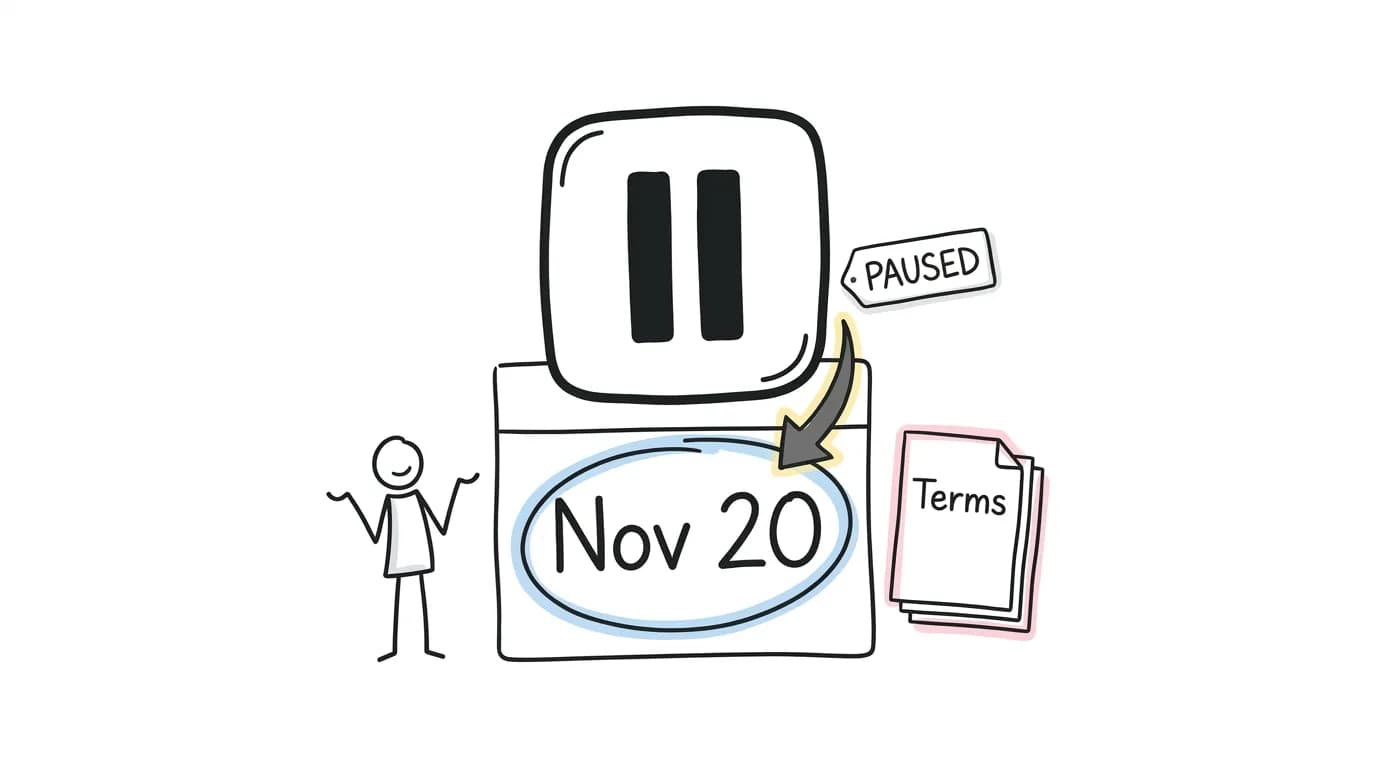
Meta's New Terms Hit the Pause Button on the Eve of the Effective Date
A while back, I was helping a friend of mine who runs a cross-border e-commerce business go through the compliance checklist for his ad account.
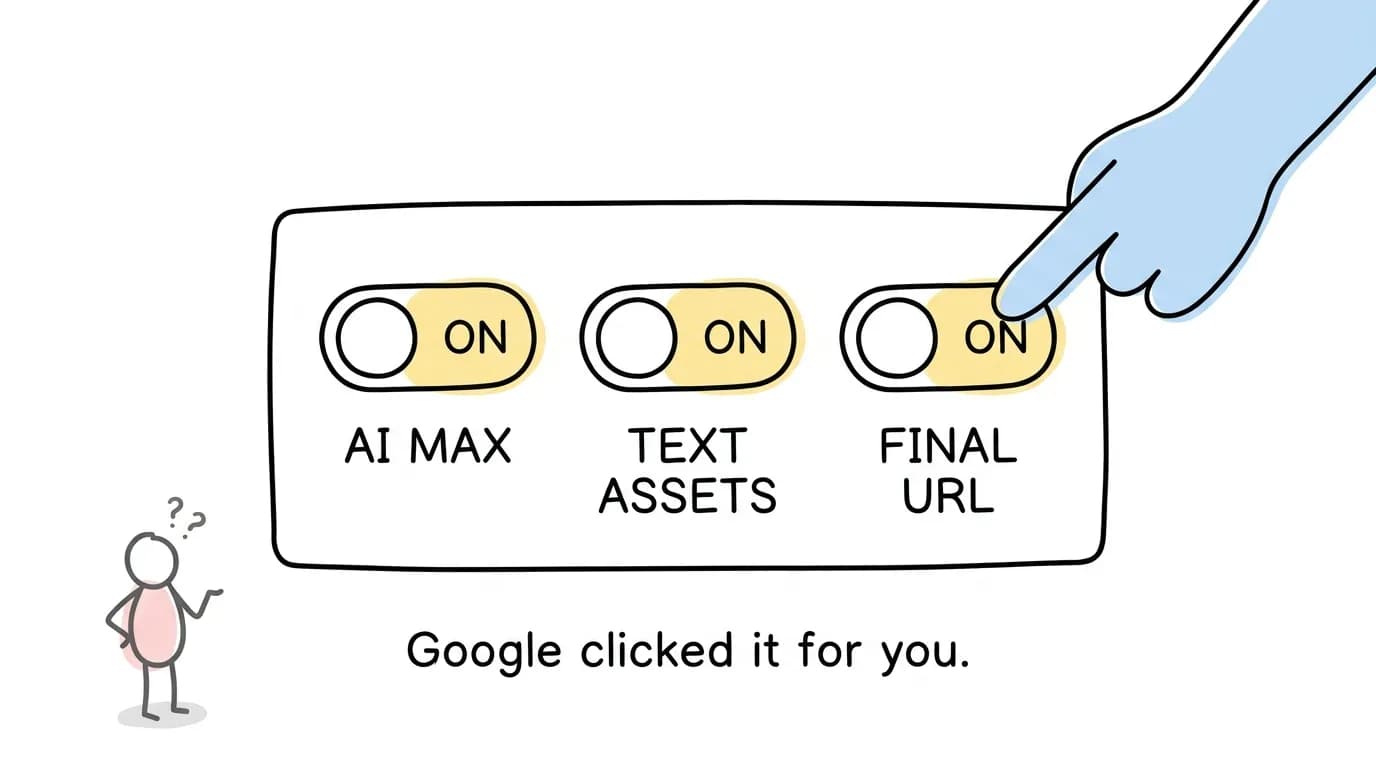
Google and Meta changed 17 ad rules this week. 6 of them need checking today.
A few days ago, I was helping a friend who runs a cross-border e-commerce business go through his ad accounts.
Stop Re-Teaching AI Every Time. Turn Your Expertise Into Its Skills.
A few days ago, a friend of mine — a marketing director — grabbed dinner with me.