
Budgets Keep Getting Cut — CMOs Have to Get the Books Straight
Marketing budgets face growing scrutiny as CFO pressure rises, while privacy rules, opaque ad platforms, and fragmented tools make ROI hard to prove. The article outlines four blockers and describes how marketing intelligence platforms such as Funnel approach data unification, measurement, and activation.
A few days ago, I had dinner with a friend who runs a consumer brand. He's been in marketing for a decade or so, and now carries the CMO title, overseeing a budget of several hundred million RMB a year.
Before the dishes had even finished arriving, he pulled out his phone and showed me a screenshot: the minutes from last week's budget meeting. The board's opening question: that several hundred million we spent last year — did it come back?
Five years ago, he said, that question was easy to dodge. A few slides on brand-buzz trends, some talk about "long-term mindshare," and you could skate by.
Not anymore. The CFO sits across the table, clutching a stack of reports, picking the numbers apart one by one.
"Is the pressure really that bad?" I asked.
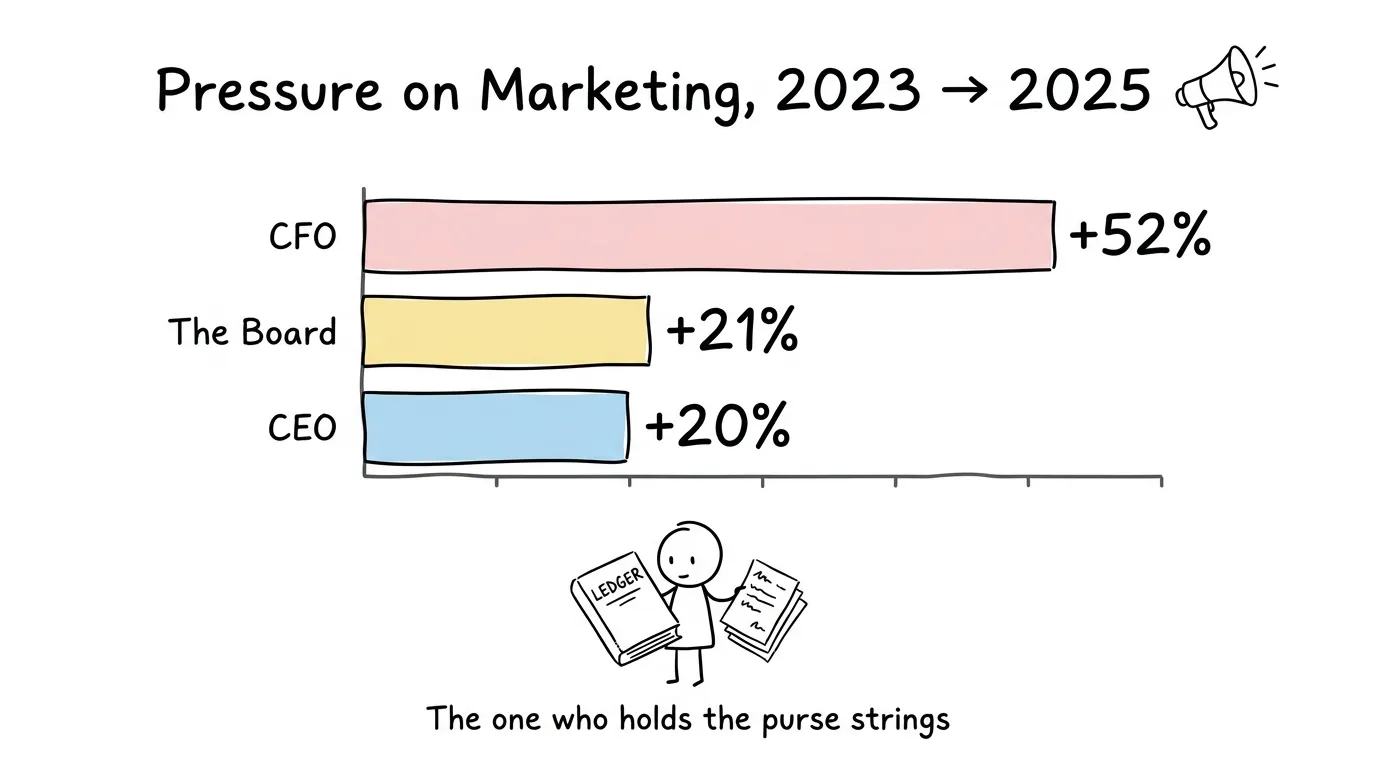
He slid a survey across the table. In its spring 2025 edition, The CMO Survey asked marketing executives around the world: from 2023 to 2025, pressure from the board rose 21%; pressure from the CFO climbed even faster, up 52%; and from the CEO, also up 20%.
52%. Nearly double.
The one who holds the purse strings is now applying nearly double the pressure.
That is where every CMO stands today: budgets are shrinking, and the questions are mounting.
The key to the problem, though, is written right there in those meeting minutes. You have to show how much revenue every yuan of marketing spend brings back. In the trade, that's called ROI.
So what is marketing ROI?
Marketing ROI compares what you put into marketing against the business outcomes it produces — customers, revenue, growth. Stripped to the bone, it's the plainest question there is: was this money worth it?
Sounds simple. Proving it is the hard part.
Why the Math Used to Add Up — and Doesn't Anymore
You might think marketers have always done this accounting. True — they always have. But it used to be a much easier ledger to keep.
Back then, the tools worked in your favor. Google Analytics plus UTM links showed exactly where users came from, what they clicked, and whether they finally bought — the whole path laid out clean. Attribution models were crude, but acceptably crude.
The shift began around 2018. Privacy regulations landed one after another, third-party cookies grew unreliable, and user-behavior data got harder and harder to capture. Two things made it worse: ad-platform algorithms got "smarter" — so smart you couldn't see at all how they thought; and teams kept buying more tools, scattering data across dozens of systems that each told its own story.
Let me give you one example of just how blurry attribution has become.
Someone browses your website on their office computer, looks around, and doesn't buy. That night at home, they pick up their phone and place the order.
To a traditional attribution model, that's two different people. One purchase, logged as two conversions.
On paper the numbers look lively; in reality they're all dirty. Would you walk into the CFO's office with a ledger like that and expect to be believed?
When attribution fails, the chain reaction is direct: if you can't articulate marketing's contribution, management loses patience and cuts the budget. And once the budget is cut, you lose the money to run experiments. Bain & Company has compiled case studies showing that companies like Allianz achieved ROI improvements of more than 20% through marketing experiments. Experimentation is precisely the most powerful engine of growth. An engine without fuel leaves the car stranded.
If you can't account for the numbers, you can't keep the money; if you can't keep the money, you can't deliver growth.
It's a vicious cycle.
Four Locks on the Books
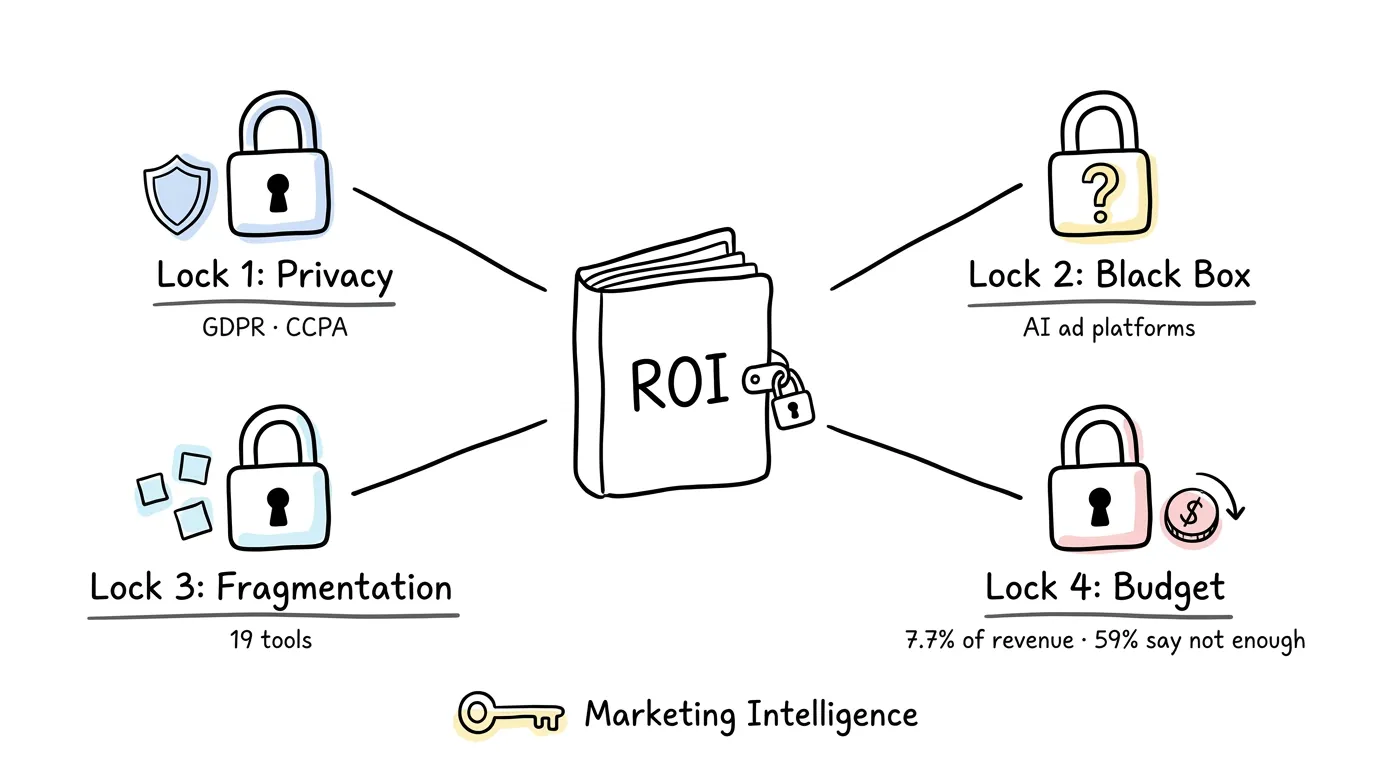
So where exactly does this cycle jam? I counted: four locks, mainly.
The first lock: privacy.
Regulations like GDPR and CCPA fundamentally changed the rules of data: if you want to track users, the users have to say yes first. Third-party cookies are heading for a full exit, and first-party data has become the mainstream path. One detail worth pausing on: as Jentis has observed, Google actually still supports third-party cookies — Chrome users can switch them on or off — and the Privacy Sandbox APIs are still there. Sounds like good news? It's actually more trouble. There are more compliant routes than before, but every one has to be rebuilt from scratch, so attribution complexity has gone up, not down. Worse still, first-party data sits scattered across your website, your CRM, and every channel, none of it talking to the rest. Try to pull it together for one consolidated view, and you can't even find a place to keep the ledger.
The second lock: the black box.
AI ad platforms are great at one thing: pumping up your clicks. Why they bid the way they do, what they optimize against — you have no idea.
That's the lethal part. Results can't be reproduced, lessons can't accumulate, and you can't even confirm whether the platform is actually making you money or just optimizing the metrics it likes to look at. What a CMO needs is predictability: knowing which action produces which outcome is the only way to steer spend toward business value.
The industry's current fix is to feed the right signals back. Funnel's Activate exists for exactly this: through server-side APIs, it sends high-quality conversion data straight back to the ad platforms, so they optimize for metrics that actually move profit — customer lifetime value (CLV) — instead of click-through rates. Get the signals right, and ad spending becomes predictable.
The third lock: fragmentation.
Airtable published a 2024 marketing trends report with a number that stuck with me: the average marketing team is running 19 tools.
Nineteen, for heaven's sake. Analytics, CRM, ad platforms, email, automation, dashboards, spreadsheets… each keeps its own books, with inconsistent naming, inconsistent definitions, plus duplicate data and lag. Put the reports from all 19 systems side by side and you still can't assemble one truthful picture of market performance.
This is exactly where Funnel focuses: data unification. It automatically collects, normalizes, and centralizes data from every marketing source — consistent naming, aligned metrics, duplicates removed — and hands you a single source of truth. Only when the foundation is level does the measuring on top of it mean anything.
The fourth lock: the budget itself.
This may be the most tangled lock of all. Gartner has reported that in 2025, marketing budgets sit at 7.7% of overall company revenue — flat versus the previous year, not a penny more. And 59% of CMOs say outright that the money they hold isn't enough to execute their 2025 strategy.
Same money, more work. Many teams' first instinct is to bring in AI tools to cut labor costs. The direction is right, but there's a precondition: without a clean data foundation, AI can't produce trustworthy numbers either. However many tools you pile on, you're just stacking messy ledgers on top of messy ledgers.
Stack the four locks together and you get the "ROI reckoning" marketers are living through: marketing must prove its real contribution to revenue. Click counts and conversion tallies alone won't get past the board.
And what does the CMO who can prove it get? Budget. When the board can see marketing's value, the money follows.
ROI isn't just about proving your innocence — it's your ticket to keep investing.
The Way Out: Marketing Intelligence
With the problem laid out, it's time to talk about the way out. What is marketing intelligence?
Marketing intelligence turns scattered, untrustworthy data into a decision system that can answer three questions: what happened, why, and what it was worth. It links data, measurement, activation, and decisions into one line. With it, you're no longer only explaining marketing's performance after the fact — you can predict it before it happens.
One caveat, though: the term is badly overused these days. Most tools on the market calling themselves "intelligent" actually stop at the dashboard — a few charts for you to look at, nothing more. Some data-integration and analytics tools are also rushing to rebrand themselves as "intelligent platforms," but both their measurement capability and their ease of use fall well short.
Put Funnel, Supermetrics, and Adverity side by side, and where Funnel goes further is this: it doesn't stop at moving data into one place and making the reports look pretty. On top of its unified-data foundation, it layers a complete measurement layer and an execution layer. The data is accurate and compliant — and it can genuinely be used to make decisions.
Unpack it, and it's three layers of work.
Layer one: lay the foundation.
Funnel connects to more than 500 data sources and stores only non-personally identifiable information (non-PII), heading off privacy risk at the source. The compliance homework has been done seriously: fine-grained access controls, plus credentials like GDPR, CCPA, SOC 2, and ISO 27001. API integrations and platform updates are managed by Funnel, so when a downstream platform revamps itself, your reports don't go dark on the spot. Historical data is retained with no cap — for trend analysis and modeling, you have all the raw material you need.
Layer two: get the math right.
On measurement, Funnel puts marketing mix modeling (MMM), attribution, and incrementality testing into one system, with its Data Hub underneath guaranteeing that every model is fed clean data. Smaller teams can use data-driven multi-touch attribution to see which channels are truly pulling their weight; more mature teams can layer on advanced models to optimize the media mix. Attribution data from online and offline channels sits side by side without any platform's slant, and you can drill into any single channel to view incremental lift, keeping an eye on the metrics that really matter: ROAS (return on ad spend) and marginal customer acquisition cost. It also serves AI-backed media-optimization recommendations, telling you where to double down and where to pull back. And by connecting to the conversion APIs of platforms like Meta, TikTok, and Google Ads for server-side tracking, it recovers a big chunk of the signal lost to browser restrictions, cookie deprecation, and ad blockers.
Layer three: connect the decisions.
Only when the foundation and the measurement are both sound do decisions stop being gut calls. With real-time reporting plus activation, you can feel marketing's pulse every day: which channel is picking up steam, which needs adjusting, where to move the budget. Every yuan's destination has data standing behind it.
To the CMOs still watching from the sidelines, one piece of advice: the window on this doesn't wait. Your competitors are already reallocating budgets in real time on intelligent platforms. Show up six months late, and catching up gets painful.
Back to That Dinner
Toward the end of the meal, I asked my friend: so where do you plan to start?
He thought for a moment. "Get the data sorted first," he said. "If you can't get the books straight, everything else is just talk."
I couldn't agree more.
Budget pressure isn't something you can dodge. But look at it another way: it's also pushing marketing to get better, forcing every marketing organization to evolve from storytelling to accounting. Whoever gets this ledger straight first is first in line for the money that funds the next round of growth.
And here's a wish for you: may you never again have to prove your innocence, over and over, in a budget meeting.
Continue reading
Related articles

It's 2026: Stop "Buying" AI Tools for Your Marketing Team — Start "Hiring" AI Agents
This learn article explains how AI agents differ from standalone AI tools in marketing, outlines three agent categories — build-your-own platforms, CRM-native agents, and vertical tools — and covers use cases across SEO, social media, advertising, and reporting, plus criteria for choosing one.

Did the Money You Spent on AI Marketing Ever Come Back?
A guide to measuring AI marketing ROI across three layers: ad reports, sales pipeline, and the financial ledger. Covers metrics such as ROAS and CPA, eight dashboard metrics, industry benchmarks, and common measurement mistakes.

How to Pick a Creative Automation Platform: First, Figure Out What These Eleven Actually Do
A learn article sorts eleven creative automation platforms — including Bannerflow, Celtra, Smartly.io, and Storyteq — into four functional groups and proposes five evaluation questions covering publishing reach, automation depth, ease of adoption, team fit, and verifiable evidence.