
What Is GEO? Data from 16,000+ Websites Tells the Whole Story
A learn article explaining GEO (Generative Engine Optimization) — getting brands and content cited in AI answers. It cites an SEOcrawl study of 16,661 websites comparing Google and AI traffic, then covers five content tactics, technical crawlability, authority signals, five metrics, and a 90-day plan.
A while back, a friend of mine who has been running an independent cross-border e-commerce site for seven or eight years messaged me on WeChat in the middle of the night.
He said: take a look for me — has my organic search traffic dropped too?
I asked why the sudden question. He sent a screenshot of his analytics dashboard. The Google line had dipped. But there was a new traffic source he had never built: ChatGPT.
He asked me, what am I looking at here?
I said, congratulations — you've stumbled onto something big that's happening right now. It has a name: GEO, Generative Engine Optimization.
There's the name. Now let's start from the beginning.
First, Four Numbers
You can't talk about this in the abstract, so let's look at the data first.
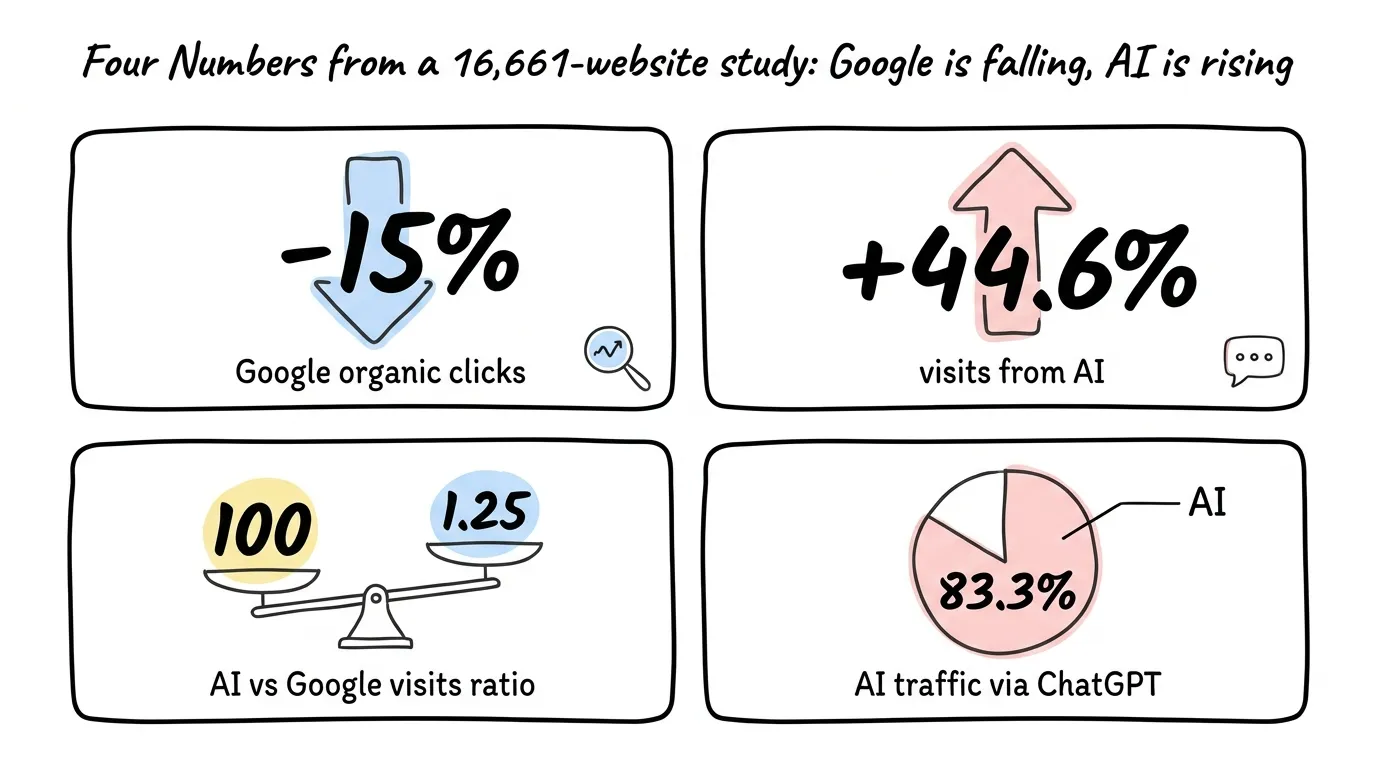
SEOcrawl ran a study covering 16,661 websites and did the math on Google organic search and AI traffic together. Here are four numbers I picked out for you:
The first: Google organic clicks fell 15% in a year. And the decline is accelerating — by August 2026, they were down 21.8% year over year.
The second: visits from AI rose 44.6%. That comes from 3,949 websites with GA4 installed, comparing March through August 2026 against the same period in 2025.
The third: AI's scale is still tiny. For every 100 visits Google sends, AI sends 1.25. A year ago it was 0.7. The growth is fierce, but don't forget — Google still sends 80 times what AI does.
The fourth, and the most interesting one: ChatGPT alone accounts for 83.3% of AI referral traffic. Gemini 6%, Perplexity 4.7%, Claude 3.7%, Copilot 2.1%. But Claude grew 6.6-fold in a year, Gemini almost tripled, while Perplexity actually fell by half.
Man, this board is shifting fast.
All four numbers point to the same verdict: GEO can't replace SEO yet, but it's the channel that's growing.
One more caution: 1.25 is the lower bound — an underestimate. Many ChatGPT visits carry no source attribution, and clicks from AI Overviews and AI Mode get counted as Google organic search in the stats.
The real level is likely higher still.
What Is GEO?
What is GEO?
GEO is getting your brand named by AI and your content cited by AI — getting inside its answers.
You ask ChatGPT a question. As it answers, will it mention a certain brand? Will it link to a certain page? That "will or won't" is exactly what GEO fights for.
What does SEO fight for? Rankings. When a user searches a term, where does your link land?
What does GEO fight for? Citations. At the moment AI composes its answer, does it bring you along?
Keep in mind: the two are related, but they are not the same thing.
A page can sit firmly at position one, yet be entirely absent from AI's answer. It can also go the other way: Perplexity cites it every day, while its rank in traditional search is nothing special.
AI is no longer just ranking for you — it has started answering for you.
Where did the term come from? In November 2023, a team led by Princeton University, together with several research institutions, published a paper that formally defined it. They tested 10,000 queries and compared 9 optimization methods. The conclusion: adding statistics to your content, citing your sources, and quoting experts verbatim can raise your content's visibility inside AI answers by as much as 40%.
Put plainly: whom AI cites is something that can be engineered.
So Where Are the Engines Citing From?
Now for the next question, which is counterintuitive.
Which websites is AI actually citing?
SEOcrawl threw questions like "what is GEO software" to six engines and recorded the answers over a few days in late October 2026. Across all answers, 29 domains were cited. Among them: six "best GEO tools" listicles, Wikipedia, Reddit discussion threads, and the very research paper that defined GEO in the first place.
For another question — "which SEO tools support MCP" — the most-cited source was GitHub, with 10 different repository pages.
See the pattern?
What engines cite are the places where a topic has already been discussed and compared.
Listicles, documentation, communities, papers. AI rarely cites a lone self-promotional page; it cites the places where "everyone is already talking about this."
This tells us something: half of the GEO battle isn't fought on your own website.
Five Content Plays
So how do you play the other half — the part on your own site?
Five rules, in priority order.
Rule one: answer first.
When you write your opening, write as if the AI will only ever read your first paragraph. Because sometimes, it truly does. Say the core answer within the first 100 to 200 words. No throat-clearing. No "before we dive in, let's first take a look at…"
Rule two: keep the structure clear.
Headings, numbered lists, tables. Especially for comparisons — put them in an HTML table, not an image. A table is text, and AI can cite it; the words inside an image are, for the most part, invisible to AI crawlers.
One small detail: don't write "as mentioned above" or "the method discussed earlier." Every paragraph must stand on its own. AI lifts paragraphs, not context.
Rule three: write sentences that can be quoted.
What is a quotable sentence?
Vague statements don't get copied. "Our platform helps teams collaborate efficiently" — nobody quotes that.
Specific statements do. "Across 3,949 websites, AI referral traffic grew 44.6% year over year" — that's what quotable means.
Vague sentences get ignored; specific sentences get cited.
Rule four: data, sources, and expert quotes.
The same research says it: statistics, cited sources, and direct quotes can lift visibility by up to 40%. First-party data above all — your own internal research, product metrics, case results. That stuff is exclusive; nobody can copy it away from you.
Rule five: target long, conversational questions.
In the search era, users typed "best rank tracking tool." In the AI era, they ask "how do I check whether ChatGPT is recommending my brand?"
Feel the difference. The first is a word; the second is a sentence.
Build your content around the question users would actually ask out loud.
The Technical Layer People Skip
Everything above is the content layer. But many people talk only about content and skip the technical layer. You can't skip this layer.
First, AI crawlers have to be able to get in.
ChatGPT's OAI-SearchBot, PerplexityBot, Claude's crawler — they all need clean, crawlable pages. If your robots.txt blocks these bots, no amount of good writing matters — it's all for nothing. Also, many AI crawlers don't execute JavaScript. Content that only renders via script simply doesn't exist to them.
Second, structured data saves AI some guessing.
FAQPage marks up questions and answers, Article says who wrote a piece and when it was published, Organization establishes brand identity, and Person attaches content to a named, real author. Done well, AI doesn't have to guess what your page is for.
Don't Forget: AI Trusts "Authority" by the Same Playbook
So why would AI trust you?
It trusts the same things Google trusts. Whatever appears frequently, gets cited a lot by other authoritative sources, and binds to clear entities floats up more easily.
Google's E-E-A-T framework — Experience, Expertise, Authoritativeness, Trustworthiness — carries straight over.
So how do you build authority, concretely?
Show up in your industry's listicles and comparison pieces, publish research in industry media, answer questions earnestly on Reddit and YouTube, and put your technical content on GitHub and in public docs. Every external mention is a data point. Once AI has seen you often enough, it's willing to put you in front of users.
One more underrated thing: author bylines. A named author with a verifiable track record, plus a consistent bio, is a trust credential written for AI to read.
By the way, digital PR now pays twice. When your boss gives an interview to an industry publication, that used to count as a PR win; now it is also a citation signal for Perplexity and ChatGPT. One effort, two payoffs.
How Do You Measure It? Five Metrics
After doing all this, how do you know whether it worked?
Five metrics.
- Prompt coverage: of the set of questions you track, in what share does your brand show up?
- Mention rate: of AI answers, how many mention you?
- Citation rate: how many answers actually link back to your domain?
- Share of voice: compared with competitors, how much of the mentions are yours?
- AI traffic: how many visits is AI actually sending you — watch it in GA4.
Keep one principle in mind: break it down by engine. The same brand can be mentioned everywhere in Perplexity while being nowhere to be found in ChatGPT.
This also explains why tracking tools exist: run the same set of prompts periodically across the various engines, save every answer, and watch the trend. SEOcrawl's AI tracking does exactly this — it runs your prompts across ChatGPT, Claude, Gemini, Perplexity, AI Overviews, and AI Mode, and connects to GA4, so you can view AI traffic next to your conversions and landing pages.
A real example: Chess.com tracked 142 prompts over 28 days, and it appeared in 91% of AI answers.
If tools feel like too much, you can also go manual: regularly ask your key questions to each AI yourself, and note down who gets mentioned. It takes time, but for those few core questions, it's the most solid ground truth you can get.
A 90-Day Roadmap
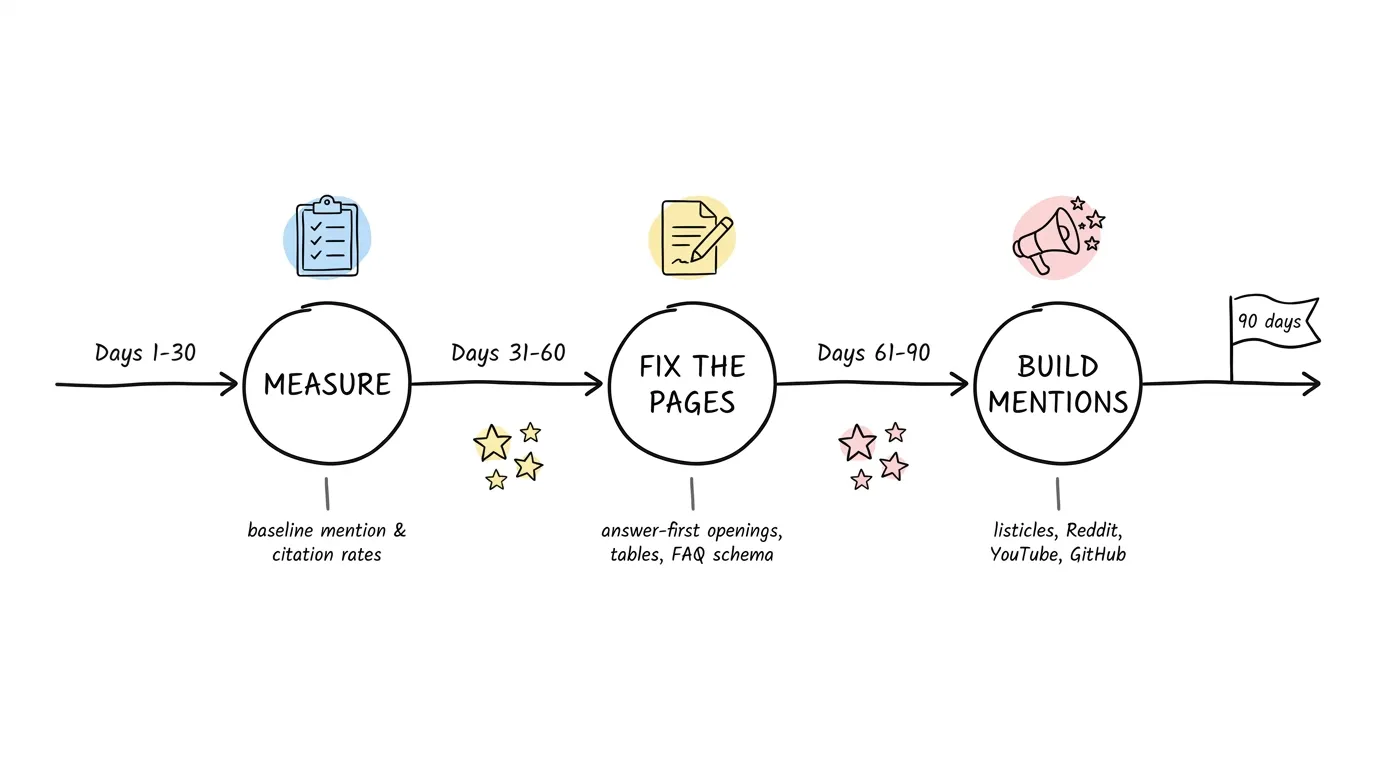
Finally, here's a roadmap you can copy outright. Ninety days, three steps.
The first 30 days: measure. Pick 20 to 50 questions your buyers genuinely ask, record the baseline mention rate and citation rate for each engine, split AI traffic out separately in GA4, and, while you're at it, check whether AI crawlers can get into your website.
The second 30 days: fix the pages. Rewrite the openings of your key pages to lead with the answer, turn comparison content into tables, add FAQ and schema, add real author bios, and refresh outdated data and dates.
The third 30 days: build mentions. Pitch your first-party data to industry media, squeeze into the listicles in your niche that engines love to cite, and show up earnestly on Reddit, YouTube, and GitHub — wherever your buyers ask questions. At the end of 90 days, compare against your baseline, and you'll know where to double down.
Back to That Friend
Back to the friend who messaged me at midnight.
My advice to him later came down to one sentence: don't stop optimizing for Google, but set aside half a day each week to take care of the AI side too.
Because the real question is: when your buyers stop searching and start asking directly, is your name in the AI's answer?
Small sites have no reason to panic either. The study has one more number: for small sites with fewer than 1,000 monthly organic clicks, every 100 visits from Google bring roughly 4 visits from AI — a ratio four times that of large sites. The depth of a niche sometimes works better than sheer size.
Visibility in the AI era doesn't come from ranking first.
It comes from being inside the answer.
Continue reading
Related articles

It's 2026: Stop "Buying" AI Tools for Your Marketing Team — Start "Hiring" AI Agents
This learn article explains how AI agents differ from standalone AI tools in marketing, outlines three agent categories — build-your-own platforms, CRM-native agents, and vertical tools — and covers use cases across SEO, social media, advertising, and reporting, plus criteria for choosing one.

What Is GEO? How Your Brand Gets "Mentioned" in the Age of AI Search
An explainer on GEO (Generative Engine Optimization) for e-commerce and DTC brands: how it differs from SEO and AEO, why AI answers shape brand visibility, and eight practices covering question-focused content, consistent brand messaging, structured pages, external evidence, comparisons, and AI mention tracking.

AI Is Already Making Decisions for Your Customers. Are You on the List?
A learn article explains GEO (Generative Engine Optimization): why AI-generated answers now shape which brands customers see, and how SEO fundamentals, entity clarity, citable evidence, and monthly measurement affect visibility in AI answers.