
October in the Search World: A Few New Cracks in the Pipeline
An October search-industry roundup covering Google's indexing pipeline timelines, poisoned SERP data affecting rank trackers, Search Console multi-country and device filters, added links in AI Overviews and AI Mode, a UGC fresh data program, and link building guidance.
A few nights ago, past midnight, a friend of mine who runs an independent site messaged me: last week he'd rewritten the titles of 30 pages, and he'd been staring at search results for seven days with zero movement in rankings. He suspected his site had a technical problem.
I sent one line back: don't panic. This month Google said it themselves — this might genuinely not be your problem.
October was a busy month in the search world. I've picked out the few stories worth your time, and I'll walk through them one by one.
First, the Pipeline Manual
What is indexing? Once you publish a page, Google first has to discover it, then crawl it, then store it in the index — and only then does it get its turn to appear in search results. It's a pipeline.
In the past, how long each stage of that pipeline took was anyone's guess.
Last month, at the Search Central conference in Barcelona, Google's Gary Illyes laid out a set of internal timelines.
Get your notebook out.
A newly discovered URL: about 20 hours on average. A recrawl of an already-indexed page: roughly 30 days. Indexing itself is actually fast — just 1.5 hours, provided Google has already reached your page. Title and snippet updates hitting the results page: 1 to 2 days. A canonical URL change: 1 to 3 weeks. A full site migration, the biggest surgery of all: officially expected to take 1 to 3 months.
The most painful one is last: hoping to recover rankings after a core algorithm update? Prepare to wait 3 to 6 months — sometimes longer.
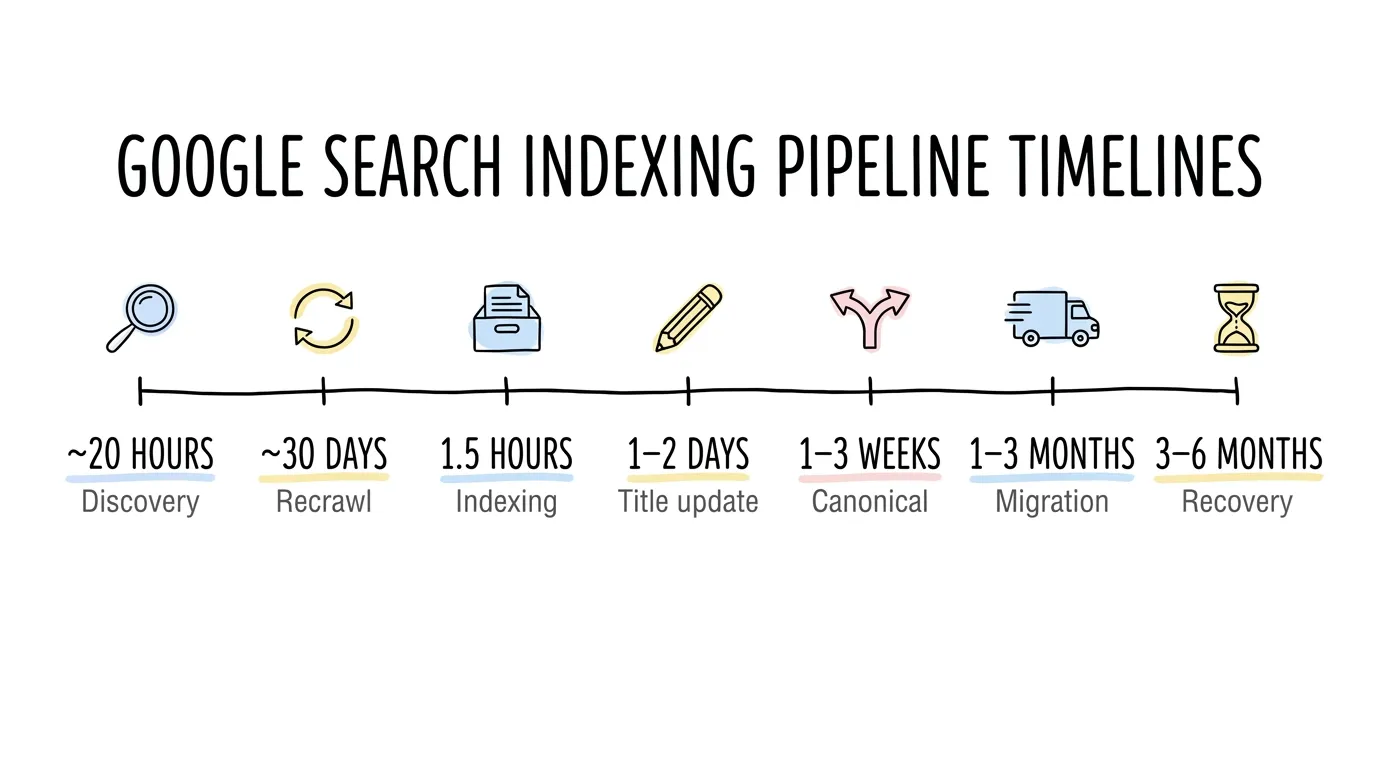
These numbers are reference anchors, not delivery guarantees. Illyes was careful to add that the processes run serially, each link chained to the next: if one stage slows down, every stage after it slows down too.
My friend's 30 pages, checked against that table — suddenly he knew exactly where he stood.
Someone Muddied the Water in the Pipeline
But this whole table rests on one premise: the data Google shows you is real.
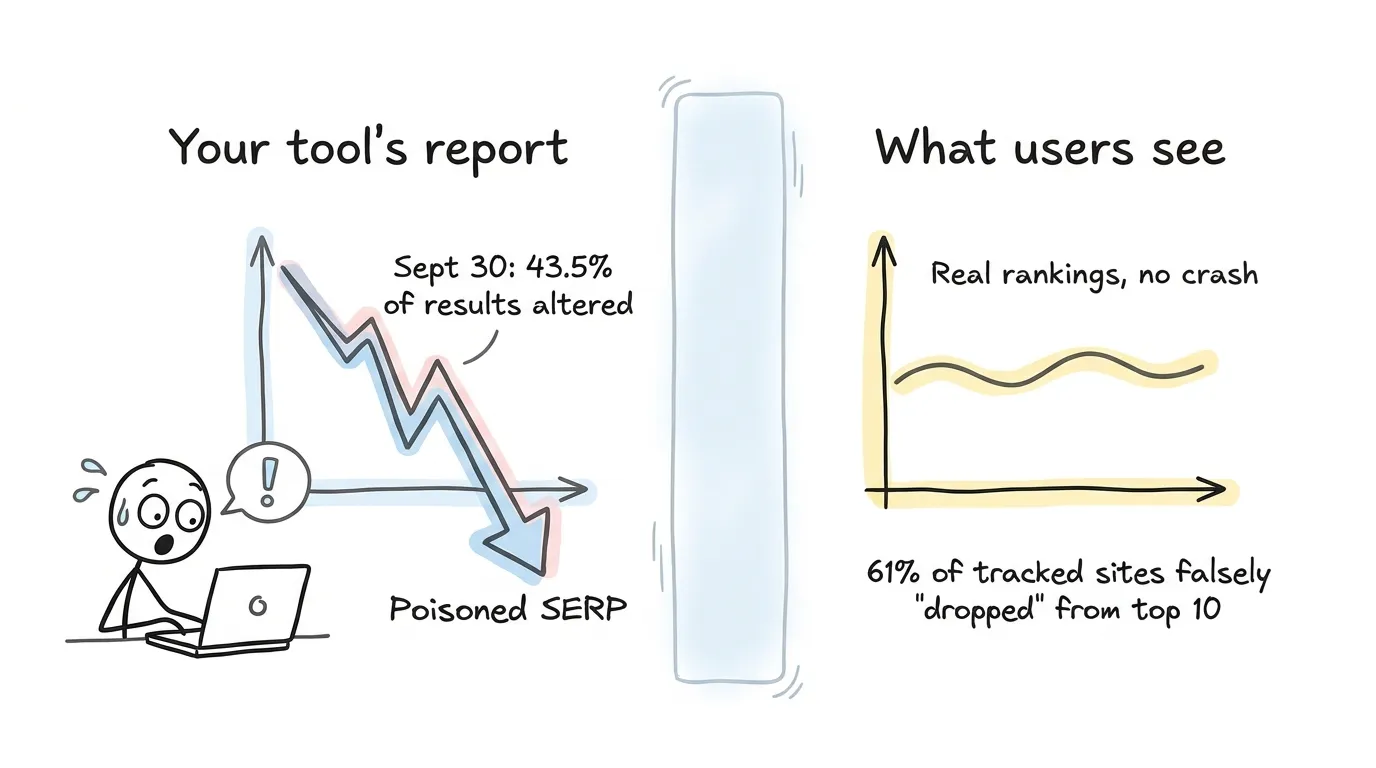
Starting in mid-September, SEO tool vendors noticed something was off. Google began feeding crawlers and rank trackers "doctored" search results — in industry jargon, a poisoned SERP (search engine results page) — completely different from what real users see.
So in every tool's report, day after day, came crashes and violent swings. Nothing had actually happened.
Let the data speak. Nozzle analyzed 56 million search results, and the worst day was September 30: 43.5% of results had been altered. And within that 43.5%, 61% of tracked websites "appeared" to have fallen out of the top 10.
That's staggering. On that day, nearly half of all ranking data was fake. Ahrefs confirmed it had been hit too.
The crash in your report and the rankings users actually see may have a pane of frosted glass between them.
Marketing Miner's response was decisive: cross-check its own ranking data against Search Console's real data, and when a suspicious swing shows up, automatically re-check — on its own dime, as many times as it takes, so dirty data never flows into your report.
Two Small Updates to the Reports
While we're on the subject: this month Google also did two small things, both for the people who build the reports.
In early October, Search Console's Performance report gained multi-country selection in a single view. Before, you could either look at one country or compare two — wanted the combined picture of the US plus the UK? Export the data and stitch it together in a spreadsheet yourself. Now you just tick the boxes, and clicks, impressions, click-through rate, and average position all come together.
In early November, the same multi-select logic extended to devices. Mobile and tablet data can now be viewed merged.
Small things. But if you file a report every month, they're a genuine life-saver.
More Links in AI Answers
Next topic: AI search.
On October 15, Google made it official: links in AI Overviews and AI Mode are about to get more numerous — and more prominent. AI-generated answers will embed more clickable links directly; entry points to official websites get more prominent placement; the article carousel is expanding to more languages and markets; and in AI Mode you can now even tap through to video creators' profile pages.
The intent is obvious: move people out of AI answers and over to source websites.
Here's the question: will it actually move them?
No one breaks SEO news faster than Barry Schwartz, and he isn't buying it. His argument: if AI has already answered the question on the results page, why would a user click out at all?
And it gets more awkward. Search Console launched its AI search performance report this June, and it shows impressions only — no clicks. They'll show you impressions, but click data is withheld. How many people this redesign actually sends out — you have no way to measure.
My take is blunt: don't celebrate yet, but don't write it off either. Wait for the click data to arrive, then read the numbers. If you can't wait, Marketing Miner's AI visibility tracking is worth a look first: how often your brand appears in AI Overviews, AI Mode, ChatGPT, Gemini, and Perplexity — and how often your competitors do.
A New Channel for the Reddit Crowd
In early October, Google launched a new program: the UGC Fresh Data Program.
What does it mean? Giant communities like Reddit can push new posts and new comments straight to Google through a dedicated interface, complete with engagement signals like upvote and comment counts. The old way was crawlers chasing content; now content knocks on Google's door.
The entry requirements are spelled out clearly: it's only for mega-platforms with massive public user-generated content (UGC), content moderation, and technical capability. Ordinary websites and e-commerce stores need not apply. It's fully separate from the ordinary Googlebot crawler; joining guarantees neither indexing nor ranking.
But the direction is worth every content person's attention: Google increasingly favors fresh, first-hand words from real humans.
The Old Craft of Link Building
Back to the old rules. A backlink is still a backlink, and Google still values it.
Cyrus Shepard — SEO veteran, founder of Zyppy, formerly in charge of SEO at Moz — went through leaked Google API documentation, search patents, and public materials, and came out with five practical tips for link building. It boils down to three things: the trustworthiness of the referring domain, topical relevance, and the editorial context where the link sits.
One detail is an eye-opener: Google may look not just at anchor text, but at the words around it too. So what about deliberately varying your anchor text to dodge detection? Probably useless.
Keep this piece on file — good for brushing up on the old rules, and for reading the new intel.
A Quick Aside
Last, a tools note. Since we've been asking all along whether AI assistants can actually do SEO work, Marketing Miner turned the answer into a product.
They released a free SEO Skill: more than 22,000 words of rules and workflows, distilled from ten years of work, thousands of clients, and hundreds of case studies — packaged and ready to upload to your ChatGPT or Claude. Writing articles, setting titles, drafting product page copy, auditing pages — there's a playbook for all of it. And a playbook alone isn't enough; pair it with their MCP (Model Context Protocol) connector, which feeds in real search volume, competition data, and Search Console data. Playbook plus data — that's when AI actually knows what to write. The Skill is free; the MCP comes with a 10-day free trial.
Also: their CEO Tomáš Novák gave a talk last month at Reshoper, the Czech e-commerce show, on using AI to drive search revenue, covering traditional SEO and GEO (Generative Engine Optimization) together. 24 ready-to-use prompts plus 69 pages of presentation materials, all inside their Shoptet plugin, which you can try free for 30 days.
Back to the Pipeline
Back to my friend.
He later saved that timeline table. After editing pages, he waits by the table; when his report crashes, he verifies whether it's real first; for AI traffic, he waits for the click report.
Half of search is the work itself — the other half is knowing what's actually happening inside the pipeline.
This month's few cracks are there to help you see a little more clearly.
May next month's report show crashes that are real crashes — and gains that are real gains.
Continue reading
Related articles

It's 2026: Stop "Buying" AI Tools for Your Marketing Team — Start "Hiring" AI Agents
This learn article explains how AI agents differ from standalone AI tools in marketing, outlines three agent categories — build-your-own platforms, CRM-native agents, and vertical tools — and covers use cases across SEO, social media, advertising, and reporting, plus criteria for choosing one.

What Is GEO? How Your Brand Gets "Mentioned" in the Age of AI Search
An explainer on GEO (Generative Engine Optimization) for e-commerce and DTC brands: how it differs from SEO and AEO, why AI answers shape brand visibility, and eight practices covering question-focused content, consistent brand messaging, structured pages, external evidence, comparisons, and AI mention tracking.

AI Is Already Making Decisions for Your Customers. Are You on the List?
A learn article explains GEO (Generative Engine Optimization): why AI-generated answers now shape which brands customers see, and how SEO fundamentals, entity clarity, citable evidence, and monthly measurement affect visibility in AI answers.