
AI Search Has Dragged SEO and Brand Marketing Back to the Same Table
A learn article on how AI search is bringing SEO and brand marketing back together, covering parametric knowledge versus RAG in brand mentions, off-site signals like third-party mentions and reviews, and levers including category entry points, reference content, and technical crawlability.
A while back, I attended a brand marketing industry conference.
After all my years in marketing, it was the first time I heard someone seriously discuss "search" in that setting. Not a passing remark over coffee — a formal talk, right there on the agenda.
Here's the coincidence: not long afterward, I went to a gathering of SEO practitioners, and what were they talking about? Brand.
Two tribes that never used to speak to each other suddenly started paying each other visits.
Why? This story is worth telling from the beginning.
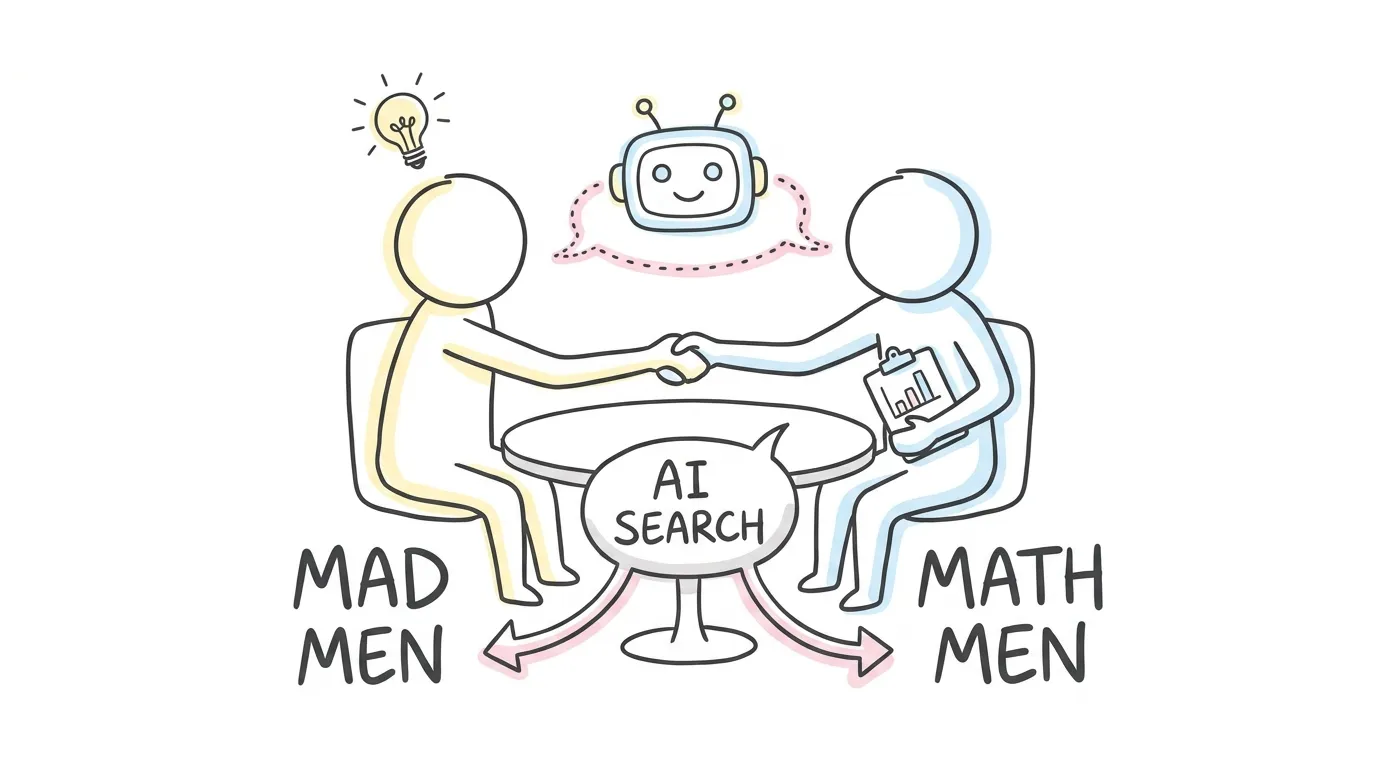
Mad Men, Toppled by Math Men
Some background first. In the marketing world, brand marketing and technical marketing used to be two separate universes.
Brand people handled persuasion, stories, and the "big idea." Technical people handled data, systems, and ROI.
Then performance advertising, programmatic buying, and social feeds kept expanding, and budgets chased whatever could be measured and attributed. A saying made the rounds in the industry: the Mad Men were toppled by the Math Men. Brand people held on to big ideas, channel people held on to their reports; each did their own work, and neither felt they owed the other anything.
In truth, this "remarriage" had been foreshadowed for a long time. Marketing science professor John Dawes, together with the Ehrenberg-Bass Institute and the LinkedIn B2B Institute, proposed the 95:5 rule: in any category, at any given moment, only about 5% of buyers are actually in the market, ready to spend. The remaining 95% — your performance ads hammer on their door every single day, yet they have no intention whatsoever of buying anything. The more you spend, the less it buys — and the flatter growth becomes.
In the search industry, someone put it even more bluntly. Mike King has said that AI search is, at its core, a brand channel.
My view goes a step further: AI search is fed almost entirely by brand. The signals that decide whether you appear in AI answers are the very same signals that decide brand strength.
And what has actually forced the two tribes back to the same table is AI search.
Why Would a Model Mention You?
Have you ever stopped to wonder: when systems like ChatGPT answer a question, why do they mention your brand and not your competitor's?
To understand that, you first need to know about the two kinds of knowledge inside a model.
The first is parametric knowledge — what the model learns during training. Take an example: there's a cybersecurity company called CovertSwarm that specializes in "offensive" security services. If "offensive cybersecurity" and this company keep appearing together, repeatedly, across large numbers of independent sources, that association gets "baked" into the model's weights.
Want to change it? You'll have to wait for an entirely new training run. Months to years at minimum, and almost completely out of your control. The only lever you can pull is long-term brand building — then wait for the next batch to come out of the oven.
The second is RAG, short for retrieval-augmented generation. Ask "who are the best B2B agencies in the UK," and the model rewrites your question into several search queries, retrieves material, and synthesizes an answer on the spot. This kind of knowledge never enters the weights; the model forgets it once the conversation ends. It's fast, and traditional SEO can still make a difference here.
Sounds like RAG is flexible? It is. But the real dividing line sits before the search ever happens.
A researcher named Suganthan Mohanadasan dug through 27 of ChatGPT's retrieval traces and found that in 21 of them, brand names the user never mentioned had already appeared in the first round of search queries.
In other words, before the model even searches, it already has a shortlist in mind.
The math here is a little scary: brands that made it into the first round of queries ended up in the answer 68.9% of the time; brands scooped up only during the retrieval stage appeared just 2.1% of the time. A 33-fold gap.
The sample was just one account, but the direction is clear enough: parametric knowledge decides who gets into the arena; RAG only decides who gets cited once they're inside.
Most of the tricks being sold in the market today under the "GEO" (generative engine optimization) banner live entirely inside that 2.1%.
The Signals That Lead the Pack Aren't on Your Website
So which signals get a brand onto the model's shortlist?
Ahrefs ran a study covering 75,000 brands: the number of times a brand gets mentioned across web pages correlates with AI Overviews visibility at 0.664, while the classic backlink metric referring domains came in at just 0.218. A follow-up study spanning ChatGPT, AI Mode, and AI Overviews found the strongest-correlating signal was YouTube mentions, at roughly 0.737.
The backlink — the metric the SEO world once prized above all — sits near the bottom of this new leaderboard. How others mention you off-site leads the pack.
Other research points to the same place. Muck Rack, a media data company, found across three consecutive studies that 82% to 89% of AI citations come from sources that are neither owned nor paid — with journalism holding a steady quarter of that mix. Trustpilot commissioned Seer Interactive to analyze 800,000 AI answers: brands with no review profile had a median citation rate of 1%; brands with actively managed profiles hit 75%.
1% versus 75% — that's not a hard multiple-choice question.
For SEO practitioners, this conclusion stings a little: the factors that decide AI visibility are nearly the same factors brand marketers can't stop talking about — mental availability.
Let me be clear about one thing, though: the technical baseline still matters. Content must be crawlable, renderable, indexable by AI-powered retrieval engines, with a clear structure. But that's an entry ticket, not a championship trophy. Past that line, the most influential levers are almost all outside your website.
Parametric knowledge only moves every few months to years, so anyone who confidently promises to "make your brand take off in AI search in 30 days" — don't doubt it for a second: they're selling snake oil.
Mental Availability, and Model Availability
Brand marketing has an old term: mental availability — the moment a buyer enters a category and feels a need, does your brand spring to mind first?
For the AI search era, I'd propose a matching concept: model availability. When the same question is put to a model, does your brand get mentioned?
These two things burn the same fuel — and they feed each other.
The more mentally available you are, the more people search for you and talk about you. That branded search volume and those mentions are exactly the signals models can see.
In turn, the more AI answers you show up in, the more human shortlists you enter. The AI shortlist slowly becomes the human shortlist.
Clickstream data from Similarweb found that brands recommended by AI were 2.5 times more likely to see a site visit within 7 days than other brands. And most of that traffic came through branded search, not clicks on the link itself.
An even more extreme case is emerging: people are starting to let AI agents make choices for them. At that point, model availability is no longer influencing the decision — it is the decision.
Where does all of this start? With brand strategy: what you stand for, and which buying situations you want to own. Then comes the integrated effort: ad campaigns, video, digital PR, social media, creators, review platforms, communities. Visible to humans, readable by machines.
Without brand money, you have no place in the model. There is no technical shortcut to model availability.
The Three Ledgers of Share
Marketing effectiveness research drew this road map a long time ago.
Research by Les Binet and Peter Field shows that when a brand's share of voice exceeds its market share, it tends to grow; the reverse, and it tends to shrink.
Binet's later research for the UK's Institute of Practitioners in Advertising (IPA) extended that line to search: share of voice drives share of search — first a short-term pulse, then a slower, longer tail. And share of search, in turn, is a leading indicator of market share.
A study called Return on Awareness from a company called Tracksuit filled in the final link: around the 30% mark of brand awareness, every 5-point gain in awareness brings roughly a 5-point gain in share of search. And the lower your awareness, the harder every point becomes.
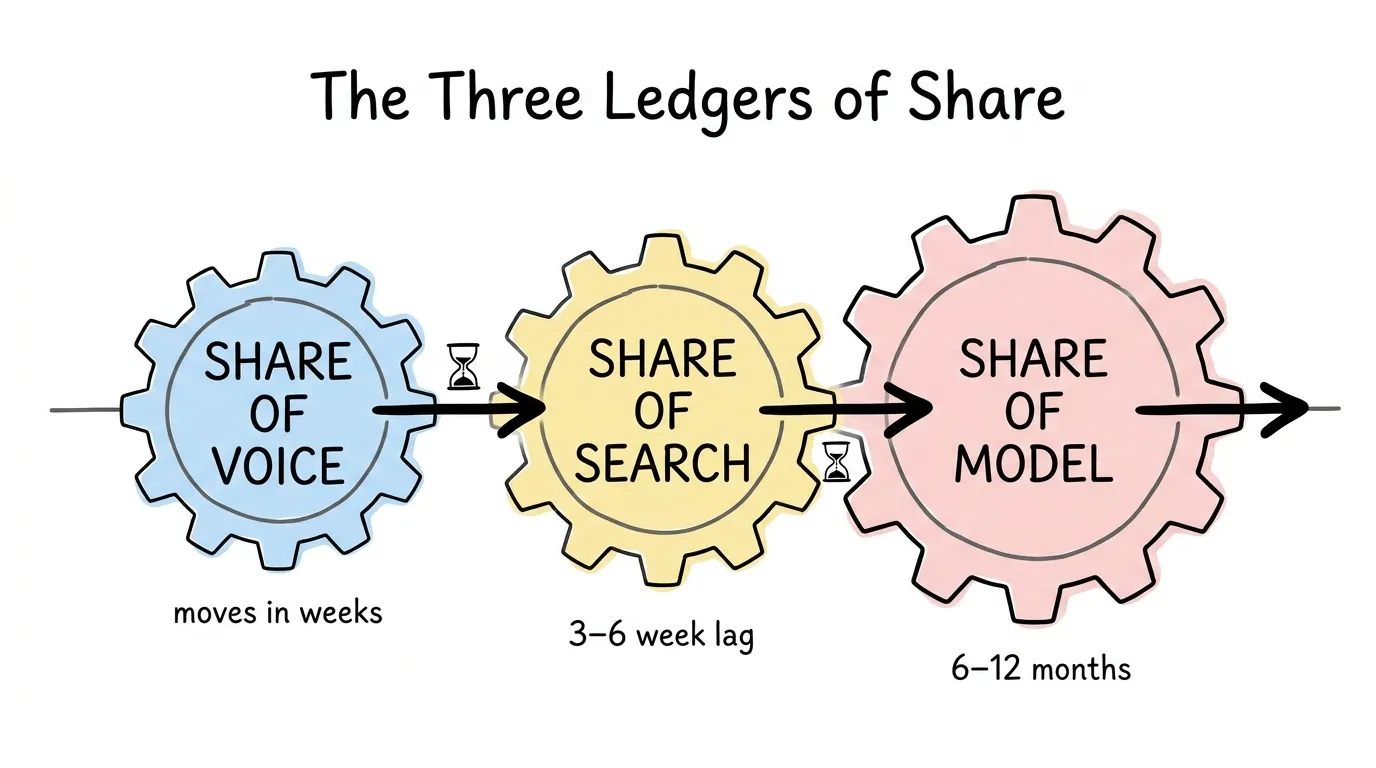
Linked together, they form three interlocking gears of share — mind the time lags:
- Share of voice: your brand's share of mentions across media and social media, driven by paid, earned, and owned activity. It can move within weeks.
- Share of search: your brand's search volume as a share of total category search volume; it follows share of voice, typically with a 3-to-6-week lag.
- Share of model: how often models mention you when answering questions about your category, influenced by branded search and mentions. Expect 6 to 12 months before it shows.
Here's a painful truth that needs calling out: media spend and organic performance have now been welded together. As users keep migrating to AI models, advertising becomes ever more important. Frankly, this may make search more pay-to-play than it was in the traditional SEO era.
I'm not saying SEO is dying — search has never mattered more. But I also want to be clear: SEO operating entirely on its own is genuinely losing influence.
Four Levers to Pull
So what, concretely, do you do? Break it into four levers.
First, get clear on whose answer you actually are.
Search engines reward optimization; models reward distinctiveness and clarity. If you can't articulate what question you're the answer to and who you serve, the model can't either.
Jenni Romaniuk of the Ehrenberg-Bass Institute has a concept: the category entry point — the cue that brings your brand to mind in a given buying situation. Note: the situation, not the keyword.
Take CovertSwarm. The cybersecurity market traditionally orbits "annual penetration testing"; this company positioned itself as "offensive cybersecurity" — continuously attacking its clients' own systems to find vulnerabilities first. The term barely existed before them. Their entry points look like this:
- "We failed a pen test, and the audit is in six weeks."
- "How do I prove to the board that we're secure?"
- "We're acquiring a company — how do we assess its security?"
- "We've been breached, and we don't know how they got in."
AI search is conversational, so these situations naturally map to real questions far better than keyword lists ever could.
And here's a positive example: one agency identified its client's category entry point as "how to track complex regulatory changes across multiple health departments," wrote a single article answering exactly that one question — and got cited by ChatGPT.
Second, make your content the reference answer.
Positioning gets implemented through content. On your own site and on third-party sites, build reference-grade explanations — the kind nobody can cover the topic without citing: pillar pages, content hubs, structured documentation, maintained FAQs, clearly attributed long-form pieces.
First-party research is the most valuable: new information the category doesn't have yet. Since the AI content flood came rolling in, recycled content has been depreciating in the eyes of both models and humans. What you should pursue is information gain: an original take, clear attribution, depth over breadth, a small increment beyond what already exists, visible fingerprints of a real human expert.
And don't lock yourself into text only. YouTube mentions — the top-correlating signal — how do machines read them? Captions, chapters, titles, descriptions: all clean, structured text.
Third, in the places you can't speak, let others speak for you.
Of the four levers, this is the hardest to do and the most critical. To be written into the weights ahead of time, a brand must exist in the training data: mentions, PR, reviews, third-party coverage.
Where specifically? Digital PR coverage and citations, industry award shortlists, conference speaking slots, reviews on G2 and Trustpilot, discussions on LinkedIn, community threads on Reddit.
Models seem to especially trust "authenticity" — the kind of signal a brand can hardly manufacture on its own. Advertising can help build buzz, but at the root of it, it's other people talking about you and searching for you, not you publishing content about yourself.
Some brands are now investing in creators specifically for AI visibility — Zoom recently partnered with a podcast host. The same trend is written into the product logic of social platforms: LinkedIn's Thought Leader Ads promote individual spokespeople, not company pages, with the company reporting roughly 1.7 times higher click-through rates; ZenABM analyzed more than 160,000 LinkedIn ads and found a median CTR of 2.68% versus 0.42%.
Why? Because people only really pay attention to people.
Fourth, the technical baseline: make sure AI can find you and read you.
This one is closest to traditional SEO, and it's the foundation for the other three. A few things that matter even more to AI systems than to classic search:
- Confirm you haven't accidentally blocked AI crawlers. Block the training bots and you'll eventually vanish from model memory; block the search and user-triggered bots and you'll never appear in real-time answers. Check your CDN and firewall rules — don't just stare at robots.txt.
- Don't ignore Bing. ChatGPT's search leans heavily on the Bing index, and Bing Webmaster Tools and IndexNow are becoming more important.
- Organize content around "passages," not "pages." AI retrieves passages: lead each section with the answer, use clear headings, and put comparisons in tables.
- Use Organization schema with sameAs links to tell machines who you are: profiles on LinkedIn, Wikidata, Crunchbase, and the like.
- Make yourself citable: mark "last updated" dates accurately; for every asset gated behind a form, publish an ungated summary page. A PDF hiding behind a form will never get cited.
- Watch your server logs. Visits from user-triggered agents like ChatGPT-User can tell you which pages are being fetched in real time to answer real questions from real buyers.
Traffic Isn't the Yardstick
There's also a practical question: how do you measure this?
Clicks from AI Overviews and AI Mode usually carry a google.com referrer and get counted as organic traffic. Many AI assistants' visits carry no referrer at all and get logged straight as "direct traffic." GA4's newly added AI Assistants channel helps, but it only counts visits with an identifiable referrer.
Much of AI's influence never produces a click at all. It shows up afterward: a branded search, a direct visit, a spot on a shortlist.
Hallam, a UK agency, analyzed its own client data and found that visitors arriving from AI recommendations viewed roughly twice as many pages per session as other visitors. Fewer visits, but deeper each time.
So share of voice, share of search, and share of model belong on a single dashboard — don't keep separate books.
- Share of voice: within a fixed competitor set, track your share of mentions across media, social, and video — adding share of ad spend if you can.
- Share of search: your branded searches as a share of the category's total branded searches. To start for free, Google Trends is enough.
- Share of model: on a fixed set of category prompts, track your mention rate and citation rate across ChatGPT, AI Mode, AI Overviews, and Perplexity. Draw the prompts from your category entry points.
And one more unpleasant truth up front: don't expect weekly share-of-model reports to reveal much — that's mostly noise. Ask the same question twice, and the AI comes back with a different answer every time.
Back to That Table
Back to those two venues from the beginning.
Brand people rediscovered search; search people rediscovered brand. They had been looking for each other all along — it was the money of the past twenty years that kept them apart.
AI has lengthened the list of factors that move the business: brand strategy, PR, creators, reviews, video, paid media. Things many SEO teams used to wave off as "not my job" now all belong to you.
And this job needs to be run by whoever understands search mechanics best. SEO — or whatever we call it these days — is exactly the right discipline to lead it.
Search engines have never mattered more. But the way to win at search has never looked less like "search."
The Math Men have to go back and learn to tell stories. The Mad Men have to sit down and read the reports.
The two of them have never needed each other like they do today.
If you're about to throw next year's entire budget into performance advertising, I'd suggest thinking first about the 95% who aren't in the market yet — and about the model that hasn't asked about you yet.
These are my observations; they may not be right. But this direction is worth running your own numbers on.
Continue reading
Related articles

It's 2026: Stop "Buying" AI Tools for Your Marketing Team — Start "Hiring" AI Agents
This learn article explains how AI agents differ from standalone AI tools in marketing, outlines three agent categories — build-your-own platforms, CRM-native agents, and vertical tools — and covers use cases across SEO, social media, advertising, and reporting, plus criteria for choosing one.

What Is GEO? How Your Brand Gets "Mentioned" in the Age of AI Search
An explainer on GEO (Generative Engine Optimization) for e-commerce and DTC brands: how it differs from SEO and AEO, why AI answers shape brand visibility, and eight practices covering question-focused content, consistent brand messaging, structured pages, external evidence, comparisons, and AI mention tracking.

AI Is Already Making Decisions for Your Customers. Are You on the List?
A learn article explains GEO (Generative Engine Optimization): why AI-generated answers now shape which brands customers see, and how SEO fundamentals, entity clarity, citable evidence, and monthly measurement affect visibility in AI answers.