
Which AI Should Your Startup Actually Use for Marketing?
A startup marketing guide explaining the difference between AI models and tools, sorting tools by job (writing, research, design, leads, email, video ads), and outlining a 30-day test plan for choosing them. It also covers generative engine optimization and budget trade-offs.
A while back, a friend of mine who had just closed a seed round came to me and fired over seven or eight "best AI marketing tools" lists for November, asking which one he should buy.
I took a look. Of the eight lists, at least six were written by the very companies selling the tools. The loudest one awarded first place to itself.
Interesting.
I went through his list from top to bottom and ran the numbers while I was at it. Today, I'll give you the verdict.
The short version: there's no "best model," only the "best fit for the job"
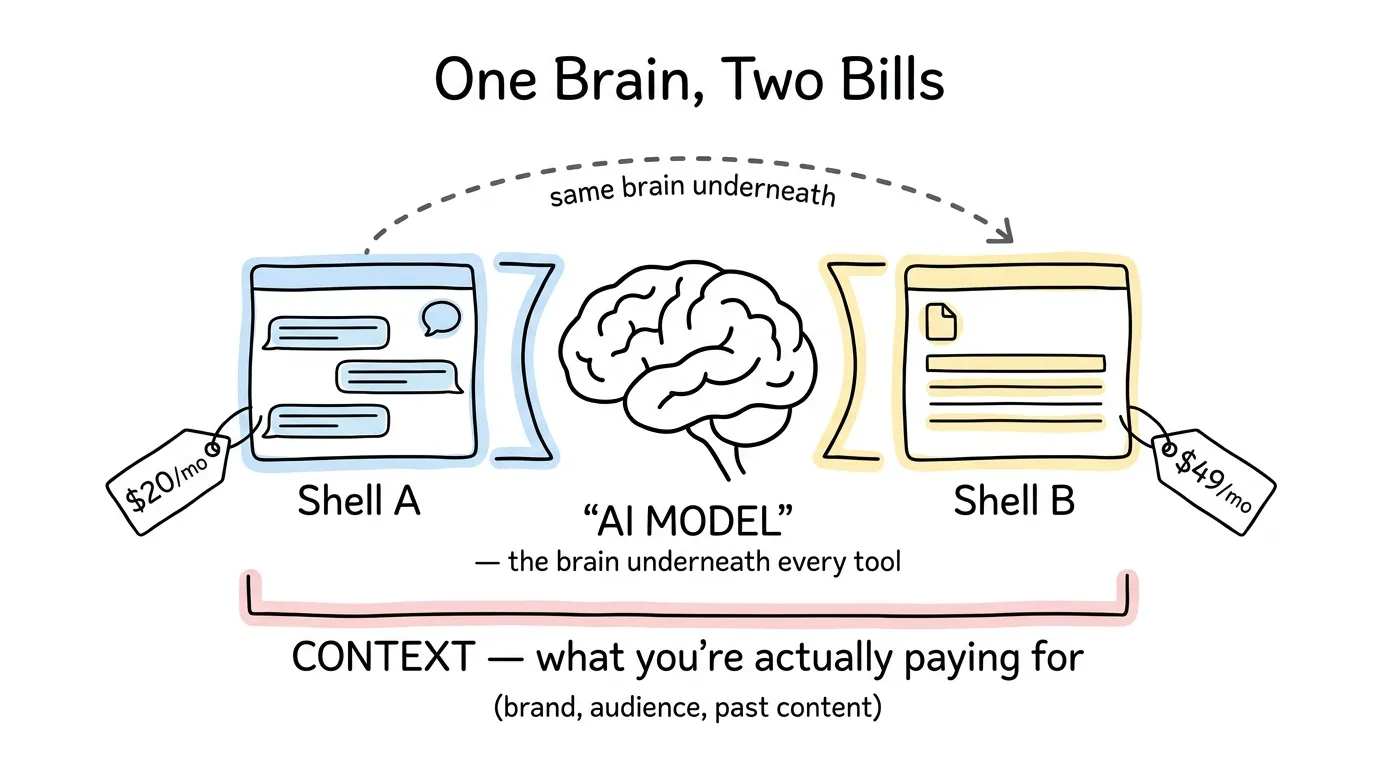
What's an AI model? It's the brain underneath ChatGPT, Claude, and Gemini — trained on oceans of text.
What's an AI tool? The shell wrapped around that brain: the interface, the templates, the memory, the workflows. Averi, Jasper, Copy.ai — those are tools.
This distinction goes straight to your wallet.
Plenty of people pay $20 a month for a ChatGPT subscription and another $49 a month for a writing tool, convinced they've bought two brains. Odds are you're paying twice for the same brain, just in a different outfit.
So before you pull out your credit card, ask one question: which model is running under the hood of this tool, and what does it give you on top of the model?
The answer comes down to one word: context. Your brand, your audience, every piece of content you've ever published. The model handles grammar and fluency — context is what you're actually paying for.
How do these rankings get made?
Think about it: a list written by Averi that puts Averi first — how much should you trust it?
My take: don't swallow it whole, don't dismiss it either.
The companies selling tools often know their category best. Averi's own comparison table even admits it's a "newer category with a smaller user base" — a candor you don't see often. But read any list as a sales page with a table of contents.
The rule is simple: trust their criteria, test the conclusions yourself.
One more thing worth knowing: this seat changes hands every month. In May it was Gemini leading, in July it was Claude, in August Averi took the crown. If you switch tools every time the list reshuffles, you'll never accumulate anything.
The tools, sorted by the job
Writing. ChatGPT or Claude at $20 a month is enough. They lack brand memory, and that gap can be fixed almost for free: write a one-page brand brief — who you're selling to, what voice you use, which words never to use, three pieces of evidence, two competitors — and paste it into every new session. I've watched far too many people complain that AI writes garbage, then look at their input box and find nothing there. The model wasn't the problem. You never said anything. If your team already lives inside the Google stack, add Gemini — it connects with Docs, Sheets, and Ads.
Research. Perplexity, for summaries with citations. Remember one rule: click the citations. A summary is a claim, and an unverified claim doesn't belong on your landing page. It also doubles as a free GEO checkup — ask it the questions your buyers would ask, and see whether your brand shows up in the answers. What's GEO? Making your content easier for answer engines like ChatGPT and Perplexity to find, understand, and cite.
Full content pipeline. Averi, free beta, one workflow covering strategy, writing, SEO, and publishing. It's aiming straight at the patchwork you're running now: ChatGPT for drafts, Surfer for SEO, Semrush for keywords, WordPress for publishing. But stay clear-eyed: a free beta means you are part of the test. Export and back up all your content every month — don't let it become the only home your content strategy has.
Design. Canva's Magic Design: type "make me an Instagram graphic for my CRM tool" and get several templates to tweak. The bottleneck usually isn't design, it's the message. Write the headline yourself, then let the design dress it up. A beautiful image over a vague sentence still won't convert.
Leads. Start with HubSpot's free tier — its AI does lead scoring and recommends content based on search trends; switch to Pipedrive once your sales process gets complicated. Marketing that never lands in a visible sales pipeline is called a hobby.
Wiring the workflow. Gumloop — no-code, with premium models built in, so you don't buy API credits separately. Copy.ai covers the sales side of automation: $36 a month including 5 seats, $7.20 per seat. The math works out well for a small team, but budget a weekend for setup.
Email. Brevo: 300 emails a day free, 9,000 a month, zero cost. It charges by volume sent, not by number of contacts, so your bill doesn't grow as your list does. Solo at the start? Mailchimp is the easiest, until your automation needs get complicated and you have to switch.
Video ads. The performance marketing crowd runs a combo: Claude writes the script, Kling AI generates the footage, ElevenLabs does the voiceover, Topaz Labs handles post-production enhancement. Add a Klap — $29 turns ten 45-minute long videos into 100 clips, about $0.29 each. Record one founder talk a week and you can feed a month of short videos. Record once, cut many times.
Two to skip. Jasper starts at $49 a month and shifted its focus to enterprise customers long ago — early-stage founders should steer around it for now. And conversational chatbots like Drift: wait until your site has steady traffic. Before that, the founder answering messages personally learns more than any bot ever will.
Running the numbers
General-purpose model: $20 a month. AI writing tools: $39–69. GTM (go-to-market) platforms: $36–49. Content engines: free to $45.
How does a typical small startup team buy? One general-purpose model, plus a writing tool, plus a GTM platform. $95–138 a month, $1,140–1,656 a year. Three tools that don't know about each other — sharing no context whatsoever.
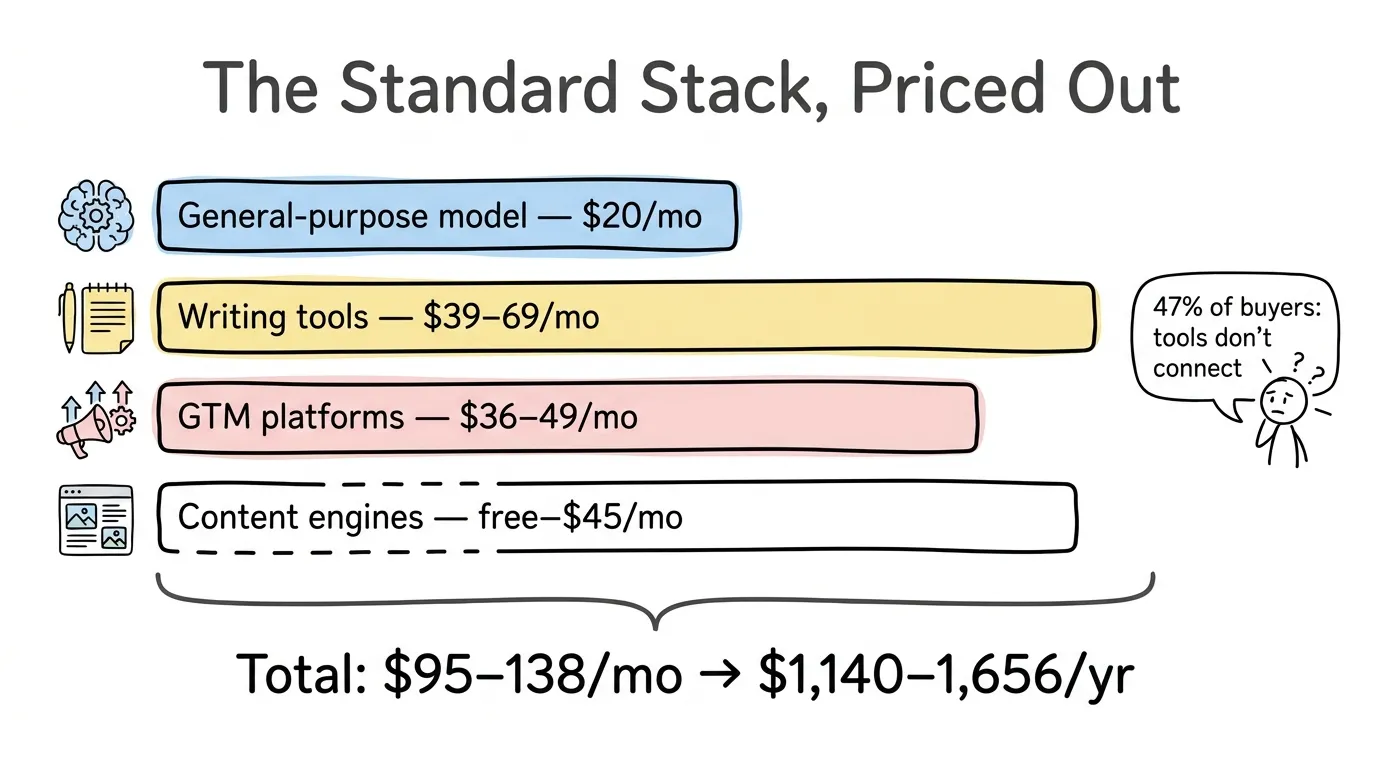
Here's the wild part: it's not even the price. It's that nearly half the buyers already know these tools don't talk to each other — and keep paying anyway. In Averi's own survey, 47% of martech buyers named "tools that don't connect with each other" as their number one pain.
How many rounds of customer interviews would that budget fund? One small ad test? A week of a freelance editor?
Only two metrics are worth tracking: hours saved, and the conversion rate your automation brings. Posts published, words generated — vanity metrics, every one. Track none of them.
30 days: run a mission you can win or lose
Treat this like a game. There is exactly one win condition: get one AI workflow running that saves measurable time and produces at least one measurable lead.
- Days 1–3: audit your time. Time every marketing action for three days — research, drafting, design, publishing, follow-up — and log how long each takes.
- Days 4–5: write a one-page brand brief. One page. From then on, it's the standard input for every tool you test.
- Days 6–8: pick exactly one job. The most time-hungry one that sits closest to leads. B2B? Usually blog and LinkedIn. Consumer? Short video.
- Days 9–15: blind test. Give the same brief to three contenders: one general-purpose model, one specialized tool, and a draft you write by hand. Find a co-founder or a customer to score them, without knowing which is which.
- Days 16–20: check the plumbing. Can the winner publish straight to your CMS? Do leads flow into your CRM? If not, wire it up with Gumloop, n8n, or Zapier, and count how many copy-pastes are left.
- Days 21–27: ship for real. Against the Days 1–3 baseline, log hours saved; log replies, signups, and calls booked.
- Days 28–30: keep, cut, swap. Anything saving less than 4 hours a week or producing zero leads — cancel the subscription.
After 30 days, write the workflow up as a checklist so a freelancer or a new hire can run it without you. A process that lives only in the founder's head is a liability.
Finally, the part that stings
Output is worthless now. AI-generated text, images, and video are faster than any human. What's expensive is judgment: what to publish, to whom, and when to stop.
I keep arguing for keeping humans in the loop: judgment, ethics, and narrative belong to people; AI handles patterns and drudgery. The day you catch yourself thinking an AI tool "writes pure garbage," don't switch tools — rewrite the brief first. Ninety percent of the time, the disease is an input with no audience, no goal, no constraints.
One more thing, far more important than bookmarking the next list: generative search is rewriting the rules of the game. ChatGPT, Perplexity, and Google's AI answers are deciding whose content gets cited. What you publish now — well-structured, with reliable sources — becomes the material library these engines draw on in the future. If a competitor spends the next six months publishing two well-sourced, substantive pieces a week, it will be very hard to displace them in 2027.
What's worth being anxious about? Not the next new tool. The window itself.
Oh, and one red line — worth repeating three times and more: never feed confidential designs, unreleased product details, or customer data into public AI tools. Until you've checked the data policy, don't upload your lists or contracts either.
Back to my friend. My advice to him came down to three lines: write a one-page brief, test three tools, and cut the tool whose model you're already paying for somewhere else.
The tools will keep changing. The brief is yours.
Here's to a handsome win in your game.
Continue reading
Related articles

When AI Does the Creative, Mistakes Come in Batches Too
A learn article on the risks of using generative AI for marketing creative across brand, legal, compliance, and operational layers, with case examples and seven practices for review, rights clearance, documentation, and vendor governance.
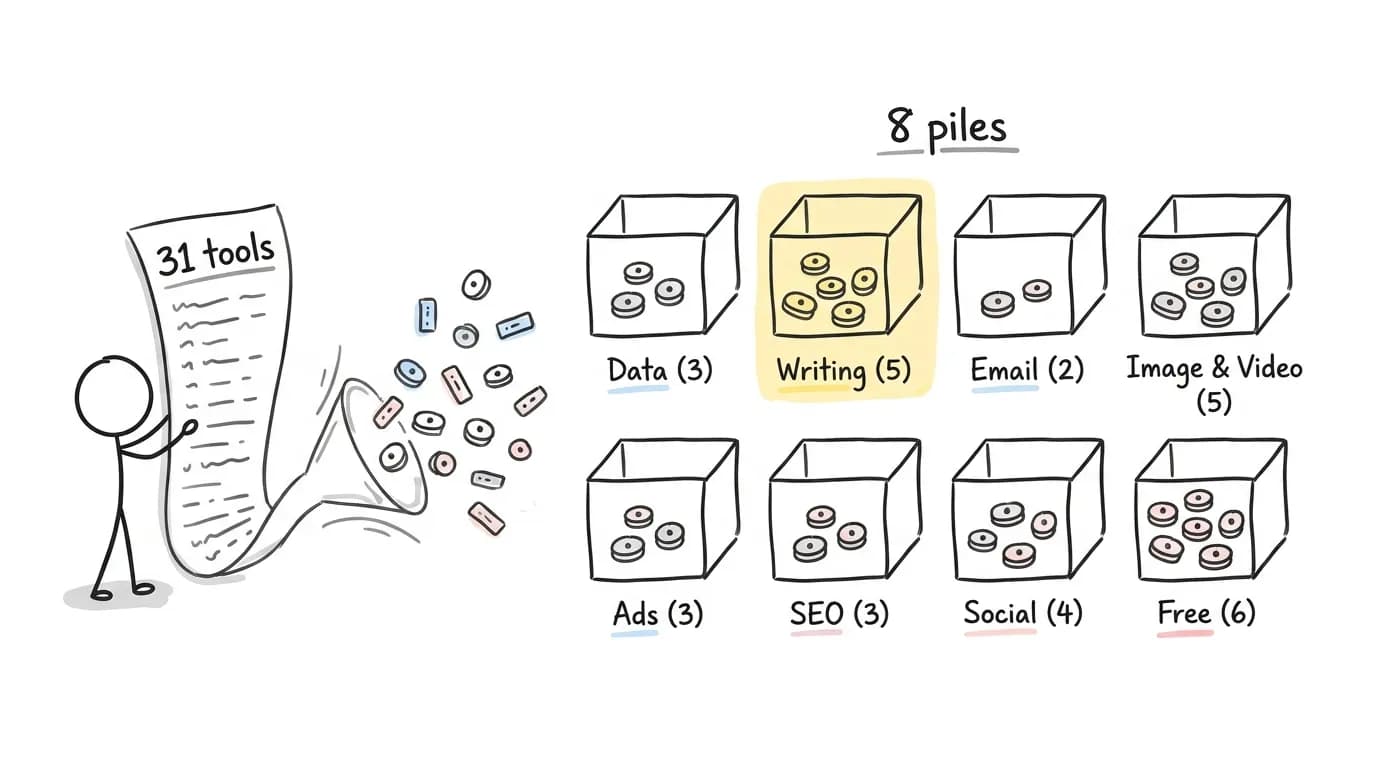
31 AI Marketing Tools, Reviewed One by One: How Exactly Should You Spend the Money?
A review of 31 AI marketing tools grouped into eight categories, covering data, content, email, video, ads, SEO, social, and free options, with guidance on choosing one strong tool for your most frequent task and testing free tiers first.
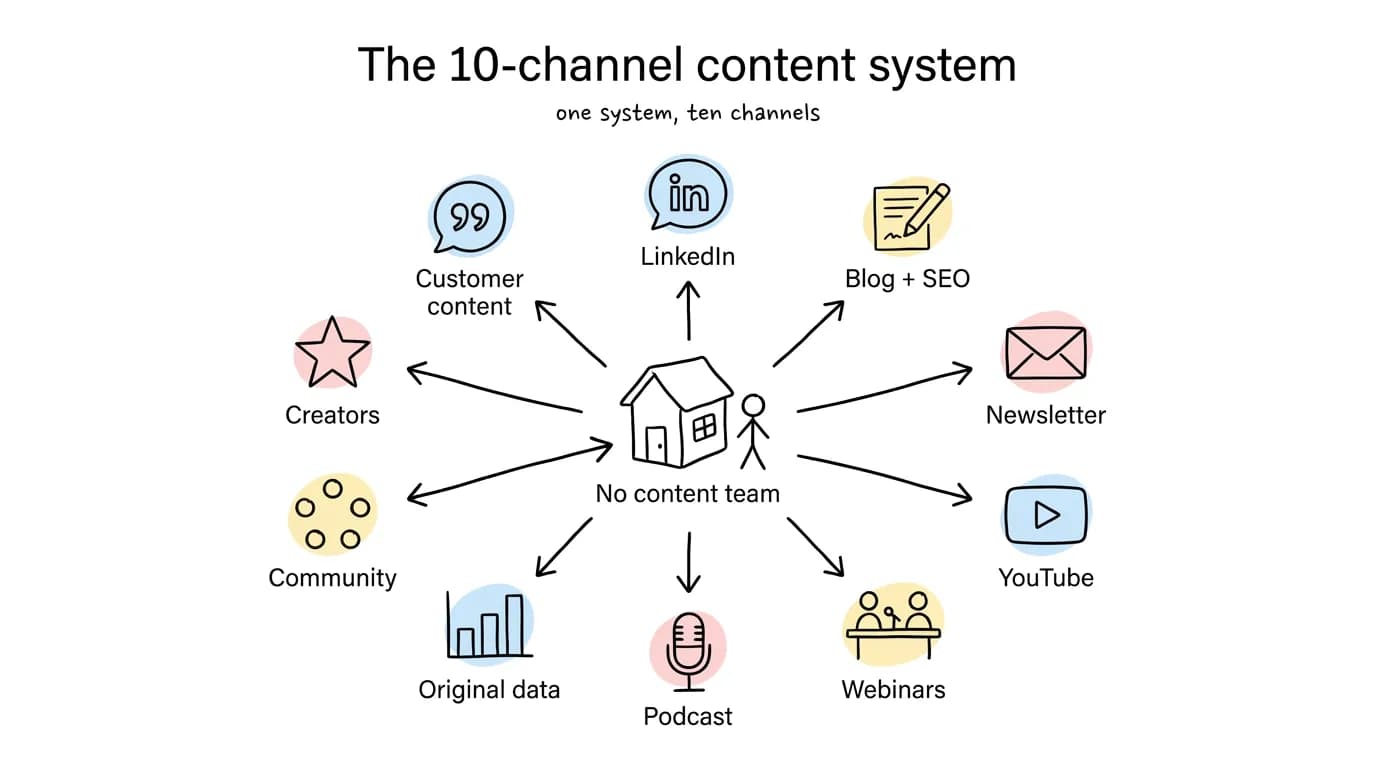
How a Company With No Content Team Grew Its Website From Zero to 4,000 Monthly Visitors in a Year: A Breakdown of Postbeam's 10 Content Channels
An article breaking down the ten content channels Postbeam used to grow its website without a content team, covering LinkedIn, blog and SEO, newsletters, YouTube, webinars, podcasts, original data, community, creators, and customer content, plus AI-assisted workflows and visibility in AI answers.