
Google Just Moved Ads Into AI Conversations — What Paid Media Practitioners Should Watch This November
A practitioner-focused rundown of Google's recent updates moving ads into AI Mode conversations, covering the expansion to ten countries, multi-turn ads in follow-up questions, channel prioritization and budget allocation controls, and groundwork such as clean conversion tracking, product feeds, and broad match or AI M
A few nights ago, I was helping a friend go over his ad account, and while I was at it, I flipped through the product updates Google shipped over the past two months. When I finished, I sat there for a second.
It wasn't that the updates were flashy. It was the sudden realization that the search advertising playbook we've been playing with for over a decade is being moved into a place that feels completely unfamiliar: AI conversations.
What is AI Mode? You type a sentence into the search box, and instead of throwing back a row of blue links, Google hands you an answer directly, like a chat. Ask a follow-up, and it keeps answering. Back and forth, like talking to a consultant who actually knows the field.
This interface used to have no ads at all.
Now it does. And Google isn't moving quietly.
First: AI Mode ads opened up in 10 countries in one go
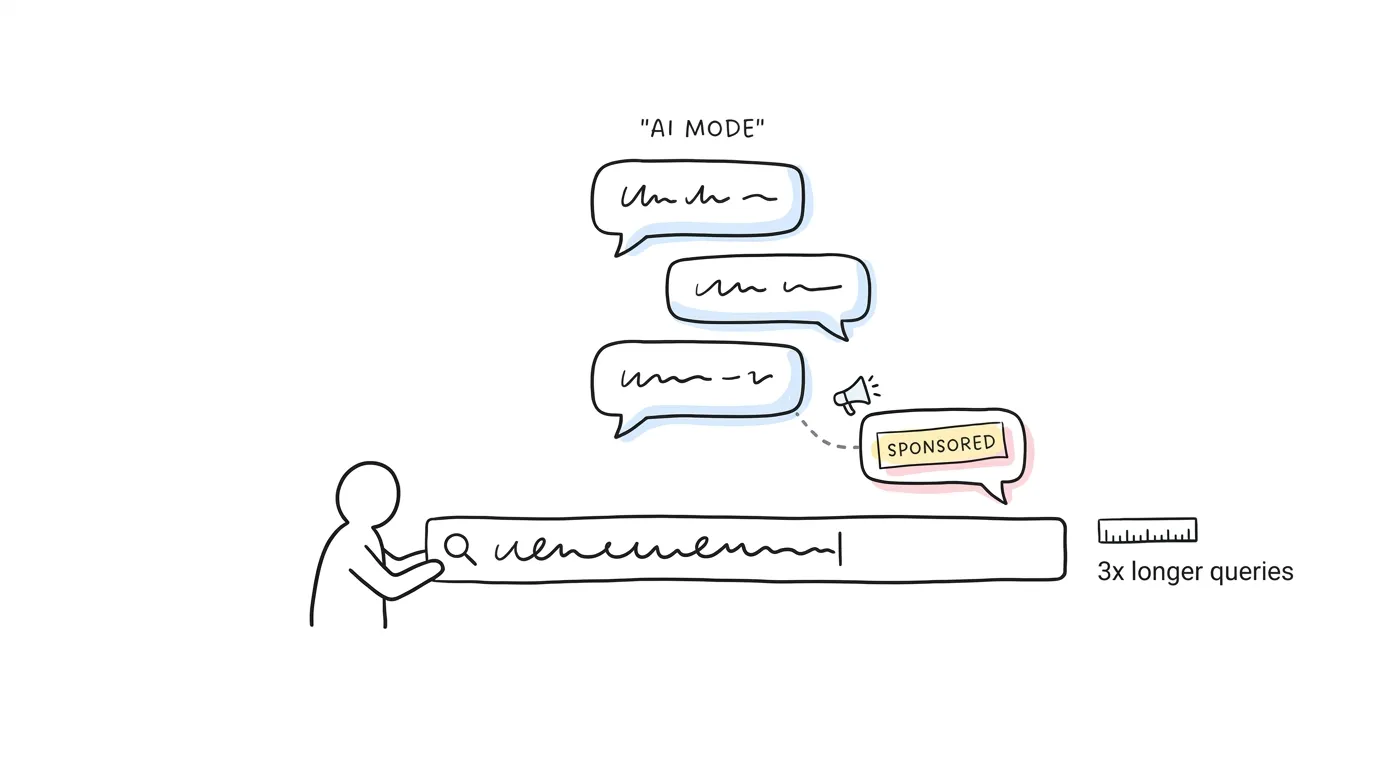
On October 28, Google announced that ads in AI Mode are officially expanding to Australia, Canada, India, Kenya, Malaysia, New Zealand, Nigeria, Pakistan, the Philippines, and Singapore. The ads will be clearly labeled "Sponsored." It also dropped a hint: Brazil, Mexico, and the UK are expected to follow in the fourth quarter.
You might ask: only 10 countries — is that worth getting excited about?
Google itself gave two numbers. First, the questions users ask in AI Mode are, on average, 3 times the length of traditional search queries. Second, inside AI Mode, the click-through rate of ad placements and organic product listings is already roughly even.
What does a 3x query length mean? Think about it. People used to search "running shoes" — two words, and who knows what they were actually after. Now they ask, "I just started running this week, I weigh 90 kilos, do you have any beginner-friendly running shoes that are easy on the knees?"
See? The length of the question is the density of intent.
The longer the question, the more specific the urge to buy. For anyone running paid campaigns, this means your ad has the chance to catch someone who is about to pay, instead of intercepting someone who is just asking casually.
Second: multi-turn ads — ads can now show up in follow-up questions
This is the part I find the most interesting.
Google put it very briefly: in the US, it launched multi-turn ads, letting ads appear in AI Mode follow-up questions. Before, your ad could only match the first question the user asked. Now, as the conversation moves on, your ad can appear again.
Let me replay this scenario for you.
A user first asks, "What are the best running shoes for beginners?" The AI gives its answer; he's not satisfied, so he follows up: "Which of these is under $150 and works for flat feet?"
Notice the difference between these two questions. The first one is browsing. By the second one, budget, needs, and context are all laid out on the table.
The second question is the one that opens the wallet. And multi-turn ads show up exactly there.
So how do you qualify to appear in follow-ups? Google hasn't set up any mysterious gate, but there are a few things you need to get solid:
- In at least one Search campaign with healthy conversion data, turn on broad match or AI Max for Search, leaving the system room to catch long, conversational sentences.
- Complete the product feed for Performance Max. Price, size, inventory — one missing or wrong field is enough to break it.
- Text customization and final URL expansion — think it through before turning them on. Your website has to actually have content pages that match, or the traffic won't land anywhere useful when it arrives.
- Look at the search terms report once a week, and add negative keywords when needed. Don't wait until the budget has burned through to come back and look.
Third: channel prioritization and budget allocation — telling your money where to go
For paid media practitioners, what's been the biggest grievance these past few years?
"I don't know where my money went."
Once the automated campaigns start running, Search, Shopping, Performance Max, and Demand Gen — four teams all eating the same budget, and inside the account you simply can't see who ate more and who went hungry. In mid-October, Google launched channel prioritization and budget allocation controls, and you can finally point your finger and tell the system: feed Search more on the big-sale days; during the pre-sale awareness window, let Demand Gen do more of the work.
I genuinely like this update.
But I have to add one piece of advice: don't move it every day. During the holiday period, set the priority once, leave it for at least a week, and let it run a full cycle. Then judge with what? With GA4, with the real orders in your store's backend. Don't stare only at the conversion numbers the platform reports to you.
The platform grading its own homework — you know how much that score is worth.
A pile of small updates that look minor alone but point the same way
While I'm at it, here's the batch of small updates from around November:
- AI Max now has a "search terms and creative combinations" report — you can finally see which terms and which creative combinations it's actually leaning on to drive volume.
- Demand Gen released a "data strength lift" metric that tells you how much more performance you can still gain by adding first-party data.
- Promotions already running on your website can now be turned into ads automatically.
- The "engaged view" threshold for video went from 5 seconds up to 10. Next cycle's numbers will drop; don't panic — the viewers who remain carry more weight.
- The All Conversions tab is fully live, so primary and secondary conversions can finally be laid out side by side for comparison.
- Advertiser verification for financial services will expand in phases to the US and Canada in early 2027 — if you're in this line of work, start preparing early.
Put these items side by side and you'll find they're all saying one sentence: Google is turning search into a conversation, and every turn of that conversation has a place for an ad to attach.
All the AI features eat from the same bowl
I've covered a pile of "what to do." In the end, I want to say something more fundamental.
AI Mode, multi-turn ads, AI Max — they all feed on the same thing: clean signals.
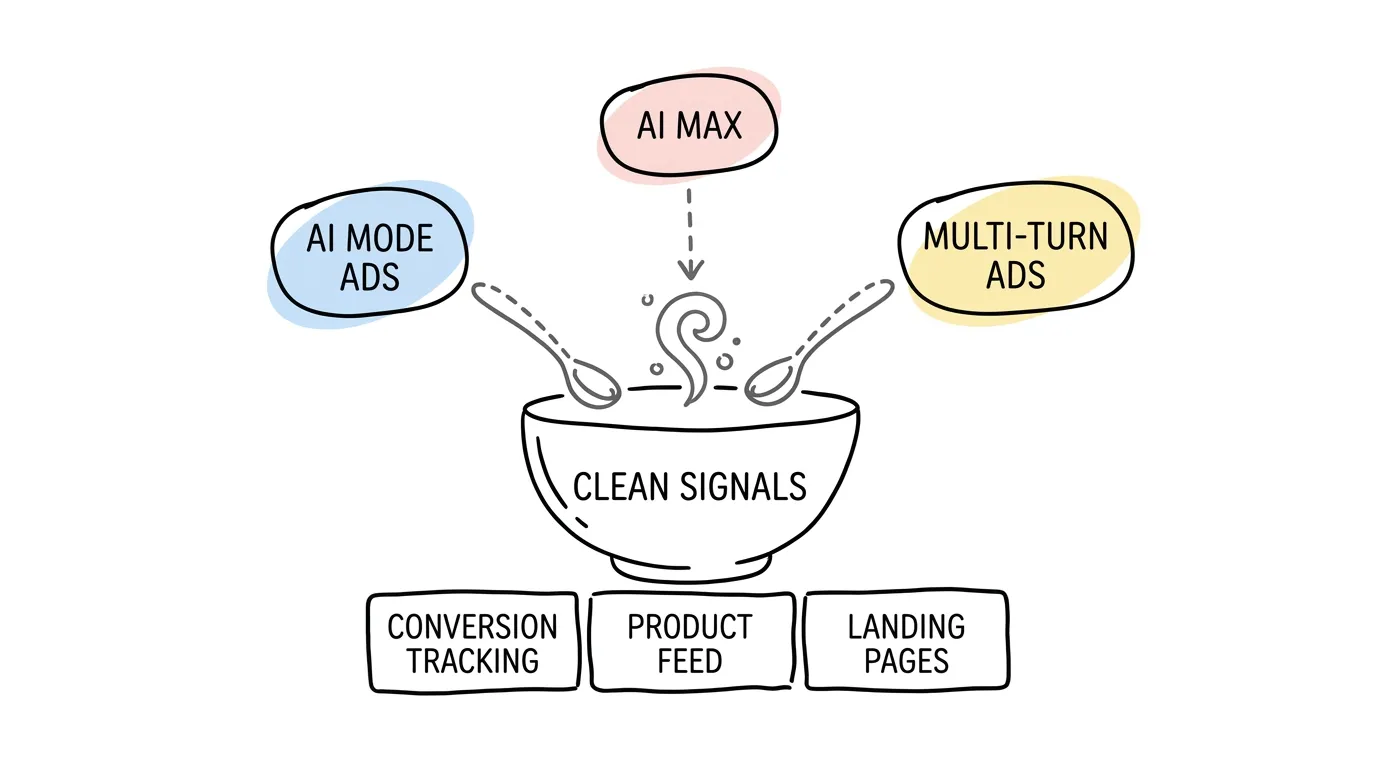
If conversion tracking isn't wired up clean, the product feed is a mess, and landing pages don't answer the question — no matter how smart the AI is, it's building on a crooked foundation. Flip it around: whoever gets this groundwork solid claims the favorable spot in this shift.
So before Black Friday, I'd advise you to schedule these things: check whether AI Mode ads are on in your target countries; take the Search campaign with the healthiest data and try AI Max or broad match; go through the Merchant Center feed completely; set channel priority once, then keep your hands off it; recalibrate your expectations for video reports to the 10-second standard; confirm Enhanced Conversions and Consent Mode are all working normally.
None of these is hard. What's hard is doing them right now.
Google has turned search into a conversation, and the ads moved in along with it. This window has just opened, and Black Friday bidding hasn't gone up yet.
Here's to your account getting ahead of the crowd before everyone else catches on.
Continue reading
Related articles

It's 2026: Stop "Buying" AI Tools for Your Marketing Team — Start "Hiring" AI Agents
This learn article explains how AI agents differ from standalone AI tools in marketing, outlines three agent categories — build-your-own platforms, CRM-native agents, and vertical tools — and covers use cases across SEO, social media, advertising, and reporting, plus criteria for choosing one.

Did the Money You Spent on AI Marketing Ever Come Back?
A guide to measuring AI marketing ROI across three layers: ad reports, sales pipeline, and the financial ledger. Covers metrics such as ROAS and CPA, eight dashboard metrics, industry benchmarks, and common measurement mistakes.

How to Pick a Creative Automation Platform: First, Figure Out What These Eleven Actually Do
A learn article sorts eleven creative automation platforms — including Bannerflow, Celtra, Smartly.io, and Storyteq — into four functional groups and proposes five evaluation questions covering publishing reach, automation depth, ease of adoption, team fit, and verifiable evidence.