
More People at AI's Door. So Where's the Money?
A commentary for media buyers on AI ad monetization: ChatGPT ads have expanded to 89 countries with over 100,000 advertisers, while Google says AI Mode ads currently earn less than traditional search ads. The author advises verifying placement availability and reviewing your own data before moving budgets.
A few days ago, a friend of mine who works in media buying asked me: everyone's saying AI is grabbing traffic — shouldn't we move our ad budgets over right away?
I said, hold on, don't rush.
As it happens, a few things have crossed my desk lately. Each one looks small on its own, but pieced together, they're fascinating. Let me tell you about them.
First, the ChatGPT ads story.
What does commercializing AI traffic actually mean? Simply put: users ask questions inside an AI, and the AI casually shows them an ad. The place where people search and ask has shifted from a search box to a chat box, so naturally, the ads have to move too.
How fast is the move?
OpenAI's ChatGPT ads have now rolled out across 89 countries, with more than 100,000 advertisers in total. This latest round alone added 26 new countries.
100,000 advertisers — what does that tell you? It means people have stopped sitting on the fence. Real money is being spent. The direction goes without saying: the people voting with their wallets have already shown up.
But.
There's a detail a lot of people have missed: India is not on the latest list of 26 countries. And ever since ChatGPT ads launched in August, India has been on managed buying (you buy through a reseller instead of opening and running your own account). After this expansion, that hasn't changed.
So if your team is waiting to run self-serve campaigns in India, don't take it for granted. Check with OpenAI or your reseller partner first, then make your plans. The gate you imagine is open is often still shut.
Alright, story number two. This one is even more interesting.
On its Q3 2026 earnings call, Google said so itself: ads running in AI Mode currently earn less than traditional search ads.
And yes — this came from Google's own mouth.
Keep in mind, on AI Overviews, Google's line used to be "ad revenue there is on par with non-AI-Overviews." This time was different. Ads in AI Mode simply earn less — no hedging, no dodging.
What's even more interesting is that Google, while admitting AI Mode ads earn less, keeps rolling out AI Mode at massive scale.
Why? Because the front door is moving. Wherever users go, the ads must follow. Even if there are hardly any shops on this road yet, the road has to get built first. Fall a step behind, and someone else builds it before you.
So what does this mean for you, a budget holder in media buying?
It means don't move your money carelessly. The wind is one thing; the harvest is another.
Third thing: a small study. Not big, but there's one number in it I've been staring at for a long time.
0.9%.
A single-site case study estimated the click-through rate on its own website's impressions in AI Overviews (and AI Mode): 0.9%.
What does that mean? It's like ten thousand people walking past your storefront, and nine of them come in. Nine.
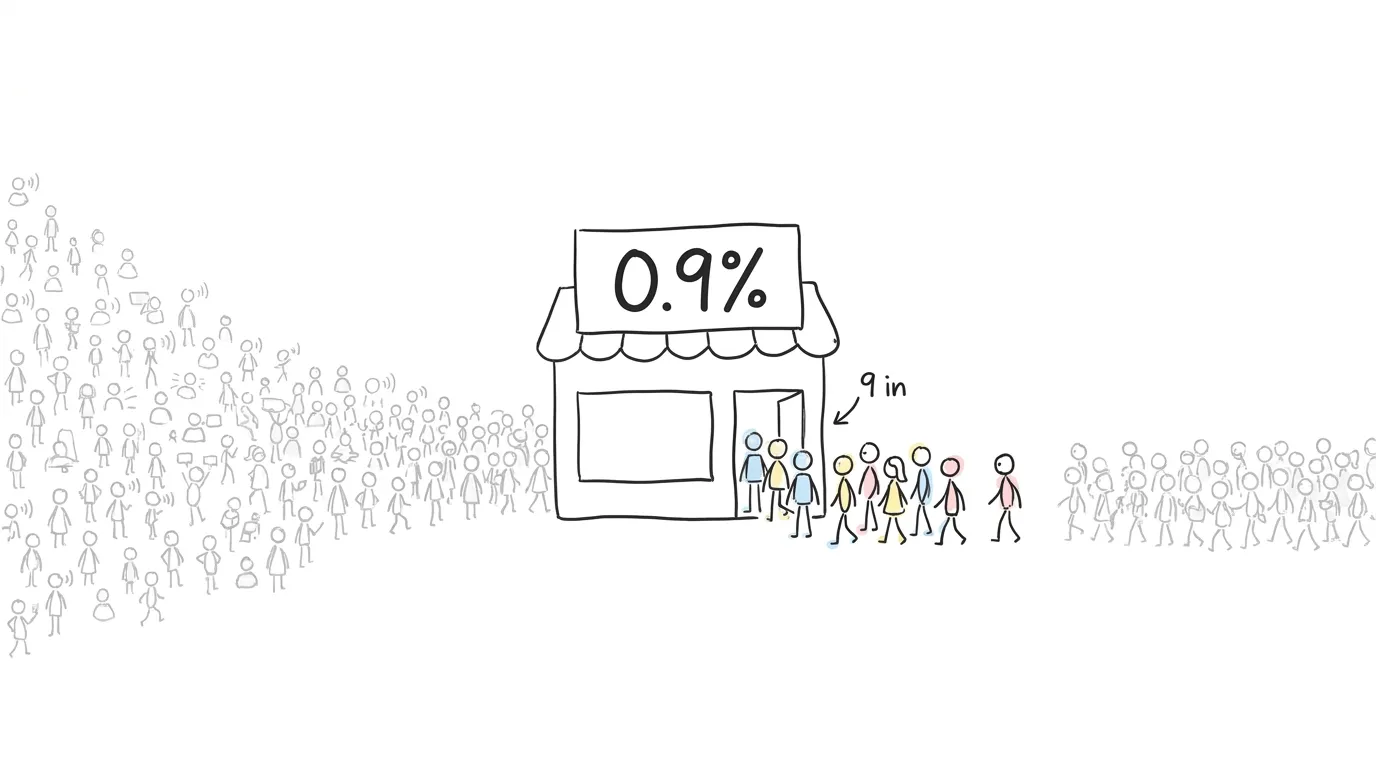
Can you trust that number? Honestly? I wouldn't take it as gospel. The sample is a single site — far too small to serve as an industry benchmark. But the direction is worth heeding: the "exposure" AI gives you and the "clicks" you're used to from search may not even be in the same order of magnitude. The exposure is noisy; the clicks are quiet.
Three stories told. Have you noticed? They're all really saying the same thing:
The crowd at AI's door keeps growing, but the checkout counter isn't installed yet.
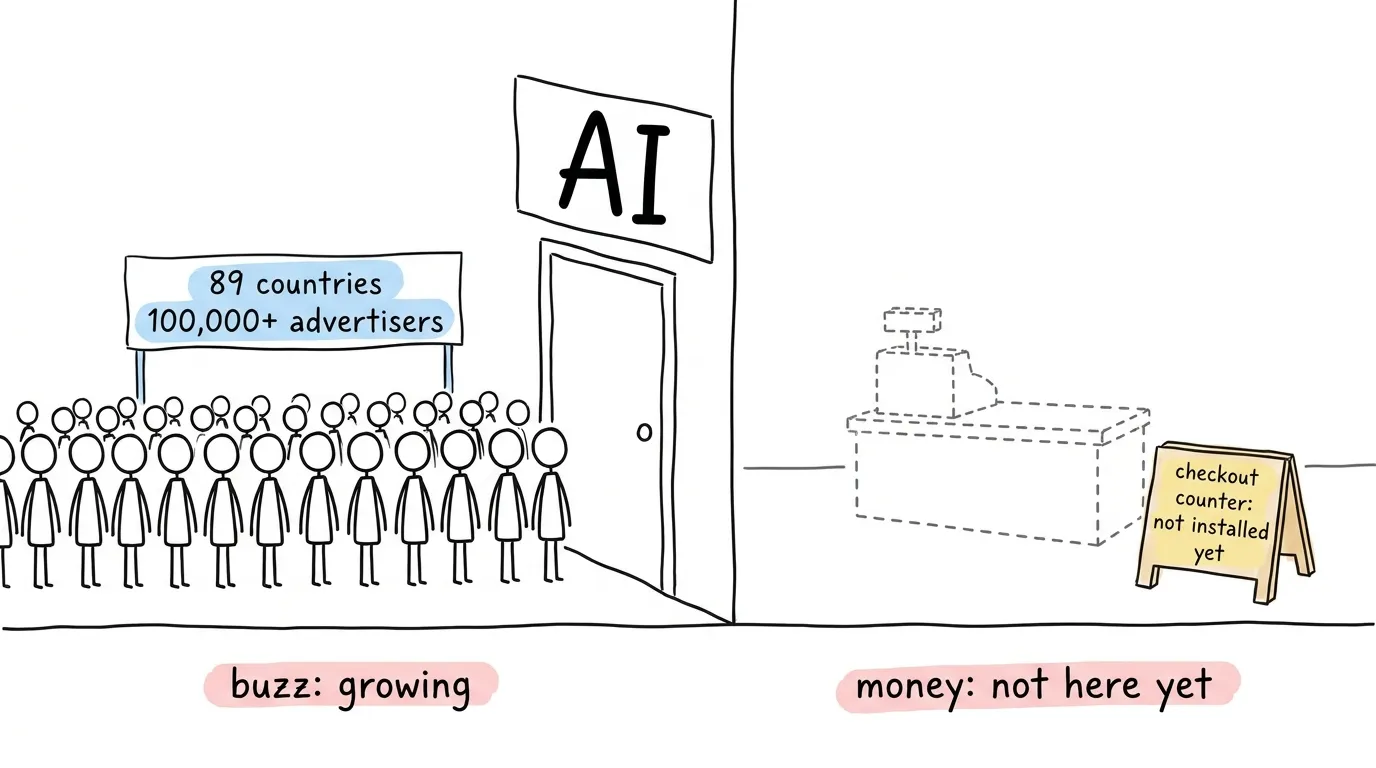
Countries expanding and advertisers piling in — that's the foot traffic. Earning less, and 0.9% — that's the checkout counter, still not installed.
So here are three things you can do for free:
- If you're waiting for self-serve ChatGPT ads in India, check progress with OpenAI or your reseller partner first. Don't build your schedule on assumptions.
- If a new AI Mode placement shows up in your Google Ads account, compare it against your existing search ads before deciding whether to move any budget.
- Spend less time reading other people's studies and more time looking at your own data: open GA4 and Search Console, and see how your clicks moved when your visibility in AI Overviews changed.
Your own books will always be more honest than someone else's study.
One last thing.
This round of AI commercialization looks just like the early days of every platform migration: the buzz arrives first, the money comes later. 89 countries and 100,000 advertisers — that's the buzz. Earning less, and 0.9% — the money is still on its way.
Nothing shameful about that. Every new platform grows up this way. What you need to do is tell which statements are about the wind and which are about the harvest — and never place your bets as if the wind were the harvest.
May you read the wind clearly — and hold on to your harvest.
Continue reading
Related articles

What Is GEO? How Your Brand Gets "Mentioned" in the Age of AI Search
An explainer on GEO (Generative Engine Optimization) for e-commerce and DTC brands: how it differs from SEO and AEO, why AI answers shape brand visibility, and eight practices covering question-focused content, consistent brand messaging, structured pages, external evidence, comparisons, and AI mention tracking.

AI Is Already Making Decisions for Your Customers. Are You on the List?
A learn article explains GEO (Generative Engine Optimization): why AI-generated answers now shape which brands customers see, and how SEO fundamentals, entity clarity, citable evidence, and monthly measurement affect visibility in AI answers.

Google Is Stuffing Ads Into AI Search: These Recent Stories Are Really One Story
A news roundup linking recent AI marketing stories—Google adding ads to AI Mode, Amazon's Ads Agent, ChatGPT image updates, a UK startup tracking brand mentions in AI answers, and an AI ransomware warning—arguing that control over ad data and visibility is shifting toward platforms.