
How Does AI "Remember" a Brand? Let's Run the GEO Numbers
A learn article introducing GEO (Generative Engine Optimization): how AI engines cite sources, how SEO rankings correlate with brand mentions in AI answers, and tactics covering content, Wikipedia, Reddit, technical setup, and measurement of brand visibility.
A while back, I gave a friend of mine in consumer goods a slightly devious little experiment.
I said: open ChatGPT, type "Is " into the input box, then your brand name. Don't hit Enter. Just watch the autocomplete.
Every suggestion that popped up was somebody else's name. Who's partnering with whom, who's still leading, who sponsored which big tournament. His brand? No such person on record.
He stared at the screen for a beat, then asked: what does that tell you?
I said it tells you that in AI's world, your brand hasn't been "remembered" yet.
And your customers have already started asking AI. Which brand is good, which supplier to pick, how an industry really works. However AI answers, that's how your business gets rewritten.
This thing now has a name: GEO, Generative Engine Optimization.
Today I'll run those numbers for you from the top.
First, Some Numbers to Gauge the Water Level
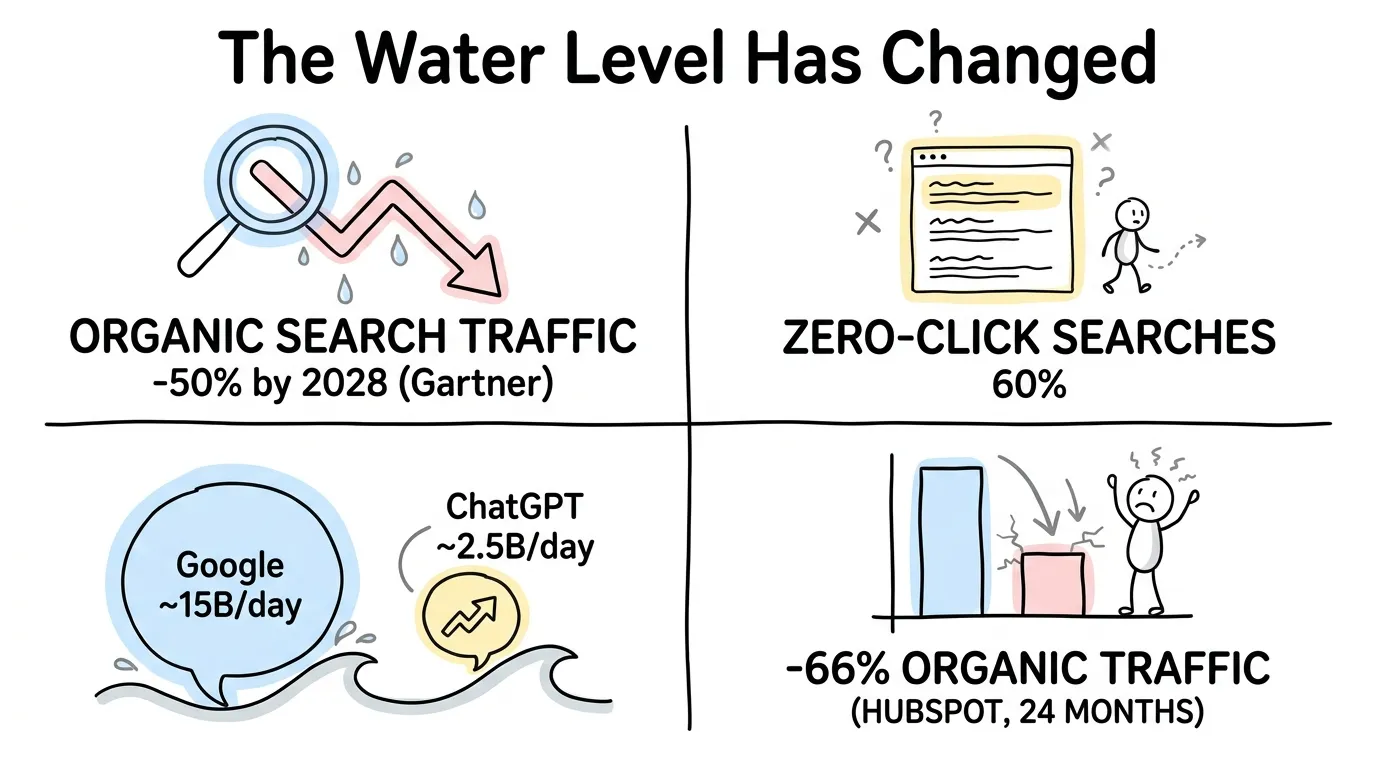
The first: Gartner predicts that by 2028, organic traffic to traditional search engines will drop by half.
The second: zero-click searches — users who read the answer on the results page and leave without clicking a single link — have reached 60% in the US and Europe. Since May 2024, Google has pinned AI-generated summaries (Google's "AI Overviews") right at the top of its search results. Authoritas has counted that roughly 30% of searches show one of these summaries; if the user is asking a "how do I solve this problem" type of question, the share approaches three quarters.
The third: ChatGPT has squeezed into the global top ten of website traffic, handling around 2.5 billion prompts a day. Google has spent more than twenty years doing search and handles about 15 billion a day. For the first time, the chaser has stepped into the ring.
The fourth one stings the most: HubSpot, the benchmark of content marketing, lost 66% of its organic traffic in 24 months.
Good grief, what a fall.
It did nothing wrong. The door people knock on to ask questions has changed.
The old path was "write content, rank it, wait for clicks." The floor of that path is being pulled out right now. But don't panic — the rules of the new game can be studied. Read on.
What Exactly Is GEO?
What is GEO?
GEO means getting your brand to appear in AI's answers. When it talks about a category, you hope your name is there; when it cites a source, you hope your page is there.
Set it next to SEO and it's clearest.
SEO fights for ranking. A user searches a word — where does your link place?
GEO fights for being named. AI composes an answer — did it mention you on the spot?
SEO fights for rank; GEO fights for a name-check.
The industry has a few more acronyms; let me untangle them while I'm here: GAIO is the umbrella term for any optimization that influences AI outputs; GEO specifically means optimizing for AI engines with search capability; LLMO means influencing the training data of the large models themselves.
This distinction is not pedantry. Behind it lie two entirely different time scales.
The Most Valuable Passage in This Piece: AI Has Two Memories
AI answers questions using two memories.
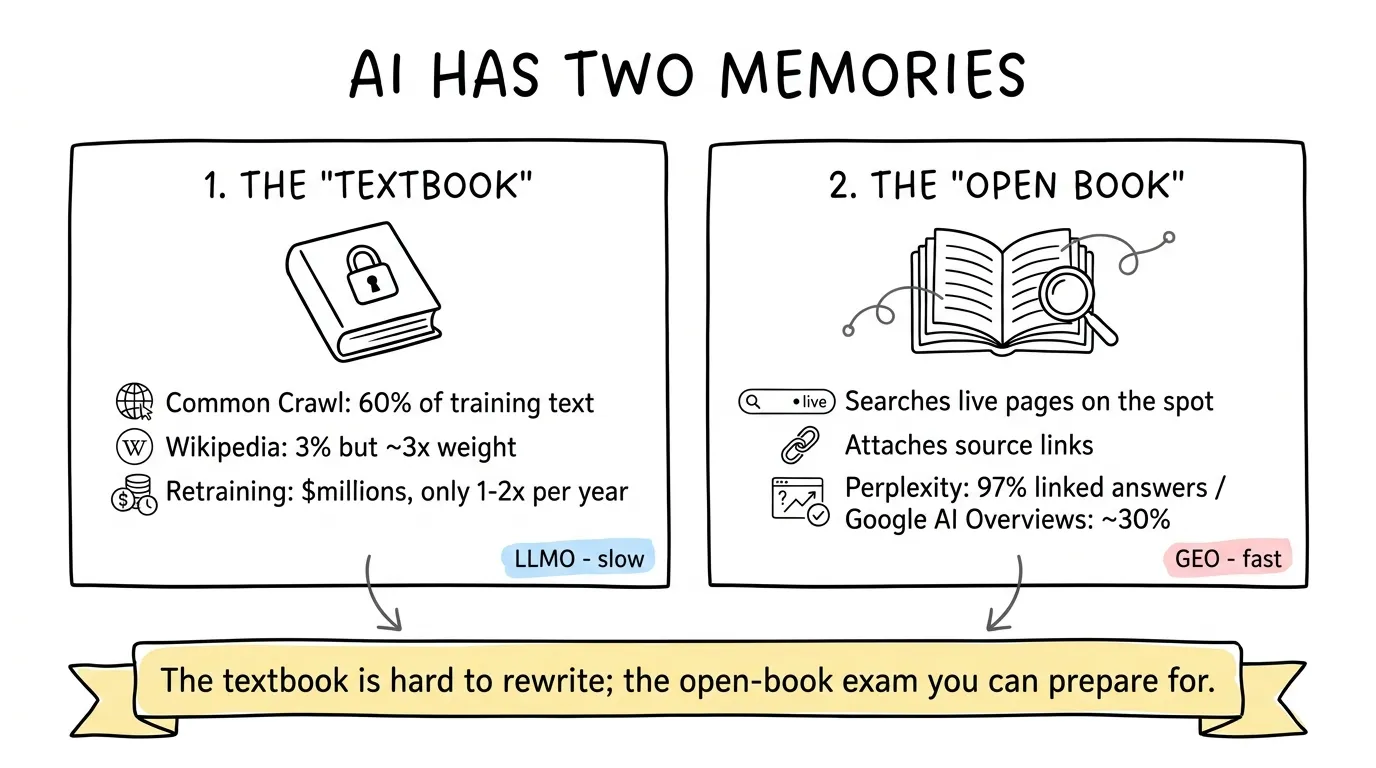
The first is called the "textbook."
Before a large model leaves the factory, it has devoured a mountain of internet text. Common Crawl, a crawl of the whole web, makes up 60% of it; Wikipedia is only 3%, but it is double-weighted and matters roughly three times as much as ordinary material; the rest is books, papers, code, and forum discussions.
This memory's fatal weakness: updating it requires retraining. One retrain costs several million dollars on the cheap end, several hundred million on the expensive end — and it comes only once or twice a year.
So if you want to influence a pure large model's memory, there is exactly one road: long-term brand engineering. Let authoritative content keep accumulating, and wait for the next "textbook revision" to write you in. That's LLMO, and it can't be rushed.
The second is called the "open book."
ChatGPT's search, Google's AI summaries, Perplexity — these AI search engines flip through sources on the spot before answering: they fire off a real search, read the pages they fetch, synthesize an answer, and, while they're at it, attach the source links.
The textbook is hard to rewrite; the open-book exam you can prepare for.
Want fast results? Optimize for its open-book exam. Want to win in the long run? Rewrite its textbook. GEO's entire playbook hides inside those two sentences.
And here's the good news: the open-book exam comes with citations. 97% of Perplexity's answers carry source links; about 30% of Google's AI summaries do; ChatGPT's share of linked answers is rising too. As long as the links are there, you can check, trace, and work backwards to what it read.
Three Crowbars
How do you actually start? Here are three crowbars — prying first on your own ground, then onto other people's turf.
Crowbar One: Bury "Lines Worth Lifting" in Your Content
Researchers at Princeton published a rather famous paper: they ran 10,000 prompts as an experiment, testing different ways of reworking content to see which ones get the content into AI's answers more often.
The conclusions aren't complicated. Add statistics, and visibility rose by up to 40%; citing reliable sources bought just over 40%; quoting an expert's own words, around 40%; writing fluently and plainly, 10 to 30%.
One detail matters enormously: one or two citations or quotes is enough — don't stuff in whole paragraphs.
Now think about how users ask. Traditional search: two to four words. Asking AI: a dozen-plus words on average — full sentences. So use questions as your subheadings, answer exactly what's asked, and put the answer in the first paragraph beneath the question.
What's the most useless move of all? Piling in keywords. The paper tested it: the harder you pile, the further visibility falls. AI doesn't take dictation from a parrot; it wants content with numbers, with sources, in human words.
Vague lines get skipped; specific lines get lifted.
Crowbar Two: Your SEO Wasn't Wasted
The moment many people hear "AI search," they want to disband the SEO team. Hold on.
Seer Interactive ran a test: 10,000 prompts from finance and SaaS, fed into GPT-4o, counting how often brand names appeared, then cross-checked against Google and Bing ranking data.
The correlation was 0.65. The higher your Google organic rank, the more likely AI names you. Bing was weaker, but still around 0.5.
The interesting finding is the reverse one: backlinks — the SEO era's most prized currency, other people linking to you — came in at a correlation of just 0.1, nearly neutral.
Your ranking is the precondition for AI naming you; your backlinks are no longer.
So don't tear it all down and start over. Keep the chassis, move the muscle to the first crowbar.
Crowbar Three: Show Your Face in Its "Textbook"
The first two crowbars work on your own website. The third means going deep into AI's memory to be seen.
First, look at who AI reads. OtterlyAI analyzed the citation links across 100,000 AI answers: the most-cited domain, number one, was Reddit, over 3,000 times; behind it came YouTube, Wikipedia, LinkedIn.
Then look at the textbook's recipe. OpenAI has signed content partnerships with more than a hundred news outlets; Reddit has simply licensed its content to the major model makers. And think of that famous failure case — AI suggesting spreading glue on pizza — its origin was a joke in a forum thread. Forum posts really do become textbook.
Three high-leverage moves, ranked by return on effort.
The first, Wikipedia. The three-times weighting is sitting right there. After OtterlyAI itself got a Wikipedia entry, its brand visibility climbed in plain sight — they call this "AI positioning." But it isn't easy to get in: you need third-party, verifiable coverage, you need neutral writing, and you can't edit it yourself — you can only propose on the talk page and submit sources.
The second, Reddit. Answer questions seriously, share cases and hard-won lessons, don't advertise. The community is extremely sensitive to the smell of ads, but genuine substance settles and becomes textbook.
The third, industry media. Every time your data or your viewpoint gets cited, that's one more channel into the textbook. A word for friends in PR: every piece you write now has one more invisible reader — AI.
In September 2025, OtterlyAI released a large-sample monitoring study: 200,000 prompts, 1.4 million pieces of AI-cited content. Of those citation links, 51% were brand websites, 20% were news media, 6% came from Reddit. You see — there's been a seat at this table all along.
The Technical Layer: Don't Let It Drag You Down
Beyond content there are a few more things. Doing them earns no bonus; not doing them costs you.
First, AI crawlers can't read JavaScript. Content on your page that renders only via scripts, dynamic modules hidden inside third-party tools — in their eyes it doesn't exist. What AI can't see doesn't exist. Put your key content in plain, honest HTML.
Second, structured data is worth adding. JSON-LD is like handing AI a crib sheet: what product this page is, who wrote it, what it costs. More than 40 million websites and hundreds of billions of structured markup objects are already in use worldwide. Don't gamble on whether it reads it today — have the crib sheet ready.
Third, let me debunk something. There's a new thing called llms.txt, billed as a robots.txt for AI. OtterlyAI checked carefully and found no AI search engine using it so far. Put one up if you like, but don't pin hopes on it, and above all don't let it delay the real work.
One final red line: don't touch the shady stuff. Research has shown that burying specific instruction sequences in a webpage did push products to the front in about 40% of cases. You can cheat short-term; you will crash long-term — once the model makers catch on, they claw it all back with interest. Black-hat GEO ends far worse than black-hat SEO.
How Do You Know You're Making Progress?
Finally, measurement. Many people get stuck here.
AI's answers are a little different every time; ask today and ask tomorrow, the wording shifts. So how do you optimize anything?
OtterlyAI ran a rather reassuring experiment: the same prompt, asked once every 20 minutes, for multiple rounds. Conclusion: the brand list basically keeps the same names — only the seating shifts occasionally, and the citation links stay stable. The jitter introduced by the temperature parameter (a setting that controls output randomness) cannot shake the big picture.
AI's answers are like weather; the brand rankings are like climate. Weather changes daily; climate holds steady for years.
So don't let the jitter of any single answer scare you off. Watch the primary metric: brand visibility — how often and how high your name appears across a set of core questions. Citation links are the second metric, for working backwards to what it read and where competitors surfaced.
On tools: platforms like OtterlyAI can run prompts on a schedule, by country and by engine, store the answers, and watch the changes. Some teams use the blunt method: genuinely ask the core questions in every AI once a week and log them in a sheet. Time-consuming — but for those few life-or-death questions, it's the most solid raw data you can get.
You can only improve what you can measure. In the AI search era, that line still holds.
Back to Those Three Letters
Back to the experiment at the beginning.
My friend now types "Is " plus his brand once a month. He says it's a dashboard he installed for himself.
The first month, no such person on record. I didn't push him to demand results; I just had him fit the crowbars on one by one: added data and his own quotes to the content, rebuilt the core pages to be readable in plain HTML, spent three months answering questions seriously on Reddit, published a methodology piece carrying his own data in an industry outlet.
What he'll see next month when he types those three letters again, I don't know.
But at least he now has a seat at the table where the textbook gets revised. Most of his peers don't even know where the exam hall is.
Here's to your brand being remembered by AI soon.
And to that three-letter experiment bringing you a surprise soon.
Continue reading
Related articles

It's 2026: Stop "Buying" AI Tools for Your Marketing Team — Start "Hiring" AI Agents
This learn article explains how AI agents differ from standalone AI tools in marketing, outlines three agent categories — build-your-own platforms, CRM-native agents, and vertical tools — and covers use cases across SEO, social media, advertising, and reporting, plus criteria for choosing one.

What Is GEO? How Your Brand Gets "Mentioned" in the Age of AI Search
An explainer on GEO (Generative Engine Optimization) for e-commerce and DTC brands: how it differs from SEO and AEO, why AI answers shape brand visibility, and eight practices covering question-focused content, consistent brand messaging, structured pages, external evidence, comparisons, and AI mention tracking.

AI Is Already Making Decisions for Your Customers. Are You on the List?
A learn article explains GEO (Generative Engine Optimization): why AI-generated answers now shape which brands customers see, and how SEO fundamentals, entity clarity, citable evidence, and monthly measurement affect visibility in AI answers.