
Six Days to Black Friday: What Have Google, Meta, and TikTok Turned Ecommerce Ads Into This November?
A learn article reviewing November ad platform changes by Google, Meta, and TikTok ahead of Black Friday, covering new Google Ads priority and budget controls for Display and Search Partners, Meta's automated new-customer exclusions, AI Mode ad expansion and CPC pressure, and TikTok's agentic shopping tools.
Over the weekend I had dinner with a friend who runs an ecommerce brand. Halfway through the meal, he pulled out his phone and started scrolling through his ad accounts, his frown deepening by the minute.
I asked what was wrong. Black Friday was right around the corner, he said, and CPC kept climbing. For the life of him he couldn't figure out where the problem was.
I told him: the problem isn't you. This November, Google, Meta, and TikTok all quietly made a series of moves. Let me walk you through them—once you've heard them out, you'll stop panicking.
The moves come in all shapes and sizes, but strip them down and there's only one keyword: control.
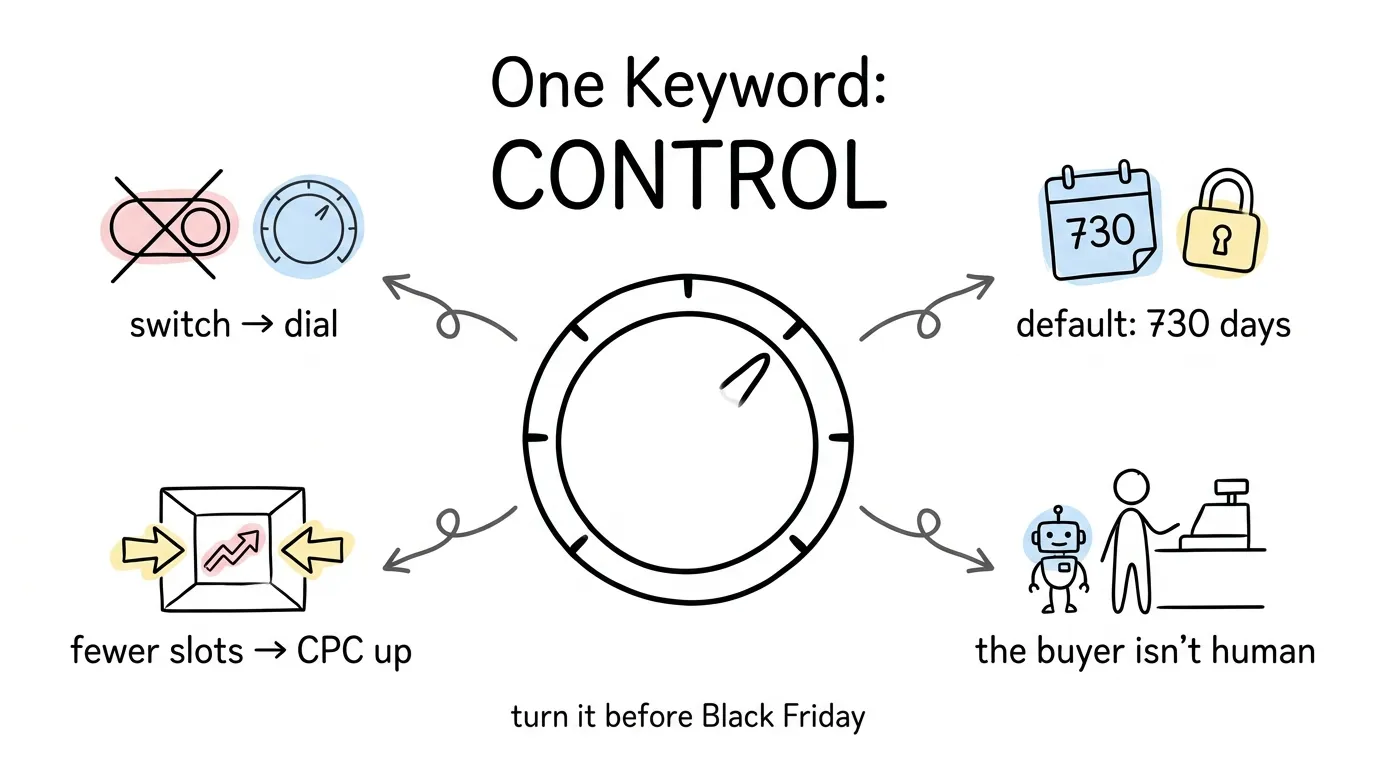
Story One: Google Replaced the Switch with a Dial
What do I mean by control?
Think about it: for years, managing Display and Search Partners (Google's network of partner sites beyond its own search results) in Google Ads meant a single switch. On or off. That was it.
Stores that left it on kept quietly paying for traffic no one had ever seen; stores that turned it off occasionally missed a few cheap orders.
On October 14, Google's Ads Liaison Ginny Marvin announced two new optional controls: one lets you mark Display Network, Search Partners, and Google Channels as high priority or low priority; the other is a budget allocation control. Both will roll out worldwide over the coming weeks.
What does that mean? It means you can finally say the one thing you've always wanted to say: "I'll keep the Search Partners traffic, but it can take a back seat." No more all-or-nothing.
That announcement pulled 726 likes on LinkedIn, running far ahead of every other Google post this month. Why? Because it answers a demand store owners have been shouting for years.
My take: this thing is genuinely useful. For most ecommerce stores, Search Partners and Display traffic already converts a step below Google's own search results. Turning it down a level beats black-and-white every time. If I had designed this dial, it would probably look about the same.
With less than a week to Black Friday, you should do two things. First, pull a Search report segmented by network and see what Search Partners and Display have actually delivered over the past 90 days. Second, anything dragging down ROAS goes to low priority—don't delete it outright; whatever's pulling its weight stays at high priority.
One more thing: make the change this week. Don't wait until Black Friday week to adjust budgets—shifts in where money goes take a few days to settle, and the biggest sales week of the year is no place to run experiments.
Replacing a switch with a dial is a bigger deal than it sounds.
Story Two: At Meta, the Chores Got Outsourced
Google handed the dial back to you; Meta chose to turn it for you.
In mid-October, Meta quietly changed its Customer Lifecycle Strategy. Running new-customer acquisition ads used to mean selecting the "new customers" goal and doing the chores yourself: uploading customer lists, adding exclusions to every ad set, and remembering to refresh them regularly. Skip a month's refresh, and your acquisition campaign was spending money on existing customers.
Now? Meta does the excluding for you. Automatically. Based on your purchase event data.
Sounds great, right? Hold the "wow" just yet.
The trap is buried in the default: the audience retention window ships set to 730 days. 730 days—two years. Meaning anyone who has bought anything from you in the past two years counts as an "existing customer," and your acquisition ads will never be shown to them.
Is that reasonable? Depends on what you sell.
If you sell sofas, someone who bought 18 months ago probably doesn't need another one yet. But what if you sell coffee, supplements, or skincare? Someone who bought once 14 months ago and never came back is, as far as I'm concerned, no different from a new customer. The default shuts them out.
So pick the window based on your own repeat-purchase cycle. 30 days, 60 days, 90 days, 180 days—the options are there.
There's another layer: this exclusion runs on purchase event data, and whether your event data is accurate depends on your tracking. If your Pixel and Conversions API miss purchases, the exclusion is empty talk. Before you turn this feature on, go through your purchase events in Events Manager first.
A related feature is also rolling out: you can now choose an audience for each individual ad creative. It may replace the old habit of splitting ad sets by age—fewer ad sets mean more data per set, and Meta's delivery system loves sets with more data.
Having the platform do the chores is convenient—but whoever sets the defaults holds the power.
Story Three: Less Room, Higher Prices
Back to my friend from the beginning: the answer to his endlessly climbing CPC lies in the third story.
On October 28, Google announced that ads in AI Mode (Google's conversational AI search experience) are expanding to 10 new countries: Australia, Canada, India, Kenya, Malaysia, New Zealand, and more. The UK and Brazil are lined up next. The US is testing a multi-turn ad format at the same time.
What is AI Mode? People used to type two or three words into the search box: "cheap wireless earbuds." Now they type the whole question: "I need wireless earbuds for working out, budget under a hundred dollars, good noise cancellation—pick one for me." AI Mode queries run roughly three times the length of traditional searches.
Where did the people go? To places with fewer ad slots.
Google's just-released Q3 earnings report puts it bluntly: search ads growth slid to 12%, from 17% the quarter before. The reason is sitting right there: AI Mode has fewer ad slots and monetizes less efficiently.
Let's run the numbers: searchers keep moving into a new home with fewer ad slots, while not a single advertiser competing for placement has dropped out. With everyone bidding in a smaller space, the contest can only end one way—CPC heads up.
So your costs went up, and it most likely has little to do with how well you optimized. The entire market is squeezing into the same small room.
What to do? Push hard on both ends. On money: leave slack in your Black Friday ROAS targets—the ones you set last November may now be so tight you can't win the volume you need at all. On product: polish your product titles and descriptions relentlessly—queries three times longer reward product data that clearly says who it's for, what it's made of, and what problem it solves.
If you sell into Australia, Canada, or New Zealand, keep a close eye on your CPC over the next few weeks—the change will hit you first.
When the traffic pool shrinks, the bidding always gets louder.
Story Four: The Buyer Isn't Human
The last story is the most interesting one.
At Advertising Week New York in early October, TikTok announced a full suite of agentic tools (AI that can act and transact on a user's behalf). Two of them touch ecommerce directly: one is called Buy Direct, one-tap checkout connected to Shopify, Stripe, Salesforce, and Shoplazza; the other is an AI shopping assistant.
TikTok Shop's Black Friday–Cyber Monday sale kicked off on November 11 and ends on the 30th. By the time you read this, it's already running, with about ten days to go.
Here's a point that hits home for me. TikTok says your dashboards routinely credit sales to other channels: someone sees your product in a video, mulls it over for a few days, searches your brand on Google, and places an order. Google takes the credit; TikTok's reports show nothing.
Sure, TikTok is grading its own homework. But the cases I've seen do look roughly like this: how many store owners tested TikTok, saw no movement in their on-site numbers, judged it "no effect," and shut it off—while it had been quietly feeding their brand search volume all along.
While the sale is still running, put your best Offer front and center. Then remember: evaluate TikTok on total revenue and brand search volume, not on its own dashboard alone.
The story doesn't end there. In mid-October, Google launched Universal Cart: products from several different stores in one shopping cart, with price-drop tracking. Shopify opened Catalog and Shop Pay checkout to any AI agent. Walmart is building an agent-facing entrance, complete with Agent Profiles that let shoppers set spending approvals and limits for the AI spending money on their behalf.
Wow. Google, Shopify, Walmart—all three are building checkout lanes for a buyer that isn't human.
Don't rush to retrofit your entire store to be robot-friendly just yet. Before you act, hear two numbers.
A Feedvisor survey: 62% of consumers say they would never be comfortable letting an AI agent transact on their behalf.
But Adobe's data says: traffic from AI brings in 83% more revenue per visit.
Fewer people, but more money.
My view: you don't have to pick a side. An AI agent reads only your product data, prices, inventory, shipping options, and return policy—nothing else. It won't squint at your images, and it won't try to read between your lines. And the craft that makes you legible to agents—honest product titles, crystal-clear shipping and return policies—is exactly the same craft that makes your Standard Shopping and Performance Max campaigns run better. Whether or not agents take off, that practice is never wasted.
If you're on Shopify, open your admin this week and check: are the shipping and return policies filled in clearly, and are the product titles written in plain language? That's your agent-readiness check.
Finally, Back to That Dinner
By the time I finished telling him the four stories that night, my friend had put his phone away.
Google handed the dial back to you. Meta turns the dial for you, but it decides the defaults. AI Mode's room got smaller—and pricier. And a new buyer who doesn't breathe is lining up in everyone's checkout lanes.
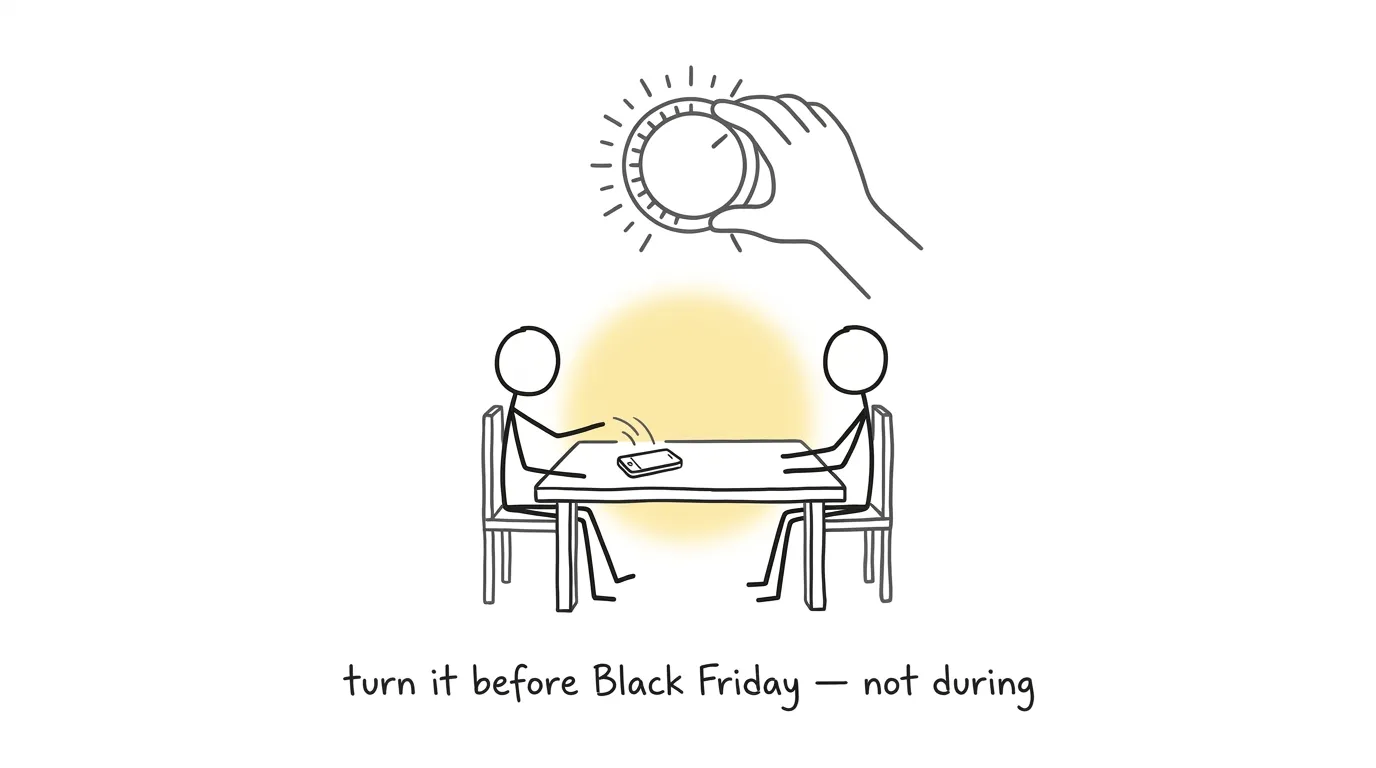
The dial was never in your hands to begin with. What you can do is think through exactly which notch to turn it to—and turn it before Black Friday, not during Black Friday week.
Wishing you a booming Black Friday.
And may every notch on every dial sit exactly where you want it.
Continue reading
Related articles

What Is GEO? How Your Brand Gets "Mentioned" in the Age of AI Search
An explainer on GEO (Generative Engine Optimization) for e-commerce and DTC brands: how it differs from SEO and AEO, why AI answers shape brand visibility, and eight practices covering question-focused content, consistent brand messaging, structured pages, external evidence, comparisons, and AI mention tracking.

AI Is Already Making Decisions for Your Customers. Are You on the List?
A learn article explains GEO (Generative Engine Optimization): why AI-generated answers now shape which brands customers see, and how SEO fundamentals, entity clarity, citable evidence, and monthly measurement affect visibility in AI answers.

Google Is Stuffing Ads Into AI Search: These Recent Stories Are Really One Story
A news roundup linking recent AI marketing stories—Google adding ads to AI Mode, Amazon's Ads Agent, ChatGPT image updates, a UK startup tracking brand mentions in AI answers, and an AI ransomware warning—arguing that control over ad data and visibility is shifting toward platforms.