
B2B Marketing: Buyers Don't Lack Content. They Lack Proof.
A B2B marketing essay arguing that AI-generated commodity content has eroded content volume as an advantage, and that buyers respond to proof and useful experiences such as sandboxes, calculators, diagnostics, and benchmark reports. It outlines plays for early value delivery, ABM gifting, customer-outcome assets, and a
A few days ago, an old friend of mine who runs an enterprise software company invited me out for tea. He looked exhausted: his team had published more than twenty articles this month, traffic hadn't dropped, but inquiries had.
I told him: don't panic yet. Go back and run a little experiment. Feed your article titles, exactly as written, into an AI and have it write its own version. Then read both. Can you tell which one your team wrote?
He paused for a moment, then said, "No, I can't."
That's the problem.
AI hasn't made B2B marketing less important. It has made mediocre B2B marketing something buyers can simply ignore.
Think about it: today's buyers already hold AI in their hands. If they want an industry explainer, they can generate ten articles in three seconds — every one of them fluent, without saying a single word to any of your salespeople. Why would they read yours?
Gartner's research shows that 67% of B2B buyers want the early research phase to be completely free of sales involvement. And in recent buying journeys, nearly half of buyers (45%) are already using generative AI.
So stop expecting "publishing more" to buy you anything. Buyers don't lack content. What they lack is something that helps them decide.
Volume is no longer an advantage. Usefulness is.
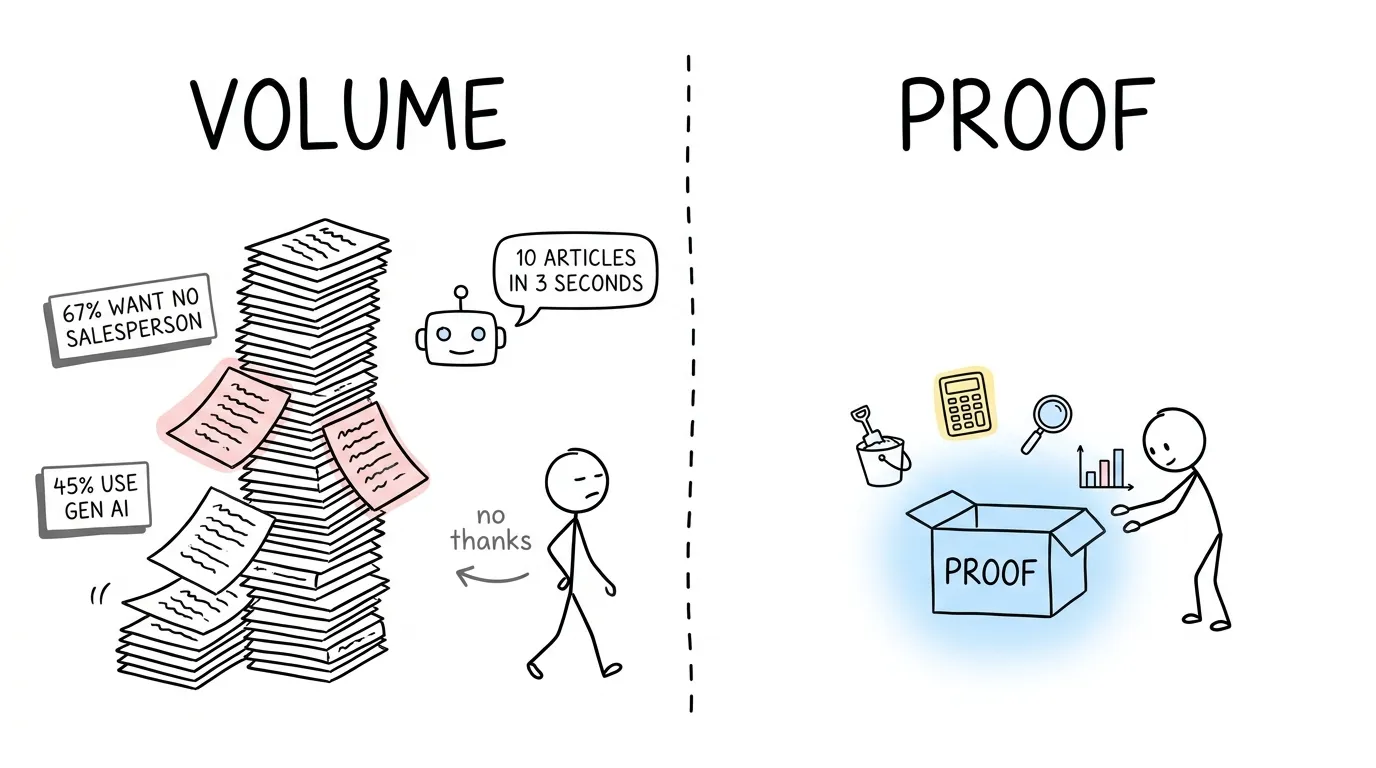
What Counts as "Useful"?
The approaches I've seen actually work fall into a few rough categories:
- A product sandbox or interactive demo that requires no login to try
- A cost-of-inaction calculator: how much more money will you burn if you don't solve this problem?
- A free diagnostic for your website, SEO, or workflow
- An industry benchmark report
- Customer milestones worth telling the world about
- A sharply argued op-ed from the founder on a specific industry issue
These all share one thing: they reduce the buyer's uncertainty. They give the buyer the confidence to take a step forward before ever meeting one of your salespeople.
It's not about standing out. It's about making buyers confident enough to commit.
Four Plays You Can Start Running Today
1. Let Buyers Feel the Value Sooner
Book a demo still has its place, especially for complex products. But it shouldn't be the only door.
Here's one example. Instead of putting up a sterile demo-request form, one data analytics platform built a five-question "report maturity assessment." Visitors answer the questions, instantly get a custom score, see exactly where their process breaks down — and only then are invited to see how the platform fills that gap.
Buyers are free to research on their own first. But when they hit the "is this right for me?" wall, they still want a human. So design the digital experience to educate, and bring in experts at the moment they're most valuable — instead of intercepting buyers at the front door.
2. ABM: Be Useful First, Personalize Second
What does most ABM (account-based marketing) actually look like? Opens personalized, ends with a meeting ask.
The stronger play is to first give that account something genuinely useful to them. For example:
- An AI search visibility audit
- A conversion-path teardown
- A competitor positioning snapshot
- An industry benchmark tailored to their market
This gift gives your outreach a reason to exist: before they've agreed to talk, they've already seen how your team thinks.
Start with 10 accounts. Track reply rate, meetings booked, new opportunities — plus honest feedback from your sales team. Once it works, scale it up.
3. Turn Customer Outcomes into a Distribution Channel
In large B2B purchases, your existing customers are often your most credible channel.
But customers won't forward a case study stamped with your logo. You have to create assets that make them look good: a verified performance milestone, an annual impact report, a maturity score, a recognition program that celebrates them, or a go-live story that puts your customer's team front and center.
The asset has to make your customer look good first — before it earns you any credit. If it does, they'll take it and show it around inside their own company. That internal showcase is your hardest proof.
4. Don't Let One Channel Carry Everything
LinkedIn, search, paid media — each one works, and each one is fragile: costs keep rising, algorithms change overnight, buyer behavior shifts. Betting your growth on any single one of them is a dangerous move.
The way we do it at VORD is to twist SEO, content, LinkedIn, paid acquisition, and email into a single rope. The rope is called revenue. The five channels don't keep separate scorecards. There's one ledger only: did pipeline move?
Three Things to Stop Doing Right Now
Stop publishing commodity content. An AI can hand you ten generic data-security guides in ten seconds. Content with no original judgment, no battle-tested framework, no customer insight, no industry data — either find a sharper angle for it, or don't publish it.
Stop putting a form in front of everything. A form should only appear at the moment the buyer trades into real value: a custom analysis for them, a tool they'll keep using, an in-depth study. Foundational education and early-stage proof should be wide open, no gate.
Stop judging by activity metrics. Traffic, impressions, follower counts — those are signals, not results. Results look like this: engagement depth from target customers, demo conversion, opportunities your sales team picks up, pipeline influenced and created, pipeline velocity, and customer referrals and expansion.
90 Days: Here's How
Month one: find the friction. Go through your highest-traffic pages, every form, and all your sales feedback, and find the moments where the buyer is asked for commitment before receiving any value.
Month two: ship one useful experience. A calculator, an assessment, a diagnostic — any of these will do. For one ICP (ideal customer profile) only, solving one high-value problem only.
Month three: build distribution around it — one article with real substance, one round of LinkedIn content, one nurture email sequence, plus one partner or newsletter collaboration.
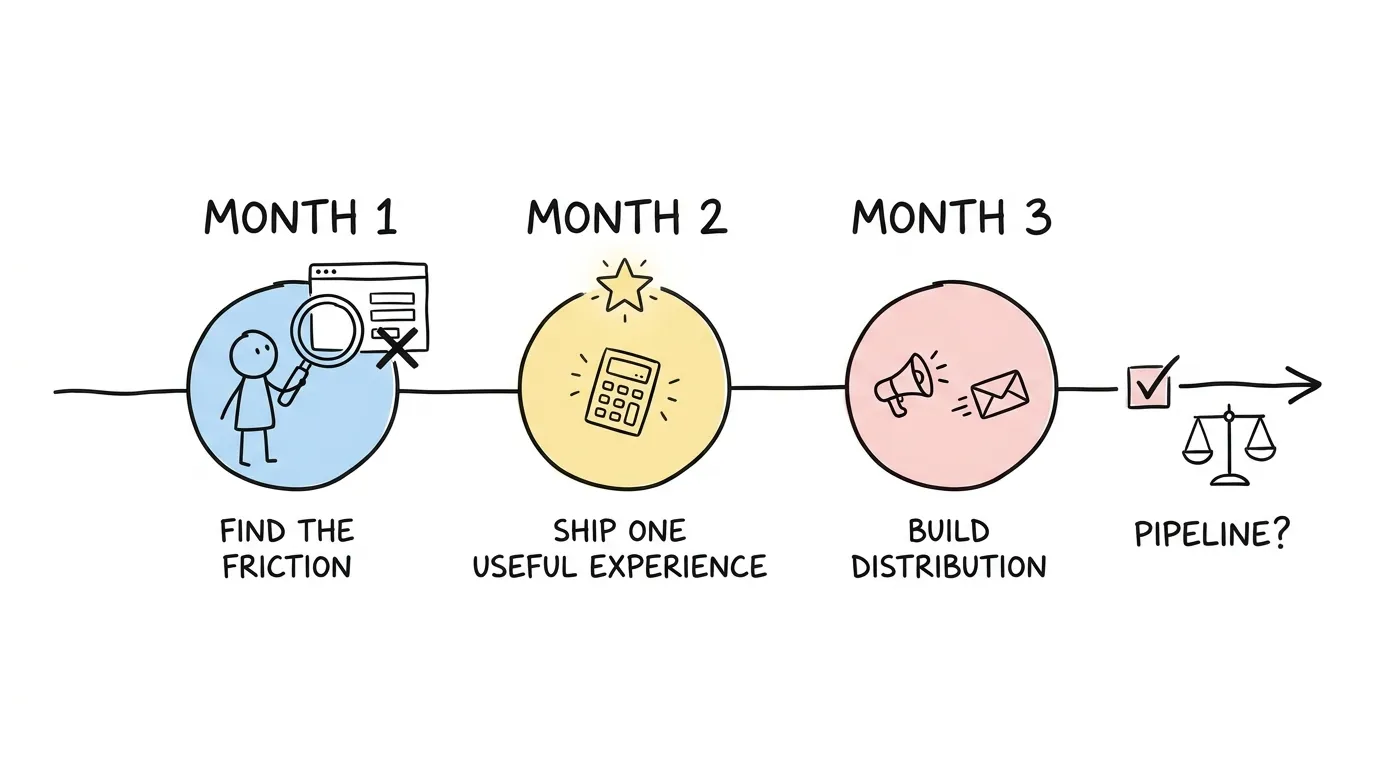
Then look at the results honestly. What generated qualified engagement and pipeline, and what only generated clicks? Double down on what works. Cut what doesn't.
Finally
That day, after tea, the first thing my friend did back at the office was cut next month's content calendar in half.
In B2B marketing, you don't win by publishing the most. You win when buyers trust you — enough to decide faster.
Here's to becoming the one buyers choose to trust.
Continue reading
Related articles

It's 2026: Stop "Buying" AI Tools for Your Marketing Team — Start "Hiring" AI Agents
This learn article explains how AI agents differ from standalone AI tools in marketing, outlines three agent categories — build-your-own platforms, CRM-native agents, and vertical tools — and covers use cases across SEO, social media, advertising, and reporting, plus criteria for choosing one.

What Is GEO? How Your Brand Gets "Mentioned" in the Age of AI Search
An explainer on GEO (Generative Engine Optimization) for e-commerce and DTC brands: how it differs from SEO and AEO, why AI answers shape brand visibility, and eight practices covering question-focused content, consistent brand messaging, structured pages, external evidence, comparisons, and AI mention tracking.

AI Is Already Making Decisions for Your Customers. Are You on the List?
A learn article explains GEO (Generative Engine Optimization): why AI-generated answers now shape which brands customers see, and how SEO fundamentals, entity clarity, citable evidence, and monthly measurement affect visibility in AI answers.