
91% of Marketers Are Using AI — and Half of Consumers Want to Hide From It
A data roundup on AI adoption in marketing: high marketer usage and platform-driven ad gains contrast with consumer aversion, inconsistent ad performance, disclosure demands, and new AI regulations.
A while back, I put two reports side by side on my desk and stared at them for a long time.
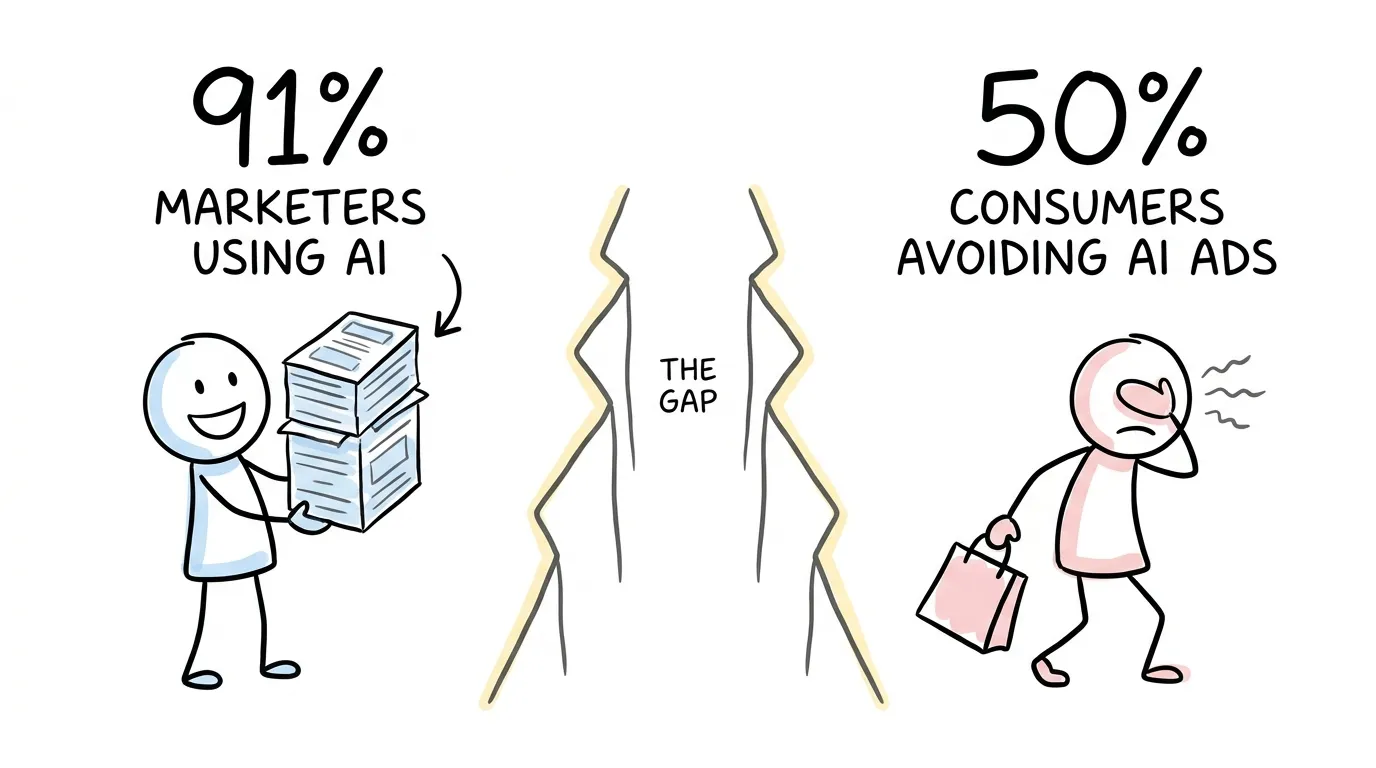
The first was The State of AI in Marketing 2026, released by Jasper in January 2026: 91% of marketers are already actively using AI at work. A year ago, that number was 63%.
The second was a Gartner survey from March 2026: half of U.S. consumers say that if a brand's messaging, ads, and content were made with generative AI, they would rather spend their money with a brand that doesn't use AI.
91% — and 50%.
On one side, nearly everyone has gotten on board. On the other, half are looking to get off.
So how do you work in this industry at all? This is how. That gap is where all the drama in marketing lives right now.
Everyone's Tasting. Few Are Eating.
What does "AI adoption" mean?
Adoption means everyone has touched it. But touching it and truly letting go and using it are separated by a canyon.
The CMO Survey's April 2026 report has a number I especially love: generative AI's share of marketing activities went from 7% in 2024 to 22.4% in 2026.
Two years. Triple.
Eurostat's December 2025 business survey points in the same direction: among EU companies using AI, 34.7% apply it to marketing and sales — the number-one use case, ahead of finance and security.
See? Even in manufacturing, the most pragmatic industry of all, AI's top use case is marketing.
But.
SmarterX's survey of more than 2,100 practitioners from the same period shows the other side: only 25% of organizations have reached the scaling stage, 47% are still piloting, and 28% are still stuck at "figuring out what it is."
Put bluntly: everyone bought the knife. Not many dare to take it into the kitchen.
The real state of AI in the marketing department: everyone's tasting, few are eating.
Where Does the Money Go? Mostly Into Speeding Up the Old Work
What about budgets?
IAB and BWG Strategy's State of Data 2026 (February 2026) put a number on it: better AI-powered measurement could unlock $32 billion over the next year or two — $26 billion in media spend saved and $6 billion in productivity.
Thirty-two billion. Whoa.
But flip over to Adobe's AI and Digital Trends (February 2026): 89% of organizations have the cloud infrastructure in place to support generative AI; when it comes to AI agents, only 51% do.
The money for knives got spent far more freely than the money for kitchens.
Why? The CMO Survey wrote the answer into its barrier list: number one is insufficient budget, at 20.1%; next come systems and talent integration.
Most companies' real plan is to do the old work a little faster — not to invent a new kind of work.
The Platform Does the Work for You. Do You Dare Let It Negotiate?
On the advertising side, the change is even more dramatic.
On its Q2 2026 earnings call, Meta said its new ad ranking model lifted Facebook ad clicks by 8.3% and conversions by 15.7%. On the same stage, Alphabet announced that advertisers using AI-driven search ad products like AI Max and Performance Max get 15% more conversions on average with return on ad spend roughly unchanged — and AI Max already has more than 500,000 advertisers.
The platform now handles audience selection, placement, even the creative. The advertiser just brings a goal and a budget.
So what work is left for media buyers? IAB's January 2026 Outlook Study asked in fine detail: among known buyers, 93% would let AI agents do performance analysis, 91% would let them run creative testing, and 82% would let them allocate budgets.
At which step do the willing suddenly thin out?
Executing and negotiating programmatic deals. Only 57%.
The unspoken message of the remaining 43%: you crunch the numbers; I sign the deal.
Does It Actually Work? Half Ice, Half Fire
So are AI-made ads any good?
Research gives two answers pointing in opposite directions.
In a field experiment published in the International Journal of Research in Marketing in March 2025, researchers Hartmann, Exner, and Domdey ran tests across more than 173,000 impressions: AI-generated banner ads had click-through rates up to 50% higher than professional stock photography.
But Kantar's March 2026 ad-testing database says: ads made with generative AI score, on average, at the 54th percentile; ads made without AI score at the 65th.
In other words, the average AI ad tests worse than the average human ad — but when it hits, it outperforms everyone.
It's not that it can't deliver. It's that its performance is inconsistent.
The budget saved is real. So is the risk of a flop.
On the Consumer Side, the Water Is Deeper Than You Think
Back to the two numbers at the top. Why are consumers hiding?
IAB and Sonata Insights' January 2026 research drew this as a gap that keeps widening: between advertisers' optimism about AI ads and consumers' aversion to them, the distance was 32 percentage points in 2024 and 37 percentage points in 2026.
Advertisers get more excited; consumers get colder. That gap will only keep widening.
The older, the more forgiving? Quite the opposite — the younger, the more averse. Among the same group of Gen Z and millennials, 39% of Gen Z are averse to AI ads, nearly double the millennials' 20%. Gartner's June 2026 survey puts it more bluntly: 49% of U.S. consumers believe generative AI has made existing content worse — among Gen Z and millennials, that number is 57%.
The backdrop is ugly too. By June 2026, NewsGuard's AI Tracking Center had identified 3,749 AI content farms spanning 16 languages.
And Adobe's March 2026 consumer report twists the knife: one in three consumers says that once they discover a brand's content is AI-generated, they stop engaging with that brand altogether.
See that? This is no longer just a matter of likes and dislikes. It's real money walking out the door.
The Disclosure Paradox: Labels Don't Drive Customers Away — Hiding Does
So what do you do? Hide it?
The data says hiding is the most expensive option.
IAB's January 2026 survey found: among advertisers using generative AI in ads, 89% disclose at least sometimes — but fewer than half disclose every time.
Meanwhile, in that same survey, 73% of Gen Z and millennial consumers said that knowing an ad was made by AI would make their willingness to buy go up — or at least stay unchanged. And the basic demand that "fully AI-made content should carry a label" is something more than half of consumers want.
Sit with that structure for a moment: consumers want a label, and advertisers are afraid to give it.
The cost of hiding is always more expensive than the label.
One more detail from Adobe's February 2026 report is worth copying down by every company building AI customer service or AI agents: what did organizations themselves rank as the number-one trust builder? Clearly disclosing that the user is talking to an AI (68%). Number two: being able to reach a human at any time (61%).
Get the truth out first; talk about intelligence second.
The Rules Have Landed — and So Has the Tuition Bill
If you still want to wait and see, the law isn't waiting.
The EU's AI Act is already in force: violating transparency obligations costs up to €15 million or 3% of global annual turnover, whichever is higher. China's measures on labeling AI-generated synthetic content took effect on September 1, 2025, requiring both explicit and implicit labels. New York State requires ads to disclose synthetic actors: $1,000 for a first violation, $5,000 for each repeat. The U.S. FTC moved even earlier, launching Operation AI Comply in September 2024 and taking action against five companies in its first round, including a tool that mass-produced fake reviews with AI.
Regulation has upgraded "handle AI with care" from a reputational matter to a legal one.
So are teams ready? SmarterX's May 2026 survey: of the four AI governance basics — a roadmap, an AI council, a generative AI policy, an ethics policy — only 13% of organizations have all of them.
And 32% have none.
On one side, massive fines. On the other, a third of companies that haven't written a single document. That gap alone is enough compliance business for years to come.
ROI: Productivity Is Up, but Fewer Can Prove It
Time for the final reckoning.
In the CMO Survey's April 2026 report, the numbers marketers credit to AI all look good: sales productivity up 14.1%, a big step beyond 2025's 8.6%; customer satisfaction up 10.8%; indirect marketing costs down 14.6%. McKinsey's The State of AI (August 2026) confirms it: the biggest revenue gains are being credited to marketing and sales.
But Jasper's report from the same period holds a number like a bucket of cold water: only 41% of marketers can prove their AI investment is paying off — down from 49% a year earlier.
More work gets done, and the books get murkier.
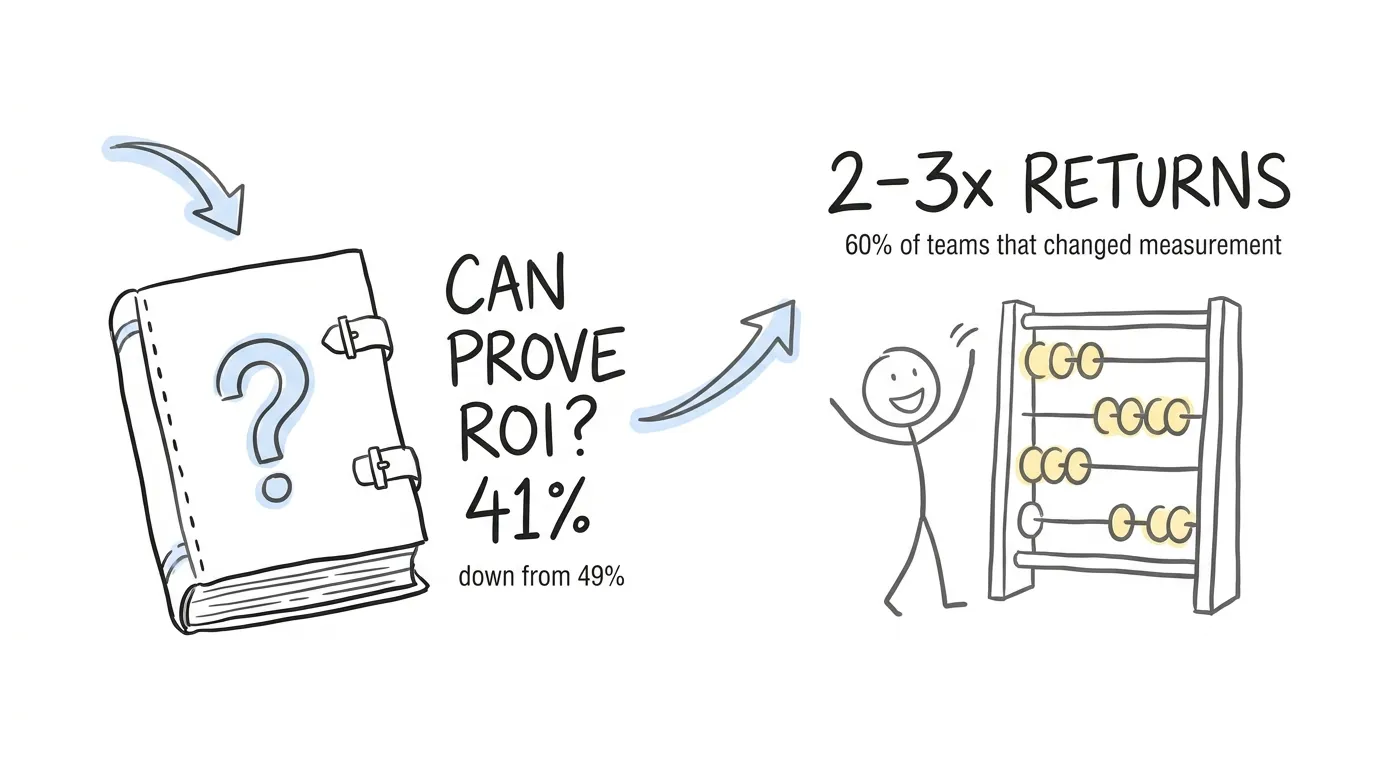
The solution is the interesting part: Jasper found another data point — among marketing teams that have changed how they measure AI, 60% are getting returns of 2 to 3 times or more.
It's not that AI won't make you money. It's that you haven't given it an abacus yet.
As for "will AI cut marketing jobs?" McKinsey's tracking data says only about half as many companies as predicted a year ago actually report cutting marketing and sales headcount over AI. The U.S. Bureau of Labor Statistics is more direct: from 2025 to 2035, employment for advertising, promotions, and marketing managers is projected to grow 6%, faster than average.
Jobs will change shape. They'll disappear slower than the talk suggests.
Back to That Desk
Remember the two reports at the beginning?
91% of marketers are using AI. 50% of consumers want to avoid it.
The question "should we use AI?" has already been answered. The real question in this industry now is a different one — and much harder:
When half your customers frown at AI, how do you use AI in a way that captures that 15% conversion lift without losing that half?
The data has already given half the answer: test boldly, give the books an abacus, keep the deal-signing in human hands, and wear the label proudly.
And may you be the one who sticks that label on first.
Continue reading
Related articles

It's 2026: Stop "Buying" AI Tools for Your Marketing Team — Start "Hiring" AI Agents
This learn article explains how AI agents differ from standalone AI tools in marketing, outlines three agent categories — build-your-own platforms, CRM-native agents, and vertical tools — and covers use cases across SEO, social media, advertising, and reporting, plus criteria for choosing one.

Did the Money You Spent on AI Marketing Ever Come Back?
A guide to measuring AI marketing ROI across three layers: ad reports, sales pipeline, and the financial ledger. Covers metrics such as ROAS and CPA, eight dashboard metrics, industry benchmarks, and common measurement mistakes.

How to Pick a Creative Automation Platform: First, Figure Out What These Eleven Actually Do
A learn article sorts eleven creative automation platforms — including Bannerflow, Celtra, Smartly.io, and Storyteq — into four functional groups and proposes five evaluation questions covering publishing reach, automation depth, ease of adoption, team fit, and verifiable evidence.