
AI Marketing Daily · 2026-11-16
AI Marketing Daily for 2026-11-16 covering AI agent governance gaps, Google adding links to AI answers, TikTok ad network expansion, Meta ad system updates, GEO guidance, and the EU Digital Fairness Act.
Governance is today's throughline. Three studies delivered the same cold water from different directions: AI tools are up and running, but nobody can do the math on them. Meanwhile, Google is — unusually — adding links to AI answers, Target has opened its store inside ChatGPT, and the rules of distribution are switching tracks at speed. A new EU bill pushes disclosure and design liability onto brands, with fines scaled to global revenue. The lead story explains how this governance vacuum came to be.
🎯 Top Story
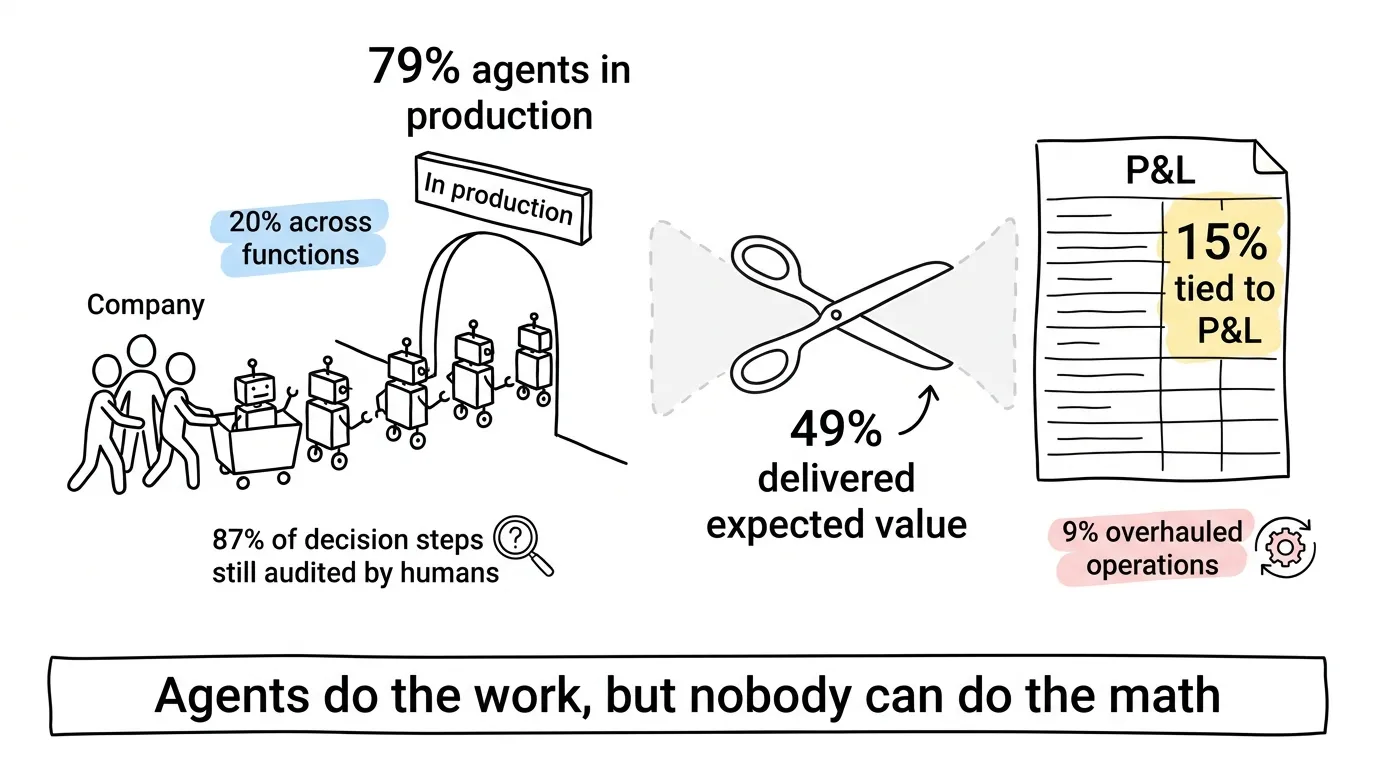
Genpact survey, dissected: 79% of enterprises run AI agents in production — only 15% have tied them to the P&L
On November 12, Genpact released its research report Autonomy in Practice, covering 17 industries and more than 2,000 enterprise executives, with respondent companies ranging from $1 billion to over $50 billion in annual revenue. The numbers, laid out: 79% of enterprises already have AI agents in production and 20% use them broadly across functions, but only 15% have fully tied AI investment to P&L outcomes, and 9% have completed a substantive overhaul of their operating model. Of AI projects initiated in the past 24 months, an average of just 49% delivered their expected value. Another contrast worth remembering: decisions led or fully executed by AI now account for 40%, double year over year, yet at least 87% of every decision step still involves human decision-making or audit. And 92% of enterprises with agents in production haven't cut jobs — headcount is flat or growing.
The same day was dense with news. HubSpot announced co-founder Brian Halligan returning as CEO to lead what it calls a refounding, and Adobe's Karen Burgess takes over as CFO on February 11, 2027, with the company flagging explicit change risk to pricing, packaging, and GTM. Scrunch launched two products at Sitecore Symposium: Citation Optimization and Imposter Detection. Basis and Cision each shipped an MCP server the same day, giving external Claude or ChatGPT agents write access to DSPs and media-intelligence systems. Flow Digital's survey twisted the knife: of organizations that asked for AI automation, only 22% have actually reached deployment or active build.
Why this set of numbers matters. The gap shows agents are already doing the work — but where the costs were saved and how much came back, most companies can't name the line item. An editor at The Agile Brand Guide ran the math: a six-person media planning team produces 40 plans a month, 10 hours each, at a fully loaded $90 an hour — $36,000 a month. With agents delivering Basis's claimed 50% efficiency gain, that frees 200 hours worth $18,000, yet nothing shows up on the P&L until the CMO decides what those hours are for. Of the three options, keeping headcount and running more tests means waiting for a ROAS change before you can validate anything; pulling the $15,000-a-month outsourced trading desk in-house is the only option that hits the P&L next quarter; and the third path is handing the 40 saved hours to senior planners to review, line by line, the DSP line items agents create.
For marketers, the impact lands in the 2027 budget season. The question CFOs ask next isn't whether you use AI — it's where the AI money went, how much it saved, and who signed off. MCP write access is the new governance vacuum: when agents initiate campaign changes, the approval workflow becomes the open question, and neither vendor's launch materials mentioned approval controls. Scrunch's research adds another layer of risk: 17% of Fortune 500 companies have found impersonator sites of their own cited in AI answers, and three-quarters of the time AI presented the fake site as the official source. ScrunchLabs data also shows more than 40% of AI sessions run start to finish with no open web search and no clicks; for traditional search that figure is 21.5%. Zero-click is getting worse in the assistant era.
As for what to do, the editors offered a five-item action list; three highlights here. First, by the end of Q1 2027, pick one agent and give it a P&L line item — choose the one where saved hours directly replace external cost, like that outsourced trading desk above. Second, before any MCP write access connects to campaign systems, stand up human approval gates; don't let agents change line items directly. Third, run your brand's most important prompts through the major AI assistants, check for impersonator sites, and route anything you find to legal for takedown notices. The list holds two more: set GEO (generative engine optimization) citation-share targets for the PR team, and teams with HubSpot renewals in H1 2027 should revisit contract terms early.
My take: Genpact sells agent operations services, so this survey is self-reported figures — discount the numbers. But the direction corroborates Gartner's 13% CIO finding; the gap is real. The essence here is managing agents like vendors: set the P&L line item, set the approver, set the kill conditions. All three in place, that's deployment; miss one, it's an experiment. Look back a year from now, and the budgets going to that 15% won't be in the same order of magnitude as the other 85%.
🔗 Further reading: Read the full article
🏷 LLM Watch
Gartner pours cold water on AI: only 13% of 2,002 CIOs think it's worth the price of admission
Governance is likewise the throughline of the Agile Brand Guide's November 7 roundup. Optimum7 relays Gartner's 2027 CIO Agenda survey — 2,002 CIOs, fielded May through July 2026: only 13% believe the enterprise has gained significant or transformative value from AI, the AI use-case success rate is roughly one in five, 31% have a rule that pilots don't go to production, 17% have a rule for sunsetting low-value AI, and 4% have begun redesigning roles around a new human-machine division of labor. CIOs with a stop rule are 2.3x more likely to land in the vanguard group. At ZERO-IN 2026, ChurnZero launched Agentic Essentials, bundling 20-plus ready-to-run agents into a subscription, and brought its own survey along: 63% of customer success leaders lack a consistent standard for measuring AI's impact, and teams like that are 4x more likely to demand manual approval of every AI recommendation. Hyperstar, a Seoul-based company, launched an agent that ranks creators by attributed sales, hooked into order data from 8 channels and a library of 10 million creators; in its case study, an account with 235,000 followers drove 35x the sales of one with 797,000. 5W PR used Profound to measure itself across 396 unbranded prompts and 140,000 executions, finding itself named 30.3% of the time — which it concedes is a ceiling.
💬 Write the baseline and the stop rule before launch, or decision-making defaults to whatever the vendor configured. The holiday-email example in the piece is worth copying outright: log last quarter's revenue per thousand emails and the unsubscribe rate, then set the rule — two straight weeks below baseline by 10% and you revert to manual. Doable this week, at zero cost.
🔗 Further reading: Read the full article
Hightouch breaks marketing agents into three types: agents will commoditize, the data foundation won't
Hightouch sorts marketing AI agents into three types: Lifecycle agents run journey orchestration, using real-time behavioral data to decide the next action; Growth agents handle budget allocation, bidding, and cross-platform ad generation; Creative agents handle content generation and long-form content reuse. Its argument: the agents themselves are commoditizing, and the durable advantage sits in the data and brand context agents depend on. The diagnosis of the status quo stings: customer data is scattered across ESP, analytics, orders, and CRM — four systems — so the agent sees four versions of the same customer; brand knowledge lives in Slack, Notion, and static PDFs, so output at scale goes off the rails. The third-party data it cites backs up the shortfall: Cisco says 85% of organizations have some degree of agent adoption but only 5% have reached large-scale production; Gartner predicts 40% of enterprise apps will embed task-specific agents by the end of 2026; and in PwC's accounting, 20% of enterprises capture 74% of AI ROI. Governance recommendations include content review checkpoints, re-engagement frequency caps, channel exclusions, and budget ceilings, with brand safety measured by off-brand flag rate and override rate.
💬 Don't rush to buy agents. Consolidate customer data into a single view first, or your agent will be making million-dollar decisions on incomplete information. Sequence: pick one high-volume workflow with clear rules to pilot, record the current conversion rate and cost per lead as a baseline before launch — only then can you say how much you saved.
🔗 Further reading: Read the full article
🏷 Product Launches
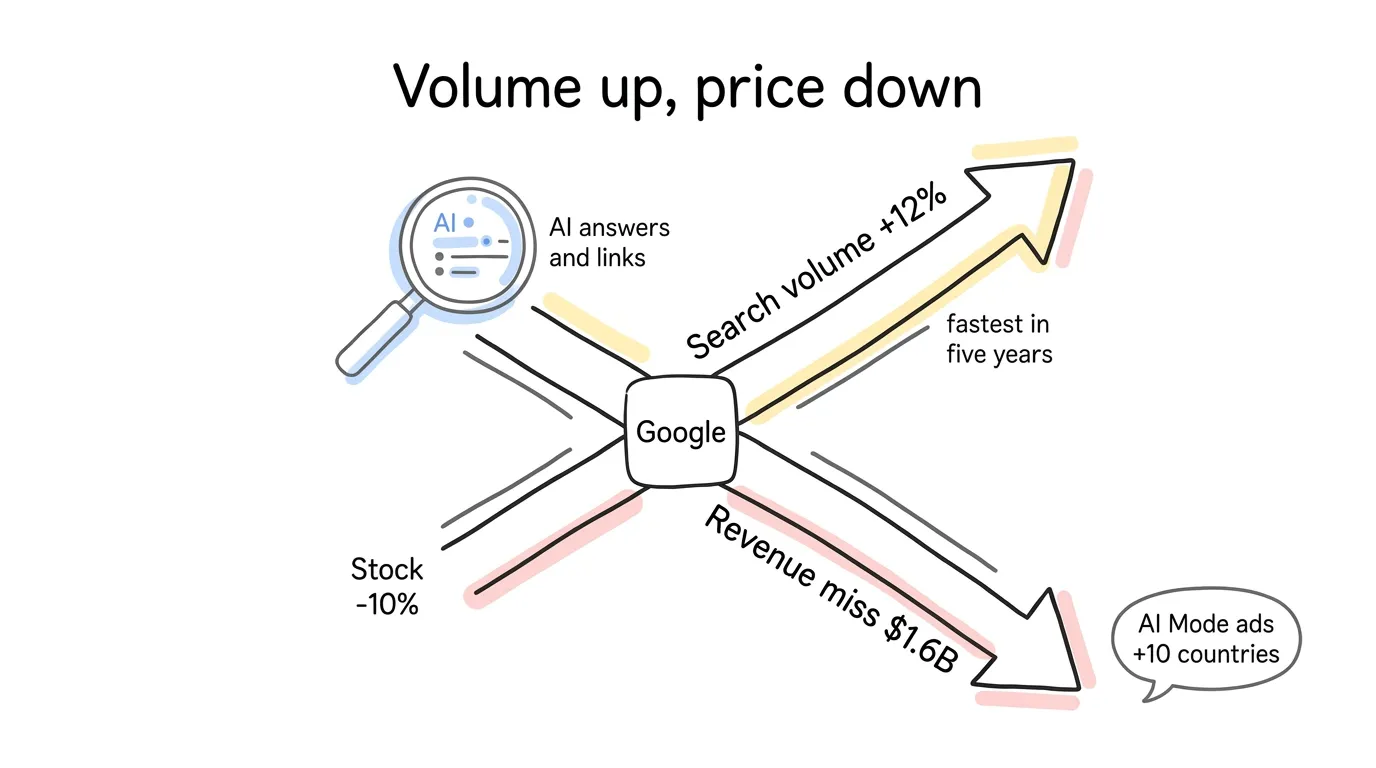
Google, unusually, adds links to AI answers — and Alphabet's earnings reveal volume up, price down
In independent SEO consultant Leanne Wong's November roundup, Google's moves mark an uncharacteristic pivot: AI Mode and AI Overviews now carry more clickable links, placed higher; official sites get dedicated display slots; and news carousels and related-article links are both expanding. AI Overview citation-card summaries are now generated by Google AI rather than excerpted from the source — publishers don't control that copy, and the best they can do is structure pages clearly and write opening paragraphs as answer sentences that can be summarized accurately. AI Mode's citation sidebar is testing a Source preferences button that lets users add a site to their preferred sources on the spot. Alphabet's Q3 earnings supply the backdrop: search volume up 12% year over year — the fastest in five years — yet revenue came in roughly $1.6 billion below expectations and the stock fell about 10%; the US has begun testing multi-turn conversational ads, with sponsored content updating dynamically through the conversation. AI Mode ads are expanding to 10 new countries including India, Canada, Australia, and Singapore, with the UK, Brazil, and Mexico to follow later this quarter. Bing Webmaster Tools launched a Topics Portfolio beta showing how a site gets cited in AI answers by topic cluster, with two metrics: Topic Size and Sites Cited.
💬 Two things this week: deploy the Preferred Source component on your site, and rewrite the opening paragraphs of your priority pages as direct-answer sentences. Bank the earnings numbers as ammunition for GEO budget negotiations — volume up, price down means Google will push ads into AI answers more aggressively, and early positioning captures the upside.
🔗 Further reading: Read the full article
TikTok ads go off-platform: inventory across 400,000 apps opens up, and agents can run campaigns via Claude
At Advertising Week New York, TikTok announced two structural moves. First, TikTok Ad Network opens to US advertisers, extending delivery beyond the TikTok app across a premium network of nearly 400,000 apps worldwide, fully integrated into TikTok Ads Manager with brand safety and placement controls — competing directly with Google Ad Manager and mobile ad networks for inventory. Second, its advertiser MCP tool has been upgraded into a cross-platform connector that plugs into Claude, Kimi, Manus, Perplexity, Replit, Snowflake, and the IAB Tech Lab's Agent Registry, letting third-party AI agents plan, launch, and manage TikTok campaigns directly; officially, advertiser usage of MCP to activate and manage campaigns grew more than 200% from July to September, with Wayfair Canada's growth marketing lead publicly endorsing it. The commerce suite landed in parallel: Buy Direct checks out in-feed; Shopping Assistant handles conversational shopping; Agentic Leads generates leads automatically in DMs and on the website; Smart+ extends to search ads; and GMV Max's automated bidding now factors in real costs like affiliate commissions, coupons, and referral fees.
💬 Media buying teams, watch two things. Test TTAN's off-platform inventory with a small budget first, and only talk about scaling up once the data transparency proves acceptable. On the MCP line, set approval rules in advance — when agents can change campaigns directly, don't wait for something to break before deciding who signs off.
🔗 Further reading: Read the full article
Meta's ad delivery is now an AI-run auction: a teardown of the Andromeda + GEM dual engine
hawky.ai lays out Meta's 2026 ad system as five major changes, each tagged with its original source. Advantage+ is now the default for Sales, App, and Leads, with the manual and AI creation flows merged early in the year. Delivery runs on a dual engine: the retrieval engine Andromeda runs on NVIDIA Grace Hopper, with model complexity roughly 10,000x the previous generation, adding 6% to retrieval and 8% to ad quality; the ranking model GEM lifts Instagram conversions 5% and Facebook Feed 3%, converting data and compute into performance about 4x more efficiently than before. The generative creative suite includes image-to-video, AI soundtracks, AI voiceover, virtual try-on, and Brand Memory, the last trained on the brand's own ad library. Attribution is shifting to incremental attribution — holdout testing plus machine learning to estimate true lift — which makes the Conversions API a de facto requirement. Targeting is being de-emphasized: Advantage+ Audience is the default, interests and demographics are demoted to suggestions, and placement plus minimum age are the only hard constraints left. Meta's goal is stated in the open: by year-end, go from a product photo plus a budget to a fully automated ad.
💬 The media team's job has shifted from tweaking targeting to feeding creative: enough differentiated assets, plus clean conversion signals, plus clear KPIs. Tear down legacy manual campaign structures early, or you're bidding for volume against already-adapted accounts. If CAPI isn't connected yet, connect it this week.
🔗 Further reading: Read the full article
Meta's October change list: one default change requires you to actively opt out
KoderXpert walked through Meta's October product and policy moves changelog-style. AI Business Assistant in Ads Manager has launched creative insights and cross-quarter memory, with campaign edit actions still tagged coming soon; officially, following its recommendations adds 5% conversions, but no measurement methodology was given. Advantage+ creative's static-image-to-video is now fully rolled out — catalog merchants can generate product videos from product photos. On the brand side, there's a new Ads Super Burst for 3-to-24-hour guaranteed-delivery scheduling; First Impression Ads gives one brand the top-of-feed ad each day in the US, in testing; and Reels Trending Ads are fully rolled out. Customer Lifecycle Strategy is fully available — note that by default it reaches both new and existing customers. From October 28, product browsing is on by default for existing ads; about 117,700 advertisers tested it in August, averaging a 3% conversion lift, and opting out requires affirmative action. Policy dates cluster around October 27–30: the marketing API removal, the US political ads restricted period, and new commerce and self-serve ads terms taking effect — continued delivery counts as acceptance.
💬 Only one item demands immediate action: product browsing is on by default, so advertisers who depend on landing pages and forms should audit their existing ads now. Copy the three compliance dates into your calendar — auto-effective terms are the easiest thing to overlook, and by the time you notice, you've already accepted.
🔗 Further reading: Read the full article
Meta's November updates at a glance: catalog products meet short-form video (signal item, thinly sourced)
Amit Kumar Yadav, a Meta ads practitioner, rounded up five updates in an early-November Reel: AI Creative Tools supports generating video assets directly from product photos; Reel Product Discovery brings a new discovery experience for catalog products inside Reels ads; Advantage+ Catalog Ads adds support for Instagram Reels product videos; Creator Cheer pairs creator content with catalog ads; and the recommended holiday mix is Reels for discovery, Carousel for consideration, Stories for urgency. He also flagged that Meta's proposed new commerce terms remain on pause, and that AI-generated creative should get a human pass before publishing. This item comes from an individual practitioner's recap, with no official link or data source — treat it as a signal and wait for Meta's announcement to confirm the details.
💬 The holiday mix formula can go straight into your schedule at zero cost. Give AI assets a human review before launch to align with disclosure requirements. Update the playbook once official details are confirmed — don't budget off a Reel.
🔗 Further reading: Read the full article
🏷 Marketing Tools
Buyers ask AI before they ever reach your site: B2B content must now serve two readers — humans and models
LeadWalnut's B2B content playbook builds its case on data. G2's 2026 data shows 51% of B2B software buyers now treat AI chatbots as a more common research starting point than Google, and 69% have walked away from a vendor they'd already chosen because of a chatbot's recommendation. Forrester puts 94% of enterprise buyers using AI somewhere in the purchase process. Ahrefs measured that when an AI Overview appears, the #1-ranked page's click-through rate drops 58% — ranking no longer guarantees visits. In CMI's survey, 95% of B2B organizations use AI applications; among marketers using AI for content, 87% report production gains but only 39% report improved content performance. The fix starts with admitting the audience has changed: swap whole-page ranking thinking for passages, tables, and definitions an AI can extract wholesale; build topic clusters around prompts and their fan-out sub-questions; and plant seeds where LLMs read — Reddit, YouTube, LinkedIn, and review sites — rather than only tending your own blog. Measurement moves from sessions and MQLs to pipeline impact plus AI share of voice. The line in the piece worth taping above your desk: models will summarize a generic page, but they only cite specific ones.
💬 The production windfall is spent; editorial standards are now the dividing line. Next sprint, pick three flagship articles and retrofit them for extractability — first sentence of every section answers directly, and add first-party data. Citations from AI belong on the content team's new KPI list.
🔗 Further reading: Read the full article
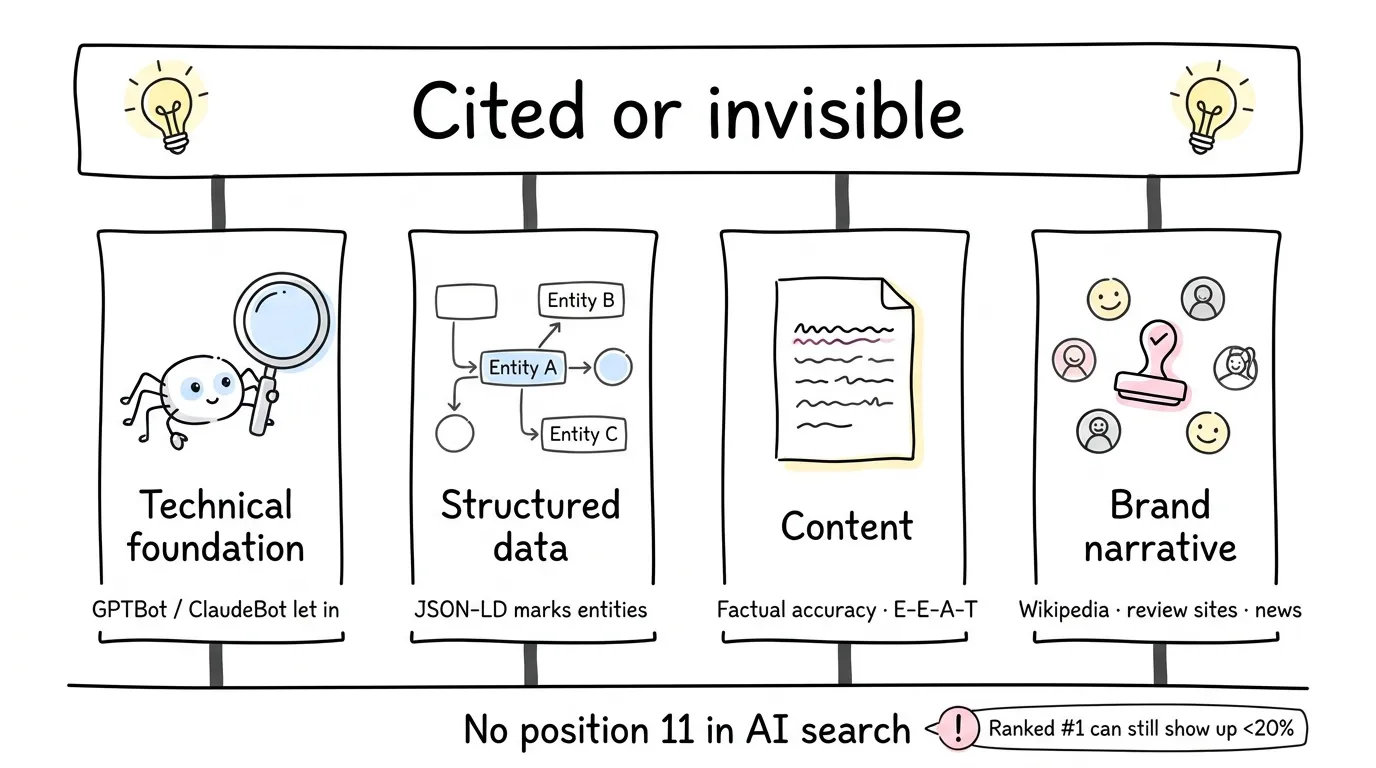
Deloitte erects four pillars for GEO — and warns that ranking #1 doesn't guarantee a citation
Deloitte Switzerland frames GEO as a zero-sum game of cited or invisible: in AI search there is no position 11, and answers typically cite only two or three brands. The data points are all here: 40% of consumers start their searches with AI tools; 30% of Google searches display AI Overviews; AI search visitors convert 4.4x better than organic visitors; and AI search's economic value is projected to overtake traditional organic search by 2028. The methodology rests on four pillars: a technical foundation that lets crawlers like GPTBot and ClaudeBot in; structured data, with JSON-LD marking up entities and relationships; on the content side, factual accuracy, clear structure, and E-E-A-T; and brand narrative, covering consistency across third-party ecosystems like Wikipedia, review sites, and news. Deloitte's own testing produced one eye-catching finding: a brand ranking #1 on Google may appear in fewer than 20% of AI answers for the same query; roughly 7% of AI answers in its evaluation sample contained false information, and price-comparison sites often get cited instead of the brand's own site. It closes by offering the AI Visibility Index as a management KPI — five dimensions measuring mention rate, share of conversation, sentiment, whether you're the preferred recommendation, and narrative control.
💬 Lift the AVI's five dimensions straight into next quarter's metrics — easier than inventing your own standard. Set citation-share targets for the PR team; almost nobody owns the third-party-ecosystem pillar, so early movers get the cheap wins.
🔗 Further reading: Read the full article
AI referral traffic grew 10x in seven months — and your analytics can't see it
Adobe's enterprise blog positions AI search optimization as critical infrastructure, not a tactical add-on. First-party data: from July 2024 to February 2025, US generative-AI referral traffic grew more than 10x; AI-referred visitors view 12% more pages per session and bounce 23% less — high-intent commercial traffic. The article lays out three structural concepts: decide which content deserves exposure to AI and build governance around it; extractability, verifiability, and contextual clarity determine who wins the citation; and not every AI platform deserves content access — IP and brand presentation need protecting. Its most original warning is the attribution blind spot for agentic traffic: GPTBot and PerplexityBot fetch documents and make decisions on a user's behalf, traditional analytics either files it under Direct or misses it entirely, and optimization turns into guesswork. The new measurement stack swaps rankings and clicks for citation frequency, share of model, and AI referral traffic. The content engineering method includes modular writing — first sentence of each section answers directly — Schema structuring, and E-E-A-T as the inclusion bar.
💬 Have your analytics team check two things this week: which channel GPTBot and PerplexityBot traffic is currently booked under, and which AI crawlers your robots.txt lets through. Until the attribution blind spot is closed, hold off putting any AI-channel ROI conclusion into a deck.
🔗 Further reading: Read the full article
15 ad copy prompt templates: build compliance review into the generation step
PrompTessor's template set rests on a simple point: AI producing 30 headlines in 30 seconds doesn't mean any of them can run. The master prompt requires binding platform, placement, audience, objective, verified product facts, and a claimable offer; output must come with character counts and a claim verification checklist; fabricated discounts and testimonials are forbidden — compliance review sits inside the generation step, not as after-the-fact cleanup. Platform differences are spelled out concretely: Google RSA lives under strict character limits; Meta adapts length by placement; TikTok needs a full script where hook, visual action, message, and CTA are all non-negotiable; LinkedIn rewards professional, credible benefit expression. The 15 prompts cover search headlines, feed ads, short-video scripts, remarketing, B2B acquisition, and A/B testing. The pre-launch checklist bans invented statistics, customer testimonials, product capabilities, deadlines, and scarcity claims, and remarketing copy must not intrusively reference personal behavior. The A/B testing discipline comes down to one rule: compare different hypotheses, not dozens of near-identical headlines.
💬 Fill the verified product facts field into your own master prompt — configure once, reuse long-term, and it blocks most hallucinated copy. When testing, group outputs by hypothesis; the review hours saved will show immediately.
🔗 Further reading: Read the full article
🏷 Industry Data
AI overtakes ABM as B2B's top budget priority for the first time: 60.4% vs 44.7%
Demand Gen Report's 2026 benchmark report delivers the annual snapshot: 60.4% of B2B marketers plan to increase budgets for AI tools and platforms, with ABM — last year's leader — falling back to 44.7%; AI takes the top budget priority for the first time. Half of respondents are moving money into AI while cutting spend on the work AI already does faster. Content production is where penetration runs deepest: 70% use AI to draft and scale content, and 75% of organizations already have generative-AI content tools in the MarTech stack — the highest penetration of any category. 51% plan to test or deploy generative AI within the coming year, making it the hottest tactic on the 2026 roadmap. Depth of adoption is another matter: 35.9% use AI across multiple specific workflows, and full operational integration remains a minority pursuit. In the sample, 52.8% of enterprises are below $50 million in annual revenue, and software and tech companies make up 44.4%.
💬 Cite these numbers directly as benchmarks in your 2027 budget request. AI getting into the budget no longer needs arguing — what needs arguing is where it ranks in the buy order. The 35.9% line merits a self-check: fewer than four in ten teams run AI across multiple workflows. Which one is yours?
🔗 Further reading: Read the full article
Annual AI marketing awards announced: judges' taste shifts from generated content to predicted demand
The Internationalist announced the AI for Better Marketing 2026 winners on November 15. All three platinum winners run on the same paradigm, which the jury calls intent before intent: Samsung, entered by Starcom Taiwan, uses AI to spot demand early from unrelated shopping behavior, turning a conversion channel into a predictive intelligence system through its retail media network; Audi reads life signals in the Amazon ecosystem — moving house, changing jobs, starting a family — and reaches buyers before car-purchase intent becomes explicit; and after its merger, Taishin Bank turned the cultural value of diligence into a measurable signal. Among the gold winners, Cathay Pacific's AI Flight Secretary spots hesitation moments in the booking journey and assembles creative dynamically by traveler type, and Shell V-Power teamed up with Ferrari F1 on AI-personalized experiences. Silver went to Nestlé's MomLogic, which tracks new mothers' decision journeys, and Haleon's Stresstabs for virtual emotional companionship — both emphasizing humans in the loop. The newly created Creative Infrastructure special recognition went to Zuuvi, for brand consistency and creative governance.
💬 Use the three platinum cases as proposal templates: list the leading signals in your own category and find which behavior exposes purchase intent three months out. The case write-ups lack quantified results — benchmark the thinking, not the numbers.
🔗 Further reading: Read the full article
Nine predictions, mid-year check-in: 2026's throughline is polarization
Four Marketing Dive editors made nine predictions at the start of the year, and those calls are now entering the verification window. The main axis: AI sharpens polarization, with marketing services converging toward high-end custom work and plug-and-play AI while the middle layer gets squeezed. Each judgment can be checked one by one: Anomaly's chief AI officer predicted roughly 50% of Super Bowl ads would use generative AI in pre-production, though not necessarily visibly; the foundational restructuring of agency groups follows the Omnicom–IPG merger, with Publicis and LiveRamp allied on the data side; the keyword in data strategy has shifted from collection to connection — Celebrus's CEO says brands are playing checkers while data companies play chess; ad tech is loosening, with Xandr's shutdown benefiting Amazon DSP; Gen Alpha holds $28 billion in direct spending power; IAB predicts US creator ad spend up 18% as budgets sink toward smaller creators; and 2026 global ad revenue is projected up 8.8%, with tariffs forcing campaigns to be shorter and faster. Brands are also self-aware memeing AI slop, and experts remind everyone that consumers' lie detectors still work.
💬 Score the nine predictions against a checklist at year-end: the hits go into next year's planning, the misses into your judgment archive. The polarization call hits agency pricing most directly — mid-tier retainer models get squeezed first. Before renewal negotiations, be clear about which end you're on.
🔗 Further reading: Read the full article
Target's AI channel traffic grew 20x: the first at-scale sample of agentic commerce
Target disclosed that in Q1 2026 its AI channel traffic grew 2,000%, against roughly 400% for retail overall. It became the first mainstream retailer to let consumers shop entirely inside AI platforms, spanning AI Mode in Google Search and the Gemini app, ChatGPT, and Microsoft Copilot — users discover products, get recommendations, and add to cart in conversation, and can link a Target Circle membership account to check out. Underneath it all is the open Universal Commerce Protocol built with Google and others, giving AI agents a shared language for shopping; the brand's own site is no longer a mandatory stop on the transaction path. One piece of executive framing worth noting: AI only provides suggestions and recommendations, the purchase decision stays with the consumer throughout, and trust was the starting point of the design. The piece was published in August, so it isn't the freshest — but as a case study, it is the most operationally detailed one available.
💬 The priority ranking for product data structuring just moved up. First make sure product titles, specs, and inventory can be read cleanly by machines — then talk about which platform to connect. Cross-border and retail teams should put UCP on next year's tech evaluation list; don't wait for a competitor to connect first.
🔗 Further reading: Read the full article
99% of performance marketers would give the open web budget — provided agentic tools exist
Realize surveyed 200 senior performance marketers spending over $300,000 a month. 76% have seen meaningful performance gains from AI-driven platforms like Advantage+ and PMax — 29% significant, 47% moderate, and only 1% reporting no impact. The biggest gain is real-time CPA and ROAS optimization at 41%, far ahead of time saved at 14% and budget allocation at 11% — machines complete thousands of micro-optimizations at the instant a signal arrives — work a human team can only execute in daily installments. The budget picture: paid search 22%, paid social 21%, open web just 13%. Top spenders hit the saturation wall first — among those spending over $5 million a month, 70% say finding incremental channels is extremely important. The most striking demand signal: 99% of respondents say they would allocate budget to the open web if an agentic AI solution existed, expecting on average to move 24% there versus 13% today — a doubling. The obstacles, in order: too many vendors at 74%, no unified attribution at 71%, brand safety concerns at 54%.
💬 The surveyor sells open-web advertising itself, so discount the direction of the conclusion — but the 41% figure confirms real-time optimization as where agent value is actually won. Saturated teams should put the open web on the Q1 test list, starting the budget at 5%, and scale only after the attribution standard is set.
🔗 Further reading: Read the full article
Between Coke's flop and Heinz's comeback: AI ad disclosure strategy decides life or death
A VivaTech roundup uses two contrasting cases to lay out the pattern of AI-ad backlash. Coca-Cola's 2023 AI co-creation platform succeeded — user work made it onto Times Square and Piccadilly; its 2024 AI-remade Christmas ad triggered a backlash for replacing human artists. Heinz did the opposite: it made AI the selling point outright, and the draw ketchup prompt reliably produced images uncannily like its own bottle — making it a classic case that turned brand recognizability directly into revenue. Backdrop data: nearly half of consumers already use AI to search for products, discover brands, and shop; creative production has compressed from weeks to days and hours; and advertising has shifted from one creative aimed at a million people to a different version for every person. Adobe CEO Narayen proposed at VivaTech 2026 giving content nutrition-label-style metadata to disclose AI involvement, and Smartly's survey shows that when there's no disclosure, most consumers feel manipulated. The piece closes on three rules: pair human-machine collaboration with strong oversight, speed is the competitive advantage, and governance matters as much as innovation.
💬 Setting a disclosure rule for the brand costs far less than after-the-fact PR. Label AI involvement in tiers, and handle assisted generation and fully generated work separately. Heinz's path shows AI itself isn't the problem — hiding it is.
🔗 Further reading: Read the full article
🏷 Policy & Funding
EU Digital Fairness Act targets influencer marketing and AI design, with fines up to 6% of global revenue (paywalled, limited detail)
Per WSJ, the European Commission has put forward a draft Digital Fairness Act tightening online consumer protection rules. The bill names three targets: deceptive interface design — dark patterns; influencer marketing on social media; and AI-related applications, including addictive design. Penalties for violations run as high as 6% of a company's global annual turnover. The report was updated November 11, so this is this week's regulatory news. The original sits behind a paywall — the capture includes only the headline, lede, and penalty terms; details of the full bill will have to wait for publication.
💬 Teams selling into the EU market should pull three things for a self-audit: the interface design of conversion pages, the disclosure process for influencer partnerships, and the recommendation logic of AI personalization. The 6% fine basis is global revenue — it will sting more than the GDPR era did. Move compliance review up to Q1; don't wait for the first enforcement case to act.
🔗 Further reading: Read the full article
15.3% of budget spent on AI, but only 30% of CMOs feel ready
Veza Digital's B2B generative-AI governance guide stitches together its own version of the same disconnect: CMO Survey's spring edition shows AI involved in 24.2% of marketing activities, up from about 13% two years ago; in Gartner's accounting, an average 15.3% of budget flows to AI projects; 70% of CMOs list AI leadership as a priority; 73.9% of enterprises use AI to produce content — yet only 30% of CMOs rate their own AI readiness as mature. The conclusion: the bottleneck is the operating model, not the tools. The actionable framework it offers has two layers. Use cases sort into a four-quadrant grid of value and risk: research summaries and first drafts are low-risk, high-value — go first; content published under the brand's name, competitor statements, and customer-facing automation get mandatory human review; bulk homogeneous content trips Google's scaled content policy; and AI-fabricated reviews are off-limits. The operating model sets three roles: an owner who sets standards and the prompt library; a reviewer who runs three gates — before publish, before customer contact, before anything competitor-related; and a data owner who decides what data may enter the tools. Three compliance lines come with dates: the FTC's ban on AI-fake reviews, effective October 2024; EU AI Act Article 50 disclosure obligations, applicable since August 2, 2026; and Google's on-platform policy, in force since March 2024.
💬 The three roles can all be assigned this week at zero cost, and doing so cuts the approval queue roughly in half. 15.3% is an average, not a target — hidden costs like data preparation, training, and human review often exceed the subscription fee. Measure by campaign impact, not output volume.
🔗 Further reading: Read the full article
💡 The Big Picture
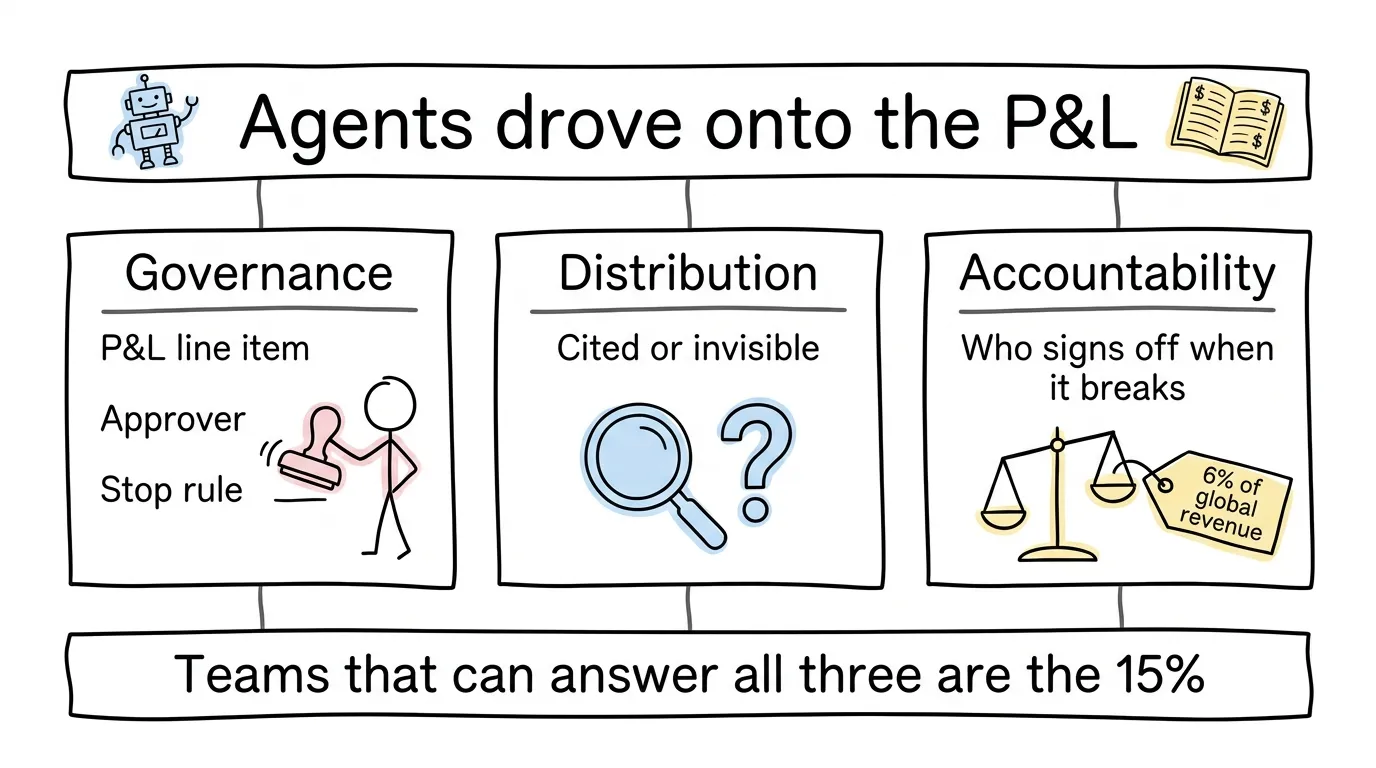
Read today's 20 items together and there's only one throughline: agents have driven out of the demo room and onto the P&L. Genpact says 79% of enterprises already run agents in production, but only 15% can do the math; on Gartner's side, 13% of CIOs think it's worth the price of admission; ChurnZero twists the knife — 63% of teams don't even have a measurement standard. Three sets of numbers point at the same thing from different directions: AI's first dividend wave — the saved-hours wave — has already been eaten, and the second wave belongs to the teams that close the governance gap: baseline written before launch, stop rule set before the incident, P&L line item in place before the budget.
The second thread is distribution rules switching tracks. Google is unusually adding links to AI answers even as Alphabet's earnings show volume up, price down; Deloitte and Adobe say the same thing from opposite ends — cited or invisible, no middle state; and Target's 20x AI channel traffic proves on-platform transactions can work. The SEO team's KPIs, the PR team's targets, the e-commerce team's data structures — all of it is being rewritten along this line.
The third thread is accountability tightening. The EU's 6% fine pushes disclosure and design liability onto brands, Meta's terms take effect automatically, and the FTC and EU AI Act dates have already passed. Next year's budget meetings will press exactly three questions: what did it earn you, what did it save you, and who signs off when something goes wrong. Of today's 20 items, the teams that can answer those three questions are the 15%.
Continue reading
Related articles
AI Marketing Daily · 2026-11-22
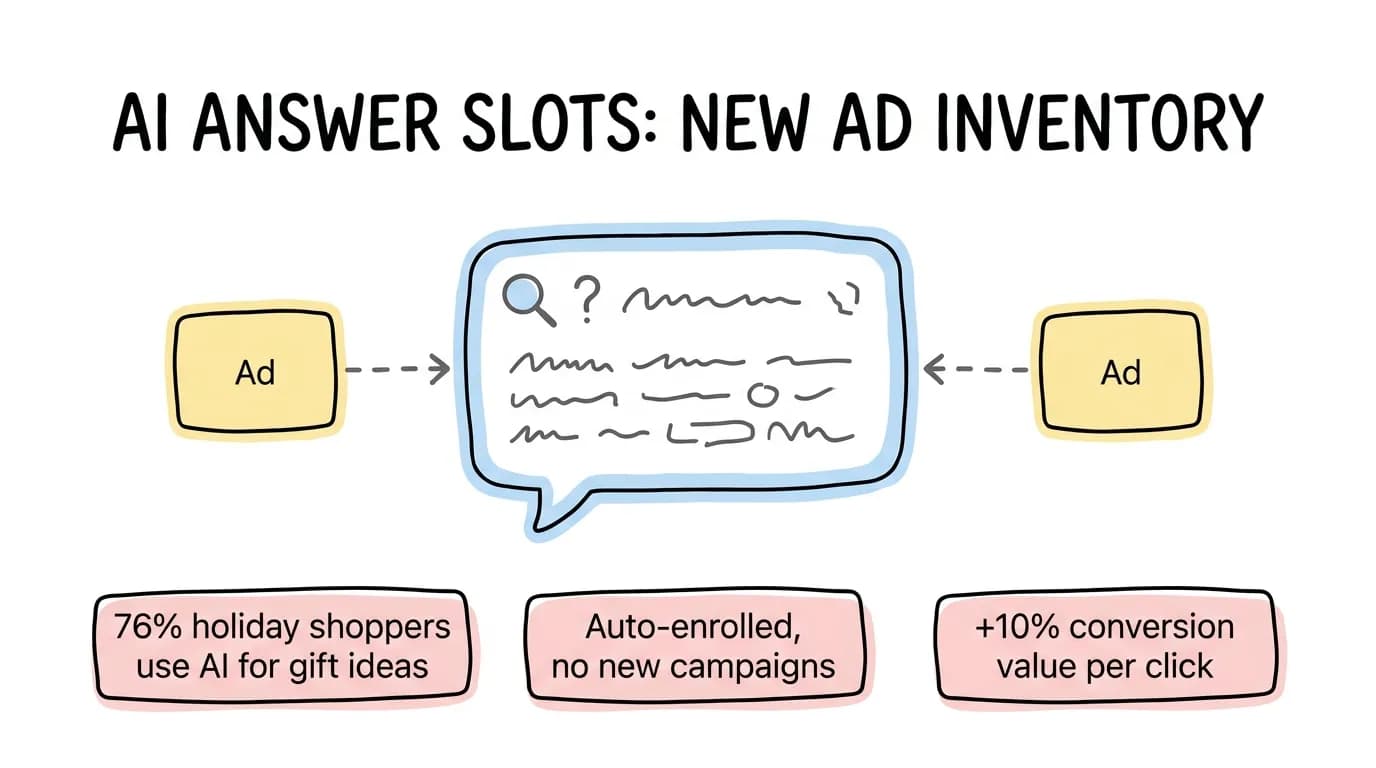
AI Marketing Daily for 2026-11-22 rounds up 20 items led by Microsoft opening Bing AI Overviews to ads and Google expanding AI Mode ads to ten countries, plus GEO guides, ad automation delegation guidance, AI Overviews CTR data, and a legal-risk checklist for AI-generated creative.
AI Marketing Daily · 2026-11-21
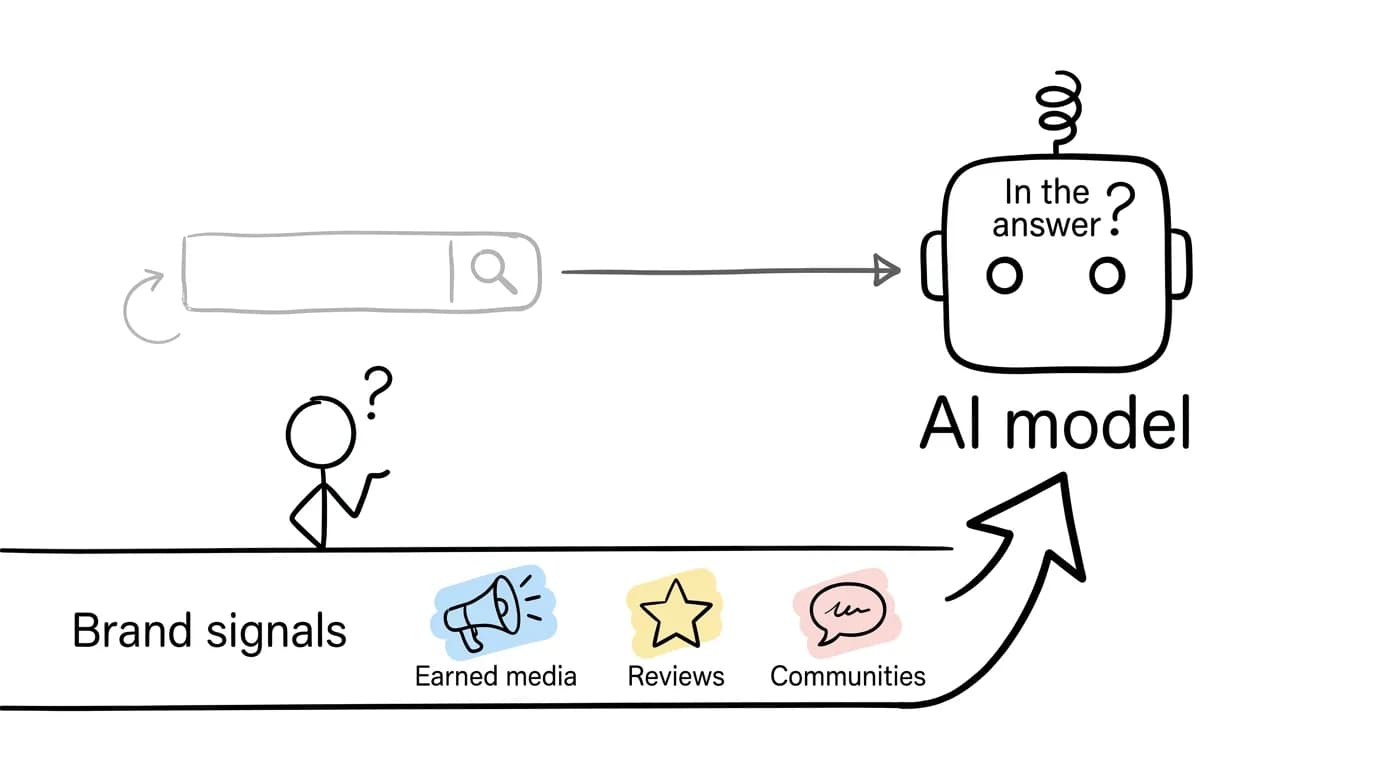
A November 21, 2026 AI-marketing daily covering AI search visibility, GEO methods, Google AI Mode ads expanding to ten countries, Meta's pre-Black Friday changes, agentic shopping, and industry adoption and ROI data.
AI Marketing Daily · 2026-11-20
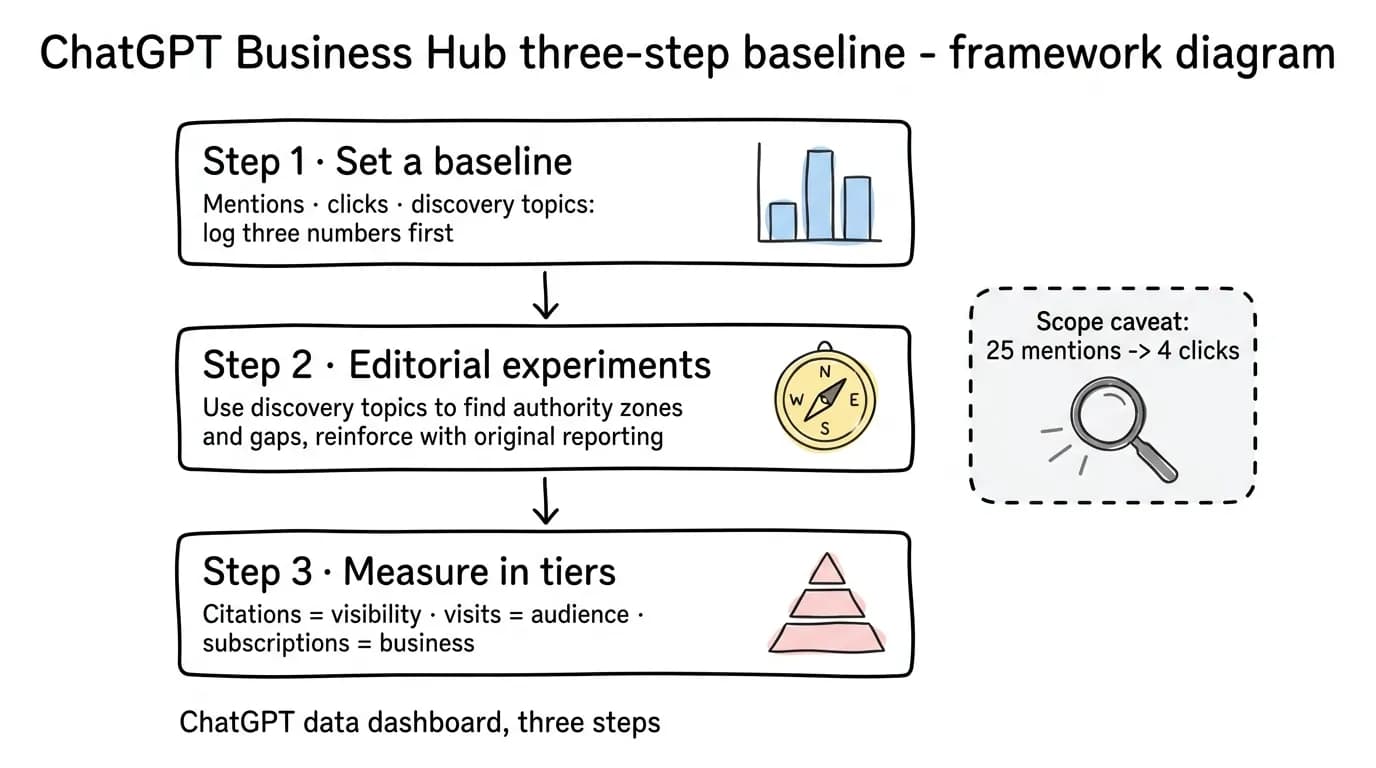
AI Marketing Daily for 2026-11-20 rounds up 19 items centered on measurement: OpenAI's ChatGPT Business Hub dashboard, EU rules for agent-mediated purchasing, Meta pausing four AI terms, and B2B data on shortlists and the dark funnel, each with action advice.