
AI Is Making Ads Now: Is It Crashing the Party — or the Industry's Next Frontier?
This article examines how generative AI is reshaping advertising: faster production, higher entry bars, brand cases like Coca-Cola and Heinz, personalization at scale, plus trust, ethics, and compliance questions including the EU AI Act. It concludes AI should amplify, not replace, human creativity.
A while back, a friend of mine who does design at an ad agency took me out to dinner. Over the meal, he said something I still remember today.
He said: our team hasn't hired an intern in almost two years. The stuff interns used to do — the tools now finish it all in a single night.
My chopsticks stopped mid-air.
This isn't just his shop. Salesforce put out a report called State of Marketing 2026, and it has a number in it: 87% of marketers are already using generative AI in at least one daily workflow.
Eighty-seven percent. What counts as a daily workflow? The kind of work that used to be done by piling on human hours.
And there's a starker one. Roughly half of consumers already make a habit of asking AI first — when they search for products, size up brands, and decide what to buy.
On one side, the people doing the work are using AI. On the other, the people paying for it are using AI too. The advertising business is squeezed right in the middle.
Think about it: what is advertising, really? Stripped down, it's the business of getting what you say to land in someone's heart. Research, creative, production, placement, post-campaign review — every step is guessing at human hearts. And now there's something guessing at human hearts at every single one of those steps.
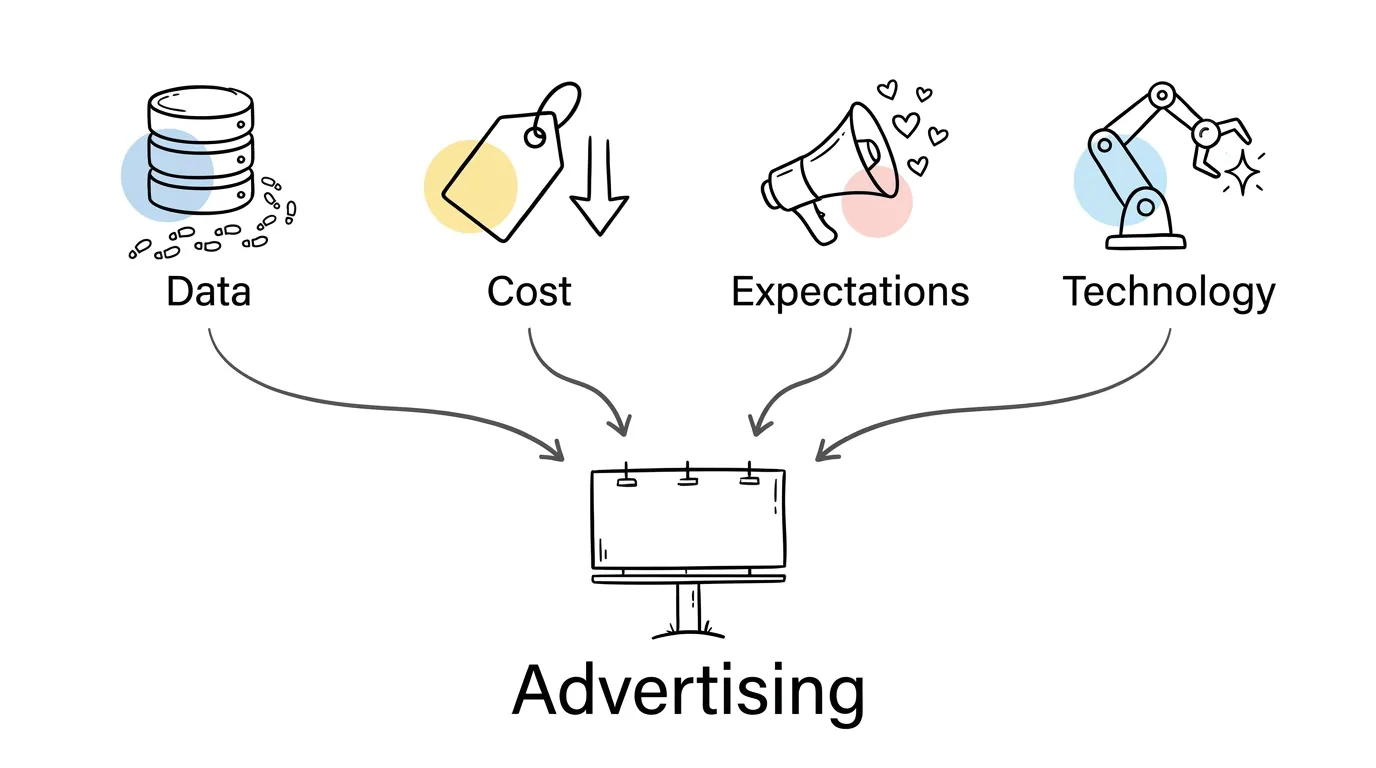
Why now? I counted at least four forces arriving all at once.
- Data. Consumers leave more footprints online than ever. Armed with that data, AI can guess what you'll want to buy next.
- Cost. For two years now, bosses everywhere have been chanting "spend less, get more." Hand the repetitive work to machines, and free people up to think strategy.
- Expectations. Adobe's CEO Shantanu Narayen said at VivaTech in the middle of this year that every company on Earth has now realized one thing: your success depends on whether you can engage customers in a sufficiently personal way, across every channel.
- The technology can finally fight. Writing copy, generating images, cutting video, planning media buys — what the models produce is now bold enough to ship straight into real campaigns.
All four forces arriving at once — you don't see a lineup like that often. Last time was probably when the smartphone first showed up.
First, the Party-Crashing Side
So who feels it first? You guessed it: the junior ranks.
A single ad used to take weeks — research, brainstorming, shooting, testing. Now? Days. Sometimes hours.
The work junior designers and junior copywriters used to do — mock up a few versions, retouch a few images, write the first draft — AI delivers in minutes.
The way agencies collaborate is changing with it. Creative teams no longer start from a blank page; they pick from a dozen directions AI hands them: have it generate concepts, storyboards, first-draft copy, then humans single out the one with a pulse and take it deeper.
Narayen has observed that when creators get together now, they talk about three new questions: how do I put different modalities to work? How do I automate the inefficient parts of my production pipeline? How do I get AI to guard my brand's aesthetic?
Notice: nobody asks "will AI replace me?" Everyone asks, how do I put AI to work.
But don't relax just yet. The bar for entry has genuinely risen. Employers now want people who can make creative judgments and run the tools: write prompts, catch AI's mistakes, read the data, and align all of it to brand goals.
Being a generalist used to be a bonus. Now it's the ticket in.
Let Me Tell You Two Stories
First, Coca-Cola.
In 2023, Coca-Cola did something fairly ahead of its time: it opened up a batch of its archive-grade creative assets and invited digital creators to use a then-first-of-its-kind AI platform to generate new works from them. Some of those works even made it onto the big screens of New York's Times Square and London's Piccadilly. Brand, artists, fans — everyone played together.
That round was a beauty.
The same company stumbled in 2024. It used AI to make a Christmas ad, intended as an homage to its own classic from 1995. The moment it aired, the public erupted: how could you use AI to replace the work of artists and real actors?
Same move. One turn made it a legend, the next drew fury.
Now Heinz.
Heinz ran an intriguing experiment: ask an image model to "draw ketchup," with no other constraints. The bottles the model produced came out wobbly and lopsided — and every single one had the face of a Heinz bottle.
Heinz rode the moment and turned it into a campaign: even AI thinks ketchup should look like mine. In one move it showcased how deeply the brand is wired into the popular imagination — and put generative AI's capabilities and limits on the table at the same time.
Clever.
Put the two stories side by side and at least three things fall out.
One: AI can't win the fight alone. Not a single winning brand handed everything to the algorithm. AI charges; humans steer. Strategy, quality, brand consistency — always gripped in human hands.
Two: speed is itself a weapon. Chasing a trend used to take weeks; now content ships in hours. Localization assets for international markets get generated in bulk. Campaign variants get tested repeatedly before launch — no more waiting for the ads to go live and listening for the echo.
Three: the rules have to come first. Approval processes, brand guidelines, legal review, whether or not to label "AI-generated." None of this is glamorous — but without it, the faster the first two run, the harder the fall.
What the New Frontier Looks Like
If replacement is AI's A-side, the B-side is this: personalization can finally afford to be "a thousand versions for a thousand people."
Before, one ad played to millions. Now, a thousand versions speak to a thousand audiences, saying different things at different moments of the purchase journey. Copy and imagery can vary, product recommendations can vary, the pitch can vary, placement strategy can vary, emails can vary — and localized creative for global markets can vary too. Which version performs? AI watches the data and tunes in real time.
And entirely new formats are sprouting up — ones that never existed before: conversational shopping, AI shopping assistants, virtual influencers, synthetic video, personalized content recommendation. Generative AI is growing its way into search engines, creator platforms, retail environments, and enterprise software. Advertising is learning to meet the moment.
The Really Hard Gate Is Called Trust
Savvy consumers have already started asking: was this ad made by AI?
Here's the interesting part: most consumers don't actually care that much whether an ad was made by AI. What they care about is whether the ad is honest, useful, and true.
But — note this "but." The moment a brand uses AI and keeps quiet about it, most people feel played.
Narayen offered an analogy I find excellent. Food has a nutrition facts label, he said — why shouldn't content carry one too? Give every piece of content its metadata, like a "nutrition label."
Where's the brilliance? It turns "should we disclose" from a moral dilemma into a product feature.
Trust takes years to pile up and a moment to collapse.
And deeper than disclosure lies ethics. AI models are fed on oceans of data. Copyright, creator compensation, bias, misinformation, attribution — every one of these hangs unresolved. Narayen says that when Adobe trains its own generative models, commercial safety and intellectual property come first: it can't just crawl the entire internet and smash the trust creators place in it.
Then there's compliance. The EU's AI Act tiers systems by risk and reins in specific AI applications; misleading advertising, whether made by humans or AI, is still governed by consumer protection law; and the regulatory thinking in the US and UK runs differently from Europe's. For a multinational brand, that's dancing to several rulebooks at once.
So ethics can't be a checkbox for the legal team. It has to be baked in from day one of the campaign.
So — Disruption, or a Leap Forward?
Back to the beginning, to my friend's line.
My read: the disruption is real. The decline, not necessarily.
Look at the numbers. 87% of marketers are using AI — yet many teams are reinvesting the time they save into strategy, experimentation, and creative development, rather than using the savings to cut headcount. The machines took the repetitive labor; people got pushed upstream.
The brands that use AI well all strike the same posture: AI does the heavy lifting; humans do the work that touches hearts. Empathy, storytelling, cultural fluency, brand-building.
One line of Narayen's stuck with me. Technology's role, he said, is to amplify human creativity, not replace it. The content and brands that truly rise above will be the ones that twist together the machine's efficiency and that emotional connection between people. He calls himself a fan of technology — but at bottom, human creativity is the key.
From TV to search, from social to mobile, every wave of new technology has reshaped advertising. This wave won't be the exception. The tools keep changing, but there's one thing I'd bet never changes:
What moves the human heart, in the end, is a human.
Here's to a happy partnership with AI. Just don't hand over the steering wheel.
Continue reading
Related articles

It's 2026: Stop "Buying" AI Tools for Your Marketing Team — Start "Hiring" AI Agents
This learn article explains how AI agents differ from standalone AI tools in marketing, outlines three agent categories — build-your-own platforms, CRM-native agents, and vertical tools — and covers use cases across SEO, social media, advertising, and reporting, plus criteria for choosing one.

Did the Money You Spent on AI Marketing Ever Come Back?
A guide to measuring AI marketing ROI across three layers: ad reports, sales pipeline, and the financial ledger. Covers metrics such as ROAS and CPA, eight dashboard metrics, industry benchmarks, and common measurement mistakes.

How to Pick a Creative Automation Platform: First, Figure Out What These Eleven Actually Do
A learn article sorts eleven creative automation platforms — including Bannerflow, Celtra, Smartly.io, and Storyteq — into four functional groups and proposes five evaluation questions covering publishing reach, automation depth, ease of adoption, team fit, and verifiable evidence.