
Will AI-Run Ads Actually Make You Money? 200 Veteran Media Buyers Gave the Same Answer
A survey of 200 performance marketing leaders reports that most have seen performance lift from AI ad platforms, with real-time CPA and ROAS optimization ranked as the top benefit. The article also discusses budget gaps around open-web investment and the infrastructure barriers cited by respondents.
A few days ago, I had dinner with an old friend who runs ad campaigns for a living. Somewhere between courses, he let out a sigh.
He said his boss now asks him every single day whether AI has actually made the company any money. And he can't answer. It's not that nothing is working — it's that he can't put a table in front of his boss that gets a nod.
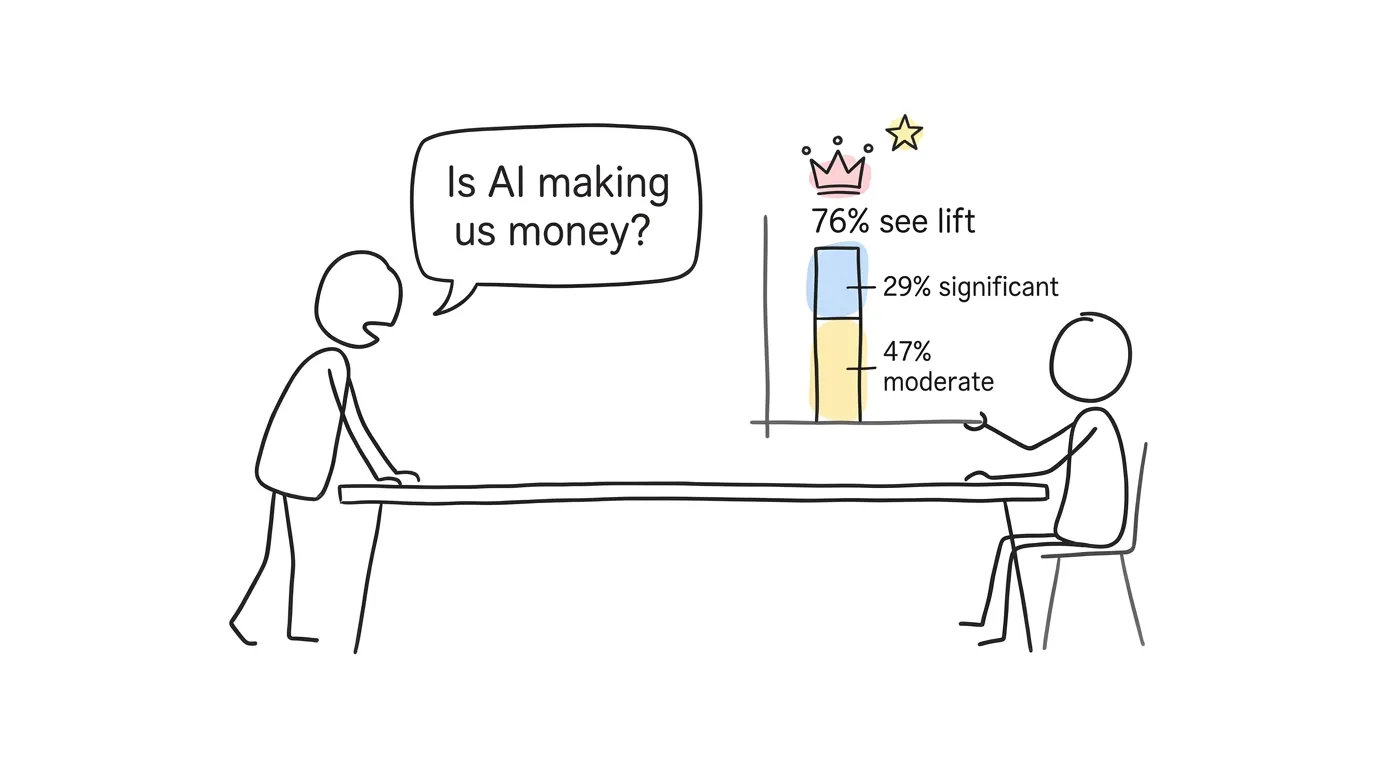
I told him: funny you should ask. I just came across a survey that was built precisely to answer that awkward question.
The survey was commissioned by Realize in mid-2026, called The Agentic Advantage in Performance Marketing. The sample isn't huge, but it carries real weight: 200 performance marketing leaders, every one of them spending real money — companies putting no less than $300,000 a month into ads.
The results were more decisive than I expected.
76% of performance marketing leaders have already seen tangible performance lift from AI ad platforms.
And that 76% breaks down further. 47% said the lift was moderate; 29% said it was significant. 7% found the improvement limited. 1% said it did nothing at all.
Wow. This is about as one-sided as data gets.
Another 17% said: I'm testing, but the tests aren't done, so I can't call it yet.
Sounds like fence-sitting? That's what I thought at first. Then I reconsidered — no, this is actually the most bullish signal of all. These people have committed real budget and real staff to proofs of concept and small-scale tests. Putting money down is the tell. When the data comes in, chances are it will speak in their favor.
So What Is AI Actually Doing for Them?
Some say it saves time. Some say it's about producing creative at scale.
Both true. Neither is the point.
In the survey, 41% of respondents gave the top spot to the same thing: real-time optimization of CPA (cost per acquisition) and ROAS (return on ad spend). Customer acquisition cost, return on ad spend — the two numbers a media buyer lives and dies by every day. Time savings came second, at just 14%. Optimizing budget allocation came third, at 11%.
Why that order?
Think about it: how many times a day can a campaign team actually check the dashboards? Twice. Three times, at most. Spot that something's off, adjust bids, shift budget, swap creative — one loop and half the day is gone.
But user clicks and competitor bids change by the second.
Humans optimize by the day. Machines optimize by the second. That's how the gap opens up.
What an AI ad platform does is watch every signal and act the moment it arrives: adjust bids, shift budget, rotate creative, tighten audiences. Any single adjustment is too small to notice. But stacked over a full campaign cycle, thousands of micro-adjustments compound — and the compounding kicks in.
So it's no surprise at all that Meta's Advantage+ and Google's PMax are near-universal. They delivered the right answers on the metrics that matter. Which, incidentally, also explains why agentic AI can scale a new channel so quickly: the playbook is proven — you just run it on a new track.
But the Pond Is Full
The old channels have hit a wall.
In the survey, 74% of respondents put more than a quarter of their budget into paid search, and 67% into paid social. Between them, these two channels carry most of the performance marketing load.
It used to be easy money, and it still earns. But the line keeps getting longer while the pond stays the same size. A business that turns a profit on $500K a month won't necessarily keep the same margins at $2M or $5M. Audiences saturate, high-intent keywords get bid up, and the cost of reaching a new customer only goes one way: up.
Who does that hurt the most? Exactly the ones spending the most.
So one number from the survey stuck with me: among the big players spending over $5 million a month, 70% said finding an incremental channel is "extremely important." Across the whole sample, three in four rated it "important" or "extremely important."
Where does that incremental growth come from? The data gives a pretty consistent answer: the open web. Everything beyond the two walled gardens of search and social — that wide-open expanse.
Wanting to Invest vs. Actually Investing — How Big Is the Gap?
Put today's budget allocation next to the one people carry in their heads, and you'll see a crack.
Today: paid search 22%, paid social 21%, the open web 13%, connected TV 12%, retail media 9%, affiliate 8%.
The open web: 13%. Fourth place.
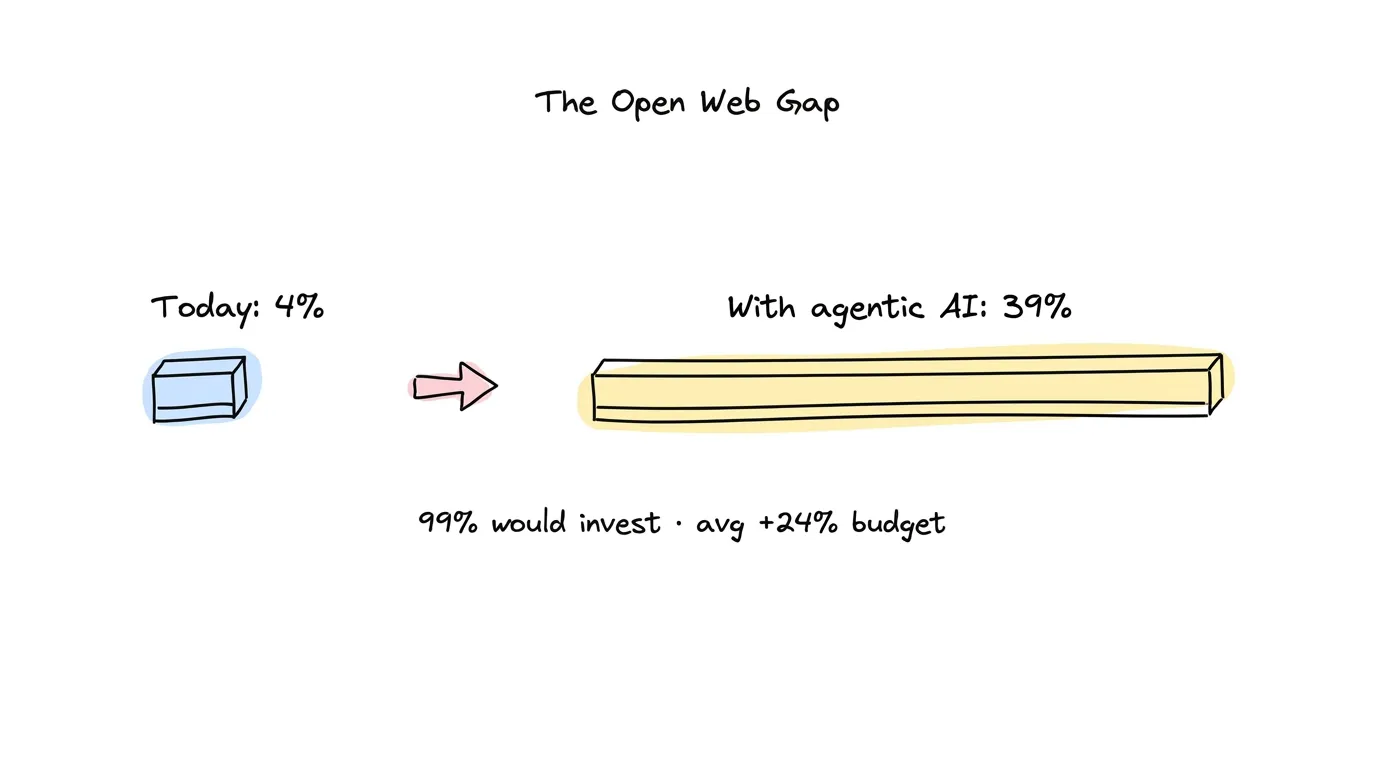
But when asked "if agentic AI ad-buying tools existed for the open web, would you invest?", 99% said yes. The average budget they'd shift over: 24% — double today's share. The bigger the spender, the stronger the appetite.
Dig one layer deeper and it stings more. Today, only 4% are actually putting serious money into the open web. Yet with agentic AI tools available, 39% would be willing to allocate 26% or more of their budget there.
4% versus 39%.
That gap says people don't lack the will. They lack the confidence to pull the trigger.
So what's missing? Infrastructure.
The survey asked what roadblocks were holding them back: too many fragmented vendors, 74%; attribution that doesn't reconcile, so the numbers never add up, 71%; brand safety concerns, 54%; not enough hands on deck, 42%.
Notice anything? Those roadblocks are exactly what a well-designed agentic platform is built to clear: one interface, unified reporting, automated traffic management, automated execution. What PMax and Advantage+ hand you inside the walls, nobody yet hands you on the open web.
Which makes the next number inevitable: 81% said that if an automated AI ad-buying solution existed for the open web, they'd increase their spend.
The Ledger, Tallied
Back to my friend and that dinner-table sigh.
If his boss asks again, "is AI actually working?", here's the answer he can give now. One: on the two proven tracks of search and social, 76% of his peers are seeing results in real dollars — and the numbers they're seeing are exactly the two the boss cares about most, ROAS and CPA. Two: the next wave of growth lives outside the walls, and the money that wants to go there is already lined up. All that's missing is an infrastructure people trust enough to bet on.
Put simply: on the question of whether AI pays, there's nothing left to argue about.
The only question left is execution.
The playbook is ready and the direction is right. Whoever gets the open web's infrastructure running first is first to feast on the next wave of incremental growth.
Here's hoping my friend is one of the first at the table.
Continue reading
Related articles

Did the Money You Spent on AI Marketing Ever Come Back?
A guide to measuring AI marketing ROI across three layers: ad reports, sales pipeline, and the financial ledger. Covers metrics such as ROAS and CPA, eight dashboard metrics, industry benchmarks, and common measurement mistakes.

How to Pick a Creative Automation Platform: First, Figure Out What These Eleven Actually Do
A learn article sorts eleven creative automation platforms — including Bannerflow, Celtra, Smartly.io, and Storyteq — into four functional groups and proposes five evaluation questions covering publishing reach, automation depth, ease of adoption, team fit, and verifiable evidence.
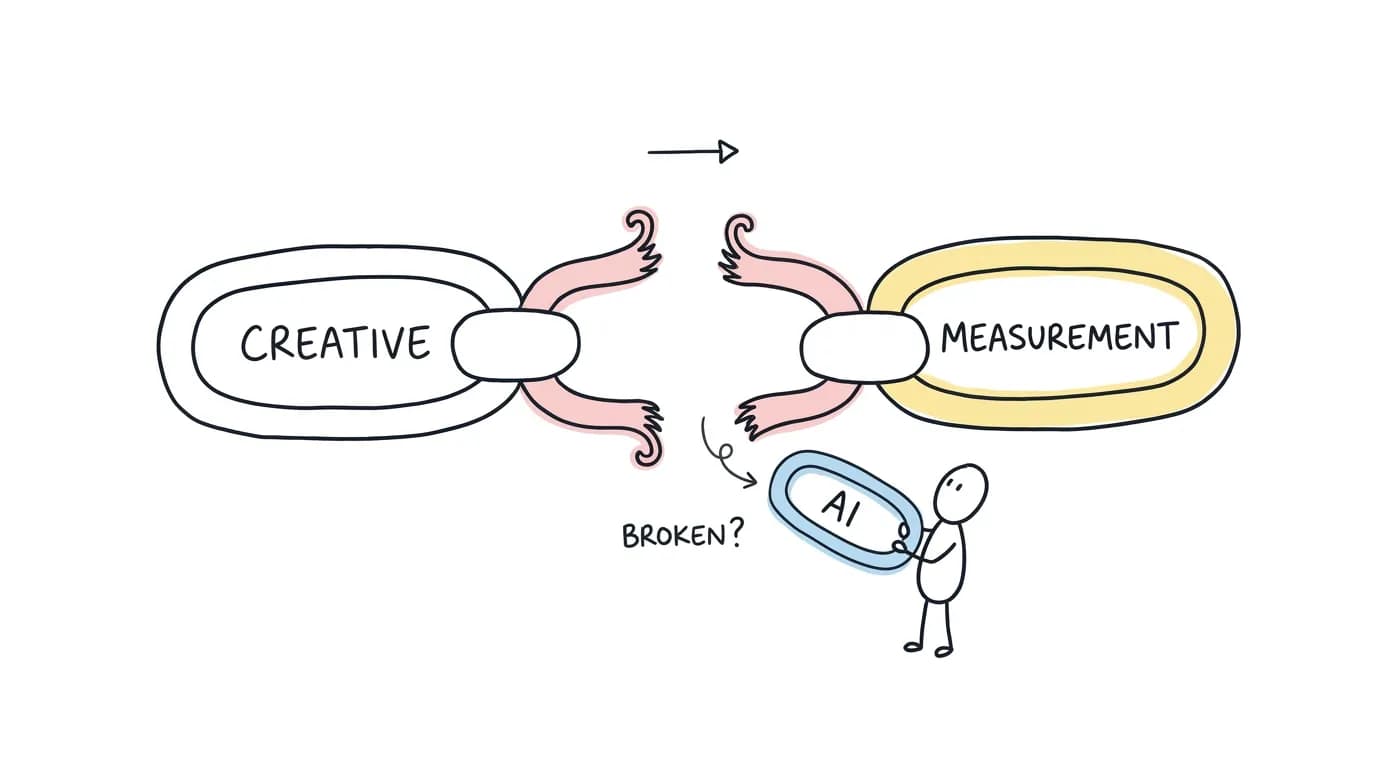
How to Choose a Creative Ad Tech Platform: Put 8 Side by Side, and the Gap Isn't Features — It's How Far the AI Actually Goes
This article compares eight creative ad tech platforms—Innovid, Smartly, Clinch, Jivox, Celtra, Bannerflow, Google CM360, and VidMob—on channel coverage, creative production, ad serving, measurement, and AI agent capabilities. It suggests matching the platform to the broken link in the creative-to-media chain.