
You Bought All the Tools — So Why Hasn't AI Made Your B2B Marketing Team Any Money?
Explores why B2B SaaS marketing teams that buy many AI tools often see no measurable returns, arguing the gap is the operating model: ownership, review checkpoints, budgets, and measurement. Covers task prioritization, Google, FTC, and EU AI Act rules, and GEO for brand visibility in AI answers.
A while back, I got together for tea with a few friends who work in B2B SaaS. What did we talk about? AI.
I expected to hear a parade of wins. Instead?
One said: we've bought seven or eight tools, and the budget got approved. But ask how much time we've saved or how much extra money we've made — nobody can say for sure.
Another said: everyone on the team writes with AI now. But when my boss asked me what AI has actually brought the company, I couldn't answer.
So I asked: are you still buying?
They said: yes. If we don't buy, we're afraid of falling behind; if we do buy, we're not sure what we're hoping to get.
After that tea session, I went home and dug through the data. Only after digging did it hit me: the confusion my friends feel isn't an isolated case. It's the norm.
AI has already entered most B2B marketing teams. The value AI creates has not.
First, a Few Numbers
This spring, Duke University's Fuqua School of Business and Deloitte ran a survey (The CMO Survey). It showed that AI is now involved in 24.2% of marketing activities. Two years ago, that number had just crossed 13%.
Two years, nearly doubled. Fast? Fast.
Same survey: 73.9% of companies are already using AI to produce content.
Gartner's CMO Spend Survey this year is even more direct: CMOs are putting 15.3% of their budgets into AI projects on average. And 70% of marketing leaders say getting AI right is the top priority this year.
The money is there, and so is the commitment. But the third number is the one that stings:
Only 30% of CMOs consider their own AI capabilities mature.
What does that mean?
The money was spent, the tools were bought, everyone is using them. But fewer than three in ten have truly figured AI out.
So where's the problem? Many people's first reaction is: wrong tool, swap it for another.
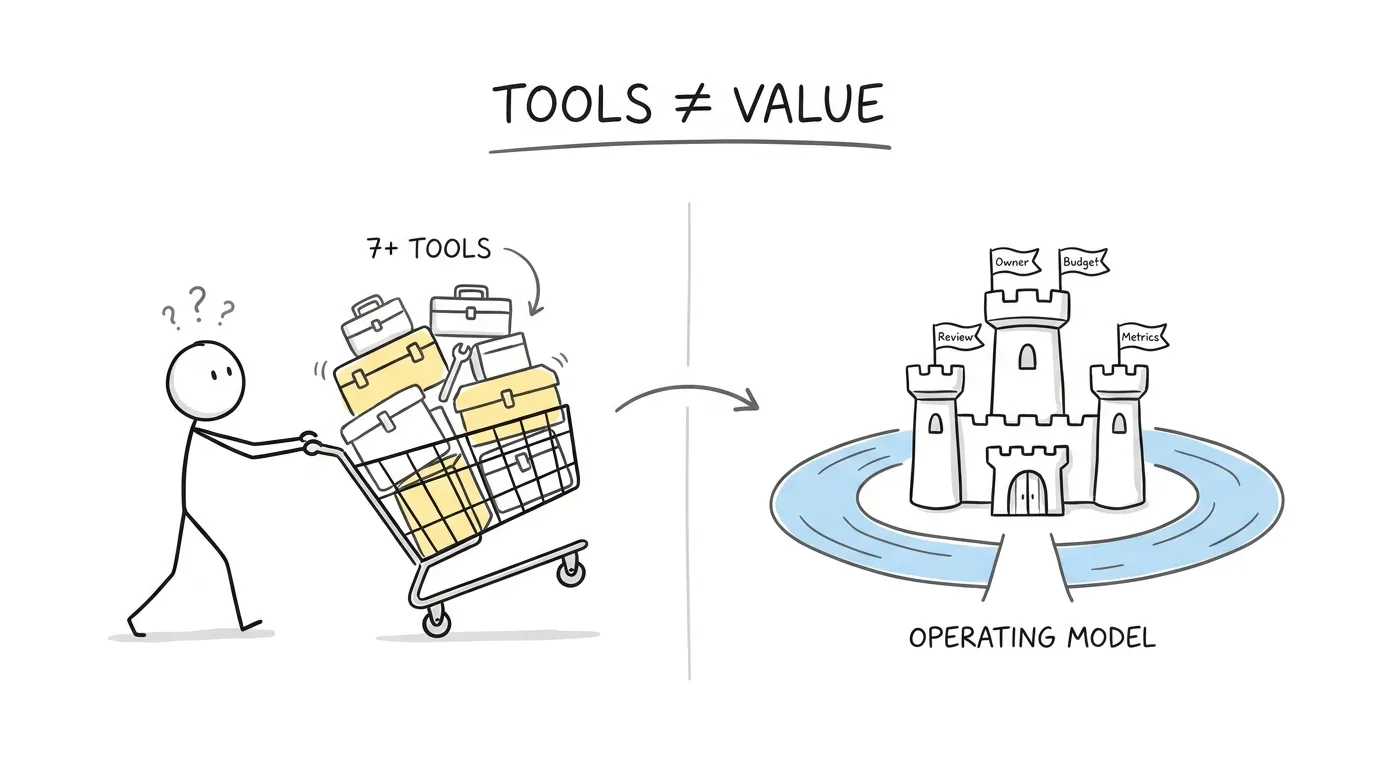
I'd urge you not to rush into swapping tools. What's lacking was never the tool — it's the operating model.
What is an operating model? It's these questions: who is responsible for AI's work? Where do humans keep watch? What is the budget actually buying? How do you measure the results?
If you can't answer these four questions, no matter how many tools you buy, you're only converting money into software subscription fees.
This article is written for marketing leaders at B2B SaaS companies. Let's take these questions apart, one by one.
First, Get This Straight: Not All AI Is the Same
Before we take anything apart, we need one distinction.
What is predictive AI? It's the set of things marketers have used for years: lead scoring, churn warnings, next-best-channel. It's like a veteran accountant flipping through your historical ledgers, helping you guess the next move.
What is generative AI? The new species of the last two years: writing copy, drawing images, making videos, writing code. It's not like an accountant — it's like a writer. You give it an assignment and it goes straight to writing, from zero.
One guesses; the other creates.
Don't underestimate this distinction. When the guessing kind gets it wrong, at worst you change your approach; when the creating kind gets it wrong, the error is printed and put in front of customers. So these two kinds of AI have different owners, different risks, and different ways of blowing up. Plenty of articles about AI marketing mix the two together. This one covers generative only.
One more point: B2B and B2C are also two entirely different things.
When B2C makes a mistake, it blows up today and a new ad tomorrow washes the topic away. And B2B? Your sales cycle easily runs six months to a year, and the decision isn't made by one impulsive individual — it's made by a committee that has to reach agreement around a table. Every claim your marketing makes, sales has to defend face-to-face with the customer.
And if sales can't defend it?
One wrong promise will have your sales team paying off its debts over and over for the next six months.
On top of that, B2B buyers lean heavily on third-party review sites before making decisions. So don't copy marketing advice written for B2C straight onto B2B. The rules of the game are different.
What You Can Hand to AI — and What You Can't
So which work, specifically, can be handed to AI?
Here's a judgment framework. Don't make a list — lists are useless. You need to learn to rank. Rank by what? Two dimensions: how much the task is worth, and how much it hurts if it's botched.
Draw it out, and you get four quadrants.
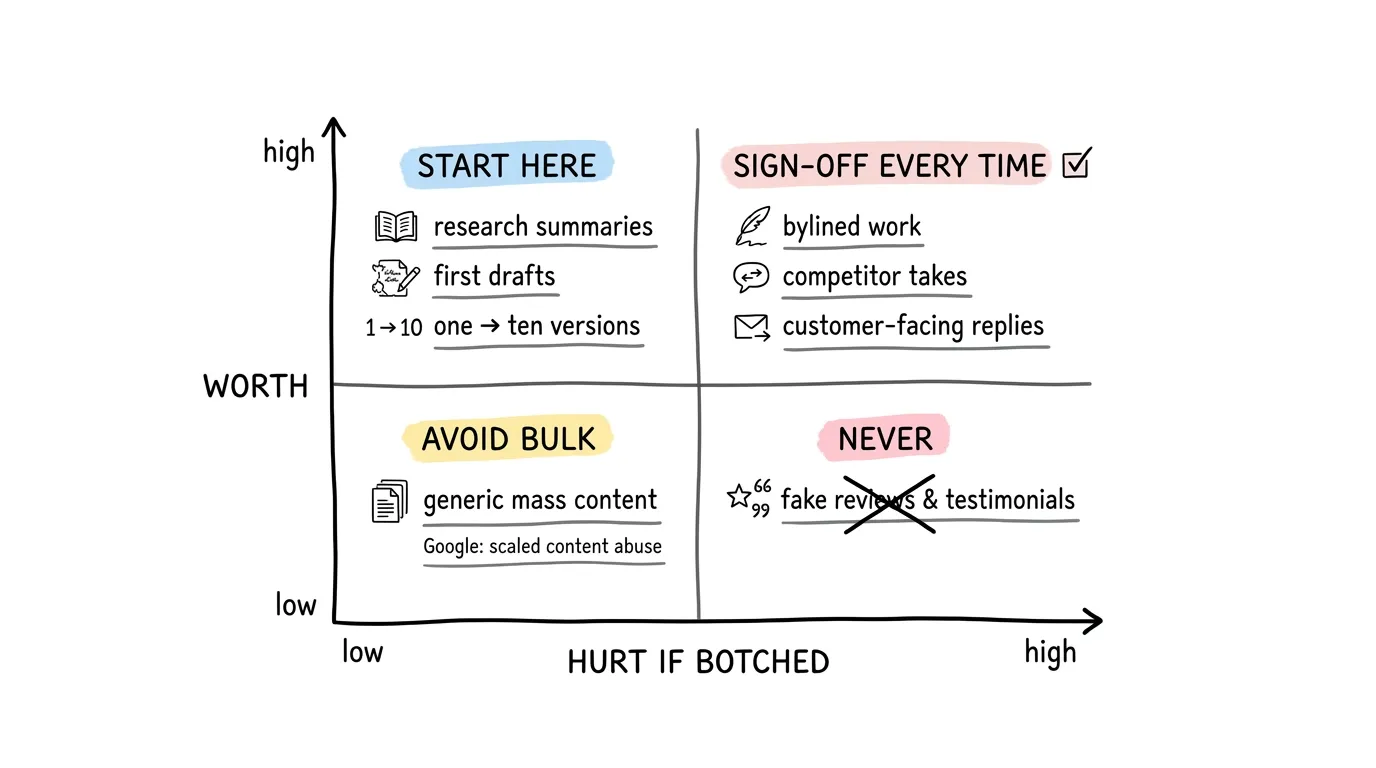
Quadrant one: worth money, and safe. Organizing research summaries, writing first drafts from the material you supply, turning one piece of content into ten versions, analyzing your own data. Notice anything? These tasks share one trait: they all grow out of material you already have and can trust, and the output is always reviewed by a person before it ships. Even if the AI errs, the loss is limited; the time saved, though, is absolutely real.
Most teams should start here, and grow from here.
Quadrant two: very valuable, but very dangerous. Anything published under a byline, commentary on competitors, automated responses that face customers directly. AI does these jobs lightning-fast, but they share one identity: they land directly under the buyer's eyes.
One unvetted claim that veers off course, and the moment it reaches a customer, you have a serious problem. So this quadrant has only one rule: every single time, someone must sign off. No exceptions.
Quadrant three: not worth much, but very cheap. Mass-producing content so generic it fits everywhere. Low cost, big temptation. But Google doesn't like this — its scaled content abuse policy, launched in March 2024, exists precisely to clean up this kind of thing. You think you're saving money; you're actually burying landmines under your search rankings.
Quadrant four: shouldn't be touched at all. Using AI to fabricate customer reviews and user testimonials. This isn't a question of whether it's worth it — it's a question of whether it's a violation. When we get to the rules later, you'll see how serious this is.
So What Is an Operating Model?
Good — now you know which work can be done. Next question: who manages this work?
In practice, the industry plays it only three ways.
The first: centralize. Stand up a central AI team that keeps the tools, the rules, and the work firmly in its own hands.
The second: everyone fends for themselves. Each team buys its own tools, sets its own process, manages itself.
The third: hybrid. The top sets unified rules; below, each does their own thing.
Which is good? Depends on team size. For small and mid-sized B2B SaaS marketing teams, my answer is clear: hybrid.
Why not put everything in the center? Think about it: a central team is too far from the specific channels. The ins and outs of SEO, the judgment calls in events, the feel of community language — if a team isn't living inside them daily, its judgment drifts. Not to mention that companies of this size mostly can't afford a dedicated central team anyway.
Why not push everything down? Because the result of everyone fending for themselves is inevitable: three teams with three playbooks, three toolsets, and three review standards. Quality lurches up and down, risk exposure sprouts here and there, and nobody can say what the company's AI is actually doing overall.
How does hybrid resolve this? Pull up what should be unified; push down what should be specialized. Things that need to be aligned — data rules, disclosure policy — the center locks down; how to actually do the work is handed to the teams living inside the channels.
The model is set, but you also need people. At minimum, three roles.
First, the owner. The person who sets standards and maintains the shared prompt library.
Second, the reviewer. Nothing customer-facing ships without their nod.
Third, the data steward. What data can be fed to which tool — they have the final say.
A small team is short on people; one person wearing two hats is fine. But every role must have a name on it. Roles can be doubled up; they cannot be left vacant. Anything without an owner will eventually go wrong.
People alone aren't enough — you also need checkpoints. Three of them, none dispensable: before publishing, before reaching a customer, before mentioning a competitor.
Why three? Because each checks for a different kind of error. Before publishing, check facts and brand voice; before reaching a customer, check whether the promises can be honored; before mentioning a competitor, check whether sales can defend what's said. One checkpoint fewer means one more hole that the other two can't plug.
One layer deeper. The ceiling of this whole system is data quality.
What you feed the model is what it hands back to you. Give it a pile of notes that don't hang together logically, and it returns a pile of prose that doesn't hang together logically. More troublesome is data security: feed customer data into a tool it should never enter, and the problem happens on the spot — and afterward, there is no undoing it.
Finally, agents. What is an agent? AI that can run a whole string of tasks on its own: research, write, quality-check, publish — without you watching every step.
Sounds wonderful, right?
But think about it: between two checks, how much can it get done?
So my advice is: onboard an agent the way you'd onboard a new hire. Give it a task with clear boundaries, give it only the minimum information it needs to finish that task, and — without fail — assign a person to review its output. Would you let a new hire send messages to the outside world without review? You wouldn't. Same for agents.
How to Spend It, How to Measure It
Next, let's talk money.
That Gartner 15.3% — many articles treat it as a target. Wrong.
15.3% is someone else's average, not your target. It's for checking yourself against. Hold it up like a mirror: if you're far off, think about why. If your team depends heavily on content, you probably should invest more; if content is only a small slice and the sales team is big, you probably should invest less. The point of an average is to force you to think through your own answer, not to hand you a ready-made one.
And I have to warn you: money goes to far more places than tool purchases.
Does data preparation cost money? Does staff training cost money? And there's one more item, the most easily overlooked: review time.
Let me run the numbers. Suppose a five-person content team uses AI to double its output — then the amount needing review doubles too. At one hour of review per person per day, that's 25 hours a week, and three hundred hours over a quarter. That time bill dwarfs the subscription fees.
So if a team buys AI tools but leaves no time for review, what it bought isn't productivity.
It bought a risk with no insurance.
Now, how to measure results. Many teams' first reaction: count output. How many pieces published, how much faster, how much the per-piece cost dropped.
I'd urge caution.
Efficiency metrics are fine to look at — provided quality passes. And who gets the final say on quality? Someone first has to define clearly what counts as acceptable, then go check. Otherwise what happens? The team discovers you're grading output, so it chases output hard. And then? Low-quality content piles higher and higher, and the problem grows bigger and bigger.
Output volume is the most deceptive of all metrics. If you look at anything, look at results: did this campaign actually have an impact on potential buyers?
Here Come the Rules — Three of Them, All with Dates
Tools, model, money — all discussed. Last, let's talk about something many people still haven't taken seriously: the rules.
The rules currently governing generative AI marketing come down to three, and each has a clear date.
The first: Google's rules. Since March 2024, Google's scaled content abuse policy has been in effect. Note that Google's stance is actually quite clear: using AI for research and structuring is fine — even encouraged. What it cracks down on is pages generated in bulk that bring no incremental value whatsoever. The rule targets a pattern of behavior, not the tool itself. A page built with AI's involvement but reviewed by a human and genuinely useful to readers is treated the same as any other page.
So your moves are: every number has a source, someone signs off before publishing, and you never churn out filler in bulk.
The second: the FTC's rules. The U.S. Federal Trade Commission published its final rule on fake reviews on August 14, 2024, effective October 21 of the same year. It bans fake reviews and fake testimonials, and states in black and white: AI-generated ones count too. It also bans insiders writing reviews without disclosing their identity, and faking social-media popularity. What's more, the FTC can pursue civil penalties against knowing violators.
For B2B teams, it comes down to three sentences: never draft reviews on behalf of customers, never fabricate customer quotes in your case studies, and insiders writing reviews must disclose who they are.
These three sentences protect the credibility of all your customer evidence. The more seriously buyers read reviews, the more those three sentences are worth.
The third: the EU AI Act. The transparency obligations under Article 50 took effect on August 2 of this year. The European Commission has also published supporting guidelines, a voluntary code of conduct, and an optional EU marking.
For marketers, two parts are directly relevant.
One: deepfakes must be disclosed. Synthetic images, audio, and video — as long as they involve real people or scenes, they must be labeled. Your CEO's digital-avatar video needs a tag.
Two: AI-generated text touching the public interest must be disclosed when it's released to the public. Unless, that is, it has passed human review and editorial gatekeeping, and a specific person carries editorial responsibility for it. In other words, a blog post that someone reviewed — and someone answers for — usually doesn't need a label.
As for whether a completely fictional virtual persona counts as a deepfake, it depends on whether it could be taken for a real one — the European Commission's guidelines discuss this. For details on penalties and transition periods, consult the Commission's original documents before citing them.
Let me put it on the record: the above is a summary of the rules, not legal advice. For how this applies to your specific business, go ask your lawyer.
And here's a table for you, pinning risks, rules, responsible parties, and control actions together:
| Risk | Corresponding Rule | Who's Responsible | Control Action |
|---|---|---|---|
| Fabricated facts | Google guidelines | Content owner | Every number has a source |
| Bulk low-quality pages | Google scaled content abuse policy | SEO owner | Bulk generation prohibited |
| Synthetic video/voice of real people | EU AI Act Article 50 | Brand owner | Visible label |
| AI-written reviews/quotes | FTC rules | Marketing ops | Real customers only |
| Customer data into prompts | Internal policy | Data steward | Approved tools only |
Oh, and one more easily overlooked thing: customer data needs its own policy. Which data can go into which tool — write it down clearly, in black and white. Prefer the versions whose terms explicitly state that your data won't be used for training by default. Don't take the terms secondhand from a salesperson — go read the original text yourself. The differences between vendors are large.
Don't Forget: Your Buyers Are Using AI Too
Everything above has been about how your team uses AI. But there's another half of the game that many people simply never see:
Your buyers are using AI too.
B2B buyers doing vendor research now ask AI assistants directly. And the same survey from this spring: 41.5% of companies are already working on generative engine optimization (GEO — getting your content cited by AI assistants).
What does this mean?
It means a buyer's first impression of your company may not be your homepage, nor your whitepaper, but an AI-generated summary. The customer experience begins with the AI's answer — long before they click through to your site.
So how does your brand get into those answers?
This is, at its core, a website engineering problem. For an AI system to cite a page, there's a precondition: it can read it, extract from it, and trust it. If your website can't pass these three gates, the AI has nothing to cite. However slick your marketing team's AI game is, it can't help with this part.
That's why I say: an AI strategy that only raises team efficiency, while ignoring how buyers encounter you in AI answers, is half a strategy.
And that half is precisely the half buyers can see.
Finally
Remember that cup of tea at the beginning?
My friends bought so many tools — tools were never what was missing. What was missing: who's responsible, where things get reviewed, where the money goes, how it's measured. What was missing was an operating model that can actually run.
Add the second half: buyers are asking AI too, and your brand has to stand firm inside AI's answers.
Tools are something anyone can buy. The operating model is your moat.
Here's to answering those four questions, one by one — sooner rather than later.
Continue reading
Related articles

It's 2026: Stop "Buying" AI Tools for Your Marketing Team — Start "Hiring" AI Agents
This learn article explains how AI agents differ from standalone AI tools in marketing, outlines three agent categories — build-your-own platforms, CRM-native agents, and vertical tools — and covers use cases across SEO, social media, advertising, and reporting, plus criteria for choosing one.

What Is GEO? How Your Brand Gets "Mentioned" in the Age of AI Search
An explainer on GEO (Generative Engine Optimization) for e-commerce and DTC brands: how it differs from SEO and AEO, why AI answers shape brand visibility, and eight practices covering question-focused content, consistent brand messaging, structured pages, external evidence, comparisons, and AI mention tracking.

AI Is Already Making Decisions for Your Customers. Are You on the List?
A learn article explains GEO (Generative Engine Optimization): why AI-generated answers now shape which brands customers see, and how SEO fundamentals, entity clarity, citable evidence, and monthly measurement affect visibility in AI answers.