
Marketing Is Being Torn in Two by AI
An industry analysis of how AI is polarizing marketing: agency consolidation, generative AI in ad production, data readiness, creator economy spending, Gen Alpha, sports marketing, and tariff pressure, arguing mediocre output gets commoditized while authentic work gains value.
A while back, I had dinner with a few friends who work in marketing.
As we talked about how everyone's business had fared this year, I noticed something interesting: everyone at the table was wearing a complicated look. The creatives were cursing AI output as soulless while quietly using AI to cut their costs in half. The agency people were losing sleep over news of industry consolidation while secretly plotting to go off on their own.
One person said something that stuck with me: this industry has never been this divided.
What does "divided" mean?
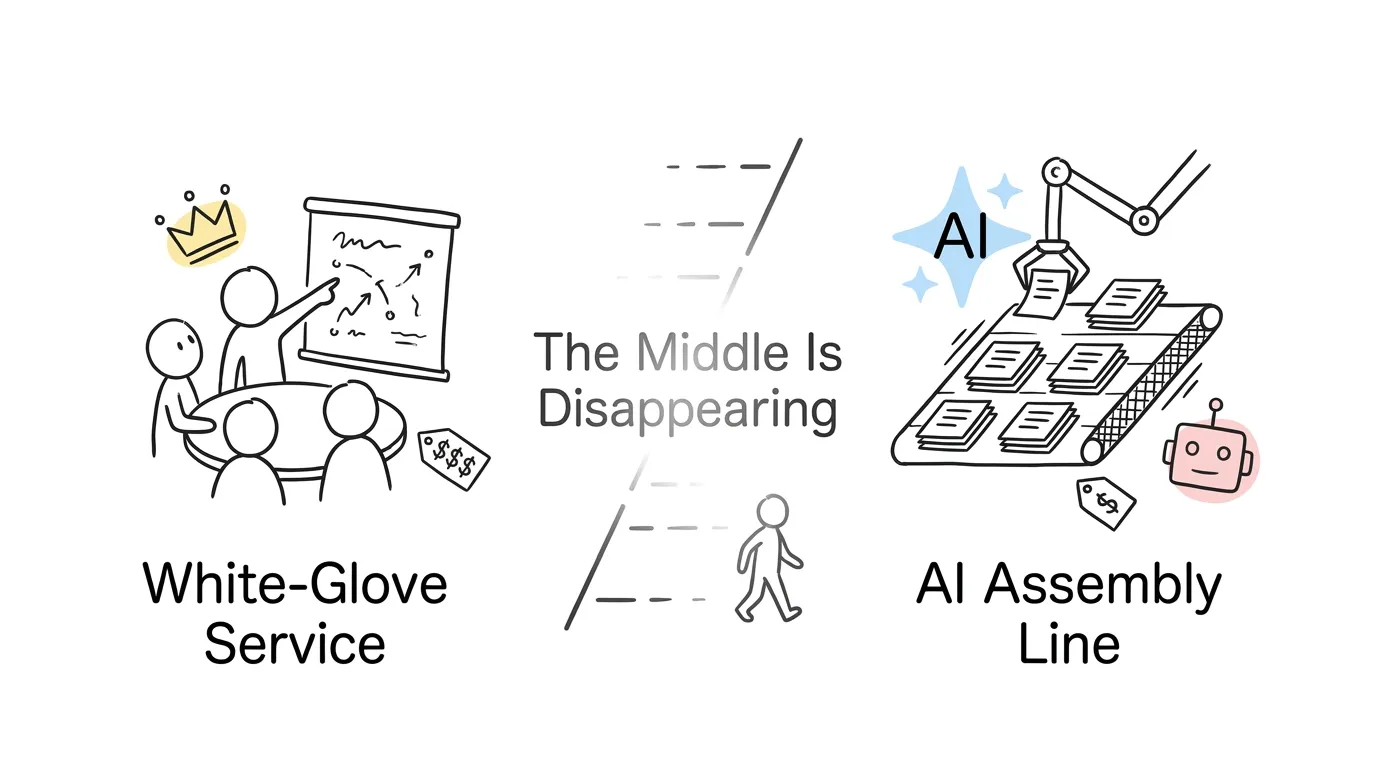
The middle ground is disappearing.
That's not my line — it's the conclusion a fair amount of research points to. On one side, the middle class is thinning out, and the business nodes that used to run on "mass consumption" are failing one by one. On the other side, mass culture is shattering too. What is mass culture? It was the era when everyone watched the same show and remembered the same tagline. Now, what each of us scrolls past is fed to us individually by an algorithm tuned to our tastes. One-to-one personalization sounds wonderful, but the price is this: there is no longer any place where "everyone is watching."
The industry itself is fracturing too. Marketing services are splitting into two poles. One pole is white-glove service — people supervising people, highly customized, expensive for a reason. The other pole is plug-and-play — an AI-built assembly line that's shockingly cheap.
The traditional agencies stuck in the mediocre middle have it worst.
Why? One creative director put it bluntly: for the past few years, the whole industry has been scrambling to please its shareholders, and the distance between the people who make decisions and the people who make things has never been greater.
First, the big companies: big fish are eating big fish
Earlier this year, Omnicom swallowed IPG. A textbook merger for the ad industry.
Forrester's analyst put it well: this merger means the thing legacy holding companies organize around has changed. It used to be creative. Now it's scale in media and technology.
Plainly put: the competition going forward isn't about who has more talent. It's about whose machine is bigger.
More chain reactions are coming. If rates keep falling and regulators stay relaxed, the deals will only multiply. Earlier this year, Publicis formed an alliance with the data company LiveRamp. Did you catch what that move means? Data is the fuel for the AI arms race. An army without provisions can't fight.
On the other end, major layoffs, and a string of respected legacy creative shops have shut their doors one after another. It hurts. But it also means a large batch of industry veterans have been "released." A professor at NYU's business school predicts you'll see a wave of former executives founding startups and going after narrower niches. The people who were forced out are heating up the small-and-beautiful end of the market.
The independents, for their part, are growing in a different way. In late 2025, Wpromote — backed by private equity — bought Giant Spoon. Capital is redefining what "independent" means: not small and beautiful, but big and flexible. Same Forrester analyst: it won't take long before the list of agencies big brands get to choose from is noticeably longer.
Now, the creative side: the AI fountain, and the human BS detector
The loudest stage early this year was the Super Bowl.
The spirits brand Svedka announced in advance that it would run a Super Bowl ad made with AI. It won't be the only one.
Anomaly's chief AI officer made this call: more than half of the ads you see at this year's Super Bowl will have used generative AI. And he added a pointed note: much of it happens in pre-production, where you'd never spot it on screen.
Good grief. More than half.
There's a reason "slop" was named the 2025 Word of the Year. What is slop? Content mass-produced by AI that looks like content but has no soul. AI has pulled everyone's average output onto the same line. One creative-company CEO put it even more bluntly: the flood of content is converging on the median, and all of it — every piece — looks more and more alike.
So what do you do?
Run in the opposite direction from the median.
Brands like Equinox and Dollar Shave Club are already doing it: using AI tools on one hand while making fun of "AI slop" on the other, turning users' AI fatigue into the creative itself. Smart. But one warning: many brands still underestimate how much consumers resent AI. A PR company CEO put it right: human beings still come equipped with one very useful feature, called the BS detector. You can't fool it for long.
There's a deeper worry underneath: bot traffic is rising. The more you spend on social media, the more fake engagement you may attract; the better your metrics look, the more you spend. A self-reinforcing loop, spinning until even the people inside the industry can't tell what's real anymore. That's roughly the flavor of the "dead Internet."
Data: from hoarding to connecting
Before third-party cookies were phased out, everyone scrambled to fence off territory and stockpile data. Now that AI is on the scene, data is worth more — and the water is muddier too: zero-click search, AI crawlers, and AI agents are all stirring the question "did the ad actually work?" into an even harder problem.
The CEO of the data company Celebrus offered an analogy I particularly love:
Brands are playing checkers. Data companies are playing chess.
Plenty of brands chant "AI-ready," but they haven't thought through what they lack or what they need to do — let alone seeing two or three moves ahead.
So what's the prescription? Several experts give the same answer: stop hoarding data; start connecting it. Use CDPs (customer data platforms) and the data fabric to stitch scattered consumer views into one complete picture. Gartner's analysts observe that their best-performing clients all focus on one thing: marketing data readiness. In plain language, that's three questions: Do we actually know what our customers want? Can we safeguard the data they've entrusted to us? And once it's safeguarded, can marketing do better with it?
Bold creative cuts through the mediocrity
Honestly, content homogenization isn't a disease AI introduced.
Think back to the ads that broke out in 2025: a great pair of jeans, a sexy plumber, a car marketed as "the best place to make out," and a summer of "body-hair freedom."
These ads were all playing the old trope of sex sells — some of them outright parodying it. Why did they still go viral? People at the marketing company AdQuick have a take: sexiness is just the shell. What really works is that the entire ad industry was bored stiff long before AI arrived. Companies became radically risk-averse, while consumers were dying to see something interesting.
But bold doesn't mean rolling back the clock. It's not dusting off aesthetics from decades ago, and it's definitely not putting scantily clad women back on screen. The same person put it this way: authenticity means being true to your company and true to your audience.
A cautionary tale is ready-made: Cracker Barrel's 2025 logo-redesign fiasco. Many people pinned it on "political correctness." But the truth may be simpler: a restaurant with real history sanded off everything with character and refashioned itself into a face anyone could draw. People are fed up with that.
People want brands to attempt something great, not something safe.
Ad tech: cracks beneath the giants too
On the ad-tech side, consolidation continues. This industry has matured — matured to the point of turning inward: DSPs and SSPs, once partners, have started poaching each other's business.
Amazon and Walmart keep growing into the advertising tech stack. Microsoft shut down Xandr and, through a transitional arrangement, handed Amazon a parting gift along the way. Connected-TV inventory keeps piling up, and buyers are experimenting with new seller-side formats: marketplace deals, programmatic guaranteed.
For brands and publishers, consolidation may be good news — fees come down. But consumers end up with fewer choices, and that's when the antitrust club swings down. Google's ad-tech antitrust case gets its verdict this year. Analysts expect: most likely no big breakup. But the moment Google's position loosens even an inch, competitors will pile on, and an M&A wave could arrive at a moment's notice.
Gen Alpha: the youngest variable
Now, the people.
Gen Alpha — kids born between 2010 and 2024. The oldest of them turns only 16 in 2026.
And yet they already hold $28 billion in direct purchasing power. From Lowe's to Hi-Chew, a pile of brands has already written this cohort into their strategy. An executive at the research firm GWI says it plainly: treating this group as a "we'll-get-to-them-later" segment when you do brand positioning is a mistake.
Why the urgency? Because three things have stacked up.
One, they've started buying things themselves — while still holding the remote control to their parents' wallets. Two, they're the generation raised in algorithms and AI; their expectations for personalization are even higher than Gen Z's, and if what you serve isn't tailored enough, they won't even bother to look. Three, their attention is even more fragmented than Gen Z's, and before buying they'll ask the people around them first: is this brand worthy of my lifestyle?
So for this generation, hard-sell advertising basically fails. You have to be authentic — and authentic in precisely the context they care about.
The creator economy: money floods in, trouble follows
Brand budgets are pouring into creators at scale. In 2025, giants like Pepsi and Unilever sharply raised their bets. The industry body IAB expects US creator ad spending to grow another 18% in 2026.
The chief creative officer of the agency Movers+Shakers says the signal underneath is this: marketers are finally starting to take community seriously, not just reach.
Going forward, budgets will flow more toward smaller creators. AI here is double-edged: on one hand, it helps brands scale content volume and map their audiences; on the other, AI-generated content has jammed the feeds, and creators have to train their creative muscles harder just to be seen.
The good news: the algorithm still knows quality. What it prioritizes, always, is good content — not follower counts.
The trouble: the always-on operating rhythm is exhausting social media teams and audiences together. More troubling, measurement still has no unified standard. That CCO's advice is refreshingly practical: don't get greedy yet; nail the metrics that can prove genuine engagement. If social media is to become a brand's operating system, it first has to be able to answer one question — what does success even mean?
Sports: big stages, micro leagues
The more fragmented the media, the more expensive the moments.
2026 is a banner year for sports: the Super Bowl, the Winter Olympics, and the World Cup arrive one after another. These are among the few remaining moments that pin a massive audience to the same screen.
But what really lit me up was the other end: micro leagues.
The head of research at Harris Poll says many small and micro leagues still have low name recognition, yet among the people who do know them, their heat is rising alarmingly fast. They're personal, they're cultural, and they could take off at any moment.
Women's sports are especially fierce. In their latest data, seven of the ten leagues at the top of the momentum rankings are women's leagues. Women's sports are nowhere near their ceiling.
A ready-made example: Unrivaled, the upstart women's basketball league, signed Maker's Mark in December 2025 as its first official spirits partner. The beauty of small leagues is that the cost of entry is low: whether you're a giant brand or a tiny one, you can take a seat in the box before the stands fill up.
Tariffs: the other shoe, waiting to drop
Last, something unglamorous that no one can dodge: tariffs.
The Trump administration's flip-flopping tariff maneuvers consumed all of 2025 and continue into 2026. Import prices keep climbing, consumers can't even plan a budget, and discretionary spending naturally slips down the list.
The interesting part: the ad industry itself has proved surprisingly resilient — global ad revenue is still forecast to grow 8.8% in 2026. But resilience is one thing; the CMO's brow doesn't relax. Forrester's research director puts it painfully: CMOs face the end consumer, and tariff-driven chaos leaves consumers unable to plan their budgets at all.
So you can see marketers' responses getting shorter and faster: shorter campaign cycles, quicker turnarounds, leading with value and deals. Not glamorous. But it works.
I'd suggest every marketer copy down the words of that Forrester principal analyst and tape them above the desk:
"Marketing has never been an easy job. It has only gotten harder."
Finally, back to that dinner
As the evening broke up, one thing kept turning in my head.
Polarization sounds frightening, but it is really forcing everyone to declare a side. The middle ground disappearing means the option called "go with the flow" no longer exists.
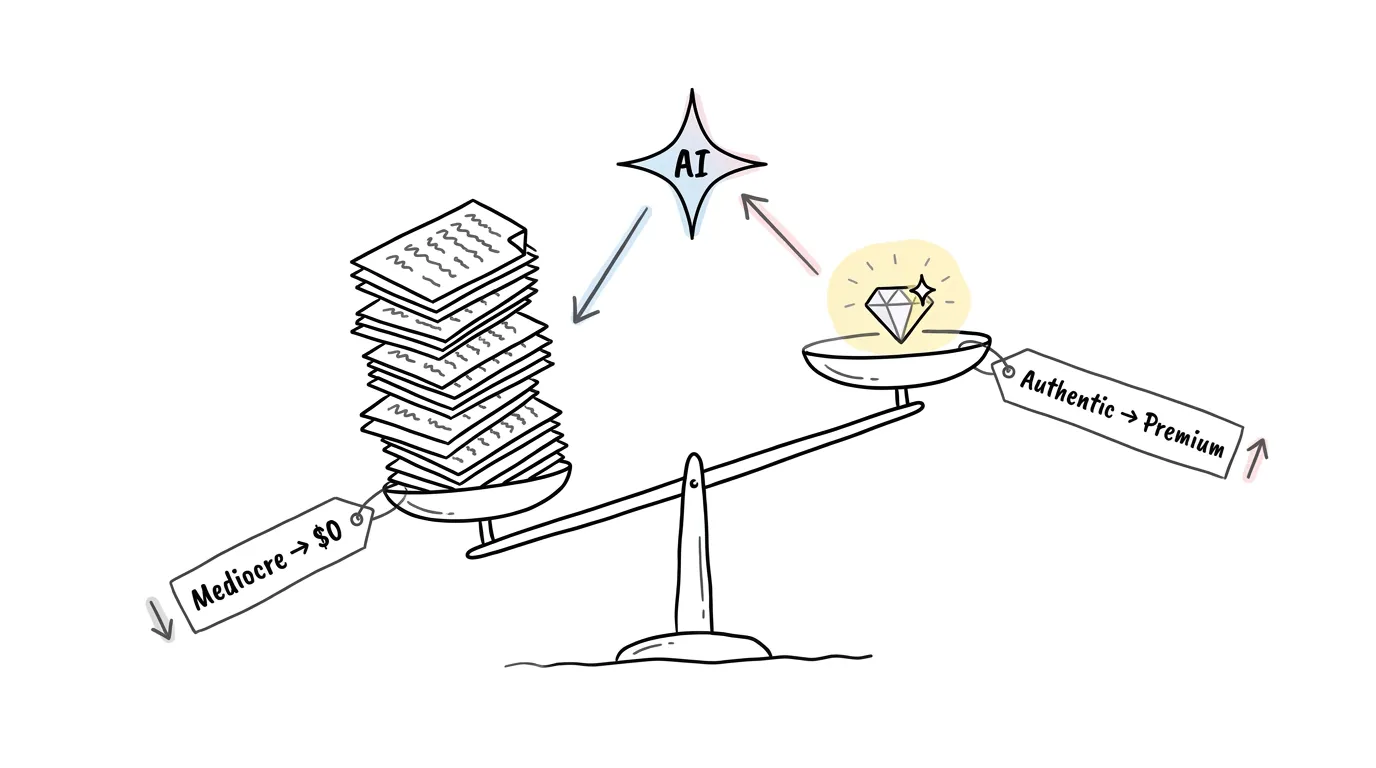
AI has crushed the cost of mediocre output to nearly zero — and, at the same time, stamped a premium price on whatever is scarce.
All mediocre supply will be zeroed out by AI. All authentic expression will be marked up by scarcity.
Yes, the industry has gotten harder. But precisely because it's harder, the opportunity for people who do serious work has never been clearer.
Here's to standing on the higher pole.
Continue reading
Related articles

It's 2026: Stop "Buying" AI Tools for Your Marketing Team — Start "Hiring" AI Agents
This learn article explains how AI agents differ from standalone AI tools in marketing, outlines three agent categories — build-your-own platforms, CRM-native agents, and vertical tools — and covers use cases across SEO, social media, advertising, and reporting, plus criteria for choosing one.

Did the Money You Spent on AI Marketing Ever Come Back?
A guide to measuring AI marketing ROI across three layers: ad reports, sales pipeline, and the financial ledger. Covers metrics such as ROAS and CPA, eight dashboard metrics, industry benchmarks, and common measurement mistakes.

How to Pick a Creative Automation Platform: First, Figure Out What These Eleven Actually Do
A learn article sorts eleven creative automation platforms — including Bannerflow, Celtra, Smartly.io, and Storyteq — into four functional groups and proposes five evaluation questions covering publishing reach, automation depth, ease of adoption, team fit, and verifiable evidence.